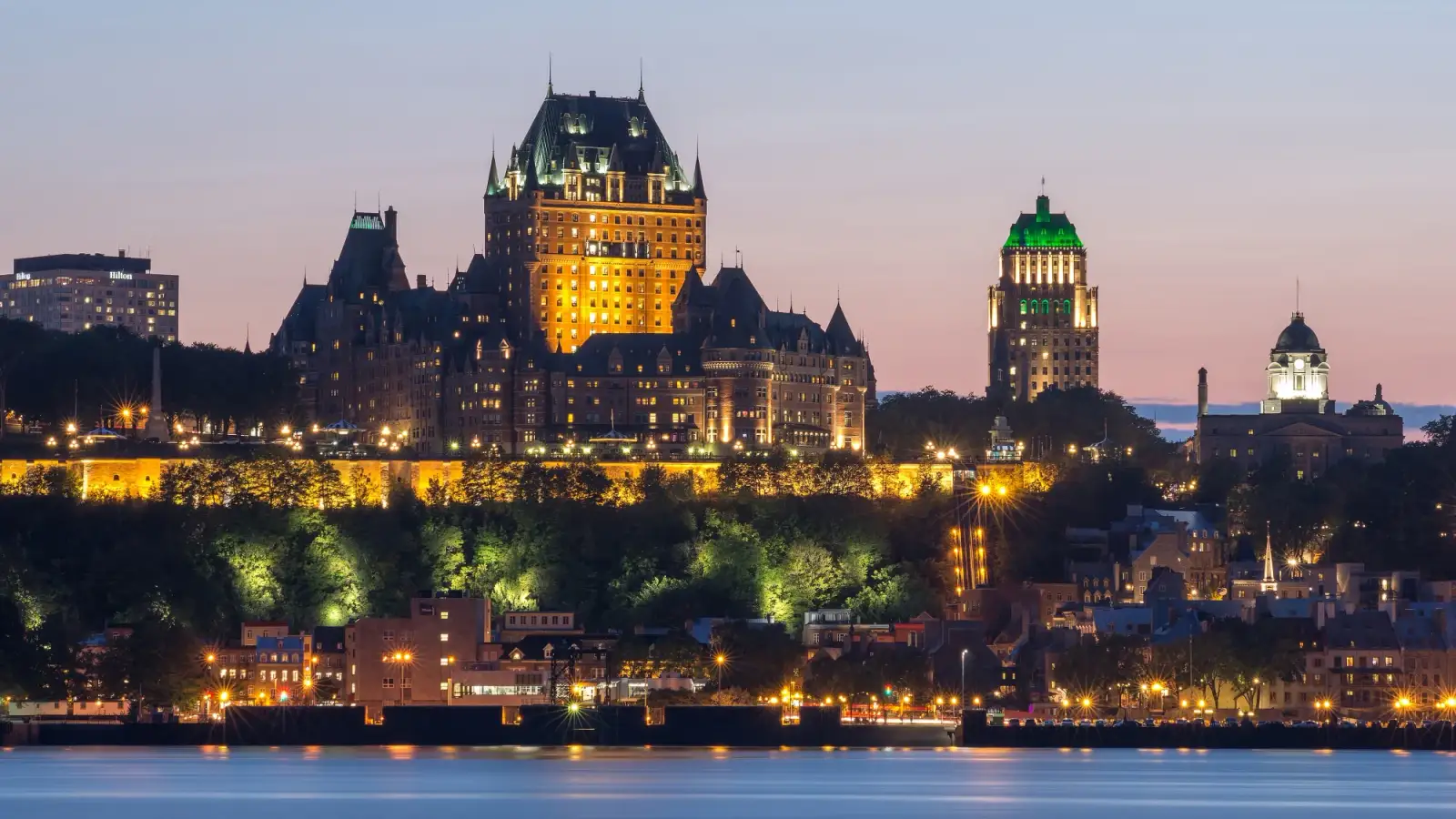
Canada
Québec City
Quebec City, the walled capital on the Saint Lawrence River
Days Start with the basic programme and choose extensions for the time you have.
How the guide reaches this number
With a third day and a car, I'd do the full loop around the Île d'Orléans or head up to the glacial valley of the Parc national de la Jacques-Cartier. A day trip from Montreal is possible by VIA Rail train (3 hours 15 minutes each way), but it sacrifices the falls, the museums and the best hour on the walls.
2–3
When June to October and February; summer and early fall bring mild temperatures and the red maple foliage of September and October, while February brings the Carnaval de Québec and snow activities.
How the guide reaches this number
June to October is the most balanced period for walking on the walls, using the staircase of the Promenade des Gouverneurs and exploring the Chute-Montmorency and the Île d'Orléans: July brings the Festival d'été and long days (with highs around 25 °C), August has stable weather and from the turn of September to mid-October the maples of the parks and nearby hills turn red and orange. February is the second high season, devoted to authentic winter: temperatures often between -5 °C and -20 °C sustain the Carnaval de Québec, the ice slide at the Terrasse Dufferin and the Hôtel de Glace in Valcartier. November and April are gray shoulder months, when there are no longer autumn leaves or firm winter snow and some seasonal attractions close for maintenance.
Per person/day Budget around CAD87; mid-range around CAD210; comfortable around CAD470 per person per day, based on spending reported by travelers to Budget Your Trip (checked October 2026).
How the guide reaches this number
Indicative figures, excluding travel to the destination.
Budget around CAD87; mid-range around CAD210; comfortable around CAD470 per person per day, based on spending reported by travelers to Budget Your Trip (checked October 2026). Indicative figures, excluding travel to the destination.
Per person per day: accommodation, meals, urban transport, visits and a small allowance for extras. Flights excluded; larger purchases vary. Editorial estimate, not a quote.
 What Nilo thinks
I'd stay two full days in Quebec City: the first to cover the Haute-Ville, the Citadelle, the Plains of Abraham and to go down to the Place-Royale and the Petit-Champlain in the Basse-Ville; the second for the Musée de la civilisation, the Chute-Montmorency and the neighborhoods outside the walls such as Saint-Jean-Baptiste and Saint-Roch. With a third day and a car, I'd do the full loop around the Île d'Orléans or head up to the glacial valley of the Parc national de la Jacques-Cartier. A day trip from Montreal is possible by VIA Rail train (3 hours 15 minutes each way), but it sacrifices the falls, the museums and the best hour on the walls.I'd go to Quebec City to walk the only historic center ringed by intact walls north of Mexico and to see how a cliff over the Saint Lawrence organized four centuries of history. At the top of the Cap Diamant stand the Château Frontenac of 1893, the star-shaped British Citadelle, the Parliament and the lawns of the Plains of Abraham; sixty meters below, by the quay, the Place-Royale keeps the stone scale of the trading post that Samuel de Champlain founded in 1608.
Read more
What makes the stay even better is that you aren't stuck inside a colonial set. Just walk through the Porte Saint-Jean to eat at a bakery on the rue Saint-Jean, head down to the bistros and microbreweries of Saint-Roch, cross the river on the public ferry to Lévis for the price of a bus ride or take city bus line 800 to watch the Chute-Montmorency drop 83 meters in front of the Île d'Orléans.
Quick facts
- Population
- 549,459 residents in the municipality (Ville de Québec) and about 839,000 in the census metropolitan area, according to the 2021 federal census by Statistics Canada.
- Founded
- July 3, 1608, when Samuel de Champlain built the Habitation de Québec at what is now the Place-Royale, on the former Iroquoian territory of Stadacona.
- Country and region
- Canada, province of Quebec, administrative region of Capitale-Nationale.
- Language
- French: about 90.6% of residents of the municipality have French as their only mother tongue, according to the 2021 Statistics Canada census. In the Vieux-Québec, tourist service also works in English, but in residential neighborhoods French is indispensable.
- Currency
- Canadian dollar (CAD).
- Time zone
- America/Toronto (Eastern Time): UTC-5 in standard time and UTC-4 in daylight saving time.
- Best time to visit
- June to October and February; summer and early fall bring mild temperatures and the red maple foliage of September and October, while February brings the Carnaval de Québec and snow activities.
- Average daily cost
- Budget around CAD87; mid-range around CAD210; comfortable around CAD470 per person per day, based on spending reported by travelers to Budget Your Trip (checked October 2026). Indicative figures, excluding travel to the destination.
When to go
June to October and February; summer and early fall bring mild temperatures and the red maple foliage of September and October, while February brings the Carnaval de Québec and snow activities.
January
-15° to -7°C
69 mm of rain
March
-8° to 1°C
74 mm of rain
April
0° to 9°C
98 mm of rain
May
7° to 17°C
87 mm of rain
November
-3° to 4°C
81 mm of rain
December
-10° to -3°C
100 mm of rain
How the year changes
June to October is the most balanced period for walking on the walls, using the staircase of the Promenade des Gouverneurs and exploring the Chute-Montmorency and the Île d'Orléans: July brings the Festival d'été and long days (with highs around 25 °C), August has stable weather and from the turn of September to mid-October the maples of the parks and nearby hills turn red and orange. February is the second high season, devoted to authentic winter: temperatures often between -5 °C and -20 °C sustain the Carnaval de Québec, the ice slide at the Terrasse Dufferin and the Hôtel de Glace in Valcartier. November and April are gray shoulder months, when there are no longer autumn leaves or firm winter snow and some seasonal attractions close for maintenance.
The same numbers as a table
| Month | Temperature °C | Rain mm |
|---|---|---|
| January | -15 to -7 | 69 |
| February · | -14 to -4 | 71 |
| March | -8 to 1 | 74 |
| April | 0 to 9 | 98 |
| May | 7 to 17 | 87 |
| June · | 12 to 22 | 104 |
| July · | 15 to 25 | 101 |
| August · | 14 to 24 | 102 |
| September · | 9 to 20 | 104 |
| October · | 3 to 11 | 118 |
| November | -3 to 4 | 81 |
| December | -10 to -3 | 100 |
Nilo's tips
Sleep at least one night instead of a round trip from Montreal
Although the 250 km from Montreal take about 3 hours by car or 3 hours 15 minutes on the VIA Rail train, I'd sleep here at least one or two nights: the Vieux-Québec changes completely after the tour buses leave in the late afternoon.
Use the Lévis ferry as a ride on the river
Instead of paying a lot for a tour boat just to photograph the city from the water, I'd board the public Québec–Lévis traversier on foot late in the afternoon: the crossing takes about 12 minutes, costs CAD 4.25 and gives you the full view of the Château Frontenac and the Cap Diamant. In 2026–2027 the timetable is the winter one all year, so I'd look at the departures before heading out.
Take bus 800 to the Chute-Montmorency
To see the 83-meter waterfall without renting a car or booking a tour, I'd take the RTC's Metrobus 800 line at the Place d'Youville and get off at the des Rapides stop, a few minutes from the top of the falls, from where you cross the suspension bridge and go down by the panoramic staircase or the cable car.
Go out through the Porte Saint-Jean at mealtime
I'd book at least one lunch and one dinner outside the walls, on the rue Saint-Jean or the rue Saint-Joseph Est in Saint-Roch: these are streets of bakeries, cheese shops and bistros that live off residents, with seasonal menus and a smaller bill than on the souvenir streets.
Explore the map
- Fairmont Le Château Frontenac
- Terrasse Dufferin and Forts-et-Châteaux-Saint-Louis
- Place-Royale and Église Notre-Dame-des-Victoires
- Quartier Petit-Champlain and Escalier Casse-Cou
- La Citadelle de Québec
- Plains of Abraham (Parc des Champs-de-Bataille)
- Fortifications de Québec and Historic Gates
- Musée de la civilisation
- Parc de la Chute-Montmorency
Explore the map, read about the other places and plan your travel days in the app.
Open the appWhat to see
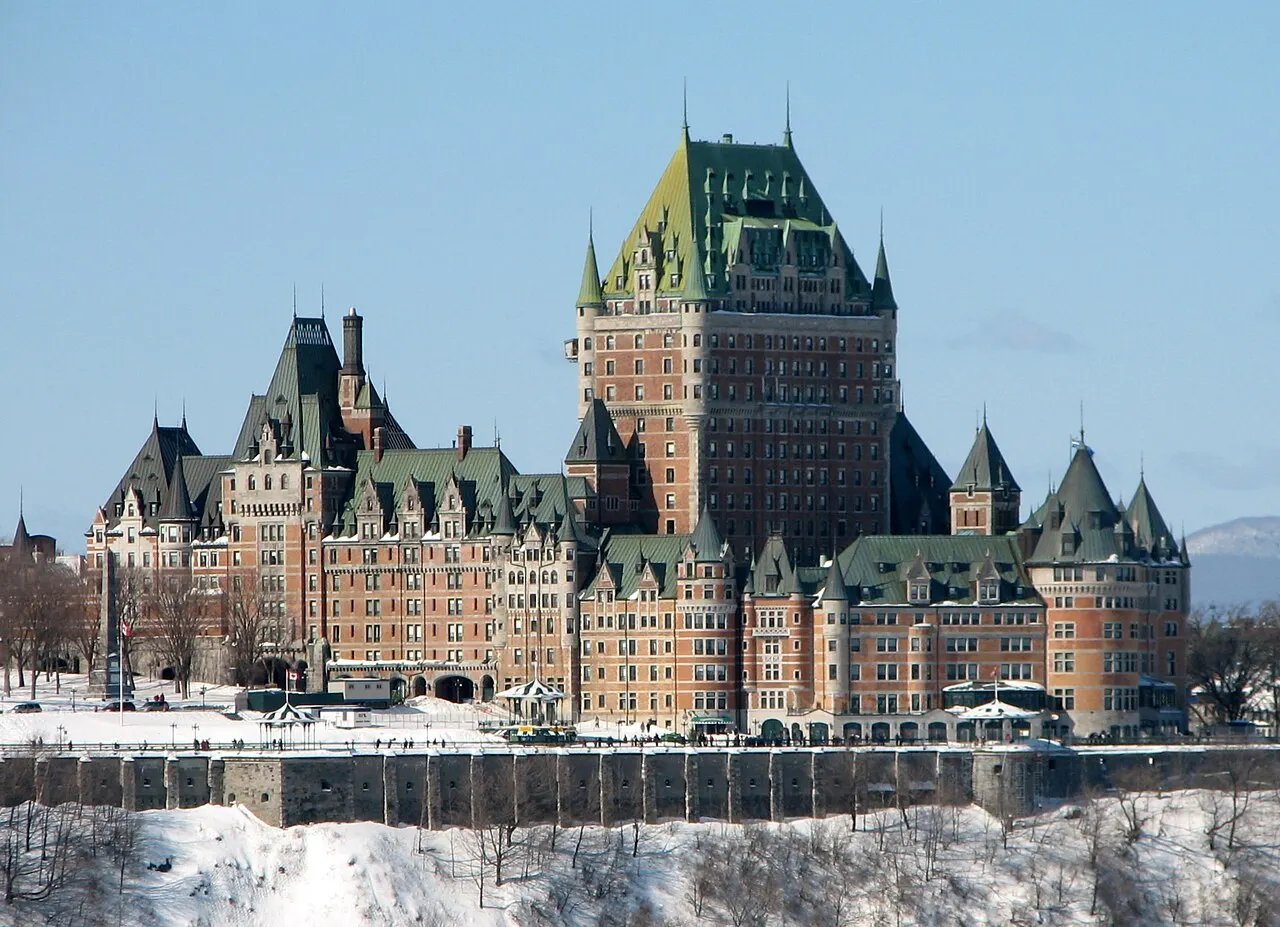
Fairmont Le Château Frontenac
Opened in 1893 by the Canadian Pacific Railway, from a design by Bruce Price in the style of the Loire châteaux, and expanded in 1924 with the central tower, the hotel dominates the entire silhouette of the Haute-Ville. Even if you aren't staying there, you can walk through the public lobby, see display cases of historic objects and stroll the Terrasse Dufferin at its feet; to see the interior salons and learn the story of the Quebec Conferences of 1943 and 1944 (with Roosevelt and Churchill), there are paid guided tours.
Check access
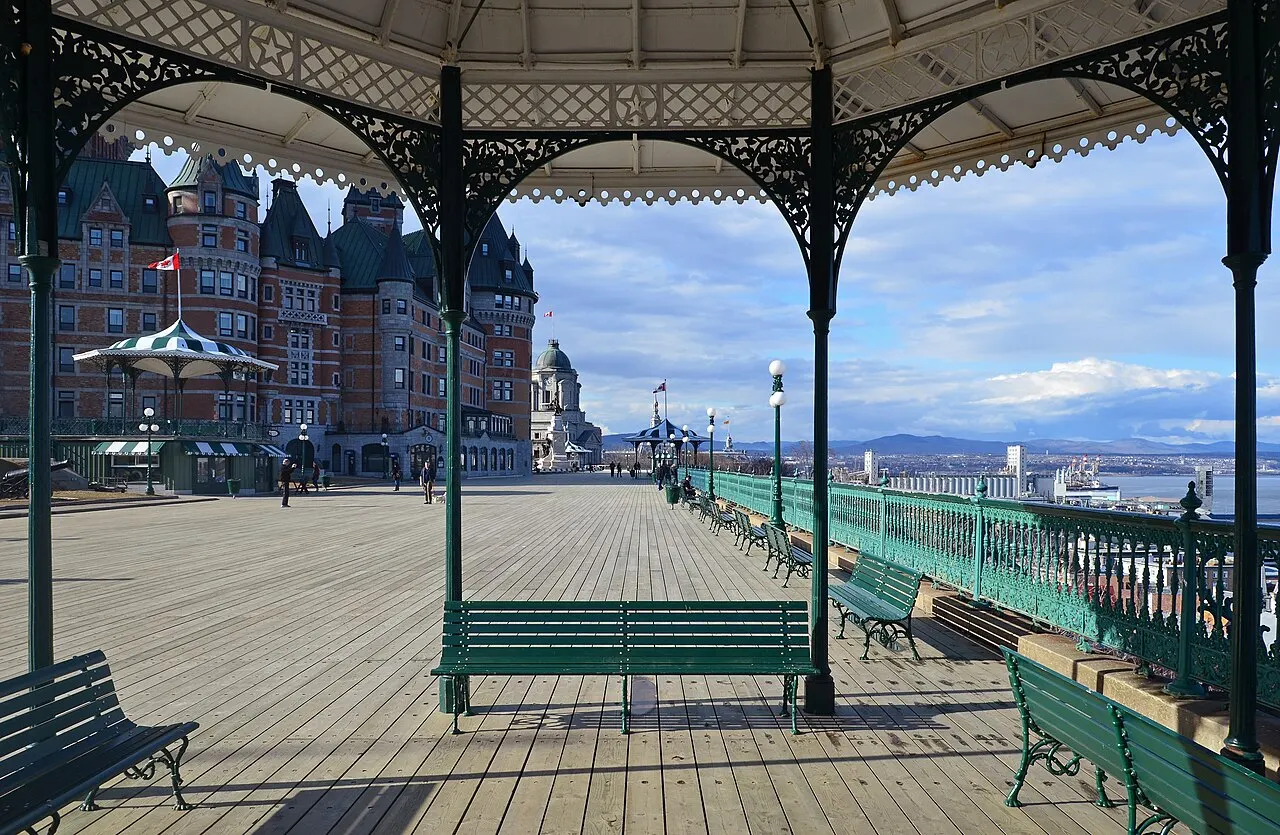
Terrasse Dufferin and Forts-et-Châteaux-Saint-Louis
The wooden boardwalk, more than 400 meters long, leans out over the Saint Lawrence along the cliff edge next to the Château Frontenac, with direct views of the Basse-Ville, the Lévis shore and the Île d'Orléans; in winter, its south end hosts the traditional ice slide (Glissades de la Terrasse), running since 1884. Beneath the planks lies the Forts-et-Châteaux-Saint-Louis National Historic Site, run by Parks Canada, where an underground walkway runs through the foundations of the residence of the French and British governors, destroyed by fire in 1834. The site is open seasonally only: in 2026, daily from May 16 to October 12 and Wednesday to Sunday until October 25, from 9:30 a.m. to 5 p.m., with admission of CAD 13.50 for adults (guided tour or audio guide included).
Check access

Place-Royale and Église Notre-Dame-des-Victoires
A small paved square in the Basse-Ville that marks the exact spot where Samuel de Champlain built the Habitation of 1608. Surrounded by old stone merchants' houses from the 17th and 18th centuries with steep roofs and firewall chimneys, it is centered on the church of Notre-Dame-des-Victoires, begun in 1688 on the ruins of Champlain's building, whose carved high altar reproduces the facade of a fortress.
Check access
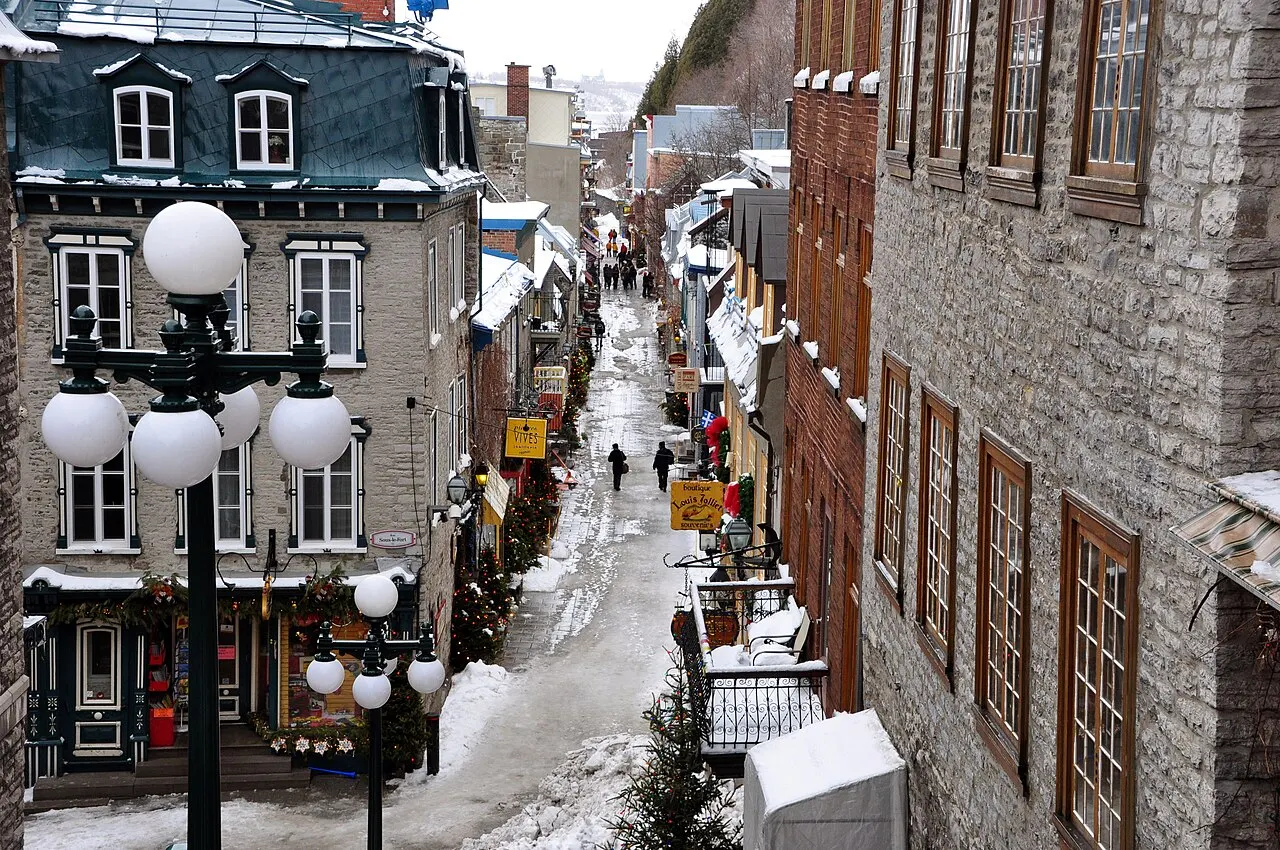
Quartier Petit-Champlain and Escalier Casse-Cou
A narrow pedestrian street at the foot of the Cap Diamant, linked to the Place-Royale and lined with artisan cooperatives, maple-product shops and bistros in restored stone buildings. Where the rue du Petit-Champlain meets the Côte de la Montagne rises the Escalier Casse-Cou (Breakneck Stairs), originally built in the 17th century; beside it is the lower station of the Funiculaire du Vieux-Québec, running since 1879 up a 45-degree incline to the Terrasse Dufferin. It runs year-round, from 9 a.m. to 9 p.m. (until 10 p.m. between June 24 and Labour Day), and a ride cost CAD 7 when checked in October 2026, paid in cash on site, with no online sales; there is an ATM at both stations.
Check access

La Citadelle de Québec
Built by the British between 1820 and 1850 on the Vauban star-fort system, it occupies the highest point of the Cap Diamant (about 100 meters above the river) and remains an active military base of the Royal 22e Régiment of the Canadian Armed Forces. Because it is a working barracks, the interior of the fortress can only be seen on the mandatory guided tour of about an hour (CAD 22 for adults when checked in October 2026), which also gives access to the regimental museum and the bastions with panoramic views of the Saint Lawrence.
Check access

Plains of Abraham (Parc des Champs-de-Bataille)
Stretching over 103 hectares west of the Citadelle at the top of the cliff, the federal park preserves the field where the French and British fought the battle of September 13, 1759. Today it is the city's main green lung, with trails above the river (the Promenade des Gouverneurs, connected to the Terrasse Dufferin by a seasonal staircase open from spring to fall), the circular Martello defense towers of the early 19th century, the sunken Joan of Arc garden (Jardin Jeanne-d'Arc) and the Musée des plaines d'Abraham, which sets out the context of the sieges of 1759 and 1760.
Check access

Fortifications de Québec and Historic Gates
The 4.6 km of walls that enclose the Haute-Ville form a National Historic Site run by Parks Canada. You can walk for free along the top of the defensive curtain between the slope of the Citadelle, the Porte Saint-Louis, the Porte Kent and the Porte Saint-Jean, reaching the Parc de l'Artillerie (a former complex of barracks and a foundry from the 18th century). In winter, when snow and ice cover the stairs, some upper stretches of the wall close for safety.
Check access
Musée de la civilisation
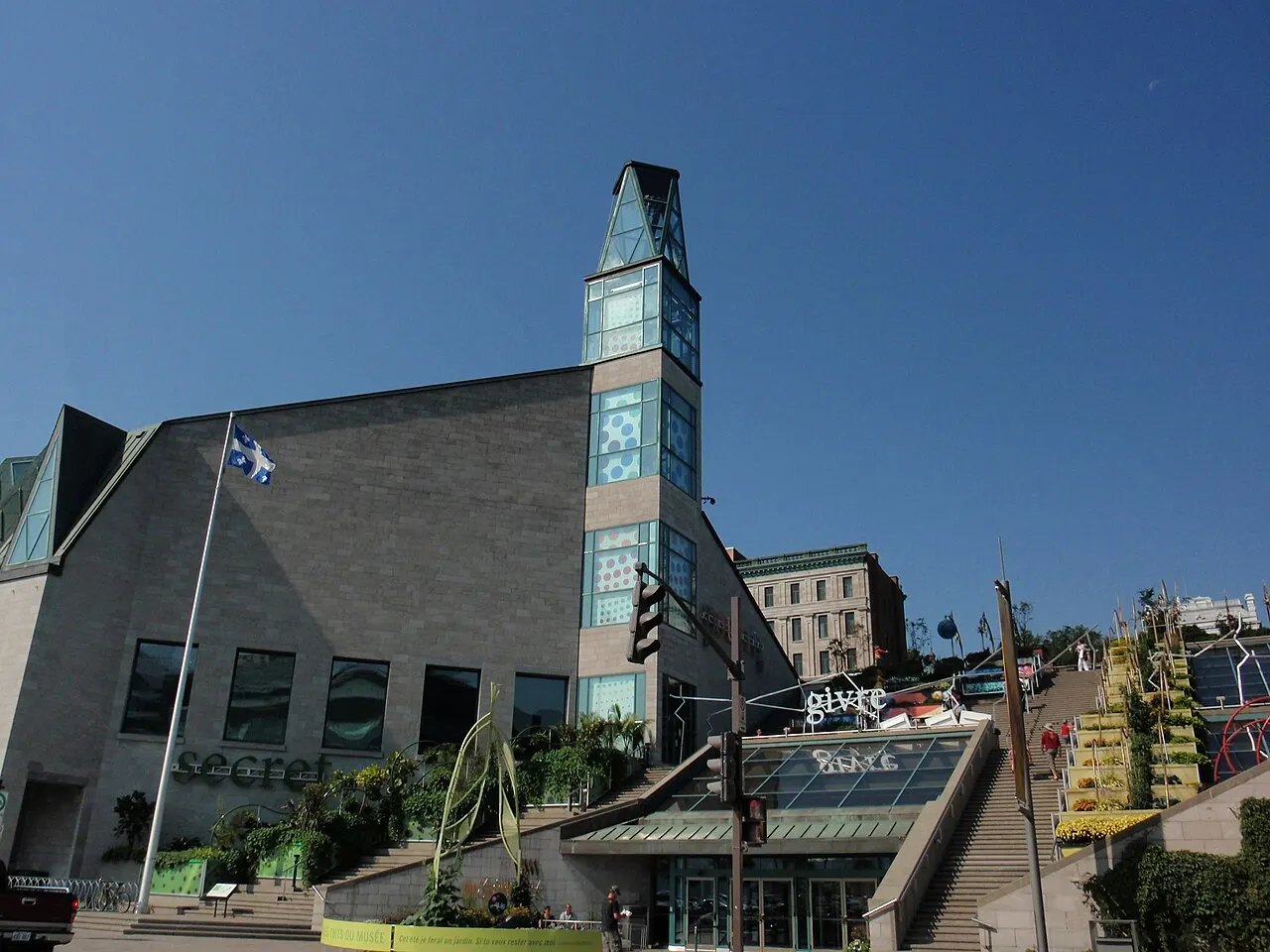
On the rue Dalhousie, between the Place-Royale and the Vieux-Port, the building designed by the architect Moshe Safdie incorporates old colonial houses and the historic boat buried in the foundations. It is the city's most complete museum for understanding the formation of Quebec society and the history, language and territory of the province's eleven Indigenous nations (First Nations and Inuit). It is open from 10 a.m. to 5 p.m., Tuesday to Sunday, and closed on Mondays, except from June 24 to September 7, when it opens every day. On the individual price list checked in October 2026, regular admission cost CAD 27 for ages 35 to 64, CAD 22 for 18 to 34, CAD 26 for 65 and over, CAD 10 for 12 to 17 and CAD 6 for 6 to 11; children up to age 5 enter free, and the family ticket (two adults and up to five children up to age 17) came to CAD 58.
Check access
Parc de la Chute-Montmorency
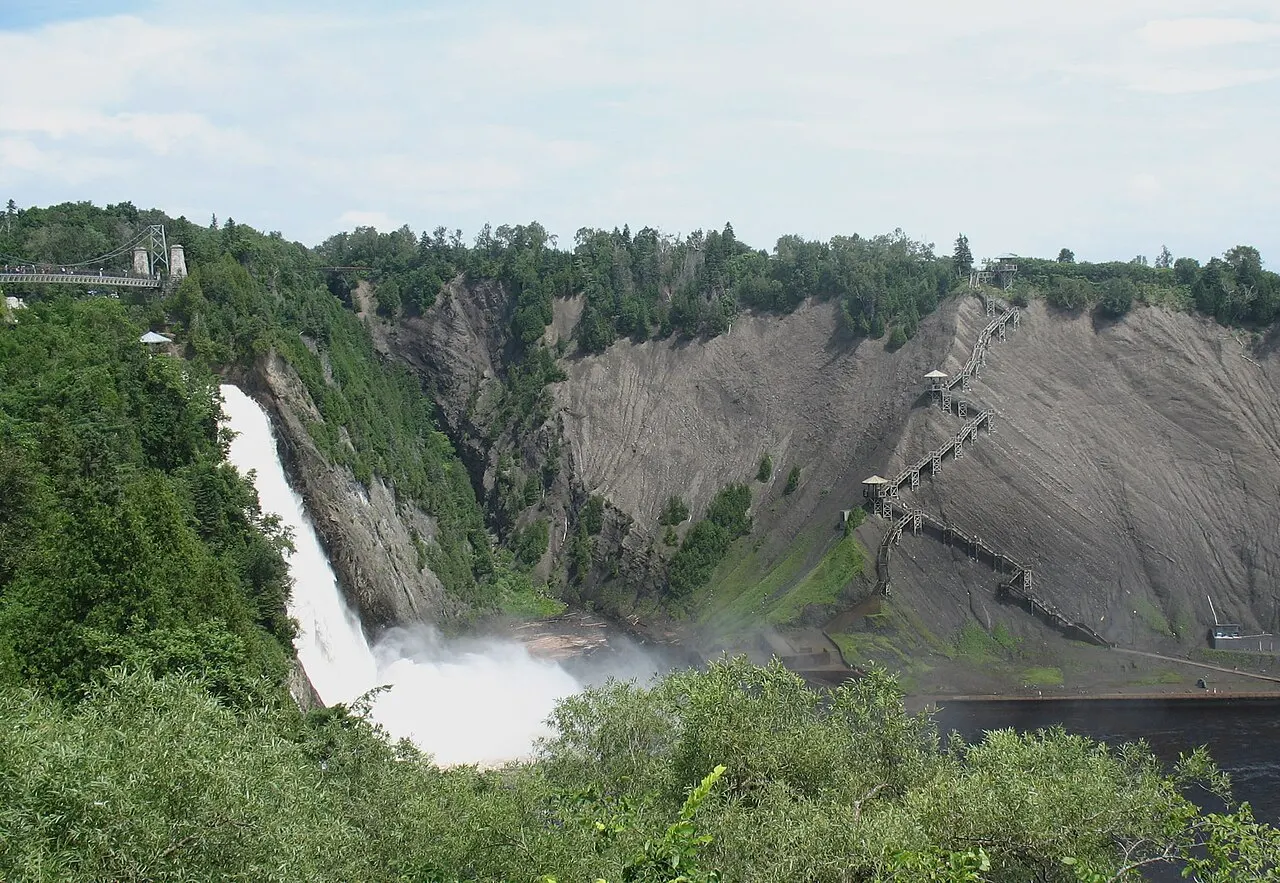
About 12 km east of the Vieux-Québec, the Montmorency River plunges 83 meters (30 meters higher than Niagara Falls) before emptying into the Saint Lawrence opposite the Île d'Orléans. The RTC's Metrobus 800 line stops at the des Rapides stop, a few minutes from the parking lot at the top of the falls, according to the tourism office; travel time depends on where you start and on traffic, and the RTC trip planner gives the exact schedule. Run by Sépaq, the park charges for access and offers viewpoints at the base, a cable car paid separately between the base and the Manoir Montmorency at the top, a suspension bridge right over the crest of the falls and a panoramic staircase of 487 steps fixed to the rock face. The park is open year-round, but the cable car hours and access to the staircase change with the season, and in winter the tourism office does not confirm that the staircase is open: check the Sépaq website before you go. In winter, the frozen spray forms a large ice cone at the foot of the falls called the Pain de Sucre.
Check access
Nilo’s itinerary
Start with the basic programme and choose extensions for the time you have.
Plan my days in the app ↗Day 1 · Haute-Ville, the Basse-Ville of 1608, the Citadelle and the ferry on the Saint Lawrence
Start at the Terrasse Dufferin, at the foot of the Château Frontenac (1893). Between May and October, go in at 9:30 a.m. to the archaeological crypt of the Forts-et-Châteaux-Saint-Louis, beneath the boardwalk; out of season, when the site is closed, carry straight on. Pass by the Place d'Armes and the rue du Trésor, where artists show prints and paintings from mid-May to mid-October, on to the Basilica-Cathedral Notre-Dame de Québec and the courtyard of the Séminaire.
Walk down the Côte de la Montagne and the Escalier Casse-Cou to the Basse-Ville: explore the Place-Royale (founded in 1608), the church of Notre-Dame-des-Victoires and, on the rue Notre-Dame, the Fresque des Québécois, a 420 m² mural with four centuries of the city's history; stroll the rue du Petit-Champlain and have lunch near the Vieux-Port or the rue Saint-Paul.
In the afternoon, go up by the Funiculaire du Vieux-Québec (cash only) or on foot and take the one-hour guided tour of the Citadelle de Québec, open year-round; on the way out, walk across the Plains of Abraham past the Jardin Jeanne-d'Arc and see the facade of the Hôtel du Parlement and the Fontaine de Tourny.
Late in the day, walk an open stretch of the Fortifications de Québec between the Porte Saint-Louis and the Porte Saint-Jean, or take the public Québec–Lévis ferry in the Basse-Ville (check the STQ departures first) to see the profile of the Cap Diamant and the Château Frontenac from the water; have dinner outside the walls on the rue Saint-Jean.
Day 2 · Musée de la civilisation, Chute-Montmorency and Saint-Roch
Spend the morning at the Musée de la civilisation, in the Basse-Ville, to learn about Quebec's social history and the exhibitions on the province's eleven Indigenous nations; it opens at 10 a.m. On a Monday between September 8 and June 23, when it and the MNBAQ are closed, switch to the Monastère des Augustines, in the Haute-Ville, open daily from 10 a.m. to 5 p.m. For visual arts on another day of the week, the MNBAQ on the Plains of Abraham is the alternative.
After a quick lunch at the Vieux-Port or on the rue Saint-Jean, take the RTC's Metrobus 800 line at the Place d'Youville to the des Rapides stop, in Beauport, or drive to the Parc de la Chute-Montmorency.
From the top of the 83-meter falls, cross the suspension bridge over the crest of the falls, with a view of the Île d'Orléans, and go down to the viewpoints at the base by the panoramic staircase of 487 steps or by the cable car. In winter, check with Sépaq which accesses and hours are open; if the staircase is closed, stay with the bridge and the viewpoints at the top and use the cable car.
Return to the city late in the day and head down to the Saint-Roch neighborhood (rue Saint-Joseph Est) to visit the microbreweries and have dinner at one of the bistros residents go to.
If you stay longer
Day 3 · Île d'Orléans
Day trip
Linked to the north shore by a bridge in front of the Chute-Montmorency (about 15 km from the Vieux-Québec, 20 minutes by car), the rural island preserves the farming landscape of the first settlers of the 17th century along the 67 km of the Chemin Royal ring road (Route 368). It calls for a car, a bike ride or a tour to stop in the six historic villages (such as Sainte-Pétronille and Saint-Laurent), to taste strawberries in summer, apples and ice cider in fall, artisanal cheeses and cassis liqueur.
Food
Tourtière and Quebec cuisine du terroir
The tourtière (a covered pie of minced or cubed meat seasoned with warm spices such as cinnamon, clove and nutmeg), the ragoût de boulettes (a stew of ground-beef meatballs with spices) and the pâté chinois (ground beef, corn and mashed potato in layers, baked until golden) form the base of Quebec's home-cooked winter cuisine, today served both in traditional houses on the rue Saint-Louis and in contemporary versions with game (venison, bison, duck).
Poutine with fresh squeaky cheese
Born in the province's interior in the 1950s, the combination of hand-cut french fries, hot dark gravy (sauce brune) and fresh cheddar curds from that day that squeak against the teeth (fromage en grains) shows up in casse-croûtes, Saint-Roch microbreweries and bistros, often topped with duck confit or smoked meat.
Maple products (érable) and the cabane à sucre
Quebec accounts for most of the world's maple syrup production. In March and April, the cabanes à sucre of the Île d'Orléans and the Côte-de-Beaupré serve rural feasts drenched in syrup: eggs in syrup, baked beans (fèves au lard), salted fried pork rind (oreilles de crisse) and the tire d'érable, hot syrup poured on clean snow and rolled onto a stick. The rest of the year, shops and markets sell maple butter and tire on snow.
Artisanal cheeses, ice cider and wines of the Île d'Orléans
The Capitale-Nationale and Charlevoix region produces award-winning raw-milk and soft-rind cheeses, served with the cidre de glace and the cassis liqueur of the Île d'Orléans. Ice cider is sweet and comes from natural cold: in most production, the apple juice is left outdoors in winter until the sugar concentrates; in the rarer and costlier method, the apples freeze on the branch or after harvest and are pressed while still frozen.
Where to eat
- Rue Saint-Jean (outside the Porte Saint-Jean) and avenue Cartier
A few steps from the wall, the rue Saint-Jean concentrates artisan bakeries for croissants and sourdough bread, cheese shops where you can put together a picnic with Quebec cheeses, pubs and bistros with local cooking that serve mainly residents and students, with bills lower than on the exclusively touristy streets.
- Saint-Roch (rue Saint-Joseph Est) and Limoilou (3e Avenue)
It is the city's contemporary dining hub in the lower town: look for restaurants with seasonal menus built on boreal ingredients (wild mushrooms, duck, venison, seafood from the Saint Lawrence estuary), in-house roasters and microbreweries for the cinq à sept.
- Vieux-Québec and Petit-Champlain
Inside the walls and in the Basse-Ville it is worth looking for historic houses that serve tourtière, pea soup and desserts with maple syrup (such as pouding chômeur or tarte au sucre), booking a table ahead for dinner and checking the menu at the door to avoid generic traps.
· 2026-10-17
Day trips
Île d'Orléans
Linked to the north shore by a bridge in front of the Chute-Montmorency (about 15 km from the Vieux-Québec, 20 minutes by car), the rural island preserves the farming landscape of the first settlers of the 17th century along the 67 km of the Chemin Royal ring road (Route 368). It calls for a car, a bike ride or a tour to stop in the six historic villages (such as Sainte-Pétronille and Saint-Laurent), to taste strawberries in summer, apples and ice cider in fall, artisanal cheeses and cassis liqueur.
Canyon Sainte-Anne and the Basilica of Sainte-Anne-de-Beaupré
Following the Côte-de-Beaupré (Route 138 east of the city), the Basilica of Sainte-Anne-de-Beaupré is 35 km away (30 minutes by car) and is a large pilgrimage shrine known for its mosaics and stained glass; 6 km farther (40 km from Quebec), the Canyon Sainte-Anne is open from May to October, with a 74-meter waterfall set in rock more than a billion years old, crossed by three suspension bridges (one of them 60 meters high).
Wendake (Huron-Wendat Community)
About 15 km northwest of the Vieux-Québec (20 to 25 minutes by car or on RTC lines to the northern sector), the autonomous territory of the Huron-Wendat Nation holds the Hôtel-Musée Premières Nations, the reconstruction of a traditional longhouse (maison longue Ekionkiestha'), the historic church of Notre-Dame-de-Lorette and the trail along the Kabir Kouba waterfall, plus a restaurant devoted to Indigenous cuisine.
Parc national de la Jacques-Cartier
Fifty km north of Quebec City on Route 175 (about 45 minutes by car), this provincial Sépaq park protects a deep U-shaped glacial valley cut by the Jacques-Cartier River, with walls more than 500 meters high. It is the best full-day choice for mountain trails (such as the Sentier Les Loups), canoeing in summer, fall colors in late September and snowshoeing in winter.
Where to begin
Haute-Ville, the Basse-Ville of 1608, the Citadelle and the ferry on the Saint Lawrence
Start at the Terrasse Dufferin, at the foot of the Château Frontenac (1893). Between May and October, go in at 9:30 a.m. to the archaeological crypt of the Forts-et-Châteaux-Saint-Louis, beneath the boardwalk; out of season, when the site is closed, carry straight on. Pass by the Place d'Armes and the rue du Trésor, where artists show prints and paintings from mid-May to mid-October, on to the Basilica-Cathedral Notre-Dame de Québec and the courtyard of the Séminaire.
Musée de la civilisation, Chute-Montmorency and Saint-Roch
Spend the morning at the Musée de la civilisation, in the Basse-Ville, to learn about Quebec's social history and the exhibitions on the province's eleven Indigenous nations; it opens at 10 a.m. On a Monday between September 8 and June 23, when it and the MNBAQ are closed, switch to the Monastère des Augustines, in the Haute-Ville, open daily from 10 a.m. to 5 p.m. For visual arts on another day of the week, the MNBAQ on the Plains of Abraham is the alternative.
Money
The currency is the Canadian dollar (CAD). As in Montreal, prices shown on menus and tags do not include the federal (GST of 5%) and provincial (QST of 9.975%) taxes, which add up to almost 15% on the final bill, nor the 15% to 20% tip expected at table-service restaurants (calculated by provincial law since May 2025 on the subtotal before taxes). In practice, multiply the menu price by about 1.3 to get the real outlay. Credit cards and contactless payment work almost everywhere; the exception that catches visitors is the funicular, which takes only cash (there is an ATM at both stations). In the October 2026 check, useful reference prices included CAD 22 for the guided tour of the Citadelle, CAD 13.50 for the crypt of Forts-et-Châteaux-Saint-Louis, CAD 4.25 for the Lévis ferry, CAD 10.50 for the RTC day bus pass and paid access to the Parc de la Chute-Montmorency, with the cable car charged separately; the Musée de la civilisation charges CAD 27 for ages 35 to 64, CAD 22 for 18 to 34 and CAD 6 for 6 to 11, with free admission up to age 5.
Getting there and around
Quebec City is 250 km northeast of Montreal by Autoroutes 20 (south shore) or 40 (north shore), a trip of about 3 hours by car or intercity bus (Orléans Express). By train, VIA Rail makes the trip in about 3 hours 15 minutes from Montreal's Gare Centrale to the historic Gare du Palais, in the Basse-Ville ten minutes on foot from the walls.
Jean-Lesage International Airport (YQB) is about 16 km west of the Vieux-Québec (20 to 30 minutes by car outside rush hour). Taxis charge a flat fare to the center, with one daytime rate and another at night (11 p.m. to 5 a.m.), published on the zone map on the airport's taxi page; the counter is on level 1, between international arrivals and the currency exchange. By bus on the Réseau de transport de la Capitale (RTC), line 80 runs from the airport to the center via the Les Saules terminal and ends at the Place Jacques-Cartier, in Saint-Roch; to go up to the Vieux-Québec, transfer to the Metrobus 800 or 801 lines. Line 76 connects the terminal to the bus and train stations in Sainte-Foy. The RTC ticket machine is in the lobby, across from the airline counters, and accepts cards and contactless payment.
On the RTC fare table in effect from July 2026 (checked in October 2026), a single fare paid by card or the RTC Nomade paiement app cost CAD 3.85 (or CAD 4.00 in exact change on board, with no change given), and the 1-day pass cost CAD 10.50. The high-frequency Metrobus 800 and 801 lines run along the axis of the Colline Parlementaire and the Place d'Youville, and line 800 continues to Beauport, with a stop (des Rapides) a few minutes from the top of the Parc de la Chute-Montmorency.
Inside the Vieux-Québec, you explore on foot; a car is a nuisance on the narrow streets within the walls, and underground parking (such as the city hall's and the Vieux-Port's) is paid. To cover the 60 meters of elevation between the Petit-Champlain and the Terrasse Dufferin, you can climb the slopes and the Escalier Casse-Cou for free or pay for the Funiculaire du Vieux-Québec (CAD 7 each way, cash only). To cross the river to Lévis, the public ferry leaves from the terminal next to the Place-Royale.
Safety
Walking through the Vieux-Québec, the Basse-Ville and the Plains of Abraham is calm by day and at night. Around the Place d'Youville and in certain low stretches of Saint-Roch late at night there may be people in vulnerable situations, which calls only for the normal attention of any urban center. The main practical risk for visitors is physical and climatic: from November to April, steep slopes and stone or wooden staircases build up slippery ice (verglas) and snow falls from the sloped roofs; respect the cordon tape on the sidewalks, use the chains and handrails, and avoid stairs closed off in winter. The emergency number is 911.
Etiquette tips
Always start in French
When you walk into a shop, bakery or restaurant, greet people with “Bonjour.” Even if you have to continue in English in tourist areas, starting in French shows respect for the language that defines the capital's identity; outside the Vieux-Québec, having basic French phrases on your phone makes a big difference.
Taxes, and tip on the pre-tax amount
In restaurants with table service, leave between 15% and 20% as a tip on the amount before taxes (the card terminal should already use that base, by provincial law). In bars, about CAD 1 to 2 per drink is the custom; at a bakery or café counter, it is not required.
Footwear and ice in winter
From December to March, slopes like the Côte de la Montagne and the rue Saint-Jean build up packed ice. Wear waterproof boots with good grip or removable urban ice cleats, and take your shoes off or wipe off the salt carefully at the entrance of inns and homes.
Mistakes to avoid
Rushing a same-day round trip from Montreal: although the 250 km take about 3 hours by road or 3 hours 15 minutes by VIA Rail train, six hours of travel reduce the visit to a hurried lunch around the Château Frontenac, missing the evening on the walls and the Chute-Montmorency.
Going up and down the Cap Diamant several times without planning your route: the 60-meter difference between the Haute-Ville and the Basse-Ville tires you quickly; group the upper-town sights in one half of the day and the riverside ones in the other.
Limiting every meal to the most touristy streets inside the walls (such as the rue Saint-Louis or the Petit-Champlain): ten minutes on foot away, the rue Saint-Jean, the avenue Cartier and the rue Saint-Joseph Est in Saint-Roch have bakeries, cheese shops and bistros that serve mainly residents, with seasonal menus and lower bills.
Underestimating the icy wind over the Saint Lawrence in winter: on the Terrasse Dufferin, on the Plains of Abraham and on the ferry to Lévis, the wind chill drops far below the thermometer reading; wear thermal layers, a hat that covers your ears and waterproof gloves.
Forgetting that menu and shop-window prices will rise about 30% when you pay, because of the almost 15% in taxes (GST + QST) added to the 15% to 20% service charge at restaurants.
Useful phrases
Bonjour
Hello / Good morning: an indispensable greeting when entering any establishment or approaching someone.
Bienvenue
You're welcome: the standard reply in Quebec French when you say thanks with “merci.”
L'addition / La facture, s'il vous plaît
The check, please (in Quebec, “la facture” is even more common in everyday use than “l'addition”).
Haute-Ville / Basse-Ville
Upper Town (on top of the cliff and inside the walls) and Lower Town (by the port and the Place-Royale).
Casse-croûte
A traditional Quebec snack bar where people eat poutine, guédilles (sandwiches on hot-dog buns) and french fries.
Where to stay
- Vieux-Québec inside the walls (Haute-Ville) · First-time visitors who want to do the Château Frontenac, the walls and the walk down to the Basse-Ville on foot.: It puts you inside the walled enclosure, with immediate historic charm at dawn and at night. Rates are the highest in the city, many old buildings have stairs without an elevator and parking for those who come by car is paid and far from the door.
- Basse-Ville and Vieux-Port (Saint-Paul and Dalhousie) · Those who arrive by train or bus at the Gare du Palais and prefer boutique hotels in old stone warehouses on the flat.: It sits next to the Place-Royale, the Musée de la civilisation and the river, with no slopes between the station and the hotel when you have luggage. In return, every time you want to go to the Haute-Ville, the Citadelle or the Plains of Abraham you will have to face the climb or pay for the funicular.
- Colline Parlementaire and Grande Allée · Those looking for larger hotels with modern facilities, easy access by car and proximity to the Plains of Abraham.: It is in the upper part, a few minutes on foot from the Porte Saint-Louis and served by the Metrobus 800 and 801 lines. Just beware of rooms facing the Grande Allée bars directly in summer, which can have night noise.
- Saint-Jean-Baptiste and Saint-Roch · Travelers who prioritize better value, neighborhood cafés and local dining.: Saint-Jean-Baptiste is up high, right against the wall; Saint-Roch is in the lower part, a 10 to 15 minute walk or an urban elevator ride (Ascenseur du Faubourg) from the upper town. It lowers the price of the room and of food, asking only for a short walk to the monuments.
· 2026-10-17
Districts
Vieux-Québec (Haute-Ville)
The portion inside the walls at the top of the cliff, around the Château Frontenac, the Terrasse Dufferin, the Place d'Armes and the rue Saint-Louis. It concentrates monuments, classic hotels and heavy tourist traffic during the day.
Basse-Ville (Petit-Champlain, Place-Royale and Vieux-Port)
A historic strip at the foot of the cliff and along the docks of the Saint Lawrence. It holds the founding square of 1608, the pedestrian shopping street of the Petit-Champlain, the Musée de la civilisation, the rue Saint-Paul (antique dealers and galleries) and the ferry terminal for Lévis.
Colline Parlementaire and the Plains of Abraham
Immediately west of the walls of the upper town. It houses the Assemblée nationale du Québec, the Citadelle, the bar and restaurant terraces of the Grande Allée and the large historic park of the Plains of Abraham, as far as the MNBAQ.
Saint-Jean-Baptiste and Montcalm
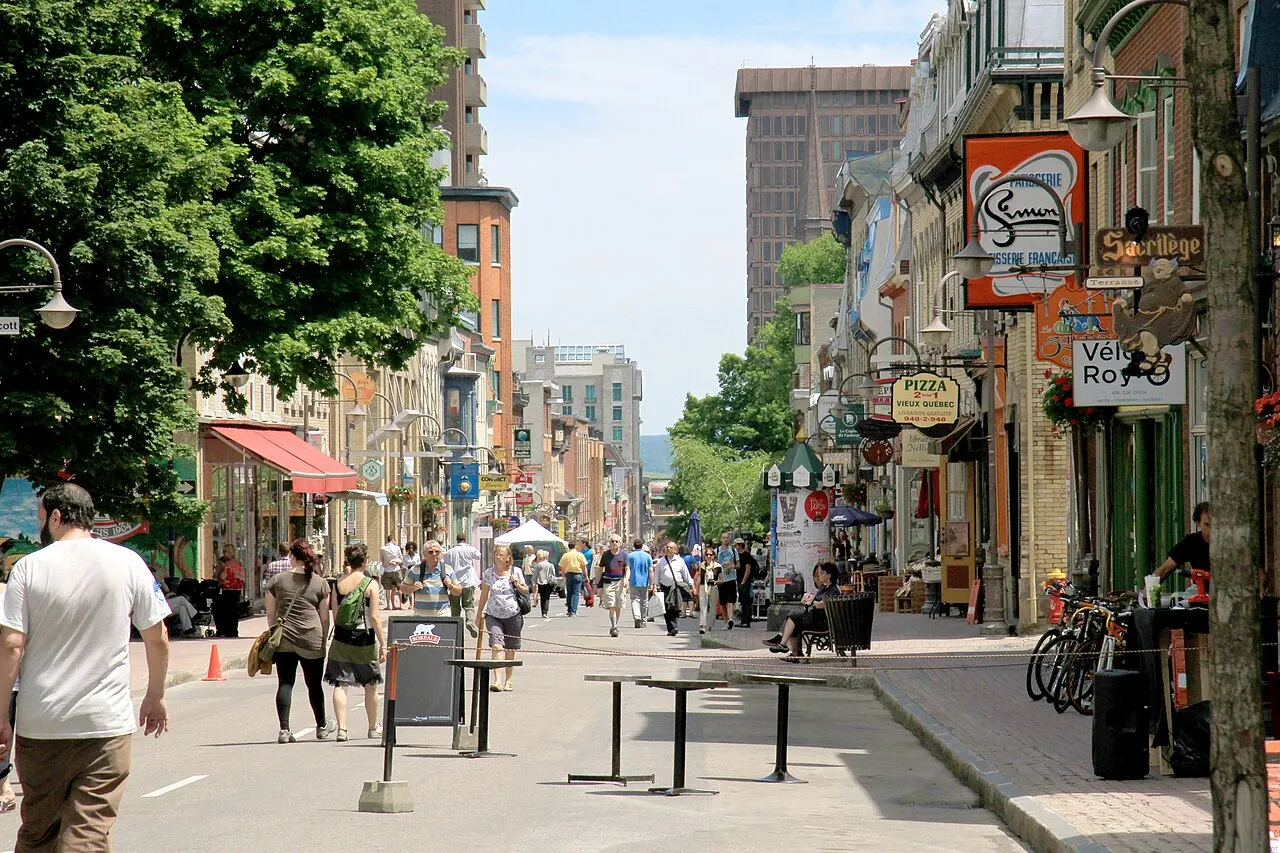
Neighborhoods in the upper part of town, west of the Porte Saint-Jean, laid out along the rue Saint-Jean and the avenue Cartier. They have a francophone neighborhood life, bakeries, cheese shops, bookstores and excellent bistros ten minutes on foot from the walls.
Saint-Roch and Limoilou
Located in the lower part, northwest of the slope, on the banks of the Saint-Charles River. A former industrial and commercial hub now taken over by tech studios, coffee roasters, microbreweries and chef-driven restaurants on the rue Saint-Joseph Est and the 3e Avenue.
History
16th century and 1535 · Stadacona and the voyages of Jacques Cartier
When the French navigator Jacques Cartier landed at the narrows of the Saint Lawrence in 1535, the area was occupied by the Iroquoian village of Stadacona, led by Chief Donnacona, in territory frequented by the Wendat (Huron), Innu and Wabanaki nations.
1608 · Samuel de Champlain and the Habitation at the Place-Royale
On July 3, 1608, Champlain set up a fortified wooden trading post at the foot of the cliff, at what is now the Place-Royale, founding the first permanent French settlement in Canada and the capital of New France.
1759 · Battle of the Plains of Abraham
On September 13, 1759, during the Seven Years' War, British troops under James Wolfe climbed the cliff west of the city and faced the French army of Montcalm; both generals died and Quebec passed to British rule, confirmed by the Treaty of Paris of 1763.
1820–1850 · Construction of the British Citadelle
Fearing a new attack from the United States after the War of 1812, the British Crown built the star-shaped Citadelle at the highest point of the Cap Diamant and reinforced the belt of walls and gates.
1867 and 1893 · Provincial capital and the opening of the Château Frontenac
With Canadian Confederation in 1867, the city became the capital of the province of Quebec and gained the Hôtel du Parlement (1877–1886); in 1893, the Canadian Pacific Railway opened the Château Frontenac above the Terrasse Dufferin.
1985 · Historic District of Old Québec on the UNESCO list
UNESCO inscribed the ensemble of the upper town, the lower town, the fortifications and the Citadelle on the World Heritage List as a preserved example of a fortified colonial city in the Americas.
Complete history
The military and commercial geography of Quebec City explains four centuries of struggle for control of North America. At the Cap Diamant promontory, the Saint Lawrence narrows to less than a kilometer wide before opening toward the Atlantic: whoever held that rock watched over the river entrance to the Great Lakes and the interior of the continent. Before the Europeans, the Saint Lawrence Iroquoians kept the village of Stadacona there, visited by Jacques Cartier in 1535, while the Wendat, Innu, Wolastoqiyik and Abenaki peoples used the banks for fishing, hunting and trade.
In 1608, Samuel de Champlain chose the narrow strip at the water's edge, at what is now the Place-Royale, to build the Habitation, a single building that served as fur warehouse, residence and small fort. In the following decades, religious orders such as the Ursulines and the Augustinian Sisters of the Mercy of Jesus climbed to the upper plateau to found schools and the Hôtel-Dieu (1639), the first hospital north of Mexico. The social and physical divide between the Basse-Ville (of merchants, sailors and artisans) and the Haute-Ville (of governors, bishops and garrisons) is still legible today.
The decisive clash between the French and British empires took place on the morning of September 13, 1759, on the farmland of Abraham Martin, just outside the walls to the west. The British victory on the Plains of Abraham ended New France, but the Quebec Act of 1774 kept French civil law and the freedom of Catholic worship. In the 19th century, fearing American invasions, the British built the four Martello towers and the present Citadelle (1820–1850), while Governor Lord Dufferin stopped the demolition of the walls in the 1870s, turning the defensive system into a public promenade.
When maritime and financial trade moved upriver to Montreal, Quebec City asserted its political and cultural vocation as the seat of the Assemblée nationale du Québec and a bastion of the French language in America. The opening of the Château Frontenac in 1893 by the Canadian Pacific Railway and the restoration of the Place-Royale in the second half of the 20th century paved the way for UNESCO recognition in 1985.
Beneath the wooden floor of the Terrasse Dufferin lie the ruins of the Château Saint-Louis, from which French and British governors administered half the continent before the fire of 1834.
Geography and shape of the city
The historic center is divided vertically by the slate and limestone cliff of the Cap Diamant. In the Haute-Ville (Upper Town), enclosed by 4.6 km of walls pierced by the Saint-Louis, Saint-Jean and Kent gates, are the Château Frontenac, the Basilica-Cathedral, the Monastère des Augustines and the rue Saint-Louis. Beyond the walls to the west, the Colline Parlementaire brings together the Hôtel du Parlement, the Grande Allée, the Citadelle and the 103 hectares of the Plains of Abraham, as far as the fine arts museum (MNBAQ); going out through the Porte Saint-Jean, you reach the Saint-Jean-Baptiste neighborhood. Sixty meters below the cliff, the Basse-Ville (Lower Town) follows the bank of the Saint Lawrence and the mouth of the Saint-Charles River: there you will find the Quartier Petit-Champlain, the Place-Royale, the Musée de la civilisation and the Vieux-Port, plus the flat, revitalized neighborhood of Saint-Roch, farther north. About 12 km east of the center, in the Beauport district, the Montmorency River plunges 83 meters in front of the bridge that leads to the agricultural Île d'Orléans.
The Saint Lawrence narrows to less than a kilometer in front of the Cap Diamant: that bottleneck gave Kebec its name and explains every battle fought here.
Culture
More than any other large North American city, Quebec lives almost entirely in French. While in Montreal everyday bilingualism swaps languages on the same block, in the capital about 90.6% of residents of the municipality have French as their only mother tongue (2021 census). That makes the city the symbolic center of Quebec's political and cultural self-assertion, summed up in the motto “Je me souviens” carved on the facade of the Parliament since the 19th century.
At the same time, the city is a laboratory of performing arts and contemporary creation that goes well beyond colonial memory. On the Place d'Youville, the Le Diamant theater, opened in 2019 for the playwright and director Robert Lepage and his company Ex Machina, incorporates the Second Empire facades of the old 1879 YMCA into a 625-seat hall and creation studios; and the Saint-Roch neighborhood is home to independent video game and design studios.
The relationship between season and public space organizes local habits: from June to September, whole sidewalks of the Grande Allée, the rue Saint-Jean and the 3e Avenue turn into open-air terraces and stages of the Festival d'été; between December and March, instead of emptying the streets, residents take over the Plains of Abraham with cross-country skiing, skating and the ice sculptures of the Carnaval.
About 90.6% of residents of the municipality have French as their only mother tongue (2021 census). Starting with “Bonjour,” even if the conversation continues in English, is the courtesy that local etiquette expects.
Festivals and events
Carnaval de Québec
Held for about ten days in February since the modern edition of 1955, it is one of the largest winter festivals in the world: it includes the ice palace of the snowman Bonhomme in front of the Parliament, night parades, snow sculptures and the canoe race among blocks of ice on the Saint Lawrence.
Festival d'été de Québec (FEQ)
For eleven days in July, the Plains of Abraham and the squares near the walls host large stages of international and francophone music for hundreds of thousands of spectators, so book your hotel well in advance.
Fêtes de la Nouvelle-France and German Christmas Market
In August, the Basse-Ville and the walls celebrate the history of the 17th and 18th centuries with music and historical cuisine; between the end of November and Christmas Eve, the gardens and the square of the city hall (Hôtel de Ville) host the lit wooden chalets of the German Christmas Market.
Books and films
Le Confessionnal (film by Robert Lepage, 1995)
The first feature film by the theater director born in the city, it interweaves the Quebec of 1989 with the shooting of “I Confess” (1953), which Alfred Hitchcock filmed at the Château Frontenac, on the staircases and in the churches of the Haute-Ville, showing the weight of the Catholic Church before the Quiet Revolution.
Bury Your Dead (novel by Louise Penny, 2010)
Set in Quebec City during the winter, the book follows Inspector Armand Gamache inside the Victorian library of the Morrin Centre and in the crypts of the Haute-Ville, exploring the historic coexistence and the quiet tensions between the francophone majority and the small local Anglophone community.
Frequently asked questions
Quebec City: how many days should I allow?
I'd stay two full days in Quebec City: the first to cover the Haute-Ville, the Citadelle, the Plains of Abraham and to go down to the Place-Royale and the Petit-Champlain in the Basse-Ville; the second for the Musée de la civilisation, the Chute-Montmorency and the neighborhoods outside the walls such as Saint-Jean-Baptiste and Saint-Roch. With a third day and a car, I'd do the full loop around the Île d'Orléans or head up to the glacial valley of the Parc national de la Jacques-Cartier. A day trip from Montreal is possible by VIA Rail train (3 hours 15 minutes each way), but it sacrifices the falls, the museums and the best hour on the walls.
Quebec City: how do I get there from Montreal, and is a day trip worth it?
Quebec City is 250 km northeast of Montreal by Autoroutes 20 (south shore) or 40 (north shore), a trip of about 3 hours by car or intercity bus (Orléans Express). By train, VIA Rail makes the trip in about 3 hours 15 minutes from Montreal's Gare Centrale to the historic Gare du Palais, in the Basse-Ville ten minutes on foot from the walls. A rushed same-day round trip adds up to six hours of travel and reduces the visit to a hurried lunch around the Château Frontenac, missing the evening on the walls and the Chute-Montmorency.
Quebec City: how do I get from Jean-Lesage airport to the center?
Jean-Lesage International Airport (YQB) is about 16 km west of the Vieux-Québec (20 to 30 minutes by car outside rush hour). Taxis charge a flat fare to the center, with one daytime rate and another at night (11 p.m. to 5 a.m.), published on the zone map on the airport's taxi page; the counter is on level 1, between international arrivals and the currency exchange. By bus on the Réseau de transport de la Capitale (RTC), line 80 runs from the airport to the center via the Les Saules terminal and ends at the Place Jacques-Cartier, in Saint-Roch; to go up to the Vieux-Québec, transfer to the Metrobus 800 or 801 lines. Line 76 connects the terminal to the bus and train stations in Sainte-Foy. The RTC ticket machine is in the lobby, across from the airline counters, and accepts cards and contactless payment.
Quebec City: how much is the RTC city bus?
On the RTC fare table in effect from July 2026 (checked in October 2026), a single fare paid by card or the RTC Nomade paiement app cost CAD 3.85 (or CAD 4.00 in exact change on board, with no change given), and the 1-day pass cost CAD 10.50. The high-frequency Metrobus 800 and 801 lines run along the axis of the Colline Parlementaire and the Place d'Youville, and line 800 continues to Beauport, with a stop (des Rapides) a few minutes from the top of the Parc de la Chute-Montmorency.
Quebec City: how do I get up and down between the Basse-Ville and the Haute-Ville?
Inside the Vieux-Québec, you explore on foot; a car is a nuisance on the narrow streets within the walls, and underground parking (such as the city hall's and the Vieux-Port's) is paid. To cover the 60 meters of elevation between the Petit-Champlain and the Terrasse Dufferin, you can climb the slopes and the Escalier Casse-Cou for free or pay for the Funiculaire du Vieux-Québec. It runs year-round, from 9 a.m. to 9 p.m. (until 10 p.m. between June 24 and Labour Day), and a ride cost CAD 7 when checked in October 2026, paid in cash on site, with no online sales; there is an ATM at both stations.
Quebec City: can I visit the Citadelle without a guide?
The Citadelle, built by the British between 1820 and 1850, remains an active military base of the Royal 22e Régiment of the Canadian Armed Forces. Because it is a working barracks, the interior of the fortress can only be seen on the mandatory guided tour of about an hour (CAD 22 for adults when checked in October 2026), which also gives access to the regimental museum and the bastions with panoramic views of the Saint Lawrence.
Quebec City: how do I get to the Chute-Montmorency?
About 12 km east of the Vieux-Québec, the Montmorency River plunges 83 meters before emptying into the Saint Lawrence opposite the Île d'Orléans. The RTC's Metrobus 800 line stops at the des Rapides stop, a few minutes from the parking lot at the top of the falls, according to the tourism office; travel time depends on where you start and on traffic, and the RTC trip planner gives the exact schedule. Run by Sépaq, the park charges for access and offers viewpoints at the base, a cable car paid separately between the base and the Manoir Montmorency at the top, a suspension bridge right over the crest of the falls and a panoramic staircase of 487 steps fixed to the rock face. The park is open year-round, but the cable car hours and access to the staircase change with the season, and in winter the tourism office does not confirm that the staircase is open: check the Sépaq website before you go.
Quebec City: does the Lévis ferry work as a river outing?
The Société des traversiers du Québec runs the crossing year-round, breaking through the ice floes in winter; it takes about 12 minutes, costs CAD 4.25 per adult on foot (fare in effect since April 1, 2026) and offers the best head-on view of the Château Frontenac and the cliff. The terminal is in the Vieux-Port, next to the Place-Royale. In 2026–2027, because the Paquet wharf in Lévis no longer receives the ship, the STQ runs the winter timetable all year, reinforced during the Festival d'été: check departures before planning the crossing.
Quebec City: how much should I add for taxes and tip, and where don't cards work?
Prices shown on menus and tags do not include the federal (GST of 5%) and provincial (QST of 9.975%) taxes, which add up to almost 15% on the final bill, nor the 15% to 20% tip expected at table-service restaurants (calculated by provincial law since May 2025 on the subtotal before taxes). In practice, multiply the menu price by about 1.3 to get the real outlay. In bars, about CAD 1 to 2 per drink is the custom; at a bakery or café counter, a tip is not required. Credit cards and contactless payment work almost everywhere; the exception that catches visitors is the funicular, which takes only cash (there is an ATM at both stations).
Quebec City: when is the best time to go?
June to October is the most balanced period for walking on the walls, using the staircase of the Promenade des Gouverneurs and exploring the Chute-Montmorency and the Île d'Orléans: July brings the Festival d'été and long days (with highs around 25 °C), August has stable weather and from the turn of September to mid-October the maples of the parks and nearby hills turn red and orange. February is the second high season, devoted to authentic winter: temperatures often between -5 °C and -20 °C sustain the Carnaval de Québec, the ice slide at the Terrasse Dufferin and the Hôtel de Glace in Valcartier. November and April are gray shoulder months, when there are no longer autumn leaves or firm winter snow and some seasonal attractions close for maintenance.
Quebec City: is it safe, and what precautions should I take in winter?
Walking through the Vieux-Québec, the Basse-Ville and the Plains of Abraham is calm by day and at night. Around the Place d'Youville and in certain low stretches of Saint-Roch late at night there may be people in vulnerable situations, which calls only for the normal attention of any urban center. The main practical risk for visitors is physical and climatic: from November to April, steep slopes and stone or wooden staircases build up slippery ice (verglas) and snow falls from the sloped roofs; respect the cordon tape on the sidewalks, use the chains and handrails, and avoid stairs closed off in winter. Wear waterproof boots with good grip or removable urban ice cleats. On the Terrasse Dufferin, on the Plains of Abraham and on the ferry to Lévis, the wind chill drops far below the thermometer reading; wear thermal layers, a hat that covers your ears and waterproof gloves. The emergency number is 911.
Quebec City: do I need to speak French?
About 90.6% of residents of the municipality have French as their only mother tongue, according to the 2021 Statistics Canada census. In the Vieux-Québec, tourist service also works in English, but in residential neighborhoods French is indispensable. When you walk into a shop, bakery or restaurant, greet people with “Bonjour.” Even if you have to continue in English in tourist areas, starting in French shows respect for the language that defines the capital's identity; outside the Vieux-Québec, having basic French phrases on your phone makes a big difference.
Quebec City: how do I visit the Île d'Orléans?
Linked to the north shore by a bridge in front of the Chute-Montmorency (about 15 km from the Vieux-Québec, 20 minutes by car), the rural island preserves the farming landscape of the first settlers of the 17th century along the 67 km of the Chemin Royal ring road (Route 368). It calls for a car, a bike ride or a tour to stop in the six historic villages (such as Sainte-Pétronille and Saint-Laurent), to taste strawberries in summer, apples and ice cider in fall, artisanal cheeses and cassis liqueur.
Other cities in the country
Canada ↗- Days
- 2–3
- When
- Sep–Oct
- Per person/day
- Average 130–260 C$Mid-range · per person/day
Cost scope
Per person per day: accommodation, meals, urban transport, visits and a small allowance for extras. Flights excluded; larger purchases vary. Editorial estimate, not a quote.
- Days
- 2–3
- When
- May–Oct
- Per person/day
- Average 160–280 C$Mid-range · per person/day
Cost scope
Per person per day: accommodation, meals, urban transport, visits and a small allowance for extras. Flights excluded; larger purchases vary. Editorial estimate, not a quote.
- Days
- 2–3
- When
- Jul–Sep
- Per person/day
- Average 190–330 CADMid-range · per person/day
Cost scope
Per person per day: accommodation, meals, urban transport, visits and a small allowance for extras. Flights excluded; larger purchases vary. Editorial estimate, not a quote.
- Days
- 3–4
- When
- Jun–Sep
- Per person/day
- Average 145 CADMid-range · per person/day
Cost scope
Per person per day: accommodation, meals, urban transport, visits and a small allowance for extras. Flights excluded; larger purchases vary. Editorial estimate, not a quote.