Canada
Vancouver
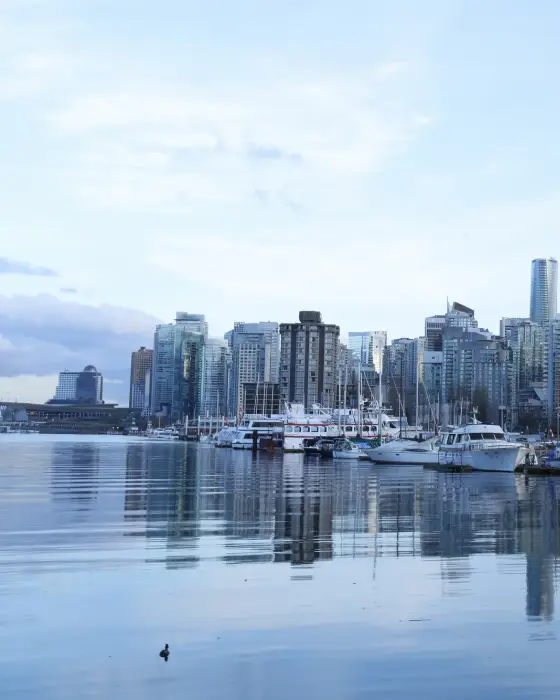
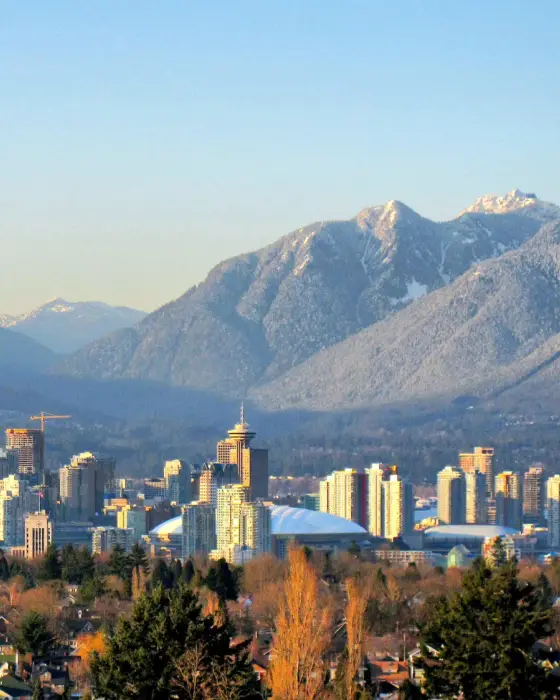
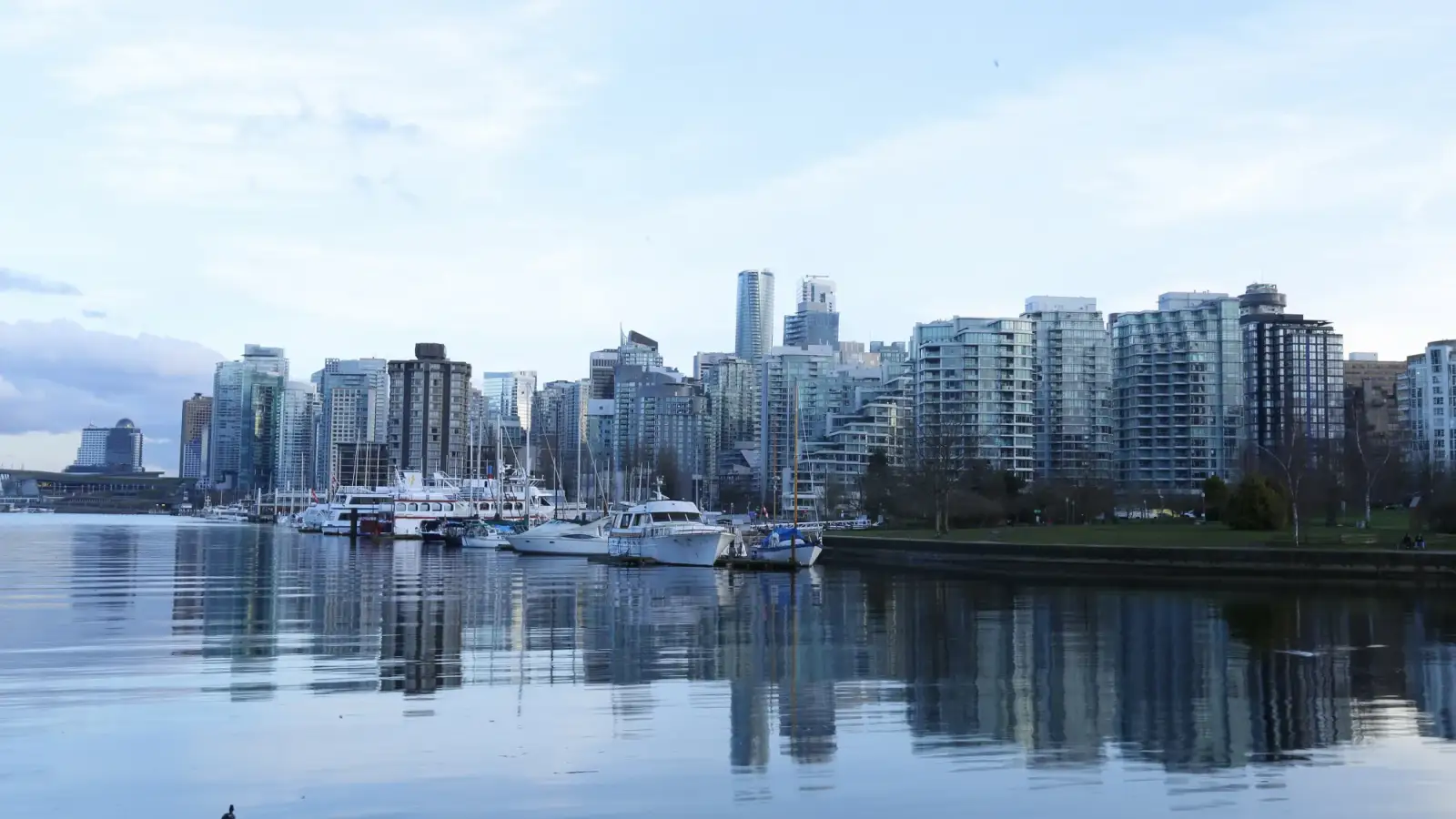
Vancouver has the sea in front and a mountain behind
Days Start with the basic programme and choose extensions for the time you have.
How the guide reaches this number
Spend the second on Granville Island, Kitsilano Beach and the Museum of Anthropology, adding the North Shore only on a third day. The scenery is the strongest reason to come: few buildings are more than 140 years old, bars close between 1am and 3am, and there are relatively few major museums. With just one day, begin with the seawall circuit in Stanley Park, on foot or on a bike rented on Denman. Take a small ferry across for lunch at the Granville Island market, then in the late afternoon catch the passenger ferry to North Vancouver. On the way back, the whole downtown skyline appears before you. Budget for taxes that aren't included on price tags and, from October to March, prepare for persistent rain. In the Downtown Eastside, Hastings between Main and Cambie is a focus of the toxic drug crisis: walking through during the day is usually uneventful, but don't photograph people.
2–3
When From July to mid-September; June tends to be cloudy, and July and August are the driest months
How the guide reaches this number
The climate is oceanic, without extremes. Winter runs from November to March, with highs of 6 to 9 °C and lows rarely below freezing; most of the annual 1,150 to 1,200 mm of rain falls then, with November and December each exceeding 170 mm. The city has about 160 rainy days a year. Snow is occasional, around 35 cm per season, and melts within days. In the North Shore mountains, ski season runs from December to March, extending to May in Whistler. June often disappoints arrivals: persistent cloud earned it the nickname “Juneuary,” and it's easy to feel you've landed in the wrong hemisphere. Dry summer starts around July 1 and lasts until mid-September, with highs of 21 to 24 °C, cool nights and almost no rain; this is high season, with hotel rates doubling. The June 2021 heat wave reached 31–34 °C in the city and revealed that most buildings lack air-conditioning. From mid-August to mid-September, smoke from inland wildfires sometimes covers the sky for days. November is rainy with short days. In the mountains, check the season opening before planning to ski.
Per person/day CAD 190–330 per person on an average trip; about CAD 110 in budget mode
How the guide reaches this number
Per person per day: accommodation, meals, urban transport, visits and a small allowance for extras. Flights excluded; larger purchases vary. Editorial estimate, not a quote.
 What Nilo thinks
Two days make a good first visit to Vancouver, with downtown, Gastown and Stanley Park on the first. Spend the second on Granville Island, Kitsilano Beach and the Museum of Anthropology, adding the North Shore only on a third day. The scenery is the strongest reason to come: few buildings are more than 140 years old, bars close between 1am and 3am, and there are relatively few major museums. With just one day, begin with the seawall circuit in Stanley Park, on foot or on a bike rented on Denman. Take a small ferry across for lunch at the Granville Island market, then in the late afternoon catch the passenger ferry to North Vancouver. On the way back, the whole downtown skyline appears before you. Budget for taxes that aren't included on price tags and, from October to March, prepare for persistent rain. In the Downtown Eastside, Hastings between Main and Cambie is a focus of the toxic drug crisis: walking through during the day is usually uneventful, but don't photograph people.From the top station of the Grouse Mountain gondola, at about 1,100 m, the view takes in all of Vancouver: the delta, downtown's glass towers and, in the distance, Vancouver Island. Below, the seawall, a continuous waterfront path of about 28 km, wraps around Stanley Park along the water, and the Granville Island market, opened under a bridge in 1979, sells the day's catch. The city began as the terminus of the transcontinental railway and occupies the unceded territory of the Musqueam, Squamish and Tsleil-Waututh, whose art is on display at the Museum of Anthropology. Asian immigration shapes the table, with Richmond's dim sum, Kingsway's pho and cheap sushi as part of everyday life here. Come between July and mid-September, the dry summer months, and allow two days.
Quick facts
- Population
- about 700,000 in the municipality and about 2.9 million in Greater Vancouver (rough estimates; the May 2026 census data hadn't been published yet)
- Founded
- Hastings Mill sawmill in 1865 and “Gassy Jack” Deighton's saloon in 1867; city incorporated on April 6, 1886
- Country and region
- Canada, province of British Columbia; regional district of Metro Vancouver, made up of 21 municipalities and one treaty nation
- Language
- English; Mandarin, Cantonese, Punjabi, Tagalog, and Korean are the most spoken home languages after it; more than 40% of residents were born outside Canada
- Currency
- Canadian dollar (CAD); the federal 5% GST and the provincial 7% PST almost never show on the price tag
- Time zone
- UTC−7 year-round since March 2026. Vancouver no longer changes its clocks in spring and autumn.
- Best time to visit
- From July to mid-September; June tends to be cloudy, and July and August are the driest months
- Average daily cost
- CAD 190–330 per person on an average trip; about CAD 110 in budget mode
When to go
From July to mid-September; June tends to be cloudy, and July and August are the driest months
January
3° to 7°C
212 mm of rain
February
3° to 8°C
116 mm of rain
March
5° to 11°C
161 mm of rain
April
7° to 14°C
110 mm of rain
May
10° to 18°C
73 mm of rain
June
13° to 20°C
61 mm of rain
October
9° to 14°C
148 mm of rain
November
5° to 10°C
234 mm of rain
December
3° to 7°C
203 mm of rain
How the year changes
The climate is oceanic, without extremes. Winter runs from November to March, with highs of 6 to 9 °C and lows rarely below freezing; most of the annual 1,150 to 1,200 mm of rain falls then, with November and December each exceeding 170 mm. The city has about 160 rainy days a year. Snow is occasional, around 35 cm per season, and melts within days. In the North Shore mountains, ski season runs from December to March, extending to May in Whistler. June often disappoints arrivals: persistent cloud earned it the nickname “Juneuary,” and it's easy to feel you've landed in the wrong hemisphere. Dry summer starts around July 1 and lasts until mid-September, with highs of 21 to 24 °C, cool nights and almost no rain; this is high season, with hotel rates doubling. The June 2021 heat wave reached 31–34 °C in the city and revealed that most buildings lack air-conditioning. From mid-August to mid-September, smoke from inland wildfires sometimes covers the sky for days. November is rainy with short days. In the mountains, check the season opening before planning to ski.
The same numbers as a table
| Month | Temperature °C | Rain mm |
|---|---|---|
| January | 3 to 7 | 212 |
| February | 3 to 8 | 116 |
| March | 5 to 11 | 161 |
| April | 7 to 14 | 110 |
| May | 10 to 18 | 73 |
| June | 13 to 20 | 61 |
| July · | 15 to 23 | 38 |
| August · | 15 to 23 | 44 |
| September · | 12 to 19 | 73 |
| October | 9 to 14 | 148 |
| November | 5 to 10 | 234 |
| December | 3 to 7 | 203 |
Nilo's tips
Allow for the surcharge when leaving YVR by train
The YVR AddFare adds CAD 6.50 to a train journey starting at YVR Airport, Sea Island Centre or Templeton and continuing off the island. The day pass bought at these stations also pays the surcharge, and monthly passes and day passes bought outside Sea Island are among the exemptions. A journey toward the airport doesn't pay this extra. Check the total fare at the machine before buying.
After 6:30pm, all transit charges a single zone
On a weekday before 6:30pm, a two- or three-zone trip costs more than a one-zone trip, which is CAD 2.85 with stored value on a Compass card. After 6:30pm, on weekends and on holidays, the whole system becomes a single zone, and the bus always charges one zone, at any hour. That's why the SkyTrain ride to dinner in Richmond pays two zones at 5pm and just one at 7pm. Transfers remain free for 90 minutes.
Take the 12-minute SeaBus in late afternoon, regular fare
The crossing to North Vancouver is the best cheap view in the city, and locals use it as their bus. Do it in the late afternoon and come back with downtown lit up ahead of you. The Lonsdale Quay market on the other side takes care of dinner before the return trip.
Swap the paid Capilano bridge for the free one at Lynn Canyon
The Capilano Suspension Bridge is 137 m long and costs CAD 60–75 in high season. The one at Lynn Canyon, from 1912, crosses another North Shore valley 50 m up, is free and is almost always empty. To get there, cross on the SeaBus to Lonsdale Quay and take bus 228 to Lynn Valley Centre, about a 15-minute walk from the park. Another option is bus 227, from Phibbs Exchange, to the main entrance.
Get to dim sum before 3pm: at night it doesn't exist
Dim sum is served from mid-morning until about 3pm, and anyone who shows up at 3:30pm has already arrived late. The most sought-after places are in Richmond's Golden Village, 30 to 40 minutes away on the Canada Line, and cost CAD 25–40 per person. At the older ones the cart still comes around; at the newer ones, you mark your order on a slip of paper and hand it in.
Check the program before planning your trip around the fireworks
The organizer has canceled Celebration of Light indefinitely. English Bay is still worth visiting for the waterfront walk and sunset; choose a clear day and combine it with a walk through the West End.
Explore the map
© OpenStreetMap · OpenFreeMap · © OpenMapTiles
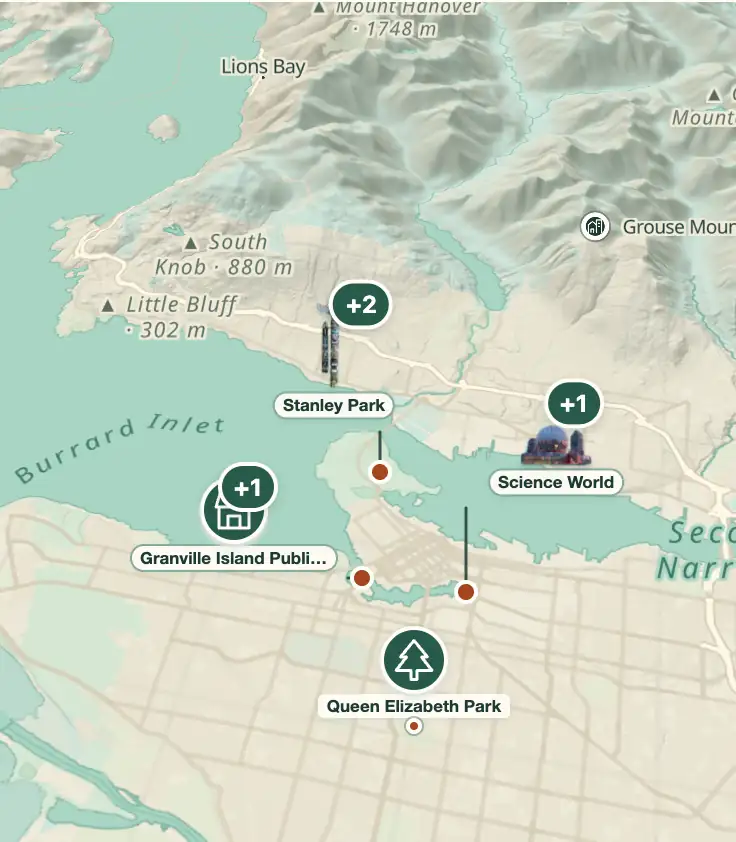
Explore the map, read about the other places and plan your travel days in the app.
Open the appWhat to see
Vancouver: The peninsula, the mountains, and the rain
Vancouver occupies the Burrard Peninsula, between the shallow fjord of Burrard Inlet to the north and the north arm of the Fraser River to the south, with the Strait of Georgia to the west and the Coast Mountains rising sharply on the other side of the water: Grouse at 1,231 m, Seymour at 1,449 m, Cypress at 1,440 m, all visible from downtown on a clear day. The central peninsula brings together offices, the cruise ship terminal, and the West End, Canada's densest residential neighborhood, with towers from the 1960s and 1970s among wood-frame houses and English Bay beach.

Stanley Park
A 405-hectare park opened in 1888 on a forested peninsula that was never entirely logged, with about half a million trees and traces of the Squamish village of Xwayxway, emptied in the early 20th century. The December 2006 storm knocked down about 10,000 trees on the west side; the Brockton Point totem poles are the province's most photographed spot.
Old-growth forest right against downtown, with the totem poles at Brockton Point: enter from Georgia Street and loop the seawall in the morning, before the path fills up, or in the late afternoon, to finish at Third Beach's sunset.
Check access

The seawall
The waterfront path runs about 28 km from the convention center to Spanish Banks. Construction of Stanley Park's 9 km circuit began in 1917 and finished in 1980; the route was later extended beyond the park. Master stonemason James Cunningham supervised part of the work for more than thirty years. Respect the marked pedestrian and bicycle lanes.
It's the walk that sums up the city: the loop around Stanley Park puts sea, forest and mountain on the same flat route, on foot or by bike.
Check access
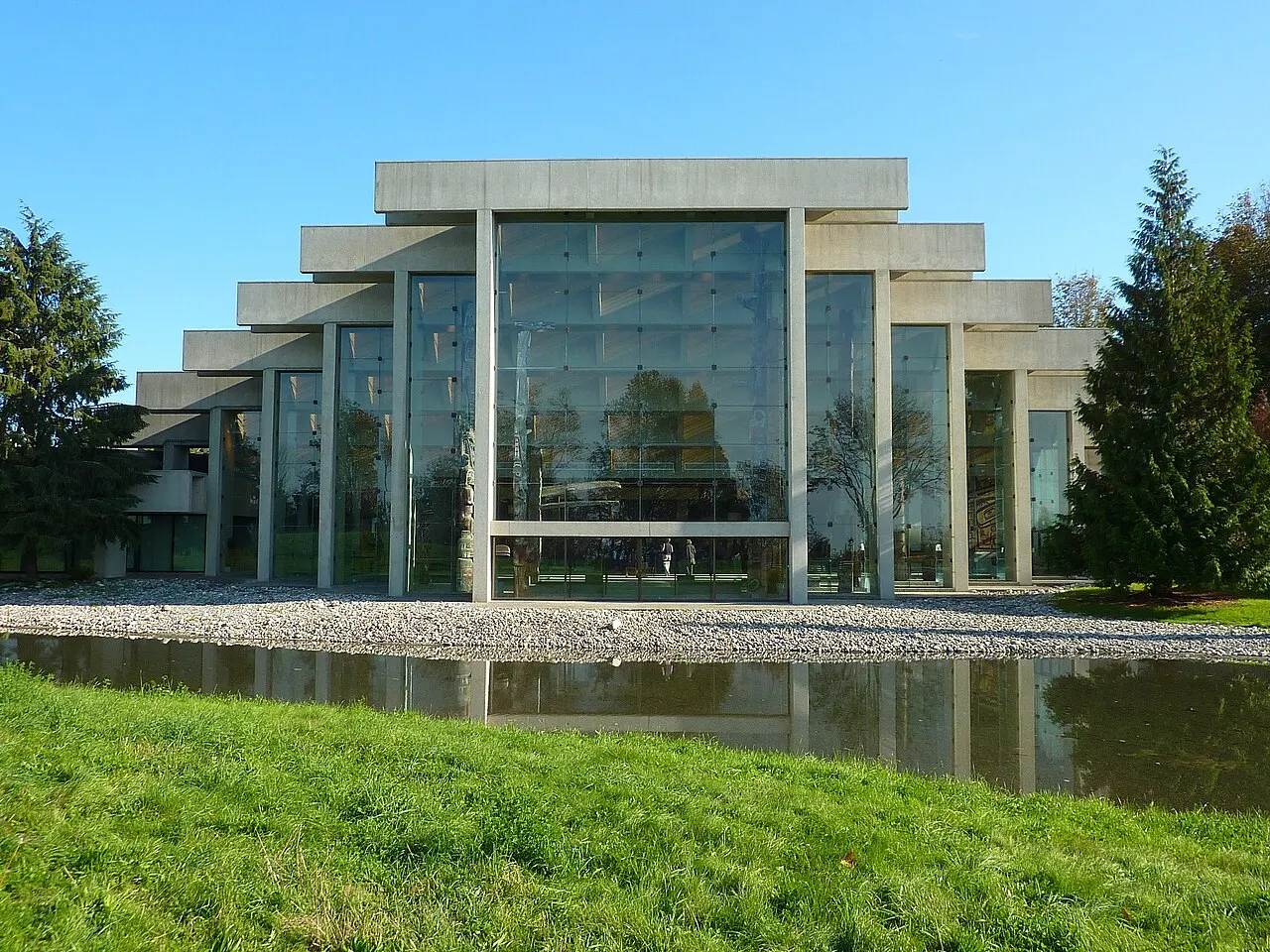
UBC Museum of Anthropology
A concrete-and-glass building designed by Arthur Erickson in 1976, with the main public collection of Northwest Coast art, including “The Raven and the First Men,” which Bill Reid carved in 1980 from a laminated block of yellow cedar. It closed entirely on January 16, 2023, for the seismic reconstruction of the Great Hall and reopened on June 13, 2024, after almost 17 months; check the hours before crossing the city.
It's at UBC, on the far west side, bus 4 or 14, and that's forty minutes each way alone. Allow two hours inside, and confirm the hours the same day before crossing the city.
Check access
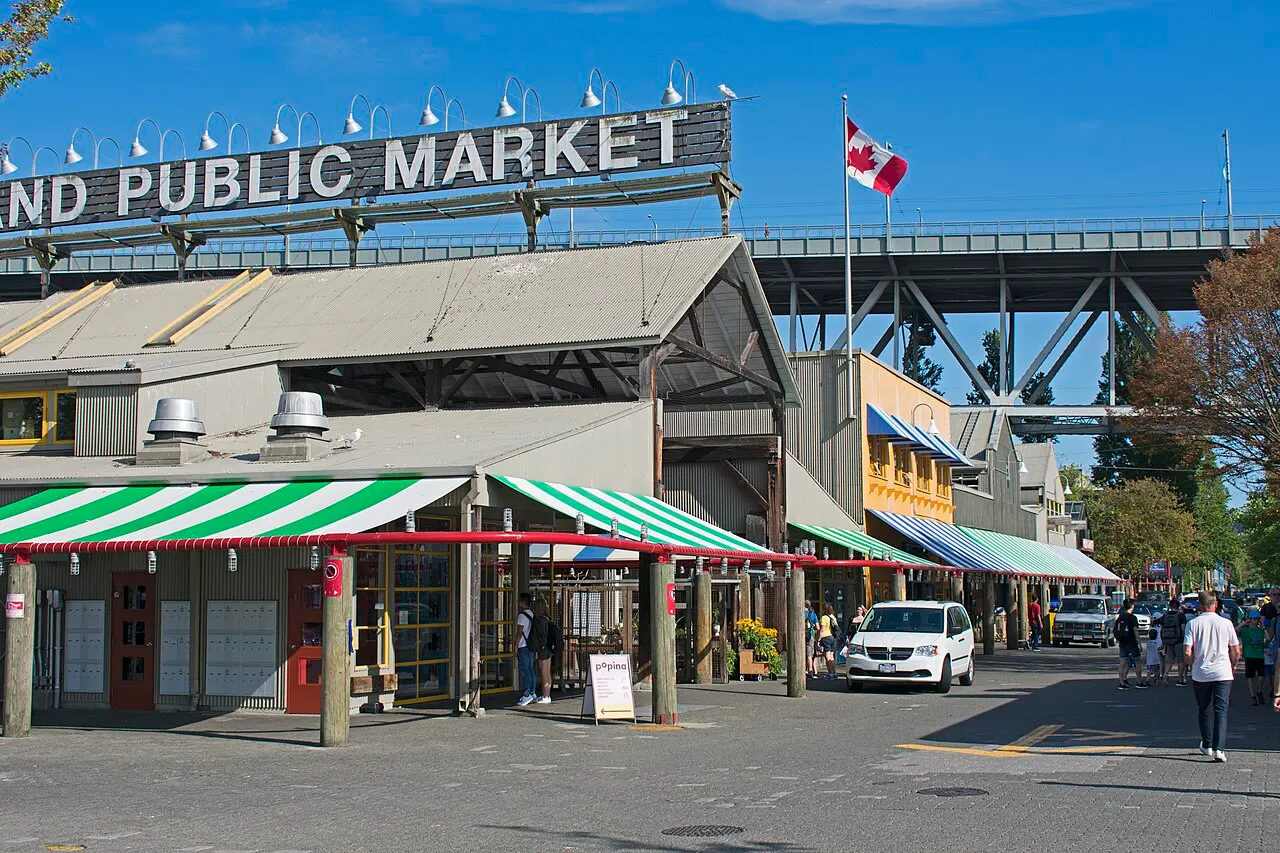
Granville Island Public Market
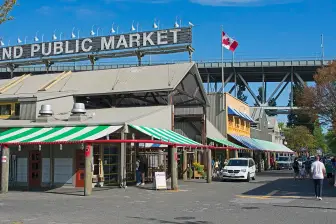
A public market opened in 1979 under the Granville Bridge, with catch of the day, producers from the Fraser Valley, and candied salmon sold in strips. It opens daily around 9am; parking is the worst in the city, and arriving by little ferry, from the Aquatic Centre or Yaletown, costs a few dollars.
Open every day from about 9am, and parking is the worst in the city: arrive by little ferry from the Aquatic Centre or Yaletown, five minutes for CAD 4–8.
Check access

Grouse Mountain and the Grouse Grind
The gondola climbs about 850 m, to close to 1,100 m above sea level, and delivers the full view of the delta, the city and Vancouver Island. Beside it, the Grouse Grind trail is 2.9 km long, with 2,830 steps and 853 m of elevation gain; it's uphill only and usually opens from May to October, depending on snow. You come down by gondola, paid separately.
Take the gondola up to see the delta, downtown and Vancouver Island all at once. From May to October, anyone with the stamina can hike up the Grouse Grind and ride the gondola down.
Check access
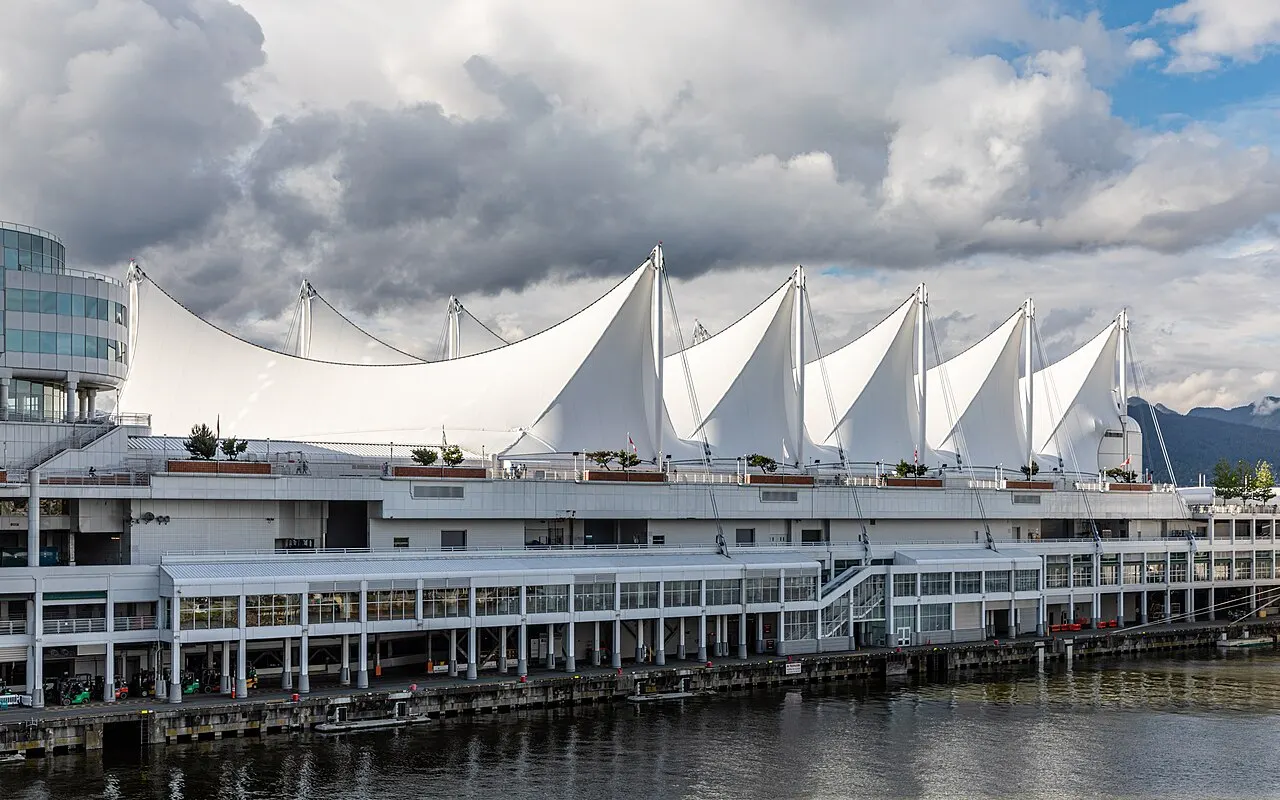
Canada Place
Expo 86's Canadian pavilion, with five fiberglass sails, became a cruise terminal and convention center. Between April and October it sends hundreds of thousands of passengers off to Alaska; the walk along the pier's edge is free and gives the most head-on view of the North Shore.
Half an hour is enough, on the way to Gastown: the loop around the Expo 86 sails pier is free and puts the North Shore right in front of you.
Check access
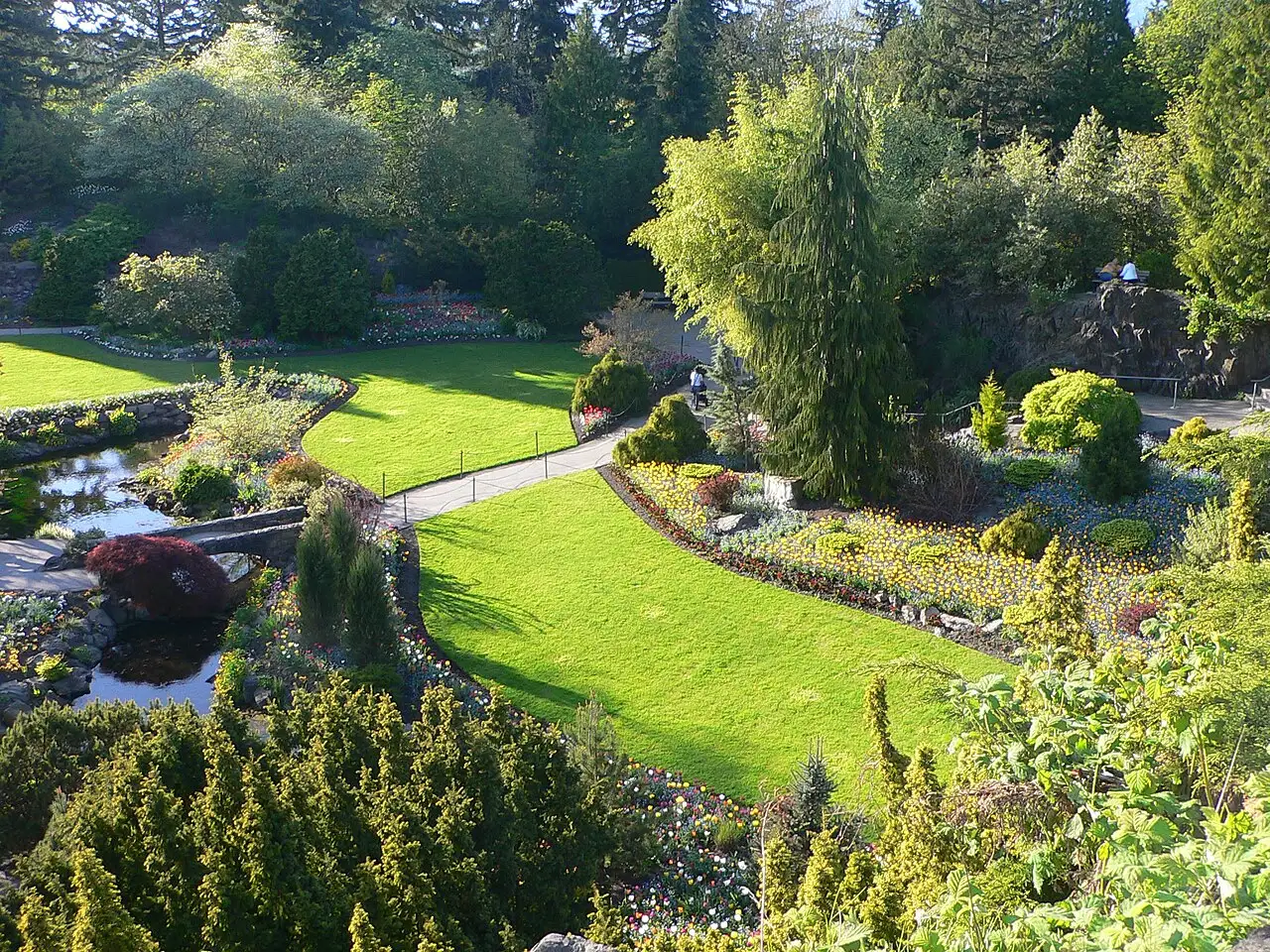
Queen Elizabeth Park and the Bloedel Conservatory
The city's highest point, at 152 m, is a former basalt quarry turned into gardens from 1948. The Bloedel dome, inaugurated in 1969, maintains a tropical climate, plants and free-flying birds; from the lookout, downtown and the mountains line up in the same view.
Check access
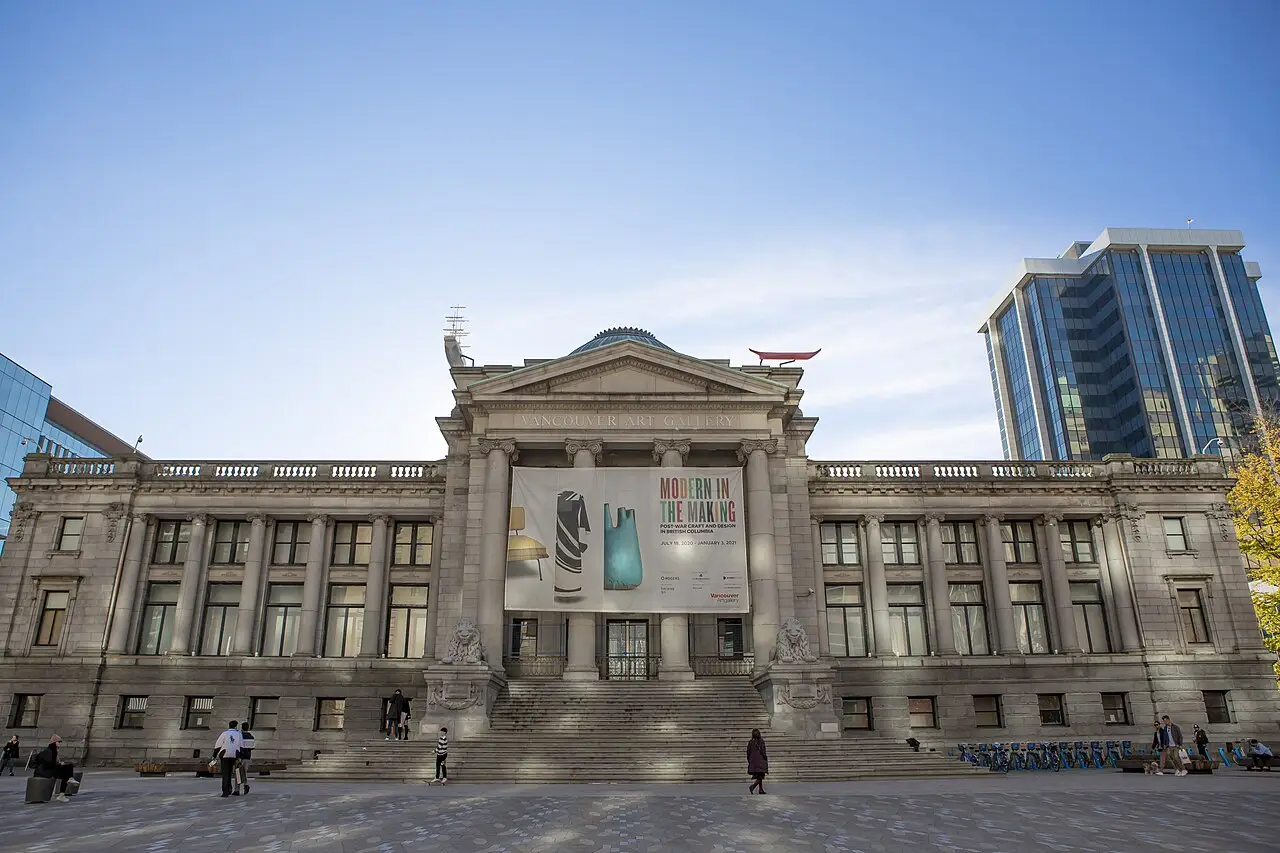
Vancouver Art Gallery
It has occupied the former 1906 provincial courthouse, designed by Francis Rattenbury, since 1983, and holds the largest collection of Emily Carr, with over 200 works. The entrance steps are the city's standard protest stage; the planned new building in Larwill Park was repeatedly delayed and still had no confirmed date in 2026.
The largest collection of Emily Carr, the painter of the forest and the coastal villages, makes it the best plan for a rainy day. On a dry July day, the seawall pays off more.
Check access

Science World
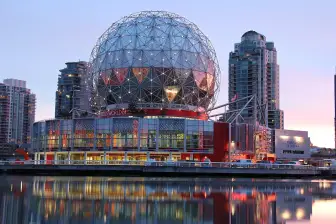
A 47 m-tall geodesic dome built as the opening pavilion of Expo 86, at the east end of False Creek, today a science museum with a facade lit by thousands of LED lights. It's a five-minute walk from Main Street–Science World station and marks the end of the inner stretch of the seawall.
The Expo 86 geodesic dome is best admired from outside, from the seawall; inside it's a science museum made for kids, and it's only worth it with kids or on a rainy day.
Check access
Nilo’s itinerary
Start with the basic programme and choose extensions for the time you have.
Plan my days in the app ↗Day 1 · Downtown, the origin, and the park
Start at Waterfront station, from 1914, and walk to Canada Place to see the North Shore head-on; 30 minutes, no cost.
Cross Gastown along Water Street, time it to pass the steam clock on the quarter hour, when it whistles, and continue four blocks south to Chinatown and the Dr. Sun Yat-Sen Garden.
Enter Stanley Park from Georgia and do the seawall counterclockwise: 9 km, about 3 hours on foot or 1 hour by bike rented on Denman.
Stop at the Brockton Point totem poles and finish at Third Beach for the sunset, which in summer happens after 9pm.
Have dinner on Denman or Davie, in the West End, and walk back along the English Bay waterfront.
Day 2 · Market, beach, and coastal art
Take the little ferry to the Granville Island Public Market from the Aquatic Centre: a 5-minute crossing for CAD 4–8. Have breakfast inside.
Walk up or take bus 22 to Kitsilano Beach and the 137 m saltwater pool, open May to September.
Take bus 4 or 14 to UBC and spend two hours at the Museum of Anthropology; check the hours the same day before heading out.
Go down the 500 steps to Wreck Beach or stay at Spanish Banks, where low tide leaves hundreds of meters of firm sand.
Come back via Broadway and have dinner on Main Street, stopping at a brewery in the old Brewery Creek, in Mount Pleasant.


If you stay longer
Day 3 · The other side of the water
Cross on the SeaBus from Waterfront to Lonsdale Quay, for the standard transit fare.
Take bus 236 to Grouse Mountain, with its paid gondola, or bus 228 to Lynn Valley, to cross the Lynn Canyon suspension bridge instead of the Capilano one.
Have lunch at the Lonsdale Quay market or at the Persian restaurants on Lonsdale Avenue, in North Vancouver.
Head back downtown and choose depending on the weather: if it's raining, Science World or the Vancouver Art Gallery and its Emily Carr collection; if it isn't, the False Creek seawall.
Finish by taking the Canada Line to Richmond for dinner at one of the Chinese restaurants in Golden Village; after 6:30pm, the trip costs just one zone.


Food
 AI illustration
Wild Pacific salmon
Sockeye, red and firm, and chinook, richer, are the most served species; the fishing season runs June to September and the price tracks the size of that year's run. The traditional coastal way is roasting on a cedar plank over open fire; the on-the-go version is candied salmon, sold in strips at the Granville Island market.
 AI illustration
Spot prawns, oysters, and Dungeness crab
Spot prawns have a short, dated season, generally mid-May to end of June, and are sold live straight off the boat at Fisherman's Wharf, in False Creek. Oysters come from Fanny Bay and Kusshi, on Vancouver Island; steamed Dungeness crab is the anchor dish at Chinese seafood restaurants.
 AI illustration
Japadog
A hot dog with Japanese seasonings (nori seaweed, Japanese mayo, teriyaki sauce, grated daikon, scallions) sold from a street cart since 2005, starting at the corner of Burrard and Smithe. It runs CAD 8–12 and is the street item most associated with the city.
 AI illustration
Sushi and izakaya
Vancouver has one of the largest concentrations of Japanese restaurants outside Japan, and cheap sushi here is routine, not an exception. The “BC roll,” grilled salmon skin with cucumber, was created in the city in the 1970s by chef Hidekazu Tojo, who also claims credit for the California roll.
 AI illustration
Dim sum
The Cantonese and Hong Kong heritage sustains hundreds of restaurants: served from mid-morning until about 3pm, with carts at the older places and paper order sheets at the newer ones. The busiest are in Richmond's Golden Village, a majority-Chinese neighborhood; count on CAD 25–40 per person.
 AI illustration
Pho and Kingsway
Kingsway Avenue has concentrated Vietnamese restaurants since the immigration wave of the 1980s. A large bowl of pho runs CAD 14–18 and the bánh mì CAD 6–9; it's the cheapest and most consistent food in the city outside lunch hours.
 AI illustration
Nanaimo bar
A three-layer sweet (a cookie, coconut, and walnut base, vanilla custard, chocolate topping) named after the city of Nanaimo, on Vancouver Island, which has appeared in local recipe books since the 1950s. It's not baked, it's served cold, and it costs CAD 4–6 at any bakery.
 AI illustration
Craft beer and Okanagan wine
The old Brewery Creek, in Mount Pleasant, gathers more than twenty breweries with tasting rooms open since 2013; a pint costs CAD 8–11. The wines come from the Okanagan Valley, five hours by car, with Riesling and Pinot Gris whites and Merlot and Syrah reds dominating the lists.
Day trips
Whistler
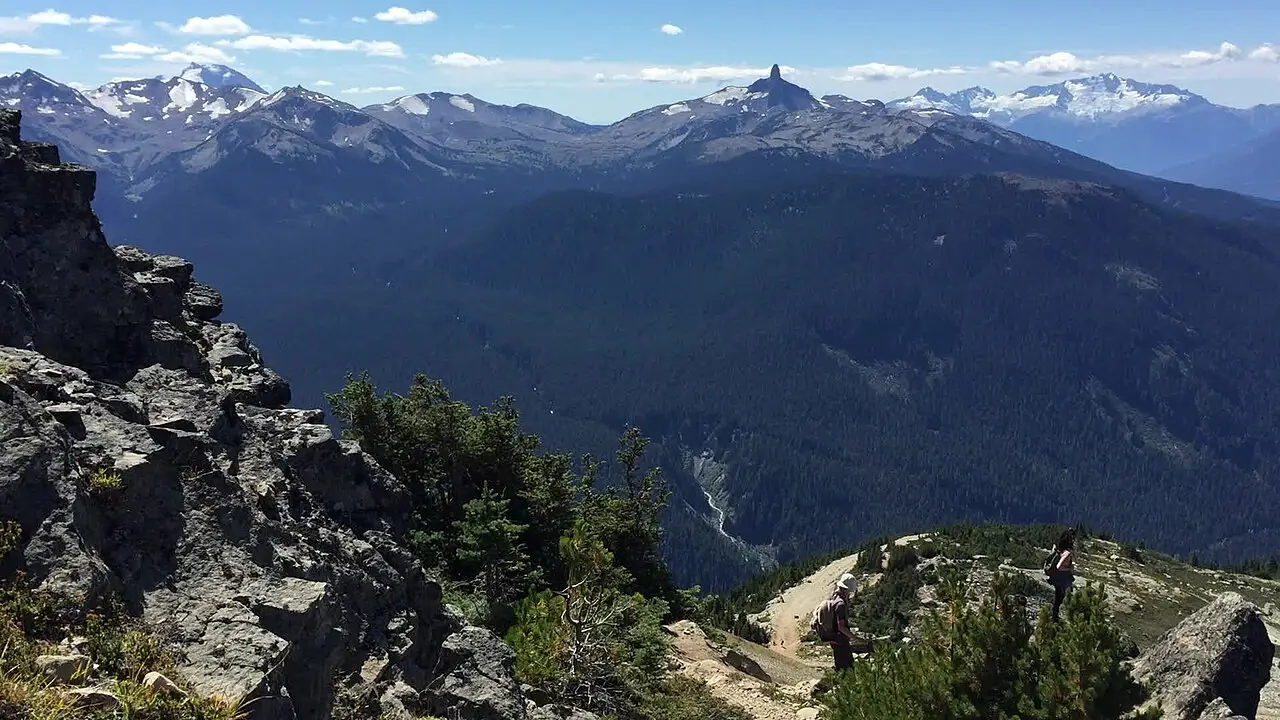
120 km north on Highway 99, the Sea to Sky: 2 hours by car and about 2 hours 30 minutes by bus, with a ticket between CAD 30 and 70 per leg. Ski resort December to May and mountain-biking hub in summer; on the way, stop at Shannon Falls (335 m) and the Stawamus Chief granite monolith, in Squamish.

Victoria and Vancouver Island
BC Ferries from Tsawwassen to Swartz Bay: a crossing of 1 hour 35 minutes, plus travel to and from the terminals. Count on 3 hours 30 minutes to 4 hours door to door, or 35 minutes by floatplane from Coal Harbour. A foot passenger pays around CAD 20 per leg; the provincial capital has the 1898 parliament building and the 1908 Empress hotel.

Richmond and Steveston
30 to 40 minutes by Canada Line to the Golden Village, North America's largest concentration of Chinese restaurants, with a night market in summer. Another 20 minutes by bus to Steveston, a still-active fishing village, where the 1894 Gulf of Georgia Cannery has become a museum.
Where to begin
Downtown, the origin, and the park
Start at Waterfront station, from 1914, and walk to Canada Place to see the North Shore head-on; 30 minutes, no cost.
Market, beach, and coastal art
Take the little ferry to the Granville Island Public Market from the Aquatic Centre: a 5-minute crossing for CAD 4–8. Have breakfast inside.
The other side of the water
Cross on the SeaBus from Waterfront to Lonsdale Quay, for the standard transit fare.
Money
The currency is the Canadian dollar. Tap-to-pay works for practically everything, including buses, the little ferries and street carts, and you never need to carry more than CAD 40 in cash on any given day. Taxes aren't included on the price tag: the federal GST, of 5%, applies to almost everything, and the provincial PST, of 7%, to goods. Restaurant meals are charged only GST, and alcoholic drinks carry 10% PST. 2026 price ranges, all approximate: coffee CAD 4–6, simple lunch CAD 15–25, sit-down dinner CAD 40–75 per person without drinks. Pint CAD 8–11, cocktail CAD 16–22, museum admission CAD 20–30. A mid-range hotel runs CAD 260–450 a night between June and September, and CAD 150–230 from November to March. Accommodation also adds about 8% PST, 3% MRDT and an additional 2.5% municipal fee, on top of GST. Tipping is expected and belongs in the budget: 15 to 20% at restaurants with table service. Card machines suggest 18, 20 and 25%, and it's acceptable to choose the lowest or enter another amount. Away from the table: CAD 1–2 per drink ordered at the bar, 10 to 15% in taxis and CAD 2–5 per day for housekeeping. Before deciding, always add the taxes and the tip to the price on the tag.
Getting there and around
Airport: 15 km from downtown, on Sea Island
Vancouver Airport (YVR) is 15 km south of downtown on Sea Island, in the municipality of Richmond. The SkyTrain Canada Line, opened in August 2009, links the terminal to Waterfront station in about 26 minutes. Trains run every 6 to 10 minutes, from 5am to 1am. Leaving the airport by train incurs a CAD6.50 surcharge called YVR AddFare. Day passes bought at Sea Island stations also pay it. Monthly passes, day passes bought off the island and journeys toward the airport are exempt. A taxi or ride-hailing car downtown costs CAD40–55 and takes 25 to 40 minutes. Flights to the United States undergo US customs preclearance inside YVR: arrive three hours early. Abbotsford Airport (YXX), 70 km east, handles low-cost flights, but the transfer to the city takes more than an hour.
SkyTrain: three lines; all driverless
The regional network is run by TransLink: three driverless SkyTrain lines, Expo, from 1985; Millennium, from 2002; and Canada, from 2009. Rounding out the network are the SeaBus, which crosses to North Vancouver in 12 minutes every 15 minutes, the West Coast Express commuter train, with few trips on weekdays, and buses that include electric trolleybuses. Since July 1, 2026, the one-zone fare with stored value on a Compass card has been CAD 2.85, and longer trips are charged by zone. Transfers are free for 90 minutes. Pay with the Compass Card, with a refundable CAD 6 deposit, sold at station vending machines, or tap a credit card or phone directly on the reader. A day pass costs about CAD 12.50. The Broadway subway (an extension of the Millennium Line, 5.7 km with six stations between VCC–Clark and Arbutus) has been under construction since 2021, with opening scheduled for 2027, and the avenue still has reduced lanes. For cycling there's the public Mobi bike share, with about 250 stations. There are protected bike lanes on Hornby, Dunsmuir and 10th Avenue, and the seawall works as a real route. The little Aquabus and False Creek Ferries boats cross to Granville Island for CAD 4–8 each way. Downtown is flat and walkable; from Broadway the ground rises, and the hills are more tiring than the map suggests.
Safety
Watch your belongings downtown and favor busy streets at night. Theft from parked vehicles and bicycle theft occur. Use two locks and leave nothing visible in your car, even for ten minutes. The Downtown Eastside lies along Hastings between Main and Cambie, where visible poverty and the toxic drug crisis are concentrated. The province declared a public health emergency in April 2016 and has recorded more than 16,000 overdose deaths. If you cross the area, go during the day, respect residents and avoid photographing people without consent. Between mid-August and mid-September, wildfire smoke may require people with respiratory conditions to wear a mask; air-quality readings are published hourly. North Shore trails have black bears and coyotes: make noise, walk with others and don't carry strongly scented food. Tell someone your route, because rescue teams handle dozens of cases a year involving people who set out without a flashlight. The sea is 15 to 18 °C in summer, cold enough to shorten a swim. The region sits on the Cascadia seismic zone, and public earthquake-preparedness guidance is available. Emergency: 911.
Etiquette tips
Take your shoes off entering a house
Take off your shoes when entering any home, even if the host doesn't ask, because nobody is going to ask. Clean socks take care of it; at dressier dinners, some people bring a pair of shoes in their bag.
Thank the driver getting off the bus
Say “thank you” when getting off, even on a crowded bus, and the driver answers each person. Getting off in silence doesn't offend anyone, but it gets noticed.
Respect the seawall lanes
Pedestrians on one side, bikes and skates on the other; on the Stanley Park stretch, cycling is one-way, counterclockwise. Going against the flow is the mistake that earns you the only shout you'll hear in the city.
The land acknowledgment is literal
Public events, classes, and even company meetings open by citing the unceded territories of the Musqueam, Squamish, and Tsleil-Waututh. It's not a decorative formula: the lack of treaties across most of British Columbia is an open legal question.
Sort trash into four streams
Organics, recyclables, paper, and garbage. Composting has been mandatory in the city since 2015, including in food courts, and getting the bin wrong in public usually earns a polite correction from a stranger.
Don't smoke in parks, on beaches, or by a restaurant's door
Cigarettes and cannabis follow the same rule: banned in parks, on beaches, and within 6 m of doors and windows, with a fine. Cannabis has been legal since October 17, 2018, for people over 19, and can only be bought at a licensed shop.
Mistakes to avoid
Thinking the mountain is close because it's at the end of the street
It's easy to think the mountain is close because it appears at the end of the street. The Lions Gate Bridge has three lanes with a reversible direction and jams at peak times. From downtown to the base of Grouse it's 40 to 70 minutes between SeaBus and bus, not 15.
A CAD 100 dinner really costs CAD 125
Adding up the prices on the menu and thinking that's the bill. Between tax and tip, a dinner advertised at CAD 100 comes out to CAD 125 to 130.
Leaving anything visible in the car
Vehicle break-ins are the city's most common crime. A backpack, a charger, or a coin in the cupholder is enough to get the window smashed.
Booking “Vancouver” and ending up in Surrey
Booking “Vancouver” on a site and ending up in Richmond, Burnaby, or Surrey without checking the nearest SkyTrain station. The difference can be an hour per trip.
Dressing for the photo instead of the rain
From October to March, prepare for rainy days: a waterproof hooded jacket and closed shoes help. A compact umbrella is useful when the wind is not strong.
Useful phrases
The Drive
Commercial Drive. No one uses the full name, and saying “I live off the Drive” places you in the east side of the city.
Toque
Pronounced “tuk.” The knit wool hat. It's a Canadian word; calling it a “beanie” outs the outsider instantly.
Skookum
“Strong, good, real.” Comes from Chinook Wawa, the coast's 19th-century trade lingua franca, which also left behind “saltchuck” (the sea) and “high muckamuck” (the big shot).
Unceded territory
The opening formula for events, classes, and council sessions: most of British Columbia was never the subject of a treaty with Indigenous peoples.
Juneuary
June mixed with January: the gray, cold June that delays summer. “Raincouver” is the sister nickname, used with more resignation than humor.
Double-double
Coffee with two creams and two sugars, the standard order at the Tim Hortons chain. It works as a password of Canadianness in any line.
Districts
Downtown and West End
The central peninsula brings together offices, the cruise ship terminal, and the West End, Canada's densest residential neighborhood, with towers from the 1960s and 1970s among wood-frame houses and English Bay beach. Robson is the shopping axis; Davie has been the center of LGBT life since the 1970s, marked with rainbow crosswalks.
Gastown
The original core from 1867, around the steam clock installed in 1977, which has backup electric motors and whistles every quarter hour. Cobblestone streets and Victorian facades restored after the 1971 heritage designation, now with design shops, bars and the largest concentration of cruise passengers between May and September.
Chinatown and Strathcona
One of North America's largest historic Chinatowns, with the Millennium Gate (2002), the classical Dr. Sun Yat-Sen Garden (1986, the first of its kind outside China), and the Sam Kee Building, 1.8 m deep. Next to it, Strathcona is the city's oldest working-class neighborhood, saved from demolition by the freeway revolt.
Yaletown and North False Creek
Former rail warehouses converted into restaurants, and behind them the glass towers built starting in 1990 on the Expo 86 site. It's the most direct demonstration of the local urban model, with a continuous waterfront walk and no freeway in sight.
Kitsilano and Point Grey
South of English Bay: wood-frame houses from the early 20th century, Kits Beach, and a 137 m saltwater pool. It was the counterculture neighborhood in the 1960s (Greenpeace was born there in 1971) and today it's expensive, with sports shops on 4th Avenue and, at the far west end, the UBC campus.
Mount Pleasant and Main Street
East of False Creek, around Main and Broadway, it gathers craft breweries in the old Brewery Creek, thrift stores, design studios, and small restaurants. It's also the neighborhood hardest hit by the Broadway subway construction, which has narrowed lanes since 2021.
Commercial Drive
“The Drive” was Little Italy for postwar immigration and still keeps Italian cafés next to Ethiopian, Vietnamese, and Latin American restaurants. It's the city's most activist neighborhood and one of the cheapest to sit and eat ten minutes from downtown by SkyTrain.
Granville Island and South False Creek
A strip of industrial landfill built in 1916 under the Granville Bridge, converted in 1979 into a public market, theaters, a marina, and studios (the Emily Carr art university moved to Great Northern Way in 2017). It's not a residential neighborhood, but it works as a central plaza: you get there by little ferry in five minutes.
History
circa 2000 BCE · The village of c̓əsnaʔəm
The c̓əsnaʔəm site, at the northern mouth of the Fraser River, was occupied continuously for millennia and is one of the oldest documented settlements on the coast. It's the territory of the hən̓q̓əmin̓əm̓ and Sḵwx̱wú7mesh-speaking peoples, today the Musqueam, Squamish, and Tsleil-Waututh.
1791–1792 · The first European maps
Spaniard José María Narváez enters the Strait of Georgia in 1791; in June 1792 George Vancouver maps Burrard Inlet and crosses paths with Galiano and Valdés's ships. Neither empire founds anything there.
1808 and 1858 · The river and the gold
Simon Fraser travels down the river that would later bear his name, as far as Musqueam, in 1808. In 1858 the Fraser gold rush brings about 30,000 prospectors and forces London to create the colony of British Columbia, on November 19 of that year.
1865–1870 · Sawmill, saloon, Gastown
The Hastings Mill sawmill opens in 1865 and Englishman John “Gassy Jack” Deighton sets up a bar next to it in 1867 to serve the workers. The cluster becomes the town of Granville in 1870: today's Gastown.
1886 · Incorporation and fire
The city is incorporated on April 6 with about a thousand residents and gets the name Vancouver by decision of the railway's chief executive, William Van Horne. On June 13, a fire destroys it in under an hour, with about 20 dead; brick reconstruction begins the following week.
1887 · The transcontinental train
The first Canadian Pacific Railway passenger train arrives on May 23, linking the Pacific to the Atlantic. The railway receives about 2,400 hectares of urban land and lays out the West End and Shaughnessy neighborhoods.

1907–1947 · The exclusion laws
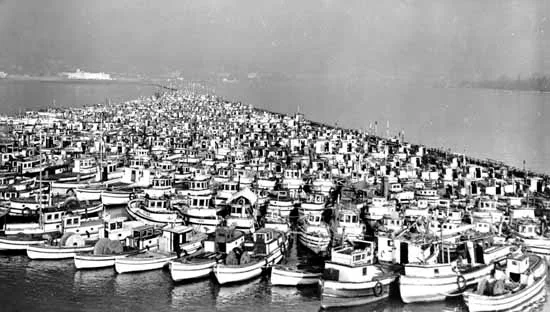
On September 7, 1907, a crowd attacks Chinatown and the Japanese Powell Street. The ship Komagata Maru, with 376 passengers, mostly Sikh, is held for two months in Burrard Inlet in 1914 and forced back; the Chinese Immigration Act of 1923 closes Chinese immigration until 1947.
1942 · The Japanese-Canadian internment
About 22,000 Japanese Canadians from the coast are removed to camps in the interior and have their houses, boats, and shops auctioned off by the government. Powell Street, once the city's Japanese neighborhood, never went back to what it was.
1967–1972 · The freeway revolt
The plan to cut through Chinatown and Strathcona with an elevated freeway is defeated by residents and city councilors, which is why Vancouver is the only major North American city without a freeway running into downtown. Greenpeace, founded there in 1971, dates from the same period.
1986 · Expo 86 and the glass towers
The world's fair from May to October 1986 draws about 22 million visits and leaves behind SkyTrain, Canada Place, and Science World. The north shore of False Creek is sold in 1988 to a Hong Kong investor and becomes the laboratory of “Vancouverism”: low commercial base, tall thin tower, protected view.

2010–2026 · Olympics, housing, and the World Cup
The February 2010 Winter Games accelerated the Canada Line and the Sea to Sky highway. Since then the city has lived with the country's most expensive housing crisis, a public health emergency over toxic drugs declared in April 2016, and, in June and July 2026, seven World Cup matches at BC Place.
 AI illustration
Complete history
Inhabited for thousands of years
The Fraser River delta has been inhabited for thousands of years by hən̓q̓əmin̓əm̓ and Sḵwx̱wú7mesh-speaking peoples (today the Musqueam, Squamish, and Tsleil-Waututh nations) who lived off the salmon that ran up the river each year and the red cedar, raw material for houses, canoes, and clothing. The first European ships pass through in 1791 and 1792 without founding anything; the fur trade arrives overland with Simon Fraser in 1808. Two smallpox epidemics, in 1782 and 1862, kill a very high share of the coast's Indigenous population before any city exists. British Columbia becomes a colony in 1858, because of the gold rush, and joins the Canadian federation in 1871 on condition of getting a railway to the Pacific.
The railway decided the spot in 1884
The promise of a railway to the Pacific, made to British Columbia in 1871, decided where the city would be born. In 1884 the Canadian Pacific Railway decides to extend the track 20 km beyond Port Moody, to the settlement of Granville, in exchange for a huge grant of public land. The city is incorporated on April 6, 1886, with about a thousand residents; on June 13 a fire that started in a land-clearing burn destroys practically every building in less than an hour and kills about twenty people. Rebuilt in brick, it receives the first transcontinental train on May 23, 1887, and becomes the point where Asia meets the Canadian railway: 13,700 residents in 1891, about 100,000 in 1911. The CPR subdivides the West End and Shaughnessy, and the layout of that legacy (long blocks, north–south avenues, the port to the north) remains in place.
The head tax and exclusion laws against Asians
The same economy that brought workers from China, Japan, and Punjab built the laws to exclude them. The head tax charged to Chinese immigrants rises from CAD 50, in 1885, to CAD 500 in 1903. On September 7, 1907, a march by the Asiatic Exclusion League turns into an attack on Chinatown and Powell Street. In 1914 the Komagata Maru, with 376 passengers from Hong Kong, sits anchored for two months in Burrard Inlet and is escorted back out to sea. The Chinese Immigration Act of 1923 shuts the door for 24 years, and in 1942 about 22,000 Japanese Canadians are removed from the coast and stripped of their belongings. Official apologies only came decades later: 1988 for Japanese Canadians, 2006 for the head tax, 2016 for the Komagata Maru, 2018 from the City of Vancouver to the Chinese community.
No freeway downtown, by popular vote
In the postwar years, the city followed an urban path different from the rest of the continent. Between 1967 and 1972 the population defeats a freeway plan that would have demolished Chinatown and Strathcona, which is why the city still has no freeway reaching downtown today. Gastown gets heritage protection in 1971, Greenpeace is born in the city that same year, and the seawall keeps being extended until it closes the loop around the peninsula. Expo 86 turns the False Creek shoreline into a construction site: the land is sold in 1988 to investor Li Ka-shing and produces the slender-tower-over-commercial-base model that came to be exported as “Vancouverism,” with view corridors to the mountains protected by municipal bylaw since 1989. Hong Kong's handover to China, in 1997, adds capital and a new wave of migration.
The 2010 Winter Olympics accelerated the housing boom
Today's city is rich, expensive and under strain. The February 2010 Winter Games left behind the Canada Line and an upgraded Sea to Sky Highway, but they also accelerated rising property values: British Columbia introduced a 15% tax on foreign buyers in 2016, raised to 20% in 2018, and Vancouver brought in the empty homes tax in 2017, without bringing prices down. Meanwhile, the public health crisis over the toxic drug supply, declared in 2016, remains unsolved, with its most visible effects concentrated in the Downtown Eastside. The economy rests on the port, Canada's largest, on film and TV production, on technology and on real estate. In June and July 2026 the city hosted seven World Cup matches at BC Place, and the subway extension under Broadway, under construction since 2021, is scheduled to open in 2027. Almost everything you see is less than 140 years old, on land that has been occupied for millennia and was never the subject of a treaty.
Choosing Vancouver as the railway terminus helped shape the city. The first transcontinental train arrived in 1887.
Geography and shape of the city
The peninsula, the mountains, and the rain
Vancouver occupies the Burrard Peninsula, between the shallow fjord of Burrard Inlet to the north and the north arm of the Fraser River to the south, with the Strait of Georgia to the west and the Coast Mountains rising sharply on the other side of the water: Grouse at 1,231 m, Seymour at 1,449 m, Cypress at 1,440 m, all visible from downtown on a clear day. The climate is temperate oceanic: 1,150 to 1,200 mm of rain a year at sea level, concentrated from October to March, dry and mild summers, snow rare in the city and abundant 900 m above it.
The grid and the twisted peninsula
The layout is a grid oriented to the cardinal points, with numbered streets running east-west south of False Creek and address numbering starting from Ontario Street and the port; the downtown peninsula is an appendix to that grid, twisted relative to it.
Height instead of a freeway
Since the freeway never reached downtown, density built upward instead: thin towers over a two-to-four-story commercial base, with view corridors to the mountains protected by bylaw since 1989, and the West End became the densest residential neighborhood in Canada. About 11% of the municipal territory is parkland, and the seawall stitches the waterline for roughly 28 km.
Culture
The continent's third-largest film and TV hub
Vancouver is the third-largest film and television production center in North America, behind only Los Angeles and New York, and the industry employs tens of thousands of people in studios in Burnaby, Richmond, and the east side of the city. “The X-Files” was shot here from 1993 to 1998 and set the pattern: the city rarely plays itself, doubling for Seattle, Portland, New York, and generic Pacific Northwest forests. It's common to run into a closed-off street and yellow location signs. The same technical economy sustains a video-game hub (Electronic Arts has operated in Burnaby since 1983) and one of the country's largest clusters of animation and effects studios.
The Vancouver School of photoconceptualism
In visual art, the city produced the so-called Vancouver School of photoconceptualism, with Jeff Wall, Rodney Graham, Ian Wallace, and Stan Douglas, whose large-format staged photographs have been studied since the 1980s. Before them, Emily Carr (1871–1945) painted the forest and the coastal villages; alongside them, and for much longer, Northwest Coast Indigenous art: Bill Reid, of the Haida nation, and Susan Point, Musqueam, whose cedar portals stand at the airport and at the Museum of Anthropology. It's what the city exports most as an image. In literature, Douglas Coupland wrote about the city in short dictionary-style entries, Wayson Choy wrote the Chinatown of the 1930s, and Timothy Taylor wrote the kitchen of the 1990s; the Vancouver Writers Fest takes place on Granville Island in October.
Nightlife is modest for the size
Nightlife is modest for the size of the city. The nickname “No Fun City” comes from decades of restrictive licensing, and most bars close between 1am and 3am. The main pastime is outdoors: running the seawall, paddling in False Creek, skiing on three mountains 30–40 minutes from downtown. In pro sports, the Canucks, founded in 1970, play hockey at Rogers Arena, opened in 1995, and have reached three Stanley Cup finals, in 1982, 1994 and 2011, losing all of them; the 1994 and 2011 losses ended in riots downtown. The Whitecaps (soccer) and the BC Lions (Canadian football) share BC Place, which hosted seven World Cup matches in June and July 2026. In music, the city gave the world late-1970s punk with D.O.A., the Nettwerk label and Sarah McLachlan in the 1990s, and more recently Grimes and Michael Bublé.
In Chinatown, the Sam Kee Building occupies a lot only 1.8 m deep.
Festivals and events

Vaisakhi
Second half of April, in south Vancouver, along Main Street and Marine Drive. The Sikh parade draws several hundred thousand people and hands out free vegetarian food on the street all day; it's one of the largest outside India.

Celebration of Light
The organizer has canceled the fireworks festival over English Bay indefinitely. Check the official website for any announcement of its return before planning a trip around it.

Bard on the Beach
A season of Shakespeare in tents at Vanier Park, from June to September, since 1990, with the back of the stage open to the sea and mountains. Tickets run CAD 30 to 70; matinees are the cheapest shows.

PNE: Pacific National Exhibition
An end-of-summer fair at Hastings Park, from mid-August to Labour Day, the first Monday of September. It's been around since 1910 and keeps a wooden roller coaster from 1958, shows, livestock contests, and fried-food stalls.

VIFF: Vancouver International Film Festival
From late September to early October, about ten days and a few hundred titles, with a strong presence of Canadian and Asian cinema. Screenings spread across downtown theaters; single tickets CAD 15–20.
Books and films
“City of Glass,” by Douglas Coupland (2000)
A portrait of the city in short entries, written by someone who grew up in it. It explains the glass towers, the body obsession, and the lack of urban memory better than any conventional guide.
“The Jade Peony,” by Wayson Choy (1995)
Novel about three siblings in the Chinatown of the 1930s and 1940s, with the head tax, legal exclusion, and the Second World War seen from inside a single family.
“Double Happiness,” by Mina Shum (1994)
The director's first feature film, shot in the city: a young Chinese-Canadian woman torn between family and an acting career. It's the most direct portrait of immigrant Vancouver in the 1990s.
Frequently asked questions
Vancouver: How do you get from the airport to downtown?
The SkyTrain Canada Line, opened in August 2009, links the terminal to Waterfront station in about 26 minutes.
Vancouver: How do you get to Whistler, and how long does it take?
Whistler is 120 km north on Highway 99, the Sea to Sky: that's 2 hours by car and about 2 hours 30 minutes by bus, with a ticket between CAD 30 and 70 per leg.
Vancouver: How do you pay, and how much does eating cost?
Tap-to-pay works for practically everything, including buses, little ferries and street carts, and you never need to carry more than CAD 40 in cash on any given day. Taxes aren't on the price tag: the federal GST, at 5%, applies to almost everything, and the provincial PST, at 7%, applies to goods. A restaurant meal pays only the GST, and alcoholic drinks carry 10% PST. 2026 ranges, all approximate: coffee CAD 4 to 6, a simple lunch CAD 15 to 25, a sit-down dinner CAD 40 to 75 per person without drinks.
Vancouver: When does it rain the most, and what's winter like?
Winter runs from November to March, with highs of 6 to 9 °C and lows rarely below freezing, and it's when most of the annual 1,150 to 1,200 mm of rain falls: November and December each exceed 170 mm. The city gets about 160 rainy days a year. Snow in the city is occasional, around 35 cm per season, and melts within days. In the North Shore mountains, ski season runs from December to March, extending to May in Whistler. June tends to frustrate newcomers: the persistent cloud cover earned it the nickname “Juneuary,” and it's easy to think you got the hemisphere wrong.
Vancouver: Do I need to take off my shoes when entering a house?
Yes: take off your shoes when entering any house, even if the host doesn't ask, because no one will.
Other cities in the country
Canada ↗- Days
- 2–3
- When
- Sep–Oct
- Per person/day
- Average 130–260 C$Mid-range · per person/day
Cost scope
Per person per day: accommodation, meals, urban transport, visits and a small allowance for extras. Flights excluded; larger purchases vary. Editorial estimate, not a quote.
- Days
- 2–3
- When
- May–Oct
- Per person/day
- Average 160–280 C$Mid-range · per person/day
Cost scope
Per person per day: accommodation, meals, urban transport, visits and a small allowance for extras. Flights excluded; larger purchases vary. Editorial estimate, not a quote.
- Days
- 3–4
- When
- Jun–Sep
- Per person/day
- Average 145 CADMid-range · per person/day
Cost scope
Per person per day: accommodation, meals, urban transport, visits and a small allowance for extras. Flights excluded; larger purchases vary. Editorial estimate, not a quote.
- Days
- 2–3
- When
- Feb · Jun–Oct
- Per person/day
- Average 210 CADMid-range · per person/day
Cost scope
Per person per day: accommodation, meals, urban transport, visits and a small allowance for extras. Flights excluded; larger purchases vary. Editorial estimate, not a quote.