
Kazakhstan
Almaty
In Almaty, the mountain appears at nearly every street's end
Days Start with the basic programme and choose extensions for the time you have.
How the guide reaches this number
On the first, combine Panfilov Park, the Green Bazaar and Republic Square; on the second, head up from Medeu to Shymbulak early, when the air is cleanest. The third day is for the Kok-Tobe cable car in the morning, the metro's mosaic stations and an afternoon at the Kasteev Museum. With only one day, do the mountains early, have lagman for lunch at a canteen on the way down and finish in Panfilov Park, home to the wooden cathedral and the Arasan Baths, which need two hours. Anyone looking for medieval streets will be disappointed: the city is a practical, not very pretty military grid, rebuilt after the earthquakes of 1887 and 1911. Avoid January, because a coat solves the cold, but nothing solves the smoke the temperature inversion traps in the lower city. If you can choose, come in September, when aport apples are sold on street corners.
2–3
When September and October; for skiing, February at Shymbulak; avoid January, the month with the most polluted air
How the guide reaches this number
The climate is dry continental, with four distinct seasons. Winter runs from December to March, with averages between −4 °C and −10 °C, lows that reach −20 °C and guaranteed snow in the mountains. It's ski season at Shymbulak and, at the same time, the worst moment for air quality, because the temperature inversion traps smoke in the lower city. April and May bring rain, snowmelt and green slopes, with wild tulips blooming on the hills from late April. Summer, from June to August, is dry and hot, with highs of 30 to 35 °C in the center and afternoon thunderstorms in the mountains, where temperatures drop 10 °C or more. September and October are the best window: 18 to 25 °C, clear skies, the aport apple harvest and hotel rates lower than at the July peak. The month to avoid is January, for its combination of cold and pollution, and March, if mud, slippery sidewalks and dirty snow bother you.
Per person/day 18,000–36,000 ₸ (about US$35–70) with a simple hotel, local food and public transit
How the guide reaches this number
Per person per day: accommodation, meals, urban transport, visits and a small allowance for extras. Flights excluded; larger purchases vary. Editorial estimate, not a quote.
 What Nilo thinks
Set aside two days for Almaty, one for the center and one for the mountains, and add a third if you can. On the first, combine Panfilov Park, the Green Bazaar and Republic Square; on the second, head up from Medeu to Shymbulak early, when the air is cleanest. The third day is for the Kok-Tobe cable car in the morning, the metro's mosaic stations and an afternoon at the Kasteev Museum. With only one day, do the mountains early, have lagman for lunch at a canteen on the way down and finish in Panfilov Park, home to the wooden cathedral and the Arasan Baths, which need two hours. Anyone looking for medieval streets will be disappointed: the city is a practical, not very pretty military grid, rebuilt after the earthquakes of 1887 and 1911. Avoid January, because a coat solves the cold, but nothing solves the smoke the temperature inversion traps in the lower city. If you can choose, come in September, when aport apples are sold on street corners.Almaty sits at the foot of the Zailiysky Alatau, and 4,000 m white peaks rise behind the buildings at many of its intersections. The best thing to do here is go up: the gondola climbs to 3,200 m, where it's cold even in summer. Back on the plain, try cured horse meat and kurt at the stalls of the covered market on Zhibek Zholy, and bite into an aport, the apple that gave the city its name. The architecture is Soviet for a reason: the earthquakes of 1887 and 1911 brought down the brick buildings. What remained standing is the log church Zenkov finished in 1907, in Panfilov Park. Rows of poplars and oaks shade the wide avenues, watered by channels that run along the curb. Come in early fall, when the days are mild and the apple harvest fills the street-corner stalls.
Quick facts
- Population
- about 2.37 million in the city (official figure, July 2026); about 2.7 million in the metro area
- Founded
- Fort Zailiyskoye in 1854, renamed Verny in 1855; before that, the Silk Road settlement of Almatu between the 10th and 13th centuries
- Country and region
- Kazakhstan, historical region of Zhetysu (Seven Rivers), at the foot of the Zailiysky Alatau
- Language
- Kazakh (state language) and Russian (official language of interethnic communication); on Almaty's streets Russian handles almost everything
- Currency
- Tenge (KZT, ₸); in September 2026, US$1 was worth about ₸455 and €1 about ₸520
- Time zone
- UTC+5 year-round since March 1, 2024, when the whole country moved to a single time zone; 8 hours ahead of Brasília
- Best time to visit
- September and October; for skiing, February at Shymbulak; avoid January, the month with the most polluted air
- Average daily cost
- 18,000–36,000 ₸ (about US$35–70) with a simple hotel, local food and public transit
When to go
September and October; for skiing, February at Shymbulak; avoid January, the month with the most polluted air
January
-8° to 1°C
35 mm of rain
AvoidFebruary
-6° to 3°C
43 mm of rain
March
0° to 10°C
72 mm of rain
April
7° to 18°C
112 mm of rain
May
12° to 23°C
99 mm of rain
June
16° to 28°C
59 mm of rain
July
19° to 31°C
43 mm of rain
August
17° to 30°C
34 mm of rain
November
-1° to 8°C
55 mm of rain
December
-6° to 2°C
44 mm of rain
How the year changes

The climate is dry continental, with four distinct seasons. Winter runs from December to March, with averages between −4 °C and −10 °C, lows that reach −20 °C and guaranteed snow in the mountains. It's ski season at Shymbulak and, at the same time, the worst moment for air quality, because the temperature inversion traps smoke in the lower city. April and May bring rain, snowmelt and green slopes, with wild tulips blooming on the hills from late April. Summer, from June to August, is dry and hot, with highs of 30 to 35 °C in the center and afternoon thunderstorms in the mountains, where temperatures drop 10 °C or more. September and October are the best window: 18 to 25 °C, clear skies, the aport apple harvest and hotel rates lower than at the July peak. The month to avoid is January, for its combination of cold and pollution, and March, if mud, slippery sidewalks and dirty snow bother you.
The same numbers as a table
| Month | Temperature °C | Rain mm |
|---|---|---|
| January | -8 to 1 | 35 |
| February | -6 to 3 | 43 |
| March | 0 to 10 | 72 |
| April | 7 to 18 | 112 |
| May | 12 to 23 | 99 |
| June | 16 to 28 | 59 |
| July | 19 to 31 | 43 |
| August | 17 to 30 | 34 |
| September · | 12 to 25 | 28 |
| October · | 5 to 17 | 50 |
| November | -1 to 8 | 55 |
| December | -6 to 2 | 44 |
Nilo's tips
The Onay card costs 500 ₸ and pays off by the seventh ride
With the Onay, which costs 500 ₸, the metro and bus fare drops from 200 ₸ in cash to 120 ₸. The 80 ₸ you save on every ride covers the price of the card after seven trips. Buy it at a station kiosk or a terminal and top it up through the app. If you'd rather not carry a card at all, a contactless bank card also works at the validator, and the conductor usually won't mention it.
At the airport, the driver in the lobby charges triple
The driver who approaches you inside the arrivals hall usually asks for about triple the app price. From ALA airport, 15 km to the north, city bus 92 reaches downtown for 120 ₸ with an Onay card, in 40 to 60 minutes; a Yandex Go or inDrive costs 2,500 to 4,500 ₸ and takes 25 to 40 minutes. Lock in the price on the app before you walk out the door.
Bring cash: Kaspi's QR code requires a Kazakh account
For everyday purchases, Almaty pays with the Kaspi.kz QR code, which requires a Kazakh account and doesn't accept foreign cards. Visa and Mastercard work in cafés, supermarkets and restaurants, but bazaars, street stalls and taxis outside the apps want tenge in hand. Change money at the exchange offices on Nazarbayev and Zheltoqsan streets, which post their rates in the window and pay more than the airport counter.
Climb Medeu's 842 steps before taking the gondola to 3,200 m
Take bus 12 or a ride-hailing car to Medeu, at 1,691 m, and first climb the 842 steps up to the mudflow dam. Doing it after the gondola, once your body has cooled down, is punishment. Then board the gondola to Shymbulak, at 2,200 m, and continue to the top station at 3,200 m, for around 6,500 ₸ round trip. Up there it's more than 10 °C colder than in the center even in July, so bring a jacket.
In winter, go up to Kok-Tobe, at 1,100 m, early
In winter, the air in the lower city gets trapped under a cold lid and improves as you climb the slope. So take the cable car from Dostyk up to Kok-Tobe, at 1,100 m, first thing in the morning, while the view still reaches across the whole plain. If your week has only one clear morning, spend it on the scenery and leave the museum for another day.
At the Green Bazaar, tasting first is the deal
At the stalls in the Zhibek Zholy pavilion, the first price is a starting point for bargaining, and vendors expect you to taste. Ask for a sliver of kurt and a slice of kazy before settling on a weight, and bring cash, because cards are the exception there.
Explore the map

© OpenStreetMap · OpenFreeMap · © OpenMapTiles
Explore the map, read about the other places and plan your travel days in the app.
Open the appWhat to see
Almaty: The alluvial fan and the altitude
Almaty occupies a sloped alluvial fan at the foot of the Zailiysky Alatau, the northern range of the Tian Shan: the center sits at about 700 m and the highest neighborhoods pass 1,000 m, with Talgar Peak (4,979 m) visible from the street on a clear day. Downtown, the Golden Square, the rough rectangle between Abay and Raiymbek avenues and Seifullin and Nazarbayev (formerly Furmanov) streets, holds cafes, galleries, offices, and the most expensive square meter in the country.

Green Bazaar (Kök Bazar)
A covered market on Zhibek Zholy, dating back to the late 19th century, with the current pavilion from the 1970s. Divided into aisles: horse meat and kazy, dairy, nuts and dried fruit from the south, and the white pyramids of kurt; tasting before buying is expected, and the opening price is negotiable.
Tasting the goods before buying is the custom, and the starting price is up for discussion, amid kazy, kurt, and dried fruits.
Check access

Medeu
A speed-skating rink at 1,691 m altitude, opened in 1972 and known for its mountain-water ice, where dozens of world records were set. It is 15 km from the center along the gorge road; the 842-step staircase beside it climbs up to the anti-mudslide dam.
The trip to the rink at 1,691 m is worth it because dozens of world records were set on its mountain-water ice, and 842 steps climb up to the dam.
Check access
Shymbulak
A ski resort between 2,200 and 3,200 m, linked to Medeu by gondola since 2011. It runs skiing in winter and hiking in summer; the temperature difference from the center passes 10 °C, and the top calls for a coat even in July.
The gondola from Medeu climbs to 3,200 m, with hiking in summer and skiing in winter, and at the top even July still calls for warm clothes.
Check access
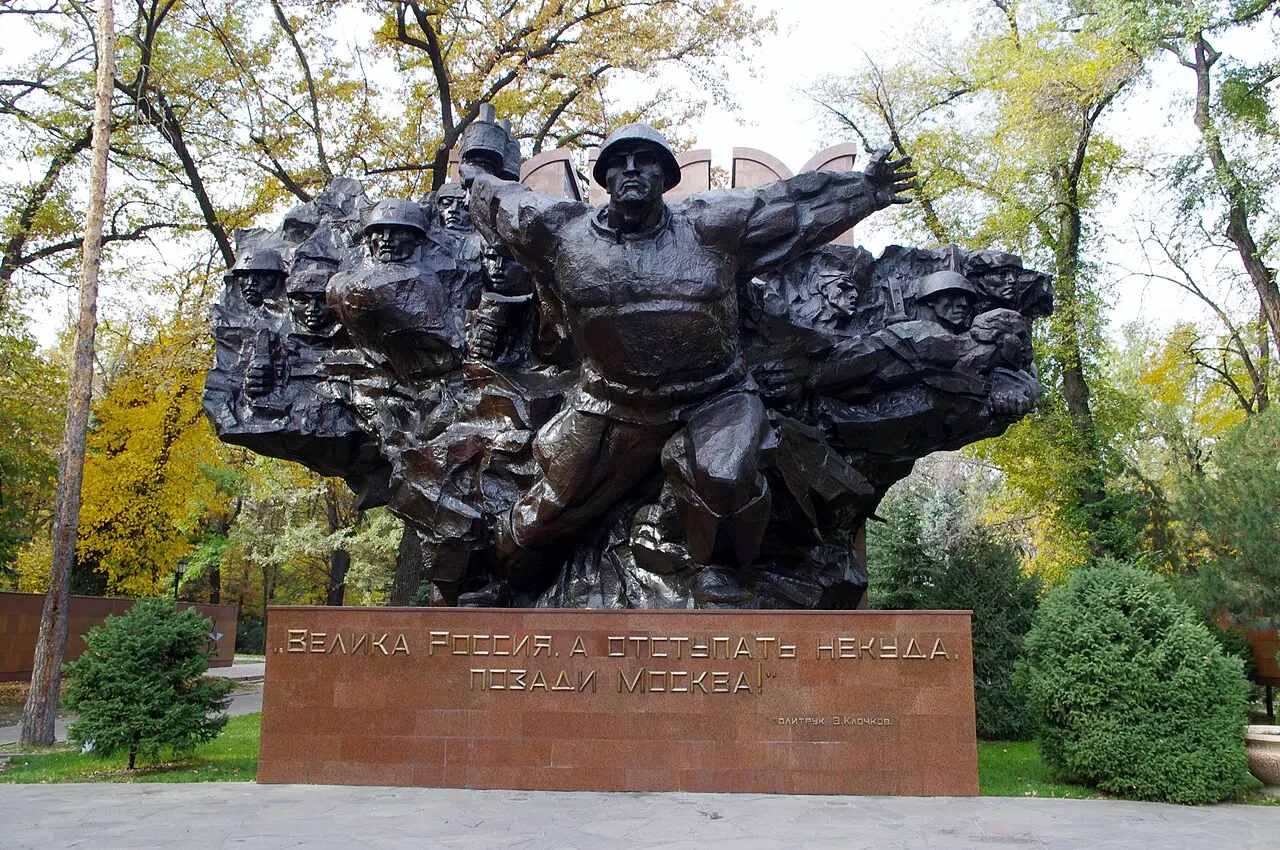
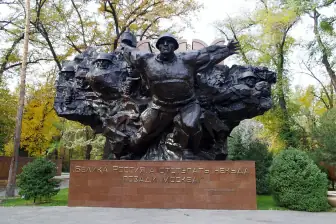
Panfilov 28 Guardsmen Park
A central 18-hectare park with poplar-lined walks, dedicated to the infantry division formed in Alma-Ata that fought in front of Moscow in 1941. It holds the black-granite war memorial from 1975, with an eternal flame, and is where the city takes its photos on official dates.
Visitors on official dates pose in front of the 1975 black-granite monument and the eternal flame, in an 18-hectare park.
Check access
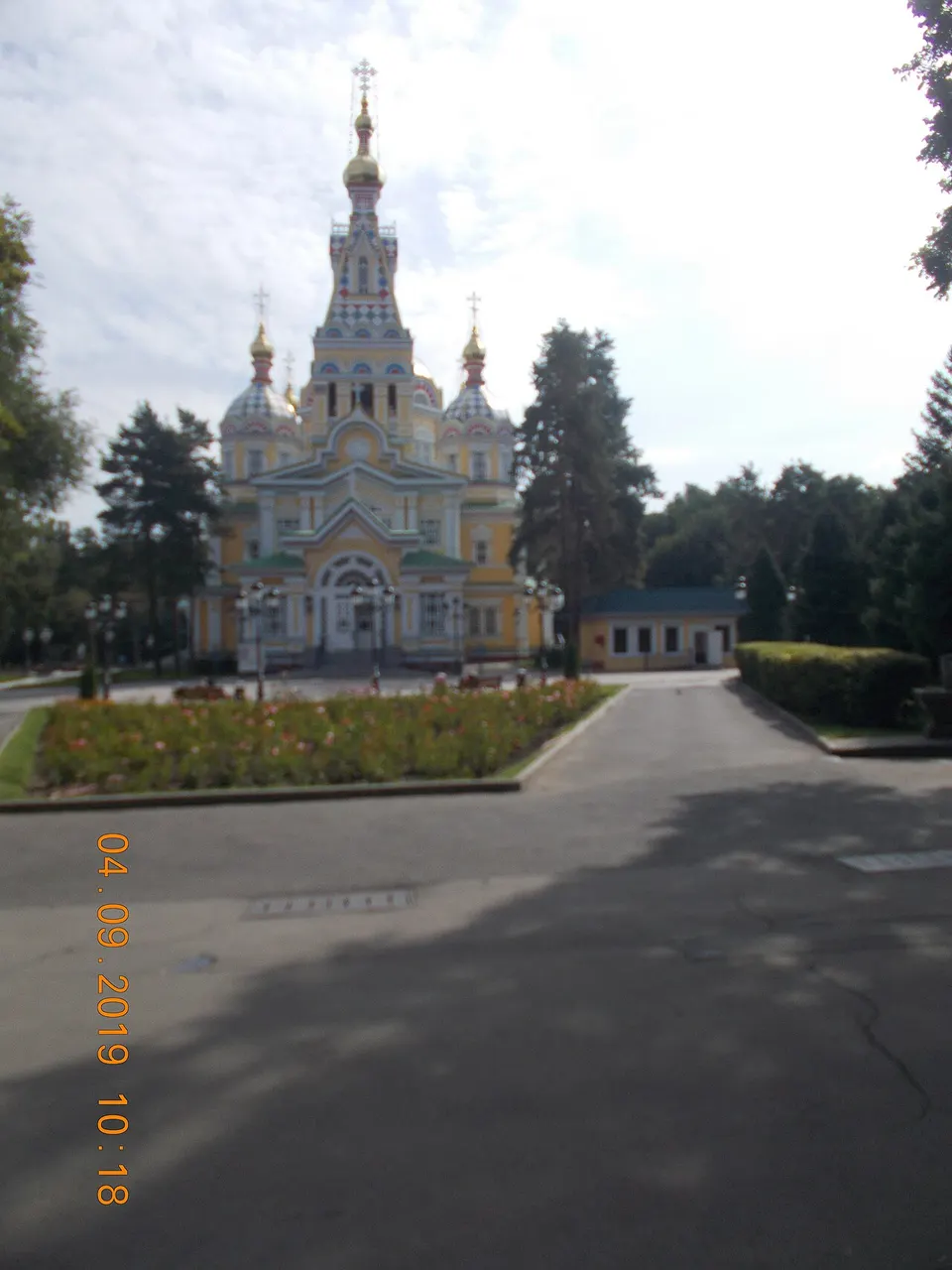
Ascension Cathedral (Zenkov)
A wooden Orthodox church completed in 1907 by engineer Andrey Zenkov, about 56 m tall and structurally engineered to absorb tremors. It survived the 1911 earthquake, served as a museum in the Soviet period and returned to worship in 1995; free entry, shoulders and heads covered for women.
The 1907 wooden structure stands about 56 m tall and has a frame designed to absorb earthquakes; it withstood the 1911 quake and returned to worship in 1995.
Check access
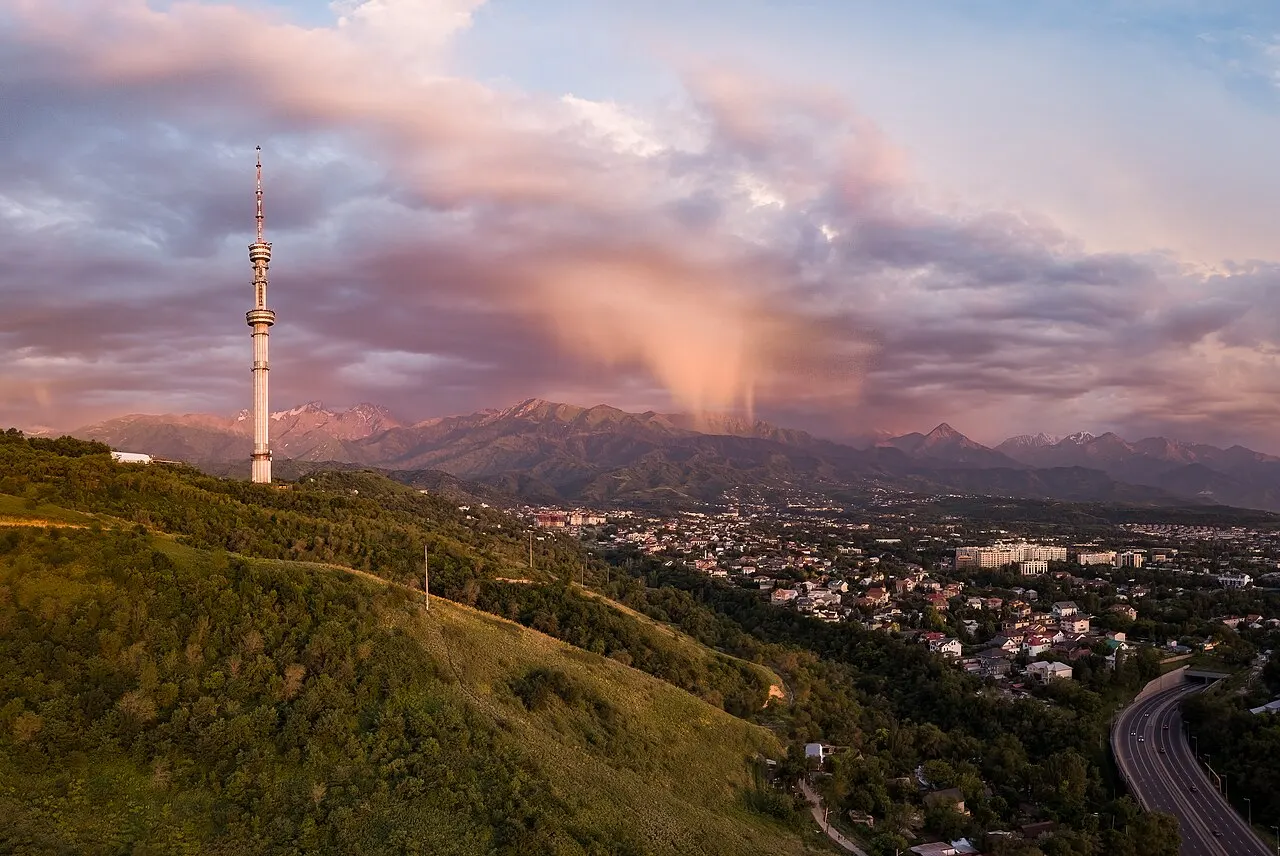
Kok-Tobe
A hill at 1,100 m on the city's southern edge, reached by cable car since 1967 from Dostyk street. It holds a viewpoint over the city grid, an amusement park and the 2007 Beatles statue; above it stands the 372 m TV tower, closed to the public.
The cable car has run since 1967, and the top combines a viewpoint and an amusement park, while the 372 m tower remains closed to the public.
Check access
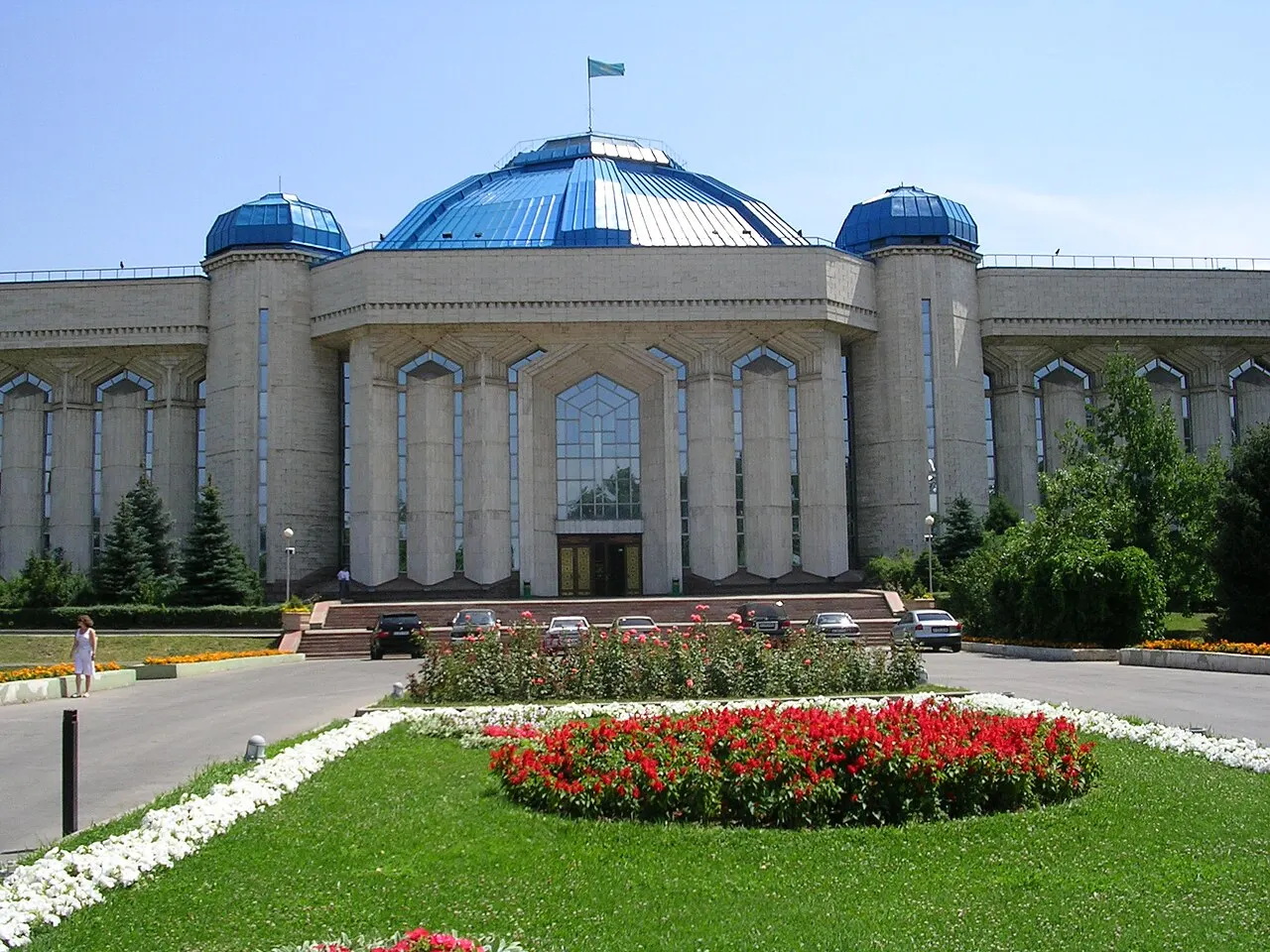
Central State Museum of Kazakhstan
Opened in 1985 in a blue-domed building beside Republic Square, it covers prehistory to independence across four halls. The most visited piece is the reconstruction of the Golden Man, covered in about 4,000 gold plates, found in 1969 in a kurgan 50 km from the city.
The Golden Man, covered in about 4,000 gold plaques and found in 1969, appears reconstructed in the blue-domed building that opened in 1985.
Check access
 AI illustration
Arasan Baths
A 1982 bathhouse complex on the edge of Panfilov Park, with Russian, Finnish and Eastern wings and capacity for thousands of people a day. It is the most Soviet social institution still running in the city. Go with sandals and set aside two hours.
The public bathhouse still in use justifies arriving in sandals and setting aside two hours, across the Russian, Finnish, and oriental wings of the 1982 complex.
Check access
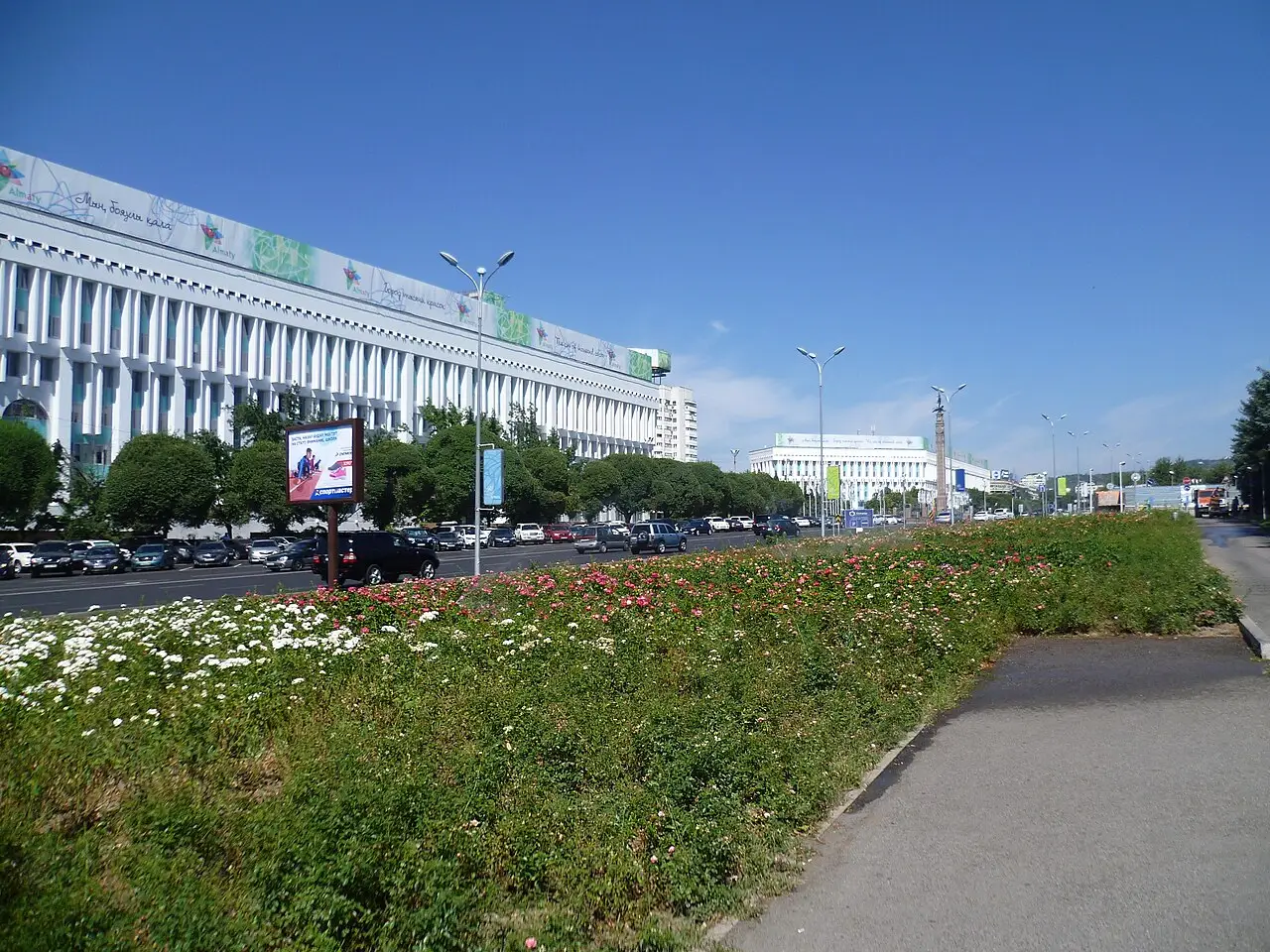
Republic Square and Independence Monument
A monumental square from 1980 where the Zheltoqsan took place in December 1986. The 1996 obelisk, 28 m tall, is crowned by a replica of the Golden Man, the Scythian warrior from the Issyk burial mound, standing on a winged leopard.
What's atop the 28 m obelisk is a replica: the reconstructed Golden Man, with about 4,000 gold plaques, is a few steps away, inside the Central State Museum. The square, from 1980, is just the way to the museum.
Check access
Nilo’s itinerary
Start with the basic programme and choose extensions for the time you have.
Plan my days in the app ↗Day 1 · The downtown streets, the park and the bazaar
Start at Panfilov 28 Guardsmen Park, see the inside of the 1907 Zenkov Cathedral and the 1975 granite memorial beside it.
Step into the Ykylas Museum of Musical Instruments, in the park's own 1908 wooden house, to hear küy recordings before you recognize the sound on the street.
Have lunch at the Green Bazaar: sliced kazy, kurt to try and an aport apple at the front stall; pay cash and negotiate the opening price.
Walk along Zhibek Zholy to the Golden Square, stopping at a local roastery cafe on Kabanbay Batyr street.
Finish at Republic Square, with the 1996 obelisk, and the Central State Museum to see the reconstruction of the Golden Man.
Day 2 · The mountain at three altitudes
Take bus 12 or a ride-hailing car to Medeu (1,691 m) and climb the 842 steps to the dam before boarding the gondola, while your body is still warm.
Take the gondola from Medeu to Shymbulak (2,200 m) and, if the weather is clear, on to the upper station at 3,200 m: round-trip ticket around 6,500 ₸.
Bring a coat and sunglasses, because up top it's cold even at the height of summer.
Head back to the city in the late afternoon and set aside two hours at the Arasan Baths, in Panfilov Park.
Have lagman or manty for dinner at a downtown canteen and finish with tea in a bowl: accept the second pour.


If you stay longer
Day 3 · A view from above and neighborhood life
Ride the cable car from Dostyk street up to Kok-Tobe (1,100 m) in the morning and pick out the city grid from the viewpoint.
Head down on foot or by bus to Al-Farabi Avenue and walk through First President's Park, from 2010, laid out to align with the mountains.
Ride the metro end to end on the single line to see the Baikonur and Auezov Teatry stations, decorated in mosaic and marble.
Set the afternoon aside for the Kasteev State Museum of Arts, the country's largest art collection, with 20th-century Kazakh painting.
Finish on the Dostyk–Kabanbay Batyr axis for dinner and to see the Golden Square at night.

Food
 AI illustration
Beshbarmak
The national dish: wide sheets of pasta boiled in broth, topped with shredded horse or lamb meat and scalded onion rings. Served on a communal platter for family occasions, with the broth (sorpa) drunk afterward from a bowl; the name means “five fingers” and it is eaten with the hand.
 AI illustration
Kazy and shuzhyk
Cured, cooked horse-rib sausages, thinly sliced and served cold as a dastarkhan starter. Sold by weight at the Green Bazaar and considered the prestige item on any table.
 AI illustration
Lagman
Hand-pulled noodles of Uyghur origin, served in broth with mutton, bell pepper and cumin, or fried (“qurma”). It is on every canteen menu and is the cheapest, most reliable lunch in the city.
 AI illustration
Manty
Large steamed dumplings, filled with knife-cut minced meat with onion or pumpkin, served with sour cream. Eaten by hand, biting the side first so as not to lose the broth.
 AI illustration
Samsa
A pastry baked against the wall of a tandyr oven, made of flaky dough with meat and onion. A classic street and bazaar item: hot, it costs around 400–700 ₸ and makes a breakfast on its own.
 AI illustration
Kurt and milk tea
Kurt are hard balls of fermented, dried milk, very salty, which the Green Bazaar sells stacked in white pyramids. Light and easy to carry, they were the nomads' travel food. Ask for a sliver to taste before you buy, as is customary at the bazaar, because the salt is strong and every stall makes them its own way.
 AI illustration
Apport apple and kumys
The aport is the large, fragrant variety developed by grafting in the city since the 1860s, harvested in September and October at street stalls. Kumys, fermented mare's milk, and shubat, from camel's milk, are sold in plastic bottles at the bazaar and taste sour and mildly alcoholic.
Day trips

Charyn Canyon
About 200 km east, 3 hours to 3 hours 30 minutes by car on a paved road. The Valley of Castles, the most visited section, has red sandstone walls 150 to 300 m high and a 3 km trail down to the Charyn River; the national park dates from 2004 and charges an entrance fee of around 2,000 ₸.

Kolsai and Kaindy Lakes
Between 280 and 330 km east, 4 to 5 hours by car; usually done as an overnight trip. Kaindy, at 2,000 m, is the lake with the submerged spruce forest formed by the 1911 earthquake, and the three Kolsai lakes sit staggered between 1,800 and 2,850 m near the Kyrgyzstan border.

Tamgaly Petroglyphs
About 170 km northwest, 2 hours 30 minutes by car along the steppe road. It holds more than 5,000 rock carvings from the Bronze Age to the Turkic period, including the sun-headed deity figures that became a symbol of the country; the site was added to the UNESCO list in 2004.
Where to begin
The downtown streets, the park and the bazaar
Start at Panfilov 28 Guardsmen Park, see the inside of the 1907 Zenkov Cathedral and the 1975 granite memorial beside it.
The mountain at three altitudes
Take bus 12 or a ride-hailing car to Medeu (1,691 m) and climb the 842 steps to the dam before boarding the gondola, while your body is still warm.
A view from above and neighborhood life
Ride the cable car from Dostyk street up to Kok-Tobe (1,100 m) in the morning and pick out the city grid from the viewpoint.
Money
The currency is the tenge (₸), at about 455 ₸ per dollar and 520 ₸ per euro in 2026. ATMs from Kaspi and Halyk banks are everywhere, and Visa and Mastercard work in cafes, supermarkets and restaurants, but the real everyday payment method is the Kaspi.kz QR code, which requires a Kazakh account and stays out of reach for anyone who doesn't have one. Exchanging money at a city currency office pays better than at the airport, and Nazarbayev and Zheltoqsan streets have several, with the rate posted in the window. These are the prices in 2026: espresso 700–1,200 ₸; lunch at a canteen (stolovaya) 1,500–2,500 ₸; dinner at a mid-range restaurant 6,000–12,000 ₸ per person; local beer at a bar 900–1,800 ₸; metro fare 120 ₸; hostel bed 5,000–9,000 ₸; mid-range hotel 25,000–45,000 ₸ a night. Tipping is not mandatory and many restaurants already add a 10% service charge to the bill. Check before rounding up, because it's easy to add twice on top of what's already included; taxis do not expect a tip.
Getting there and around
From the airport to the center: bus 92 or a ride-hailing app
Almaty's international airport (ALA) is 15 km north of the center and got a new international terminal in June 2024. City bus 92 connects the airport to downtown in up to an hour, depending on traffic. A ride-hail car (Yandex Go or inDrive, the two dominant apps) runs about 2,500 to 4,500 ₸ and takes 25 to 40 minutes. Do not accept a driver who approaches you inside the terminal: the price agreed there tends to be triple, and the approach usually starts before you even reach the door. For longer trips, Almaty-2 station is the most central and Almaty-1 sits to the north. The Talgo trains to Astana take 13 to 14 hours in a sleeper cabin and cost between 8,000 and 20,000 ₸, depending on class. Intercity buses and those going to Bishkek leave from the Sayran bus terminal, to the west, and reach the Kyrgyz capital in about 4 hours.
Almaty's metro: a single line in marble and mosaic
Within the city, the metro is a single line, 13.4 km long with 11 stations, opened in December 2011, with marble and mosaic walls and trains every 7 to 10 minutes from 6:20am to midnight. The fare is 120 ₸ with the Onay card, on both metro and bus, versus 200 ₸ paid in cash on board in 2026. The card costs 500 ₸ and can be topped up at kiosks, terminals or through the app. The bus network is large and covers what the metro doesn't reach, including the BRT corridor on Timiryazev Avenue, opened in 2018, and Yandex Maps shows real-time schedules more reliably than the signs at the stop. The center is easy to walk within the grid, but the blocks are long, the avenues have six lanes and the open aryks become a trap after dark. There's bike sharing, but expect a steady climb whenever you pedal south, toward the mountains.
Safety
Almaty is a big city with low risk for visitors: violent crime against foreigners is rare, and what does happen is theft in bazaars, on crowded transit and around stations, especially at Barakholka and near Almaty-1. For visitors, the most likely risks are traffic and weather. Cars don't stop on their own at crosswalks, so the safe crossing is one with a traffic light, and in winter sidewalks turn to packed ice and the open aryks disappear under the snow. Avoid cars that offer themselves as taxis without an app, especially at the airport and outside bars. The city lies in an active seismic zone: read your hotel's evacuation notice and know where the exit is before you need it. In the mountains, sudden weather changes and avalanches are real risks off-piste, so tell someone where you're going, don't hike alone to the lakes and check whether the route requires a border permit. Drinking alcohol in public is prohibited and fined, and joining a political demonstration can get a foreigner deported. January 2022 showed that a protest can shut down the center within a few hours, and the advice in those cases is to leave the area and follow updates from your consulate.
Etiquette tips
Take off your shoes when entering any home
Taking off your shoes at the door of a home has no exceptions, and there's no need to ask: guest slippers wait by the entrance, and wearing them is expected, because walking in with shoes on is seen as dirtying the family's space. Indoors, also avoid whistling, since local superstition says whistling drives money away.
The tea bowl comes half-full on purpose
Filling the kese to the brim means “drink and go”; the half means they will pour again and you should stay. Do not ask them to top it off, and do not refuse the second pour without having accepted the first.
Give and receive with the right hand or with both
Money, cards, plates and gifts are handed over and received with the right hand or with both, and the left hand alone comes across as careless. When greeting an older man, a two-handed handshake is the standard gesture of respect.
Do not refuse food from the dastarkhan
The set table is the host's obligation, and refusing what is served sounds like refusing the house. If you are not hungry, take a small portion and praise it: “дәмді” (dâmdí) is enough.
Kazakh is the ethnicity; Kazakhstani, the nationality
About a third of the country's population is not ethnically Kazakh, and the distinction matters in conversation. Also avoid treating the country as “ex-Soviet”: independence in 1991 is central to national identity.
Give up your seat on public transit without being asked
Older people, pregnant women and anyone carrying a child have absolute priority on the metro and bus, and anyone who doesn't give up their seat will usually hear about it loudly from another passenger.
Mistakes to avoid

Relying on English outside downtown cafés
Counting on English outside downtown cafes. Russian handles practically everything, Kazakh is the state's language, and an offline translator with a Cyrillic keyboard saves hours at bazaars, pharmacies and stations.
Raising an arm for a taxi
Flagging a taxi with a raised arm on the street and negotiating the price afterward. The city's standard is an app, Yandex Go or inDrive, with a fixed price before getting in. An unmetered private car is where most overcharging happens.
Dressing for downtown and heading up the mountain
Dressing for downtown and heading up the mountain in the same clothes. At the top of Shymbulak, at 3,200 m, it's cold even in July, and high-altitude sun can burn your skin even in snowy or cloudy conditions: a jacket, sunglasses, and sunscreen are essential year-round.
Swimming in Big Almaty Lake
Treating Big Almaty Lake as a swimming spot. It is the city's drinking-water reservoir: entering the water is banned and fined, and the road above it leads to a border zone that requires a permit obtained in advance.
Confusing it with the capital
Confusing Almaty with the country's capital. The capital has been Astana since 1997; embassies, ministries and most of the federal bureaucracy sit 1,200 km away, which matters if you need consular paperwork.
Useful phrases
Сәлеметсіз бе (Kazakh)
Hello, respectful form (pron. “salemetssíz be”)
Рахмет (Kazakh)
Thank you (pron. “rakhmét”)
Қанша тұрады? (Kazakh)
How much does it cost? (pron. “kanchá turadý”)
Сколько стоит? (Russian)
How much does it cost? The version that works at any bazaar (pron. “skólka stóit”)
Я не понимаю (Russian)
I don't understand (pron. “ia ne panimáiu”)
Дәмді (Kazakh)
It's delicious: the right word for praising the table (pron. “dâmdí”)
Districts
Golden Square (Zolotoy Kvadrat)
The rough rectangle between Abay and Raiymbek avenues and Seifullin and Nazarbayev (formerly Furmanov) streets holds cafes, galleries, offices and the most expensive square meter in the country. It is where the 1854 military grid is still legible, with regular blocks and aryks running beside the sidewalk.
Almaly
The central district running from 28 Panfilov Guardsmen Park to the Green Bazaar and the pedestrian street Zhibek Zholy, the local “Arbat.” It holds hotels, the Abay Opera and Ballet Theater, street commerce and most of the metro stations.
Medeu
Climbs the slope south of Al-Farabi Avenue and holds the city's priciest addresses, Kok-Tobe hill, the Medeu ice rink at 1,691 m and the road to Shymbulak. The higher the address, the cleaner the winter air, and that is what sets the price.
Bostandyk
A district of universities (al-Farabi KazNU, KBTU) and offices along Al-Farabi, with the Esentai Tower (168 m, 2008) and the mall of the same name. It works as both the corporate and the student axis of the city.
Auezov
The west of numbered microdistricts from the 1960s and 1970s, with standardized blocks, Sayran Lake and the Sayran bus terminal, where buses leave for Bishkek and the provinces. Residential, dense and much cheaper than the center.
Turksib and Zhetysu
The flat, railway-lined north holds Almaty-1 station, the airport, warehouses and the Barakholka market, Central Asia's largest wholesale market for clothing and household goods. It suits travelers arriving by train at Almaty-1 or anyone who wants to browse the wholesale stalls, always with an eye on their bag, because this is where pickpocketing happens most.
Alatau and Nauryzbai
A belt of expansion to the north and southwest formed by internal migration since the 1990s; neighborhoods like Shanyrak grew unplanned and only got water, paved roads and buses after being settled. It holds the youngest population and the most recent construction.
History
10th–13th c. · Almatu on the Silk Road
A settlement called Almatu occupies the valley between Kashgar and the steppe and even mints silver coins in the 13th century. The Mongol invasions wipe it out and the region returns to nomadic herding for three centuries.
1854 · The Russian fort
The Russian Empire raises Fort Zailiyskoye on the bank of the Malaya Almatinka River, marking the military advance over the Kazakh Great Jüz. In 1855 it is renamed Verny and receives Cossack, Russian and Ukrainian settlers.
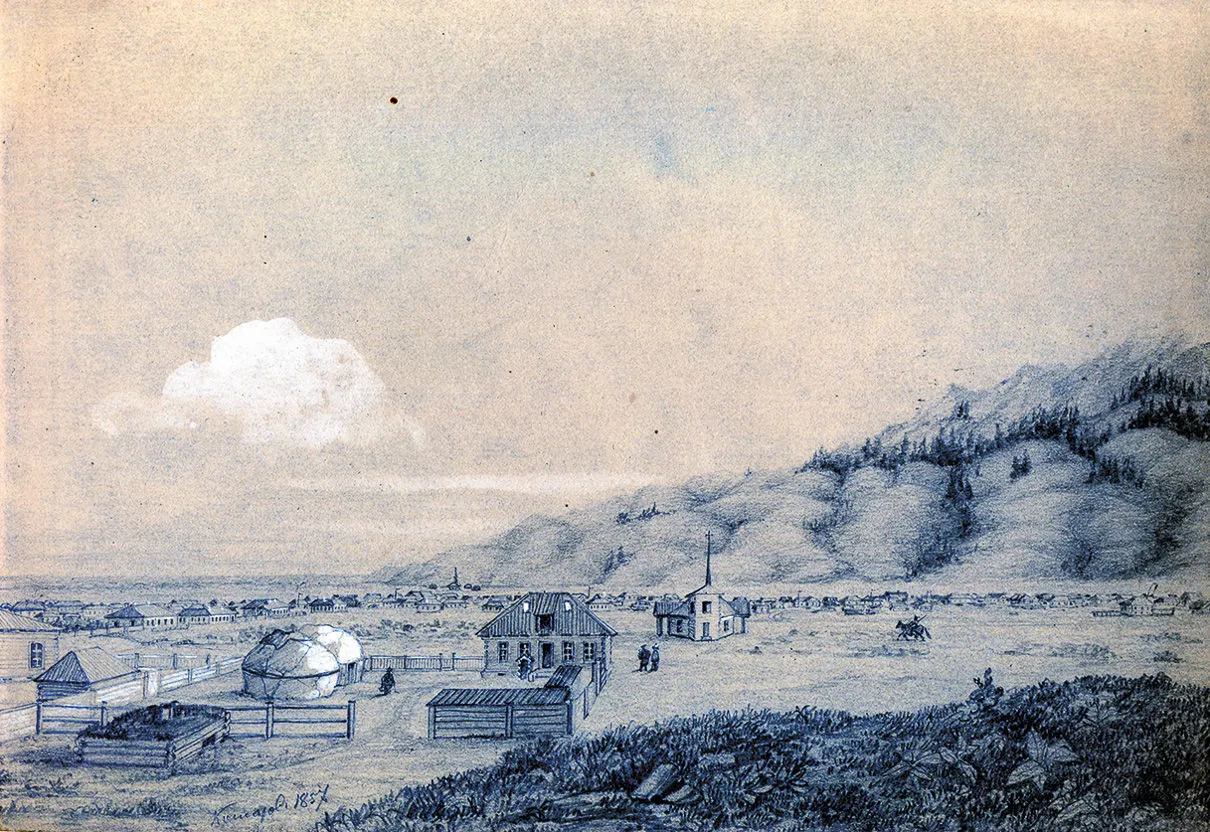
1867 · Capital of Semirechye
Verny becomes the capital of the Semirechye oblast and gains the orthogonal grid of wide streets designed by military engineers, with irrigation canals (aryks) running beside every sidewalk.
1887 and 1911 · Earthquakes that kept the city low and built of wood
The quake of May 28, 1887 brings down nearly all the brick housing stock; the one in January 1911, on the Kemin fault, destroys what had been rebuilt. The two dates explain why the city stayed low and wooden until the Soviet era.

1907 · The wooden cathedral
Andrey Zenkov completes the Ascension Cathedral in what is now Panfilov Park, about 56 m tall with an earthquake-resistant wooden frame. It survives the 1911 quake and becomes the city's most photographed landmark.

1929–1930 · Soviet capital and the Turksib
Alma-Ata (the name adopted in 1921) replaces Kyzylorda as the capital of the Kazakh Soviet republic in 1929. In 1930 the Turkestan–Siberia railway connects it to Novosibirsk and Tashkent.
1930–1945 · Famine, deportation and cinema
Collectivization triggers the Asharshylyq, a famine that kills about 1.5 million Kazakhs and reshapes the republic's demographics. In the following years Koreans deported from the Far East arrive (1937), along with Germans, Chechens and Poles, and in 1941 the film studios evacuated from Moscow and Leningrad: Eisenstein shoots “Ivan the Terrible” in the city.
1972 · Medeu and the mudflow dam
The Medeu skating rink opens at 1,691 m, where dozens of world speed-skating records would be set. In 1973, the mudflow dam built above it holds back a mudslide that would have destroyed entire neighborhoods.

Dec. 1986 · Zheltoqsan
Thousands of young people occupy the central square against the appointment of Gennady Kolbin, a Russian with no ties to the republic, to head the party in Kazakhstan. The crackdown leaves dead and imprisoned, and it is remembered as the first major ethnic protest of perestroika.

1991–1997 · End of the USSR and loss of the capital
On December 21, 1991, the Alma-Ata Declaration, signed in the city, formalizes the dissolution of the Soviet Union and the creation of the CIS. In 1997 the capital moves to Akmola, later Astana, and Almaty repositions itself as the economic center.
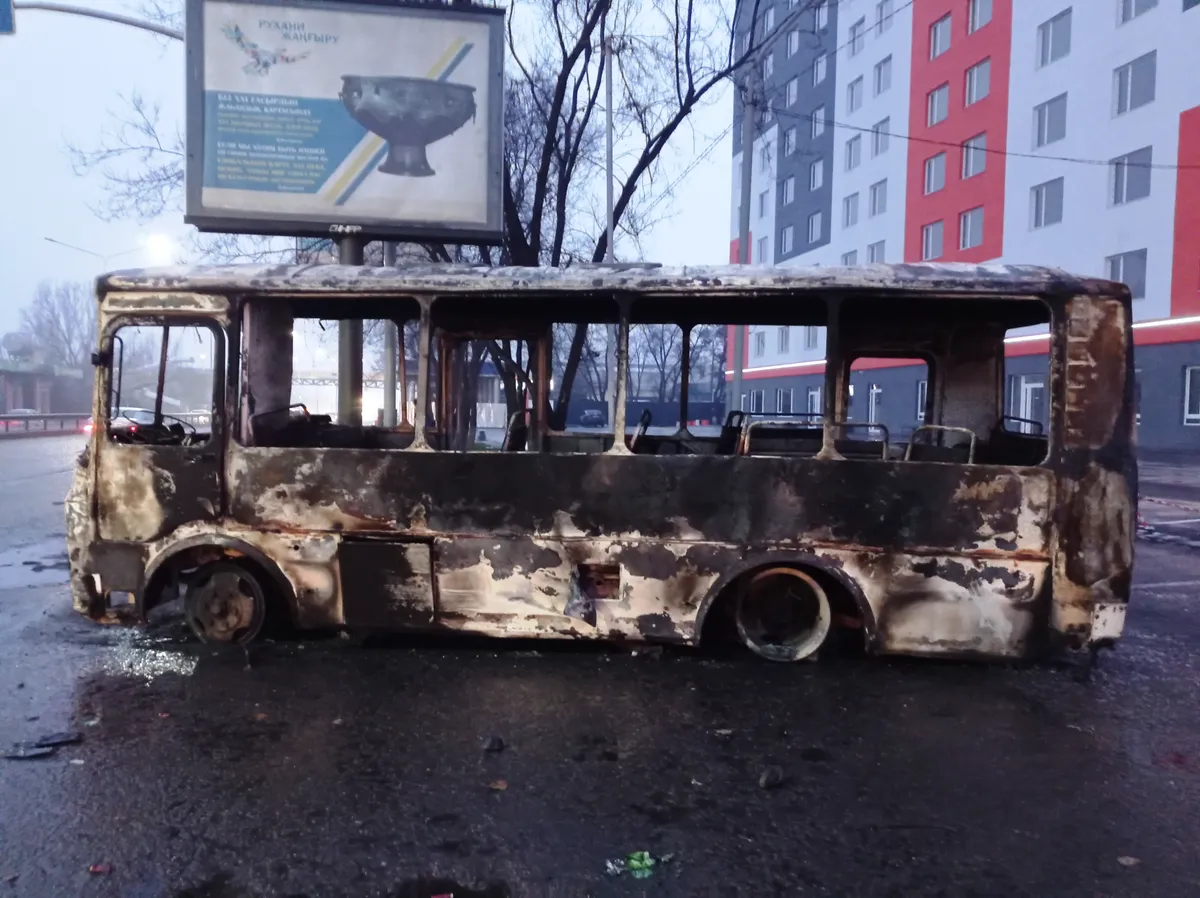
Jan. 2022 · Qandy Qantar
Protests against the rise in liquefied gas prices turn into a national crisis that hits Republic Square and Almaty's city hall hardest, both set on fire. The official toll is 238 dead nationwide.
Complete history
The settlement of Almatu and the Silk Road
The Zhetysu valley was a corridor before it was a city. Between the 10th and 13th centuries a settlement called Almatu existed there, a stopping point between Kashgar and the Kazakh steppe, with its own coinage, razed by the Mongol expansion. Then came three hundred years without a city: the territory belonged to the Kazakh Great Jüz and was used as summer pasture, with seasonal movement between the valley and the slopes. That nomadic background explains the calendar of festivals, the meat-and-fermented-milk cuisine, and the hospitality etiquette that survives intact in today's city.
Born as a fort, in 1854
The modern city is born military. In 1854 the Russian Empire installs Fort Zailiyskoye on the Malaya Almatinka River; in 1855 it becomes Verny and in 1867 the capital of the Semirechye oblast. Army engineers draw the orthogonal grid that Almaty still keeps today, with wide streets, regular blocks and aryks, open irrigation canals, running beside the sidewalks to carry meltwater to the trees planted in rows. Settlers brought from Voronezh and Ukraine graft apple trees from the 1860s onward and create the aport variety, a large, fragrant apple that became the city's trademark. Two earthquakes, in 1887 and 1911, destroyed the brick housing stock in turn and forced low, wooden construction; Zenkov's 1907 cathedral is what survived intact from that earthquake-resistant log engineering.
Soviet capital, famine and deportations (1921–1941)
The Soviet 20th century was the most violent and the most transformative. Alma-Ata, renamed in 1921, became the republic's capital in 1929 and gained a permanent rail link to Siberia in 1930, with the completion of the Turksib. In the same decade, forced collectivization produced the Asharshylyq, a famine that killed about a third of the Kazakh population and moved survivors from the countryside into the city. Then came mass deportations (Koreans from the Far East in 1937, Volga Germans, Chechens, Ingush, Poles) and, in 1941, the evacuation of factories, universities and film studios from the war front. Almaty came out of the war multiethnic by state decree, with a Korean, a Uyghur and a German community that still show up on menus and in surnames today.
Microdistricts, Medeu and the end of the USSR (1960 to 1991)
After the war, the city took the shape visitors walk through today. In the 1960s and 1970s, microdistricts of standardized apartment blocks spread west and six-lane avenues cut through the grid. The mountains got their own projects in the same period: the Medeu skating rink opened in 1972, and the mudflow dam built above it with controlled explosions held back a mudslide in 1973 that would have swept away the south of the city. In December 1986, Zheltoqsan brought students into the square to protest the appointment of a leader from outside, and the episode became a founding moment of contemporary Kazakh nationalism. On December 21, 1991, the Alma-Ata Declaration, signed in the city, formally brought the Soviet Union to an end.
No longer the capital since 1997: banks, universities, and the stock exchange
Losing the capital to Astana in 1997 did not empty out Almaty: it concentrated banks, universities, publishers, film and the stock exchange there. The city grew north and southwest through internal migration: neighborhoods like Shanyrak sprang up unplanned in the 1990s and only later got water and paved roads; the city got a metro in December 2011 and a BRT corridor on Timiryazev in 2018. Two problems dominate local debate: winter pollution, the product of a thermal inversion in a basin closed off by mountains combined with coal burning, and real-estate speculation climbing up the slope. January 2022, with the square and city hall on fire during Qandy Qantar, showed that the former capital remains the place where the country's politics play out in the street.
“Ivan the Terrible,” Eisenstein's epic, was filmed in this city during World War II, far from the front.
Geography and shape of the city
The alluvial fan and the altitude
Almaty sits on a sloped alluvial fan at the foot of the Zailiysky Alatau, the northern range of the Tian Shan: the center sits at about 700 m and the highest neighborhoods pass 1,000 m, with Talgar Peak (4,979 m) visible from the street on a clear day.
The 1854 grid and the aryks
The 1854 grid follows that slope, which gives the city a compass-free way of orienting: south is “up,” toward the mountain, and north is “down,” toward the steppe and the airport. Two meltwater rivers, the Bolshaya and the Malaya Almatinka, run channeled through the urban fabric and feed the open aryks beside the sidewalks, which sustain the rows of poplars and oaks planted during the Soviet period.
The trapped air and the seismic risk
Almaty sits in a basin ringed by mountains, and in winter a temperature inversion traps coal smoke and exhaust under a layer of cold air, often leaving pollution readings in the lower city worse than they are 300 m higher up. The city also lies in a high-risk seismic zone and under threat of glacial mudflows, which explains the dams in the Medeu gorge and the historic height limits on buildings.
From downtown at about 700 m to the upper neighborhoods above 1,000 m, Almaty climbs more than three hundred meters, so walking south means going uphill all the way.
Culture
Cinema, the strongest credential
Cinema is the city's strongest credential. The studios evacuated from Moscow and Leningrad in 1941 gave rise to Kazakhfilm, where Eisenstein shot “Ivan the Terrible” between 1942 and 1944, and where the Kazakh New Wave emerged in the 1980s, a generation trained in Moscow that came back to film the real city. The landmark is “The Needle” (1988), by Rashid Nugmanov, starring Viktor Tsoi; Tsoi, frontman of the band Kino and son of a Korean father born in Kazakhstan, has a monument on Tole Bi street that still receives flowers. The current scene runs from the export pop of Dimash Kudaibergen to the Q-pop of the group Ninety One, whose mix of Kazakh with Korean aesthetics sparked conservative protests in 2016 and became a national debate about modernity.
Abai, Auezov, the dombra and moderate Islam
The literary and musical tradition predates cinema and is still part of the school curriculum. Abai Qunanbaiuly (1845–1904), poet and translator of Pushkin and Goethe, is the country's moral touchstone and gives his name to the main avenue; Mukhtar Auezov wrote the epic novel “The Path of Abai,” published between 1942 and 1956, in Alma-Ata, and his house museum is open in the city. Steppe music revolves around the dombra, a two-stringed lute, and the küy, an instrumental piece that tells a story without words: Kurmangazy, from the 19th century, is the canonical composer and lends his name to the national orchestra of folk instruments. As for religion, most people follow Hanafi Sunni Islam in a moderate way: the central mosque, from 1999, fills up on Fridays, but alcohol is legal and the family table is rarely teetotal.
Skating, FC Kairat and nights in the Golden Square
Winter sports carry weight in Almaty because of the mountains surrounding the city. The Medeu rink has produced world speed-skating records since the 1970s, the city hosted the 2011 Asian Winter Games and the 2017 Universiade, and it bid twice for the Winter Olympics, losing to Beijing 44 to 40 in the 2015 vote. Off the ice, the passion is soccer, and the city's club, Kairat Almaty, reached the league phase of the Champions League in 2025-26. After the stadium or the rink, life gathers in the center: at night the bars fill the Golden Square and Dostyk Avenue, and by day the action is in the third-wave cafés that, after 2015, turned old houses in the center into roasteries.
The monument to Viktor Tsoi, the singer of the band Kino, on Tole Bi street, is rarely without flowers at its base.
Festivals and events

Nauryz (March 21–23)
The steppe's new year, a three-day national holiday. Yurts set up in the squares, dombra competitions, and nauryz köje, a seven-ingredient soup that promises a full year; almost everything closes and the city eats in the street.
 AI illustration
Almaty City Day (September)
Celebrated on the third weekend of September, with avenues closed off, outdoor stages and a harvest fair for the aport apple. It coincides with the year's best weather.

The Spirit of Tengri (June)
A contemporary ethnic music festival created in 2012, with bands from Central Asia, Siberia and the Caucasus playing dombra, throat singing and electronica outdoors. Free entry in most editions.
 AI illustration
Kurban Ait and Oraza Ait (movable dates)
The two major Islamic holidays are public holidays in Kazakhstan and fill the Central Mosque; families visit relatives and give out meat. Because the calendar is lunar, the dates shift by about 11 days each year.
 AI illustration
Independence Day and Zheltoqsan (December 16–17)
A national holiday marking independence in 1991 and, on the same pair of dates, the December 1986 protests. Official ceremonies in Republic Square and shops closed.
Books and films
“The Needle” (Igla, 1988), by Rashid Nugmanov
Shot in Alma-Ata with Viktor Tsoi in the lead role, it's the landmark of the Kazakh New Wave and shows the late-Soviet city without set dressing, with the courtyards and apartment blocks visitors still find in today's neighborhoods.
“Apples Are from Kazakhstan,” by Christopher Robbins (2008)
A travel account that starts from the genetic origin of the apple tree in the Almaty valley to explain the whole country: nomads, deportations, steppe and independence, with reporting on the city in the 2000s.
“Gruppa Krovi,” by Kino (1988)
The album that defined the last generation of Soviet rock, recorded by the band of Viktor Tsoi, son of a Korean father born in Kazakhstan. It explains why there is a monument to him on Tole Bi street that still receives flowers.
Frequently asked questions
Almaty: What language helps you get around the city?
Russian handles practically everything, Kazakh is the state's language, and an offline translator with a Cyrillic keyboard saves hours at bazaars, pharmacies, and stations.
Almaty: How do you get from the airport to downtown?
City bus 92 connects the airport to downtown in up to an hour, depending on traffic; by ride-hailing app (Yandex Go or inDrive) it's 2,500 to 4,500 ₸ and 25 to 40 minutes.
Almaty: Do I need to take off my shoes when entering a home?
Taking off your shoes at the door of a home has no exceptions, and there's no need to ask: guest slippers wait by the entrance, and wearing them is expected, because walking in with shoes on is seen as dirtying the family's space.
Almaty: Is the city safe for visitors?
Almaty is a big city with low risk for visitors: violent crime against foreigners is rare, and what does happen is theft in bazaars, on crowded transit, and around stations, especially at Barakholka and near Almaty-1.
Almaty: What is beshbarmak?
The national dish: wide sheets of pasta boiled in broth, topped with shredded horse or lamb meat and scalded onion rings.


