Philippines
Manila
Intramuros, Binondo, jeepneys and street food
Days Start with the basic programme and choose extensions for the time you have.
How the guide reaches this number
Anyone looking for a compact, walkable capital will be frustrated, because what's left of the old city is scattered across disconnected blocks, each a separate trip, and a real beach is a flight away. If the trip is an island-hopping one, using Manila only as a stopover is a defensible choice. With just one day, enter Fort Santiago at 8am, walk to San Agustín and Casa Manila, and have lunch at Plaza San Luis. In the afternoon, cross over to the National Museum of Fine Arts, which is free, and finish on Roxas Boulevard with the sun going down over the bay. What disappoints is Intramuros: the walls, churches, and houses were rebuilt after the war, and only San Agustín is original. What survived the war outside the walls is across the river, in Binondo and Quiapo, and calls for the second day: breakfast on Ongpin Street at 8am, then the packed jeepney to the Basilica of the Black Nazarene.
1–2
When December to February: the driest season of the year, between 24 and 31 °C and outside typhoon peak
How the guide reaches this number
Manila has two seasons and neither is cold; a jacket usually stays in the suitcase the whole time. From December to February the northeast monsoon (amihan) blows: 24–31 °C, lower humidity, little rain. It's the best window, and also the most expensive one, between Christmas and Chinese New Year. From March to May comes the dry heat: 33–37 °C at noon, with heat index passing 40 °C in April and May, when school lets out. From June to November is the rainy season, with the southwest monsoon (habagat) and typhoons, peaking from July to October; August is the wettest month, with about 400 to 450 mm, and the one to avoid. One habagat afternoon is enough to shut down España Avenue and Taft Avenue. There's no season without sun: even in August it pours hard for two hours and then clears, and the street starts over as if nothing happened. If you're traveling during typhoon season, leave one free day in your itinerary and follow the PAGASA agency's warnings, which number wind signals from 1 to 5.
Per person/day US$35–60 per person with a simple hotel, local food, and a mix of Grab and the urban rail
How the guide reaches this number
Per person per day: accommodation, meals, urban transport, visits and a small allowance for extras. Flights excluded; larger purchases vary. Editorial estimate, not a quote.
 What Nilo thinks
One day is enough for Intramuros, and two cover the whole historic center: the first for Fort Santiago, San Agustín, and the bay, the second for the river, Binondo, and Quiapo. Anyone looking for a compact, walkable capital will be frustrated, because what's left of the old city is scattered across disconnected blocks, each a separate trip, and a real beach is a flight away. If the trip is an island-hopping one, using Manila only as a stopover is a defensible choice. With just one day, enter Fort Santiago at 8am, walk to San Agustín and Casa Manila, and have lunch at Plaza San Luis. In the afternoon, cross over to the National Museum of Fine Arts, which is free, and finish on Roxas Boulevard with the sun going down over the bay. What disappoints is Intramuros: the walls, churches, and houses were rebuilt after the war, and only San Agustín is original. What survived the war outside the walls is across the river, in Binondo and Quiapo, and calls for the second day: breakfast on Ongpin Street at 8am, then the packed jeepney to the Basilica of the Black Nazarene.Manila starts in Intramuros, the walled Spanish city on the edge of the bay, where San Agustín Church, from 1607, was the only building left standing after the 1945 battle. For 250 years this port was the Asian terminal of the Manila galleon, which crossed the Pacific to Acapulco. Across the Pasig River, on Ongpin Street in Binondo, Eng Bee Tin has been making hopia since 1912. In Quiapo, the herb-and-candle market surrounds the Basilica of the Black Nazarene, and the jeepney has its own etiquette: the fare passes from hand to hand up to the driver, and the change comes back the same way. At night, order sisig sizzling on the plate with a San Miguel in Malate, and try halo-halo, whose name, “mix-mix,” is a literal instruction. Come between December and February, the driest stretch, and give one day to Intramuros or two to the whole historic center.
Quick facts
- Population
- about 1.9 million in the city of Manila (2024 census); 14.0 million in Metro Manila; about 25 million in the extended urban area
- Founding
- Settlements of Maynila and Tondo predate 1500; the Spanish city founded by Miguel López de Legazpi on June 24, 1571
- Country and region
- Philippines, island of Luzon, National Capital Region (NCR), on Manila Bay
- Language
- Filipino (Tagalog) and English, both official; English handles almost everything, including signs and menus
- Currency
- Philippine peso (PHP, ₱); about 57–59 PHP per US dollar in 2026
- Time zone
- UTC+8 (Philippine Standard Time), no daylight saving
- Best time to go
- December to February: the driest season of the year, between 24 and 31 °C and outside typhoon peak
- Average daily cost
- US$35–60 per person with a simple hotel, local food, and a mix of Grab and the urban rail
When to go
December to February: the driest season of the year, between 24 and 31 °C and outside typhoon peak
March
25° to 32°C
22 mm of rain
April
27° to 34°C
23 mm of rain
May
27° to 34°C
159 mm of rain
June
27° to 33°C
253 mm of rain
July
26° to 32°C
432 mm of rain
August
26° to 31°C
493 mm of rain
September
26° to 31°C
396 mm of rain
October
26° to 31°C
221 mm of rain
November
25° to 31°C
120 mm of rain
How the year changes
Manila has two seasons and neither is cold; a jacket usually stays in the suitcase the whole time. From December to February the northeast monsoon (amihan) blows: 24–31 °C, lower humidity, little rain. It's the best window, and also the most expensive one, between Christmas and Chinese New Year. From March to May comes the dry heat: 33–37 °C at noon, with heat index passing 40 °C in April and May, when school lets out. From June to November is the rainy season, with the southwest monsoon (habagat) and typhoons, peaking from July to October; August is the wettest month, with about 400 to 450 mm, and the one to avoid. One habagat afternoon is enough to shut down España Avenue and Taft Avenue. There's no season without sun: even in August it pours hard for two hours and then clears, and the street starts over as if nothing happened. If you're traveling during typhoon season, leave one free day in your itinerary and follow the PAGASA agency's warnings, which number wind signals from 1 to 5.
The same numbers as a table
| Month | Temperature °C | Rain mm |
|---|---|---|
| January · | 24 to 30 | 19 |
| February · | 24 to 31 | 22 |
| March | 25 to 32 | 22 |
| April | 27 to 34 | 23 |
| May | 27 to 34 | 159 |
| June | 27 to 33 | 253 |
| July | 26 to 32 | 432 |
| August | 26 to 31 | 493 |
| September | 26 to 31 | 396 |
| October | 26 to 31 | 221 |
| November | 25 to 31 | 120 |
| December · | 25 to 30 | 99 |
Nilo's tips
Withdraw the maximum at once: each withdrawal costs ₱250
With a limit of ₱10,000 to ₱20,000 per transaction, four small withdrawals burn ₱1,000 on fees alone. Withdraw the maximum allowed, as few times as possible, and carry cash, because jeepneys, tricycles, markets, and carinderias don't take cards.
At NAIA, allow up to an hour to change terminals
Connections at NAIA can take up to an hour, because the four terminals are separate. To get into the city, take a Grab (₱400–900 depending on the time) or a yellow metered taxi from the arrivals hall, and ignore anyone offering a “fixed price” at the door. The LRT-1 gained a stop about 2 km from the terminals, which doesn't help with luggage. Allow 60 to 120 minutes to the center at rush hour, and more on Friday afternoons.
Since March 2026 the train costs half
With the discount, crossing the city by rail costs less than a coffee, but it has a review date, so confirm the day before. Buy a beep card for ₱100 at the first station: it works on all three lines and on several bus routes.
Intramuros: skip Monday; San Agustín also closes Tuesday
San Agustín Museum closes Mondays and Tuesdays; the neighborhood's other museums close only on Monday. Save one of those two days to walk the walls without hurrying.
Go to Binondo at 8am, before the lines
At eight in the morning the counter is clear, the lumpia and fried siopao come out hot, and the old shops have no line. Ongpin and Benavidez streets serve from 6am to midnight, but only in the early hours does taho, warm tofu with brown-sugar syrup, come around in a street vendor's hands for ₱20–40. He's done before ten, so it's the one thing in the day you can't put off. For lunch, a carinderia does the job for ₱80–150 and is where the city actually eats.
January 9 shuts down downtown for up to 20 hours; Holy Week clears the roads
On January 9, the Traslación procession of the Black Nazarene takes over downtown, so plan your itinerary around that date. During Holy Week, by contrast, you can cross the city in half the usual time, and that's when the trip between Intramuros and Makati shortens the most.
Explore the map

© OpenStreetMap · OpenFreeMap · © OpenMapTiles
Explore the map, read about the other places and plan your travel days in the app.
Open the appWhat to see
Manila: the river mouth, the reclaimed land, and the tide
Manila occupies 42.9 km² on the eastern shore of Manila Bay, at the mouth of the Pasig River, which runs 25 km down from Laguna de Bay and splits the city in two. Right at the mouth sits Intramuros, the 64 walled hectares of the Spanish city, rebuilt after 1945 and run by its own agency since 1979.
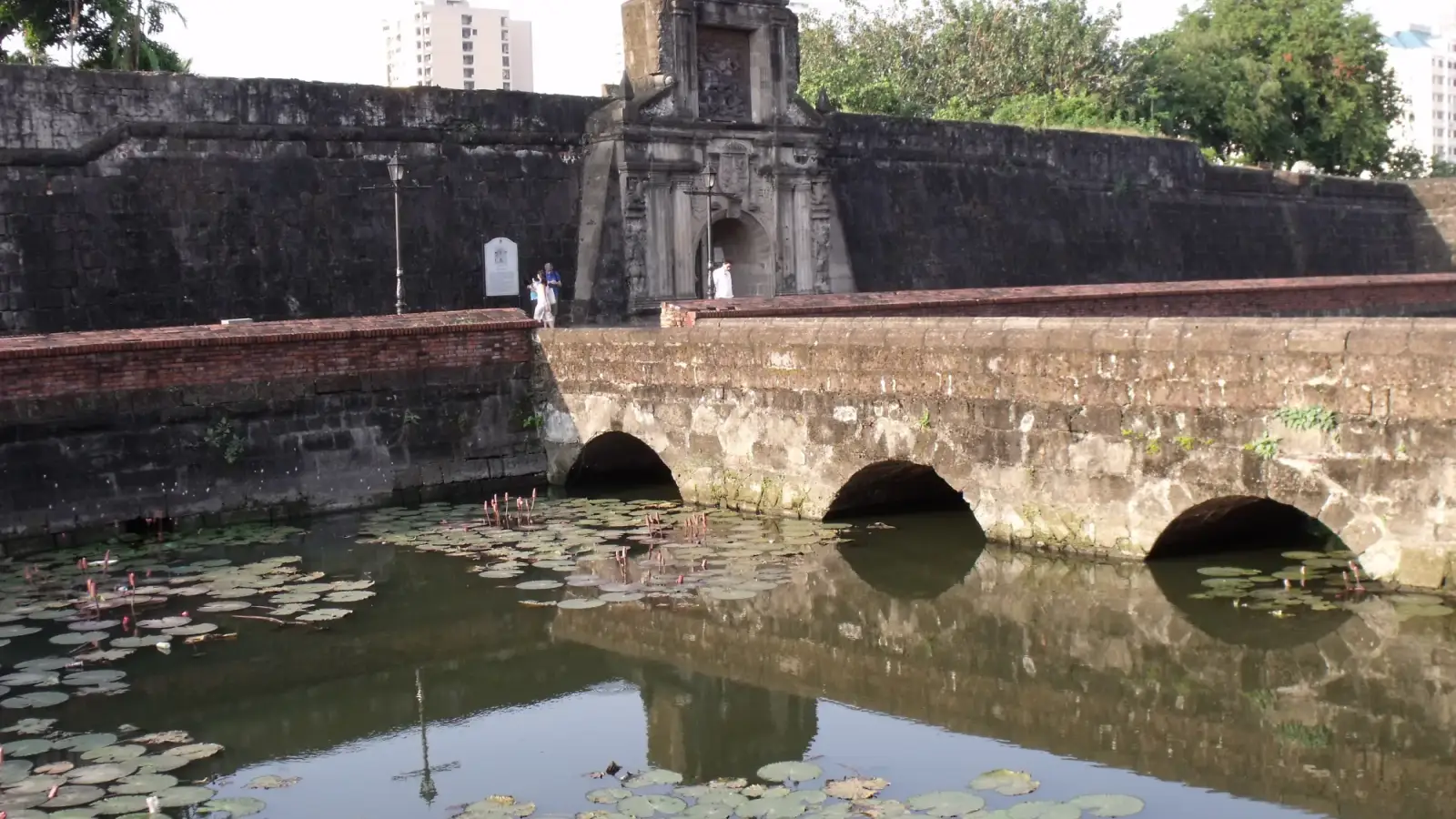
Fort Santiago
A Spanish fortress at the tip of Intramuros, over the mouth of the Pasig, begun in 1593 and rebuilt after 1945. It holds the cell where José Rizal spent his last night and the bronze footprints that retrace his 65 steps to the firing squad. Entrance around ₱75.
Holds the cell where José Rizal spent his last night before his execution, in 1896, and the bronze footprints that retrace his 65 steps to the firing squad. Avoid Monday, when several Intramuros museums are closed.
Check access
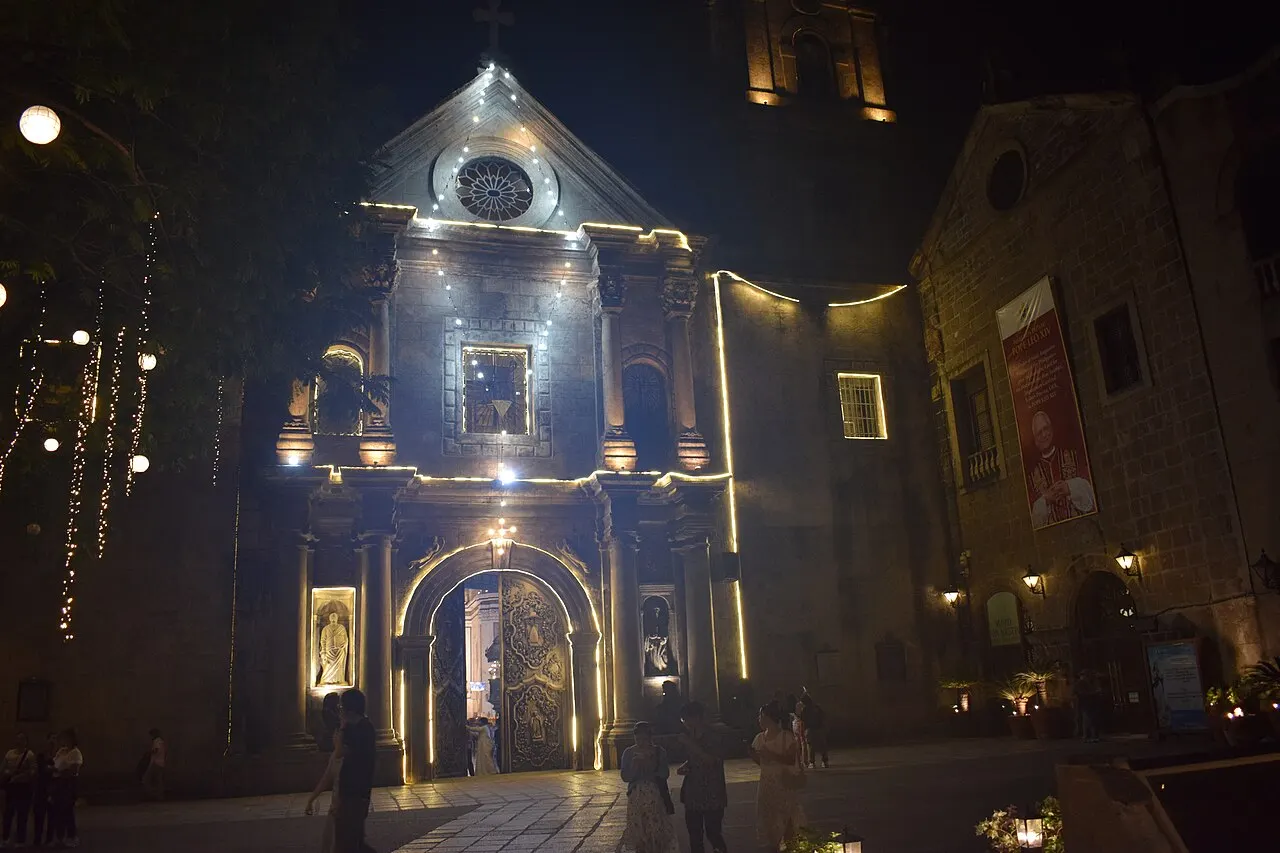
San Agustín Church
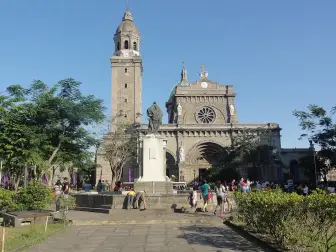
Completed in 1607, it is the oldest stone church in the country and the only building in Intramuros left standing in 1945. A UNESCO World Heritage Site since 1993; the trompe-l'œil ceiling was painted in 1875 by the Italians Alberoni and Dibella, and the adjoining convent is a museum.
If you only go into one thing inside the walls, make it this. Half an hour is enough.
Check access
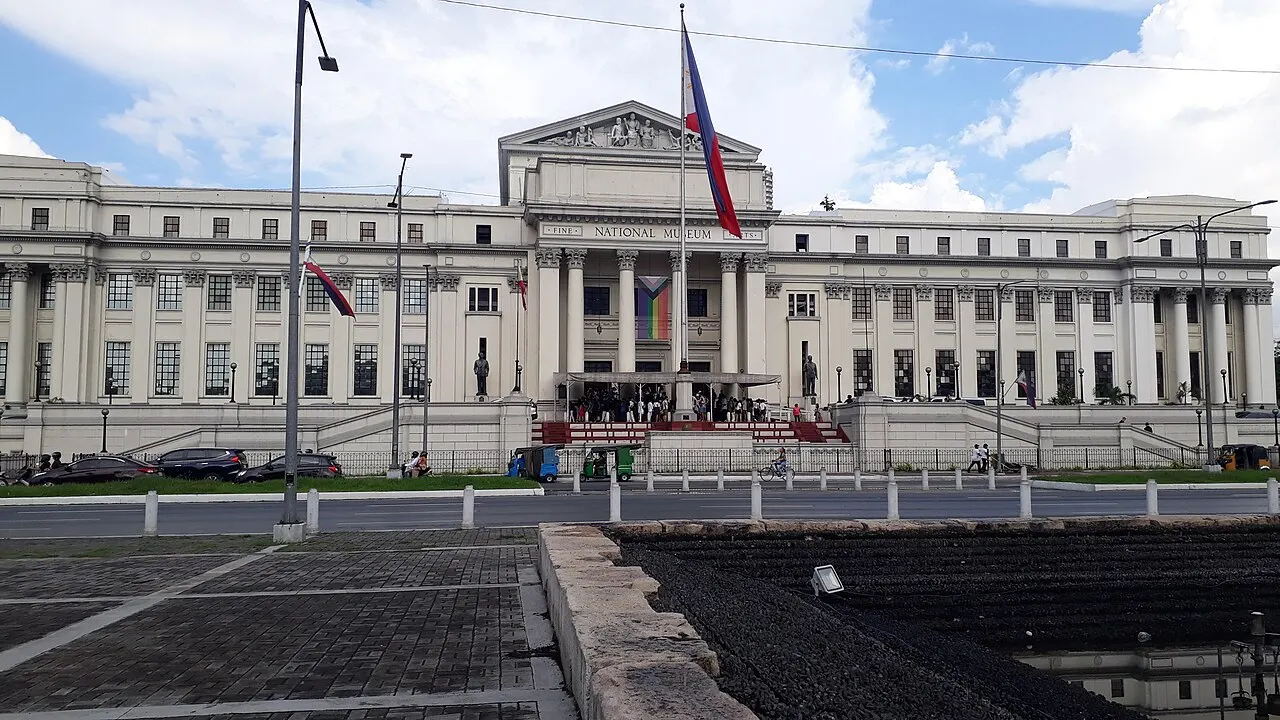
National Museum of Fine Arts
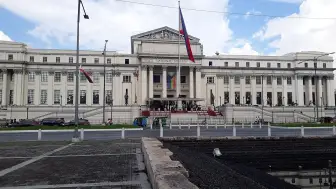
In the former Legislative Building, by Juan Arellano (1926). It holds Juan Luna's “Spoliarium”, a 4 by 7.6 meter canvas awarded a prize in Madrid in 1884. Admission to the whole National Museum complex has been free since 2016; the neighboring Anthropology and Natural History museums complete the ensemble.
Almost no one knows it's free, which is why it stays empty in a crowded city. Three hours for the whole complex, or one for the Fine Arts building alone.
Check access

Casa Manila
A reconstruction of a 19th-century townhouse on Plaza San Luis, opened in 1981. It shows how people lived in a two-story house with capiz-shell windows, a charcoal kitchen, and a side-by-side double latrine.
It's a reconstruction opened in 1981, not a surviving house, but it's the only way to see what it was like to live in a mansion with capiz-shell windows, a charcoal kitchen, and a double latrine, and it sits across the courtyard from where you have lunch, at Plaza San Luis.
Check access

Rizal Park (Luneta)
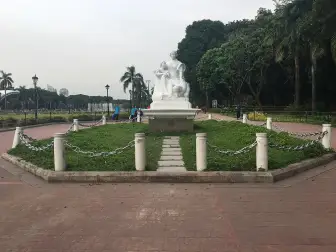
58 hectares between Intramuros and the bay, on the former Bagumbayan field. Richard Kissling's monument, unveiled on December 30, 1913, holds Rizal's remains; a group of bronze sculptures marks the exact spot of the execution, and it is where the country's road distances are measured from.
The park where Rizal was shot and is buried is worth it in the late afternoon, when the heat lets up and the sun sets over the bay. One hour is enough, counting the walk.
Check access
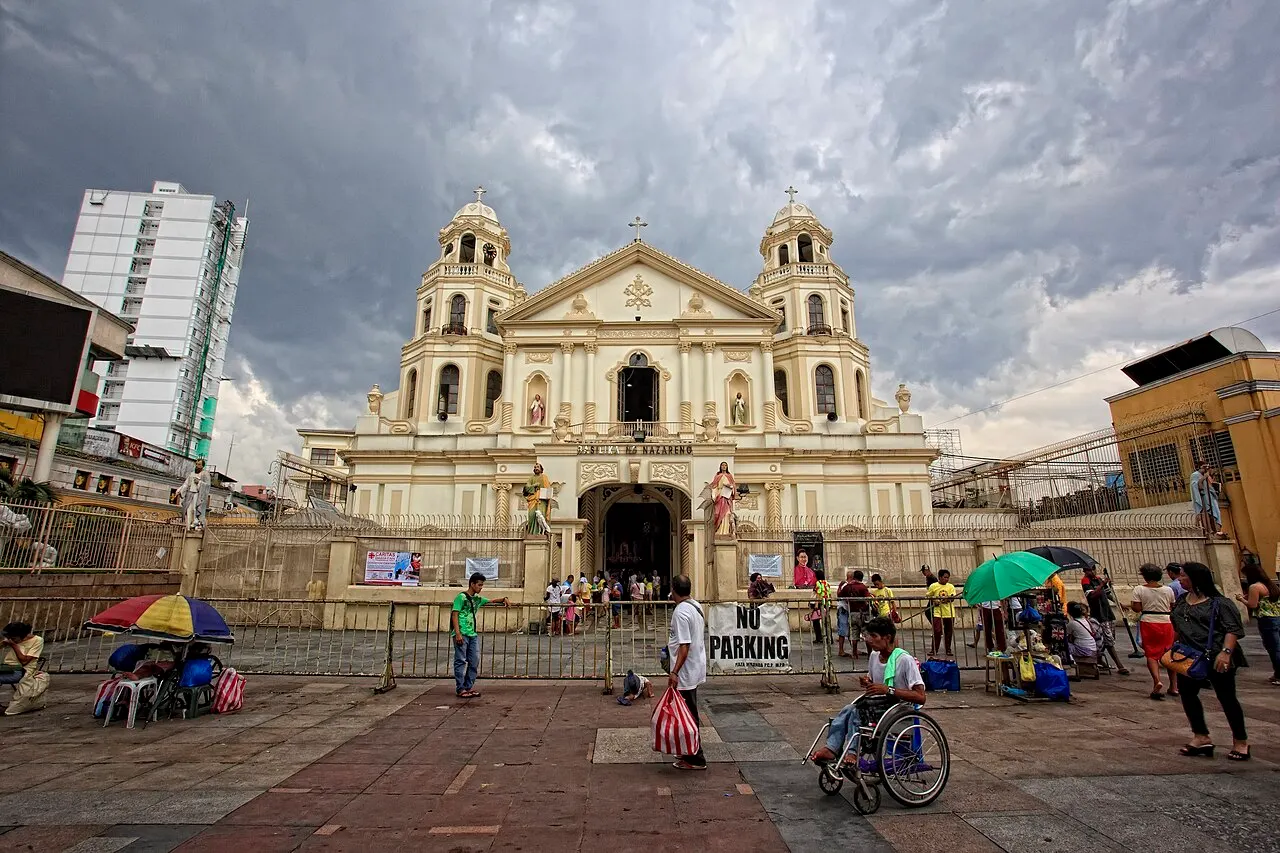
Basilica of the Black Nazarene (Quiapo)
Holds the dark image of Christ brought from Mexico in 1606, a survivor of fires and earthquakes. In the Traslación procession, on January 9, millions of barefoot devotees follow the carriage for 15 to 20 hours to Quiapo.
On January 9, at the Traslación, millions of barefoot people pull the carriage through Quiapo for 15 to 20 hours, with downtown streets closed and cell signal cut back: that day, watch from a distance or stay out of the area.
Check access
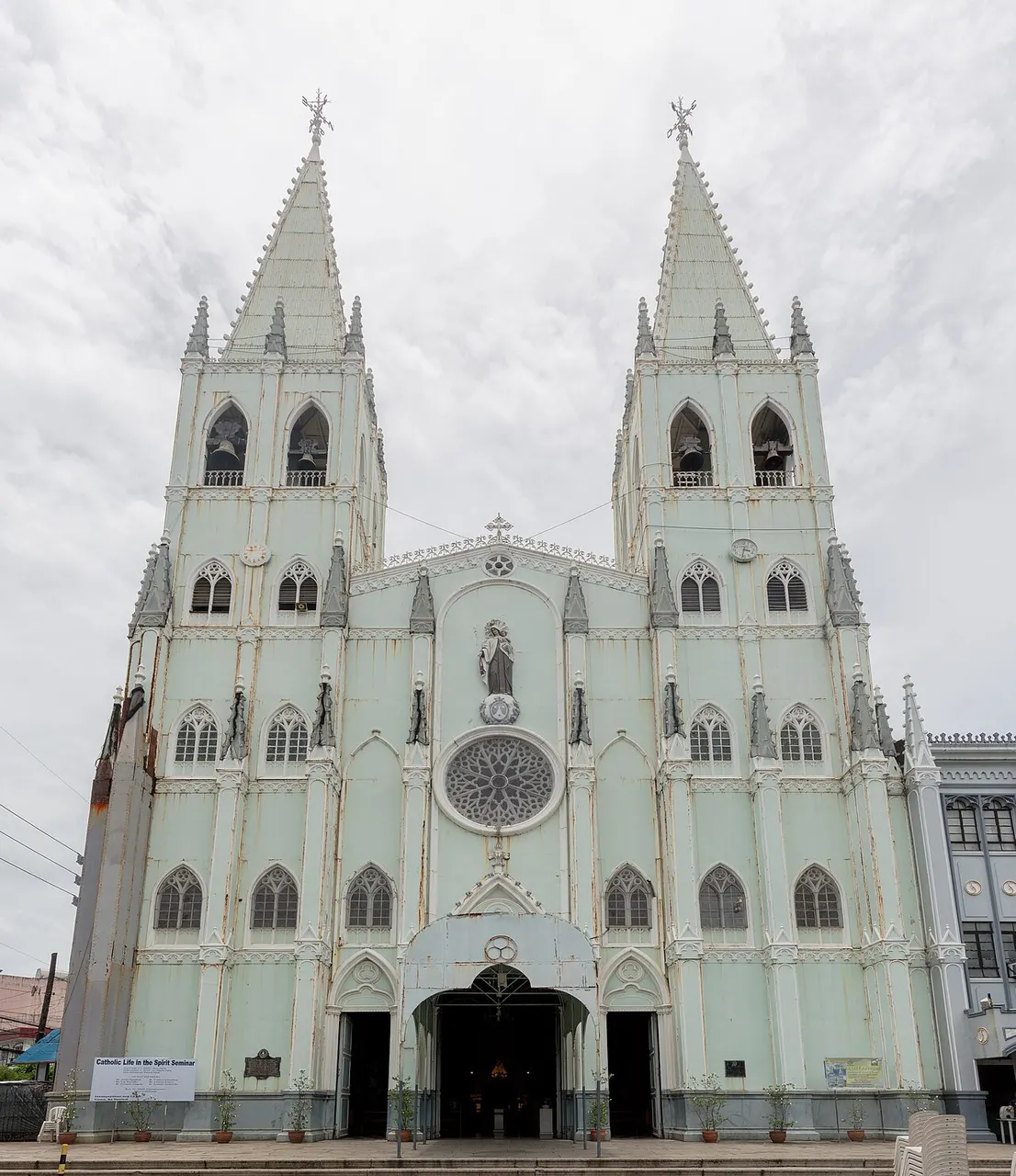
San Sebastián Church
Consecrated in 1891, it is the only all-steel church in Asia: the neo-Gothic pieces were cast in Belgium and assembled in Manila by Genaro Palacios. It has been under restoration for years because of corrosion; check whether the interior is open before going.
Check whether the interior is open before crossing town: the restoration work has already been going on for years. From outside, fifteen minutes does it.
Check access

Manila Cathedral
The Minor Basilica of the Immaculate Conception. The current building, from 1958, is the eighth on the same site since 1581: the earlier ones fell to fire, typhoon, earthquake, and war. The Dutch Kleuker organ has about 4,500 pipes.
Eight buildings on the same site since 1581, and the current one dates from 1958. Twenty minutes: the interest lies in the history of the rebuilds, more than in the architecture of the current building.
Check access

Escolta and the Central Post Office
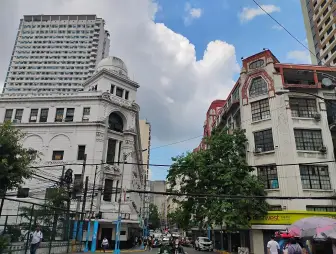
Escolta street holds the country's largest concentration of art deco (First United (1928), Calvo (1938), Regina (1934)) with studios and fairs inside the buildings. Next door, the 1926 Central Post Office burned in May 2023 and is under restoration; the new Pasig esplanade runs at its feet.
The 1926 Central Post Office burned in May 2023 and is still under restoration, and Escolta amounts to a single block: First United (1928), Calvo (1938), and Regina (1934), with studios and markets inside the buildings. It's worth it as a stop on the way to Quiapo, not as a trip of its own.
Check access
Nilo’s itinerary
Start with the basic programme and choose extensions for the time you have.
Plan my days in the app ↗Day 1 · Intramuros, Rizal, and the bay
Enter Fort Santiago at 8am, before the heat: Rizal's cell, the museum, and the bronze footprints to the gate take about 90 minutes.
Walk 600 meters to the church of San Agustín (1607) and the convent museum; continue to Manila Cathedral, five minutes further on.
Have lunch at Plaza San Luis and visit Casa Manila, across the courtyard, to see how people lived in the 19th century.
Cross over to Rizal Park and go into the National Museum of Fine Arts, free admission, for Juan Luna's “Spoliarium”.
End with a walk along Roxas Boulevard, facing the bay.


If you stay longer
Day 2 · The river, Binondo, and Quiapo
Start at 8am with a Chinese-Filipino breakfast on Ongpin street: lumpia, fried siopao, and thick hot chocolate; stop at Eng Bee Tin for hopia.
See Binondo Church, a parish founded in 1596 whose granite church, with its octagonal bell tower, was completed in 1852, and walk to Escolta past the First United, Calvo, and Regina buildings.
Walk the Pasig River esplanade, opened in stages since January 2024, from the Central Post Office under restoration to Arroceros Forest Park.
Cross into Quiapo: the Basilica of the Black Nazarene, the candle-and-herb market in the churchyard, and the stalls under Quezon Bridge.
End the day at the all-steel church of San Sebastián, ten minutes away by car, and have sisig with San Miguel for dinner in Malate.

Food
 AI illustration
Adobo
Pork or chicken cooked in vinegar, garlic, black pepper, and bay leaf, with soy sauce added after the Chinese arrived. The base is the vinegar, which preserved the meat before refrigeration; every family defends its own ratio.
 AI illustration
Sinigang
A sour broth of green tamarind (sampalok), guava, or kamias, with pork belly or shrimp and vegetables. It's the rainy-day dish and the only soup eaten with rice on the side, not before.
 AI illustration
Sisig
Chopped pig head and ear, grilled and served sizzling on an iron plate with calamansi, onion, and chili. It came from Pampanga in the 1970s and became the standard beer companion in Manila; ₱200–350.
 AI illustration
Lechon
A whole pig roasted on a spit for hours, with crackling skin. It's sold by the kilo, and the street of roasters is Quezon Avenue in the La Loma district of Quezon City; it turns up at any family celebration.
 AI illustration
Binondo food
Pancit canton and bihon, lumpia, fried siopao, kikiam, and dumplings on Ongpin and Benavidez streets. The old shops are the benchmark: Eng Bee Tin has made hopia since 1912 and Sincerity has served fried chicken since 1956; ₱120–300 a plate.
 AI illustration
Taho
Warm silken tofu with brown sugar syrup (arnibal) and sago pearls, served in a cup by the street vendor who passes by calling out early in the morning. ₱20–40; runs out before ten.
 AI illustration
Halo-halo
Shaved ice with sweet beans, jackfruit, purple sweet potato (ube), custard and evaporated milk. The name means “mix-mix” and it's a literal instruction: stir everything before the first spoonful. ₱120 to 250.
 AI illustration
Silog and balut
Filipino breakfast is synonymous with garlic fried rice, a fried egg and a meat (tapsilog, longsilog, tosilog), ₱100 to 180 on any corner. At night comes balut, a fertilized duck egg 16 to 18 days along, eaten with salt and vinegar for ₱25 to 35.
Day trips

Tagaytay and Taal Volcano
60 km south, 1 hour 30 minutes to 3 hours by car depending on traffic. The Tagaytay ridge sits at about 600 m elevation and looks down on the lake and Taal Island, which erupted in January 2020; whether you can climb the island depends on Phivolcs' alert level, so check before you go.

Corregidor Island
48 km at the mouth of Manila Bay, about 1 hour 15 minutes by ferry from the terminal on the boulevard. American gun batteries, the Malinta Tunnel, and the ruins of the barracks tell the story of the 1942 fall and the 1945 retaking; ferry service varies, so confirm the day before.

Antipolo and the Pinto Museum
30 km east, 1 hour to 1 hour 30 minutes via the LRT-2 to Antipolo station plus a jeepney or tricycle. The pilgrimage cathedral sits atop the ridge, and the Pinto Museum gathers contemporary Filipino art in white pavilions with gardens and a view of the metro.
Where to begin
Intramuros, Rizal, and the bay
Enter Fort Santiago at 8am, before the heat: Rizal's cell, the museum, and the bronze footprints to the gate take about 90 minutes.
The river, Binondo, and Quiapo
Start at 8am with a Chinese-Filipino breakfast on Ongpin street: lumpia, fried siopao, and thick hot chocolate; stop at Eng Bee Tin for hopia.
Money
The currency is the Philippine peso (PHP, ₱), at about 57–59 to the dollar in 2026. ATMs charge their own fee of ₱250 per withdrawal, often with a limit of ₱10,000 to ₱20,000 per transaction, and since the fee is per visit rather than per amount, withdrawing larger sums fewer times works out cheaper. Cards are accepted in malls, hotels and chains; in the informal economy, such as street transport and home-style food, it's cash only. Locals pay for almost everything by QR code in the GCash and Maya apps, which require a local number and so don't work for people passing through. Price ranges: coffee at a chain café ₱130–200; a meal at a carinderia ₱80–150; a dish at an ordinary restaurant ₱250–450; a full dinner in Makati or BGC ₱700–1,500; a bottle of San Miguel ₱70–130; a 5 km Grab ride ₱200–400; a midrange hotel ₱2,500–5,000 a night. Restaurants usually add a 10% service charge, which by law since 2023 goes in full to the staff, and in that case rounding up or leaving ₱20–50 is enough; with no charge on the bill, 10% is customary. A 2024 law (RA 12079) guarantees VAT refunds to tourists on purchases above ₱3,000 per accredited store, but as of September 2026 the government still hadn't chosen the refund operator, so don't count on it during your trip.
Getting there and around
NAIA Airport: 7 km from downtown, but split across four terminals
Ninoy Aquino International Airport (NAIA) sits about 7 km south of central Manila. There are four separate terminals: check which one you land at and which one you leave from, because transferring between terminals takes 20 to 60 minutes. Since September 2024 the airport has been run by a private consortium and is undergoing renovation in stages. There are P2P buses to Makati and to the Mall of Asia area. The LRT-1 extension to Dr. Santos, opened in November 2024, created the MIA station about 2 km from the terminals, but there's still no direct rail link to the airport.
Rail: the LRT-1, LRT-2 and MRT-3
The rail network has three lines: the LRT-1 (elevated, from Fernando Poe Jr. to Dr. Santos, passing through Rizal Park, Binondo and Malate), the LRT-2 (east-west, from Recto to Antipolo) and the MRT-3 (along EDSA, from North Avenue to Taft). A rechargeable card gives access to all three lines and several buses. Since March 23, 2026, the MRT-3 and LRT-2 operate with a 50% discount (a minimum of ₱6 and end-to-end ₱14 on the MRT-3; ₱8 and ₱18 on the LRT-2), while the LRT-1 stays between ₱15 and ₱30. The discount holds “until further notice”, according to the government, but confirm the day before. The PNR commuter train has been suspended since March 2024 because of the north-south railway works, and the Metro Manila underground subway isn't expected to open its first stretch before the end of this decade. On the street, the jeepney charges ₱14 on the traditional model and ₱17 on the modern air-conditioned one: pass the money forward saying “bayad po” and say “para po” to get off. Every bill travels forward hand to hand until it reaches the driver, and the change comes back the same way, with no one checking it. Tricycles handle the last 500 meters. Walking works well in Intramuros and Bonifacio Global City and poorly almost everywhere else, because the sidewalk disappears without warning; a bicycle is only for someone who already knows the traffic.
Safety
The risks here are crimes of opportunity, almost never violence aimed at foreigners. What actually happens is phone and bag theft in crowds (Divisoria, Quiapo, Baclaran, Recto Avenue, the lines at LRT stations) and quick phone snatching by two people on a motorbike on empty streets at night. Keep your phone in your front pocket, don't use it standing still on the sidewalk, and wear your backpack on your front in the stations; make these habits automatic from day one. The known scams have names, which already helps you spot them: the “budol-budol,” where a stranger poses as a friend of a relative and walks the victim to an ATM; food or drink laced with a sedative, offered by strangers on intercity buses; taxis that agree on a flat fare and then charge triple; and, in some bars in Ermita and Malate, bills padded with fees that only appear at the end. Agree on the price before you sit down. Tondo, parts of Santa Cruz and the north banks of the Pasig are best visited by day and, ideally, with someone who knows the area. In practice, though, the biggest disruption is the weather: between June and November, rain can flood streets within an hour and bring traffic to a complete standstill, so keep an eye on PAGASA's alerts. National emergency number: 911.
Etiquette tips
End your sentences with “po”
Adding “po” when speaking to someone older or to whoever is serving you is the basic mark of respect, and “opo” is the respectful “yes”. It works even inside an English sentence: “thank you po” is normal and well received.
Pay the jeepney by passing it forward
You hand the fare to the passenger next to you saying “bayad po” and it travels hand to hand to the driver; the change comes back the same way. To get off, say “para po” or tap a coin on the metal handrail.
Don't point with your finger
To point out a direction, point with your lips, your chin or your whole hand. To call a waiter, stretch out your arm with the palm down and curl your fingers in, because snapping your fingers is offensive.
Avoid scolding in public
The notion of “hiya” turns a loud reprimand into a serious embarrassment for the one receiving it and for anyone watching. Complain quietly, smiling and in private: it resolves things faster than raising your voice.
Accept a food invitation gracefully
“Kain tayo” (“let's eat”) is said as a greeting whenever someone is eating. Declining is fine, but do it gently, thanking them twice; if you accept, eat a little even if you're not hungry.
Take off your shoes and respect the church
In a family home, shoes stay at the door. In church, shoulders and knees covered, phone on silent and no crossing the nave during mass, and, on January 9, don't stand in the way of the Quiapo procession.
Mistakes to avoid
Intramuros to Makati, eight kilometers
Underestimating traffic. The eight kilometers between Intramuros and Makati can take 30 minutes at 7am and 100 minutes at 6pm, so plan two activities a day, not five, and take the train when your route runs parallel to EDSA or Taft Avenue.
Treating Metro Manila as a single city
Picking a hotel assuming “Manila” is a single city. Manila, where Intramuros is, Makati, Taguig, where Bonifacio Global City is, Quezon City, and Pasay are different cities within Metro Manila, separated by 8 to 20 km. A hotel in the wrong city costs two hours of traffic a day, every day of the trip.
Boarding the LRT with a large suitcase
Boarding the LRT or MRT with a large suitcase. Bags are checked at the entrance and bulky luggage is turned away; the first car is reserved for women, children, and the elderly, and the rule is enforced: anyone who steps in by mistake is politely sent back.
Taxi with a “fixed price” or no meter
Accepting a taxi with a “fixed price” or no meter, especially at the airport exit and in front of malls. Ask for the meter, call a Grab or get in the official taxi line; the difference reaches three times the price.
Intramuros on a Monday and tap water
Scheduling Intramuros for a Monday and drinking tap water. Several museums close on Mondays, and the water you drink is always bottled or purified, including for brushing your teeth, if your stomach is sensitive.
Useful phrases
Magandang umaga po
Good morning, respectfully (ma-gan-dáng u-má-ga pô)
Salamat po
Thank you (sa-lá-mat pô)
Magkano po?
How much does it cost? (mag-cá-no pô)
Bayad po
Here's the fare: said when passing the money forward in the jeepney (bah-yahd poh)
Para po!
Can you stop, please: to get off the jeepney (pah-rah poh)
Saan po ang CR?
Where's the bathroom? CR is “comfort room” (sah-ahn poh ang see-ar)
Districts
Intramuros
The 64 walled hectares of the Spanish city, rebuilt after 1945 and administered by its own agency since 1979. It concentrates churches, museums and downtown's most walkable sidewalks; it empties out after 7pm.
Binondo
Chinatown, founded in 1594, the oldest one in the world still operating. Ongpin and Yuchengco streets are packed with gold shops, traditional pharmacies, hopia bakeries, and restaurants serving from 6am to midnight.
Quiapo
Around the Basilica of the Black Nazarene: an herb-and-candle market in the churchyard, secondhand cameras and watch parts under Quezon Bridge, and the Muslim quarter around the Golden Mosque a few blocks away. No spot in the city packs in more people per square meter.
Ermita and Malate
The strip between Rizal Park and the bay, holding most of the hotels, embassies, and hostels. Malate has Remedios Circle and Adriatico Street, with old bars and restaurants; the area varies block by block.
Escolta and Santa Cruz
The north bank of the Pasig, where the art deco commerce of the 1920s and 1930s stood: the First United, Calvo and Regina buildings. Today it holds studios, design shops and weekend fairs inside the First United Building.
Sampaloc
The university district, along España Boulevard: the University of Santo Tomás (founded in 1611), UE, FEU. Cheap boarding houses, photocopy shops, all-night diners, and guaranteed flooding on days of heavy rain.
Makati
The neighboring city and the country's financial center since the 1960s: Ayala Avenue, the residential districts of Salcedo and Legazpi, the Ayala Museum, and the Saturday and Sunday markets. Poblacion, the old quarter, holds the nightlife.
Bonifacio Global City
A planned district built over the former Fort Bonifacio military base, in Taguig, opened from the late 1990s on. Wide sidewalks, murals, corporate towers, and prices 30% to 50% above the rest of the metro.
History
before 1571 · Maynila and Tondo
At the mouth of the Pasig, two rival centers operate: Maynila, Muslim and linked to Borneo, under Rajah Sulayman, and Tondo, under Lakandula. Both tax the porcelain and silk trade arriving from China.
1571 · Legazpi founds the Spanish city
On June 24, Miguel López de Legazpi proclaims the burned settlement of Maynila the Spanish capital. Starting in 1590, governor Gómez Pérez Dasmariñas replaces the wooden palisade with stone walls: Intramuros is born, 64 walled hectares.
1565–1815 · The Manila galleon
For 250 years the galleons cross the Pacific between Manila and Acapulco, carrying silk, ivory, and porcelain and bringing back Mexican silver. The last voyage departs in 1815, and the city's economy takes decades to reorganize.
1594 · Binondo, the oldest Chinatown
Luis Pérez Dasmariñas grants the land across the river to Chinese converts to Catholicism. It is the oldest Chinatown in the world still in operation, and it remains in the same place.
1645 and 1863 · The two great earthquakes
The earthquake of November 30, 1645, knocks down much of Intramuros. The one of June 3, 1863, destroys the cathedral and the governor's palace, which moves “temporarily” to Malacañang, where the government remains today.
1762–1764 · The British occupation
British troops seize Manila in October 1762, during the Seven Years' War, and loot archives and churches. They return the city in 1764, after the Treaty of Paris.
1896 · Rizal shot at Bagumbayan
On December 30, José Rizal is executed at Bagumbayan field, today Rizal Park, because of the novels he had written. The revolution against Spain had begun in August.
1898 · The bay changes empires
On May 1, George Dewey's squadron destroys the Spanish fleet in Manila Bay. On August 13, Spaniards and Americans stage a mock battle to shut out the Filipinos, and on December 10 the Treaty of Paris transfers the archipelago to the US for 20 million dollars.
1905–1941 · The Burnham plan
Daniel Burnham designs radial avenues in 1905, a civic axis between the bay and Intramuros, and a bayside promenade. Juan Arellano builds the Legislative Building (1926), the Central Post Office (1926), and the Metropolitan Theater (1931).

1945 · The Battle of Manila
Between February 3 and March 3 the city is taken street by street and about 100,000 civilians die. Manila is the most devastated Allied capital after Warsaw; of Intramuros, only the church of San Agustín is left standing.
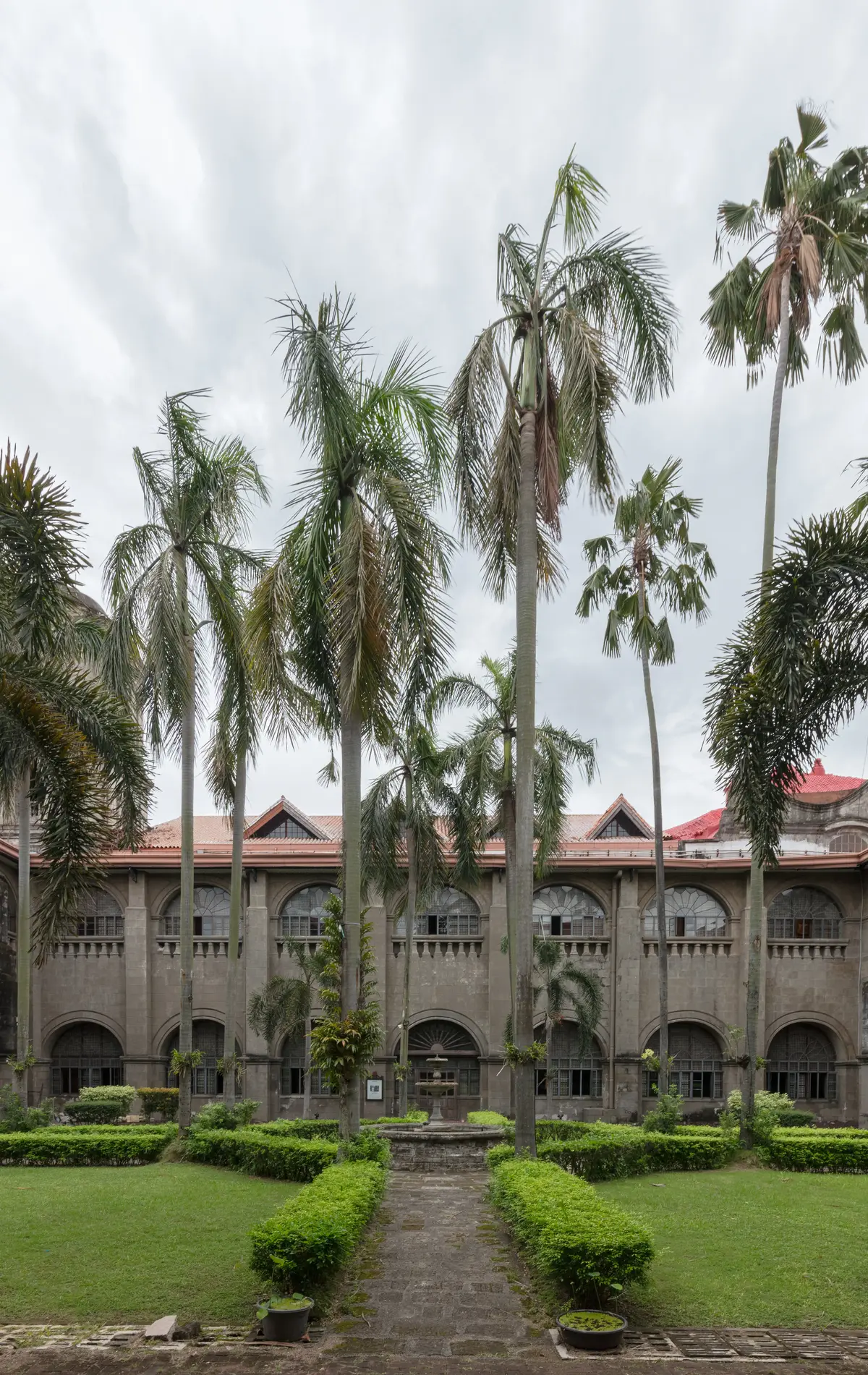
1948–today · The capital leaves, returns, and rebuilds itself
The capital is moved to Quezon City in 1948 and returned to Manila by decree 940, in 1976; Metro Manila is created on November 7, 1975. The rehabilitation of the Pasig River wins the Asia Riverprize in 2018, and since 2024, riverside esplanades have linked Intramuros to Escolta and to Arroceros Park.
 AI illustration
Complete history
A customs post before the Spanish: the mouth of the Pasig
Before any Spaniard, the mouth of the Pasig was already a customs post. Maynila (the name probably comes from “may nilad”, the shrub that grew on the bank) was a Muslim settlement ruled by rajah Sulayman, an ally of the Sultanate of Brunei, and it charged tolls on the traffic of Chinese junks going up the river toward Laguna de Bay. Across the water, Tondo did the same under Lakandula. In 1570 Martín de Goiti arrived with an expedition from Cebu; the following year Legazpi came back, found the settlement burned by its own inhabitants and, on June 24, 1571, declared the Spanish capital there. The site had the best natural harbor in the archipelago, with a navigable river behind it.
Two and a half centuries on a single route
What sustained Manila for two and a half centuries was a single route. Starting in 1565, when Andrés de Urdaneta discovered the return current across the north Pacific, galleons left Cavite loaded with silk, porcelain and ivory bought from Chinese merchants in Binondo and came back from Acapulco with silver from Mexico. The city became a trading post where the money was Mexican, the merchandise Chinese and the government Spanish, and where the Chinese population, the sangley, was at once indispensable and periodically massacred, as in 1603 and 1639. Inside the walls lived Spaniards and clergy; outside them grew the arrabales (Binondo, Quiapo, Santa Cruz, Sampaloc, Tondo, Malate) that remain to this day the neighborhoods with the most street life. The route ended in 1815, and the opening of the port to international trade in 1834, added to that of the Suez Canal in 1869, threw the city into the world economy and brought back the children of the elites who had been studying in Europe.
Rizal: the books that led to Bagumbayan, in 1896
Among the sons of the Filipino elite who studied in Europe was José Rizal, a doctor and novelist whose books “Noli Me Tángere” (1887) and “El filibusterismo” (1891) described the colonial system in enough detail to make it dangerous. Rizal was executed by firing squad on the Bagumbayan field on December 30, 1896, four months after the revolution began. The independence proclaimed in 1898 was short-lived: the American squadron sank the Spanish fleet in the bay on May 1, the Spanish and Americans staged a sham battle on August 13 to hand over the city without the Filipino revolutionaries, and the Treaty of Paris sold the archipelago to the United States. What followed was the Philippine-American War, from 1899 to 1902, and four decades of US administration, which reorganized Manila according to Daniel Burnham's 1905 plan, put up the neoclassical buildings of the civic axis and introduced public education in English, which is why English circulates all over the city today.
The Battle of Manila and reconstruction, 1945 to 1976
The Battle of Manila, in February 1945, destroyed almost all of the Spanish and American city. Declared an open city by the Americans in 1941 and occupied by Japan in January 1942, Manila was retaken in a month of urban combat, between February 3 and March 3, 1945, with American artillery bombardment and massacres committed by cornered Japanese troops. About 100,000 civilians died. Intramuros was destroyed entirely, except for San Agustín Church, and the Metropolitan Theater, the Post Office and the Legislative Building were left in ruins. Postwar reconstruction was fast, cheap and unplanned: the civic axis turned into traffic, the capital was moved to Quezon City in 1948 and only returned in 1976, and growth went east and south, far from the historic center.
Economic power shifts to Makati, Ortigas, and BGC
After the war, economic power left the historic center: it moved to Makati in the 1960s, to Ortigas in the 1980s, and to Bonifacio Global City from the 1990s onward, business districts that actually sit in other cities of the same metropolis: Ortigas is split between Pasig, Mandaluyong, and Quezon City, and BGC is in Taguig. The city of Manila kept the port, the history, the universities of España Boulevard, and the highest density in the country. The Marcos decades (1965–1986) left the Cultural Center of the Philippines complex on reclaimed land in the bay and ended with the EDSA revolution, between February 22 and 25, 1986. Since 2019 the visible agenda is different: reclaiming the Pasig River, restoring the Central Post Office, gutted by fire in May 2023, reviewing the bay reclamation projects, suspended in 2023, and finishing Metro Manila's underground subway, whose first phase is promised for the end of this decade. The Pasig esplanades opened in stages starting in January 2024, and the latest one links the Central Post Office to Arroceros Forest Park. What gets called “Manila” at the airport is a metropolis of 16 cities and one municipality, Pateros, and the city of Manila is just one of those 16.
Manila was leveled in 1945, and almost everything seen in Intramuros was rebuilt afterward.
Geography and shape of the city
The river mouth, the landfill, and the tide
Manila covers 42.9 km² on the east shore of Manila Bay, at the mouth of the Pasig River, which flows 25 km from Laguna de Bay and cuts the city in two. Almost all of it lies less than 10 m above sea level, and the port strip, Roxas Boulevard and the Cultural Center complex sit on 20th-century landfill, which is why high tide combined with monsoon rain can flood whole streets within an hour.
The river and Manila's three layouts
The river separates the commercial, Chinese north (Binondo, San Nicolas, Santa Cruz, Quiapo, Tondo, Sampaloc, San Miguel) from the institutional, touristic south (Intramuros, Ermita, Malate, Paco, Pandacan, Santa Ana, Port Area). Three layouts overlap: the Spanish grid inside the walls of Intramuros, the organic mesh of the arrabales that grew outside them, and Daniel Burnham's 1905 radial plan, of which the civic axis of Rizal Park and the bay-side promenade remain.
The other scale, the fault, and the monsoon
Metro Manila is a different scale altogether: 16 cities, Manila among them, and one municipality, Pateros, across about 620 km², stitched together by EDSA, a 23.8 km arc that concentrates traffic and the MRT-3 line. To the east, under Marikina and Taguig, runs the West Valley Fault, the earthquake scenario the region has been drilling for since 2015. The climate is tropical monsoon: hot year-round, with a dry season from December to May and a rainy, typhoon season from June to November.
Almost everything here sits less than ten meters above sea level.
Culture
Karaoke, OPM and basketball
In Manila, people sing loudly and in public. Karaoke is household equipment, not just a bar fixture: rental machines show up on sidewalks, at birthdays, and at wakes, and the song list is the night's social script. The country produced its own pop tradition, OPM, with names that span generations (Eraserheads, APO Hiking Society, Rivermaya, Ben&Ben), and churches and malls keep choirs and bands permanently active. The other national sport is basketball: the PBA, the professional league founded in 1975, plays at the Araneta Coliseum in Quezon City and at the MOA Arena in Pasay, but the real game happens on makeshift courts between houses, with a backboard nailed to a post.
Film, literature and art: from Brocka to Nick Joaquin
Manila's cultural life runs through film, literature and the visual arts. “Maynila: Sa mga Kuko ng Liwanag” (1975), by Lino Brocka, the film the city claims as its own, follows a fisherman who arrives from the provinces and gets lost in the streets of Santa Cruz; “Manila by Night,” by Ishmael Bernal (1980), moves through the small hours of Malate and was censored by the Marcos government. Then came Lav Diaz, with films of four to nine hours, and Brillante Mendoza. In literature, Nick Joaquin wrote the Intramuros that existed before its destruction, and F. Sionil José built the Rosales saga over five novels; Solidaridad, the bookstore he opened on Padre Faura Street in 1965, is still open. The visual arts gather at Art Fair Philippines, in February, in Makati, and in the studios set up in the art deco buildings of Escolta.
The calendar is Catholic
About 80% of the country is Catholic, and that organizes the calendar: packed Sunday mass, processions that close avenues, four-in-the-morning novenas in December and a Holy Week when the metropolis empties out. At the same time, the real public space is the air-conditioned mall. The SM Mall of Asia, opened in 2006 on the bay, is one of the largest in the world and works as plaza, cinema, skating rink and meeting point, from 10am to 10pm. The Cultural Center of the Philippines complex, designed by Leandro Locsin in 1969 on landfill, had its main theater closed for structural reinforcement in January 2023, and the programming was spread across other venues in the metropolis.
In Manila, karaoke is household equipment: it shows up on sidewalks, at birthdays, and at wakes.
Festivals and events

Traslación of the Black Nazarene
January 9. Millions of barefoot devotees, most wearing brown shirts, pull the carriage through Quiapo for 15 to 20 hours. Downtown streets close, cell signal drops, and transport is disrupted all day; watch from a distance or stay out of the area.
 AI illustration
Feast of the Santo Niño de Tondo
Third Sunday of January. A river and land procession with the image of the Child Jesus, street dances, and the Lakbayaw. It's the city's biggest neighborhood feast and fills Tondo from the night before.

Chinese New Year in Binondo
The date follows the lunar calendar and falls between late January and mid-February; in 2027, it's on February 6. Dragon and lion dances through Ongpin and Yuchengco streets, fireworks, tikoy sold on every corner, and restaurants with lines since morning.

Holy Week
March or April. On Maundy Thursday comes the Visita Iglesia, seven churches visited on foot or by car, several of them in Intramuros and Binondo. From Thursday to Sunday most businesses close and the city has its emptiest traffic of the year.

Simbang Gabi and Manila Day
The dawn Masses run from December 16 to 24, with bibingka and puto bumbong sold outside afterward, still in the dark. On June 24, the anniversary of the 1571 founding, Manila Day is a local holiday, with Mass at the cathedral and a program in Intramuros.
Books and films
“Maynila: sa mga kuko ng liwanag”, by Lino Brocka (1975)
A fisherman fresh from the countryside looks for his girlfriend and ends up lost in the alleys of Santa Cruz and Avenida. It's the harshest and most accurate portrait of migration to Manila; restored in 2013.
“Noli me tángere”, by José Rizal (1887)
The novel that portrays colonial Manila and the web of power among friars, officials, and local families. Published in Berlin, it cost the author his execution in 1896 at the field that is now Rizal Park.
“A Portrait of the Artist as Filipino”, by Nick Joaquin (1952)
A play set in a house in Intramuros in October 1941, a few months before the district ceased to exist. It explains the city that the 1945 battle erased and the mourning that replaced it.
Frequently asked questions
Manila: are the airport terminals in the same building?
There are four terminals, separate from each other: check which one you land at and which one you depart from, because transferring between terminals takes 20 to 60 minutes.
Manila: what's the climate like at different times of year?
No season is cold, and the jacket usually stays in the suitcase. From December to February the northeast monsoon (amihan) blows, with 24 to 31°C, lower humidity, and little rain, and it's the best window; from March to May comes the dry heat, with 33 to 37°C at midday. From June to November the southwest monsoon (habagat) and the typhoons arrive, peaking from July to October, and August is the wettest month.
Manila: how do you show respect when speaking to someone?
Adding “po” when speaking to someone older or to whoever is serving you is the basic mark of respect, and “opo” is the respectful “yes.”
Manila: is it dangerous for tourists?
The risks here are opportunistic, almost never violence aimed at foreigners.
Manila: what is adobo?
Pork or chicken cooked in vinegar, garlic, black pepper, and bay leaf, with soy sauce added after the Chinese arrived.