Chile
Easter Island
The Rano Raraku quarry, the fifteen moai of Ahu Tongariki and the Rano Kau crater in the middle of the Pacific
Days Start with the basic programme and choose extensions for the time you have.
How the guide reaches this number
On the first day, after landing at Mataveri, I'd walk the Hanga Roa waterfront, from Hanga Piko to Tahai, to watch the sunset. I'd devote the second and third days in full to covering the National Park with an accredited local guide: one day for the sunrise at Ahu Tongariki, the Rano Raraku quarry, Ahu Te Pito Kura and a swim at Anakena; the other for Ahu Vinapu, the Rano Kau crater, the village of Orongo, Puna Pau and Ahu Akivi. On the fourth day, I'd climb to the summit of Maunga Terevaka in the morning, with a guide if the park requires one, and keep the afternoon for the church of Hanga Roa, a dive from Caleta Hanga Roa Otai or an easy return to Anakena. Anyone who can stay five days gains a valuable cushion against showers and wind.
4
When October to April; October, November, March and April have mild temperatures between 22 °C and 25 °C and fewer crowds at the sites, while February brings the Tapati Rapa Nui festival and from May to August there are more showers and wind.
How the guide reaches this number
Rapa Nui can be visited all year thanks to its subtropical maritime climate with no harsh winter, but the best time runs from October to April. October, November, March and April combine pleasant temperatures between 22 °C and 25 °C, water already inviting for swimming at Anakena and for diving in the coves, good light for photographing the moai, and flight and lodging prices lower than at the summer peak. December to February is high season, with highs near 27 °C and a focus on the first half of February, when the Tapati Rapa Nui takes place: it is the liveliest time for local culture, but you must book flights and guesthouses many months ahead. From May to August (austral winter), highs are around 20 °C and lows near 14 °C, but the south wind gains strength and May usually records the largest monthly rainfall; even so, the showers are brief and the archaeological sites are almost empty.
Per person/day Budget around CLP39,700; mid-range around CLP93,600; comfortable around CLP197,000 per person per day, based on spending reported by travelers to Budget Your Trip (checked October 2026).
How the guide reaches this number
Indicative figures, excluding travel to the destination.
Budget around CLP39,700; mid-range around CLP93,600; comfortable around CLP197,000 per person per day, based on spending reported by travelers to Budget Your Trip (checked October 2026). Indicative figures, excluding travel to the destination.
Per person per day: accommodation, meals, urban transport, visits and a small allowance for extras. Flights excluded; larger purchases vary. Editorial estimate, not a quote.
 What Nilo thinks
I'd set aside four days for Easter Island, counting the day of arrival: it is the minimum to make up for the more than five hours of flying from Santiago without rushing through the sites or missing the sunrise if it rains one morning. On the first day, after landing at Mataveri, I'd walk the Hanga Roa waterfront, from Hanga Piko to Tahai, to watch the sunset. I'd devote the second and third days in full to covering the National Park with an accredited local guide: one day for the sunrise at Ahu Tongariki, the Rano Raraku quarry, Ahu Te Pito Kura and a swim at Anakena; the other for Ahu Vinapu, the Rano Kau crater, the village of Orongo, Puna Pau and Ahu Akivi. On the fourth day, I'd climb to the summit of Maunga Terevaka in the morning, with a guide if the park requires one, and keep the afternoon for the church of Hanga Roa, a dive from Caleta Hanga Roa Otai or an easy return to Anakena. Anyone who can stay five days gains a valuable cushion against showers and wind.I'd go to Easter Island to see up close the scale of the moai against the size of the ocean around them: stone faces several meters tall on an island of 163.6 km² surrounded by thousands of kilometers of open Pacific. In the crater of Rano Raraku, hundreds of them are still fixed to the rock at different stages of carving, and that is where you understand how an isolated Polynesian society produced almost nine hundred statues. At Ahu Tongariki, fifteen raised moai face the interior with the surf at their backs, and on the cliff of Rano Kau the village of Orongo shows the phase when political contest passed from the statues to the annual Birdman competition.
Read more
A visit is not a solitary walk through abandoned ruins. Rapa Nui culture is alive in the streets of Hanga Roa, in the language spoken by families, in the Polynesian canoes leaving the coves and in the community management of Ma'u Henua, which requires an accredited local guide at the park's sites to protect the sacred platforms.
Quick facts
- Population
- 4,800 inhabitants in the commune of Isla de Pascua, which covers the whole island, according to the 2024 Census of the INE (7,750 in the 2017 census). The INE's demographic projection for 2024, calculated before the census, was 8,872. Almost the entire population lives in Hanga Roa, the only urban settlement.
- Founding
- Polynesian settlement led, in oral tradition, by the ariki Hotu Matu'a (9th–12th centuries AD); first European contact by the Dutchman Jakob Roggeveen on Easter Sunday, April 5, 1722; annexation by Chile on September 9, 1888.
- Country and region
- Chile, Valparaíso Region, province and commune of Isla de Pascua (special territory), in eastern Polynesia, about 3,700 km from the Chilean mainland coast.
- Language
- Chilean Spanish and the Rapa Nui language (vananga rapa nui), of the Eastern Polynesian branch, spoken daily in families and taught in the island's schools.
- Currency
- Chilean peso (CLP); about CLP 964 per dollar on the reference date of September 24, 2026. US dollars in cash are accepted at dive shops, from guides and for the park's international rate.
- Time zone
- Pacific/Easter: UTC-6 in standard winter time and UTC-5 in daylight saving time, from early September to early April (two hours behind Santiago).
- Best time to go
- October to April; October, November, March and April have mild temperatures between 22 °C and 25 °C and fewer crowds at the sites, while February brings the Tapati Rapa Nui festival and from May to August there are more showers and wind.
- Average cost per day
- Budget around CLP39,700; mid-range around CLP93,600; comfortable around CLP197,000 per person per day, based on spending reported by travelers to Budget Your Trip (checked October 2026). Indicative figures, excluding travel to the destination.
When to go
October to April; October, November, March and April have mild temperatures between 22 °C and 25 °C and fewer crowds at the sites, while February brings the Tapati Rapa Nui festival and from May to August there are more showers and wind.
May
18° to 23°C
117 mm of rain
June
17° to 22°C
109 mm of rain
July
16° to 21°C
113 mm of rain
August
16° to 21°C
97 mm of rain
September
16° to 22°C
97 mm of rain
How the year changes
Rapa Nui can be visited all year thanks to its subtropical maritime climate with no harsh winter, but the best time runs from October to April. October, November, March and April combine pleasant temperatures between 22 °C and 25 °C, water already inviting for swimming at Anakena and for diving in the coves, good light for photographing the moai, and flight and lodging prices lower than at the summer peak. December to February is high season, with highs near 27 °C and a focus on the first half of February, when the Tapati Rapa Nui takes place: it is the liveliest time for local culture, but you must book flights and guesthouses many months ahead. From May to August (austral winter), highs are around 20 °C and lows near 14 °C, but the south wind gains strength and May usually records the largest monthly rainfall; even so, the showers are brief and the archaeological sites are almost empty.
The same numbers as a table
| Month | Temperature °C | Rain mm |
|---|---|---|
| January · | 20 to 27 | 81 |
| February · | 21 to 28 | 69 |
| March · | 20 to 27 | 87 |
| April · | 19 to 26 | 123 |
| May | 18 to 23 | 117 |
| June | 17 to 22 | 109 |
| July | 16 to 21 | 113 |
| August | 16 to 21 | 97 |
| September | 16 to 22 | 97 |
| October · | 16 to 23 | 91 |
| November · | 18 to 24 | 75 |
| December · | 19 to 26 | 70 |
Nilo's tips
Sort out the FUI and registered lodging before going to the Santiago airport
For non-residents, the PDI checks at the Santiago airport three requirements of Law 21.070: a round-trip ticket within the 30-day limit, a reservation at a hotel or cabin registered with Sernatur (or an invitation letter from a resident certified by the Provincial Presidential Delegation) and the completed Formulario Único de Ingreso (FUI). I'd check that the guesthouse's name appears on the official Sernatur list before paying for the reservation.
Arrange the accredited guide ahead of time and protect the single entry to Rano Raraku
Because Rapa Nui National Park requires an accredited local guide (or a Rapa Nui host) at the controlled sites and allows only one entry to Rano Raraku and one to Orongo during the 10 days of the ticket, I'd hire a local guide for two full days and agree with them to use the Rano Raraku entry on the morning with the clearest sky.
Use Tahai, Hanga Roa and Anakena beach for the hours without a guide
You do not need a paid guide for every hour of the day: the park's exemptions cover the lawn of Tahai, the village of Hanga Roa with its church and coves, and the strip of sand at Anakena (not the ahu area). I'd save those places for the afternoon of arrival and for the last day, hire the guide for the south coast and Rano Kau days, and ask Ma'u Henua whether the climb up Terevaka, which starts at the controlled site of Ahu Akivi, also requires a guide.
Bring Chilean pesos and cash dollars from Santiago
When the satellite connection wavers in Hanga Roa, card machines and ATMs can be unavailable for hours, and outside the village there is no cell signal. I'd bring from the mainland enough cash to pay the guide, the kiosks at Anakena beach and any surprises.
Explore the map
Explore the map, read about the other places and plan your travel days in the app.
Open the appWhat to see
Rano Raraku
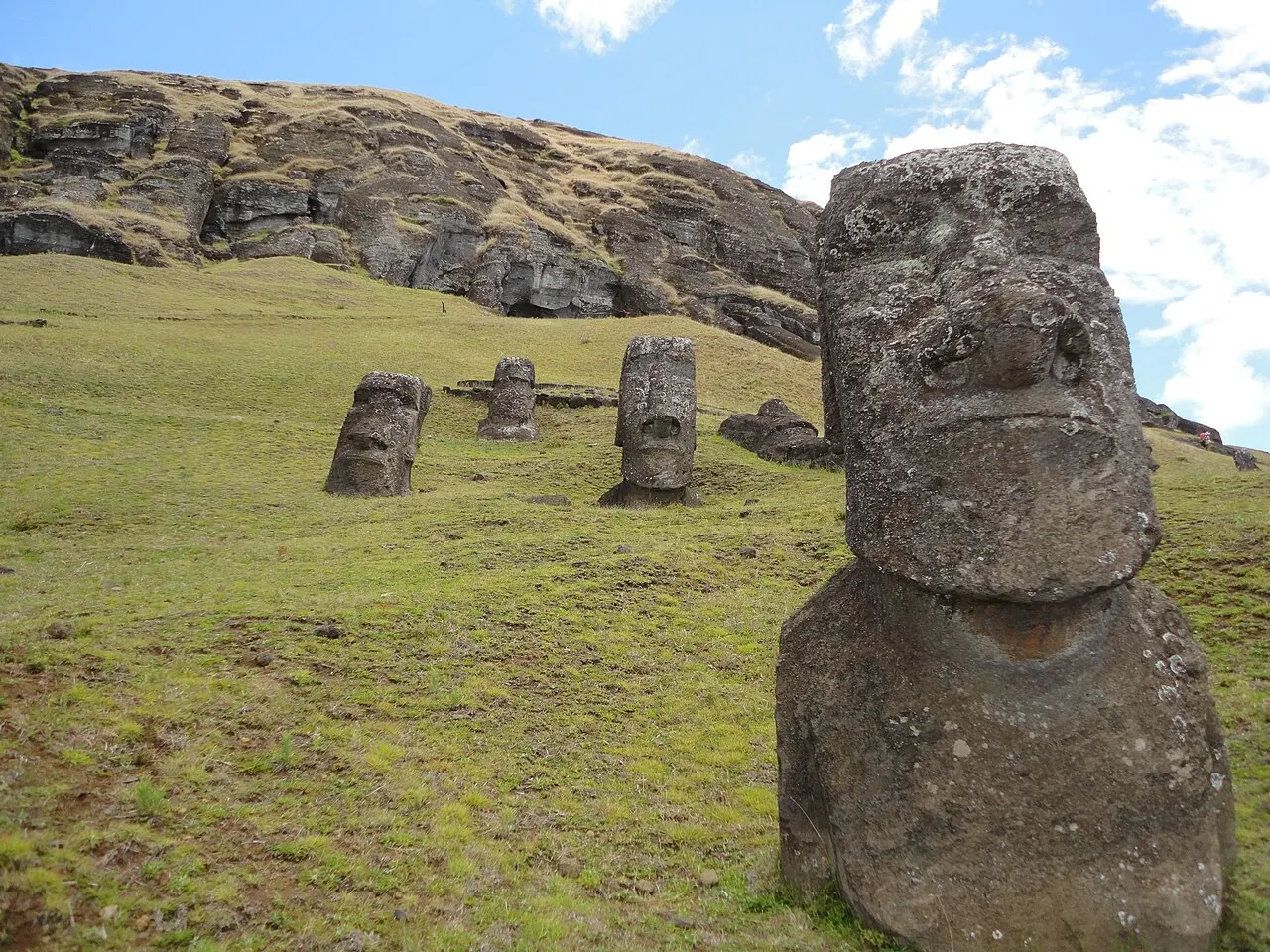
This cone of consolidated volcanic tuff, about 18 km from Hanga Roa, was the central workshop where about 95% of the island's moai were carved directly into the bedrock between the 12th and 16th centuries. Nearly four hundred statues remain on the inner and outer slopes of the crater, at different stages of carving: some still attached to the wall by the keel on their backs, like the giant Te Tokanga (more than 21 m long), others standing chest-deep in the slope's sediment, like the kneeling moai Tukuturi. The Rapa Nui National Park ticket allows entry to Rano Raraku only once during its 10 days of validity and requires the company of an accredited guide or a Rapa Nui host; after the October 2022 fire, leaving the trails marked off with ropes is strictly forbidden.
Check access
Ahu Tongariki
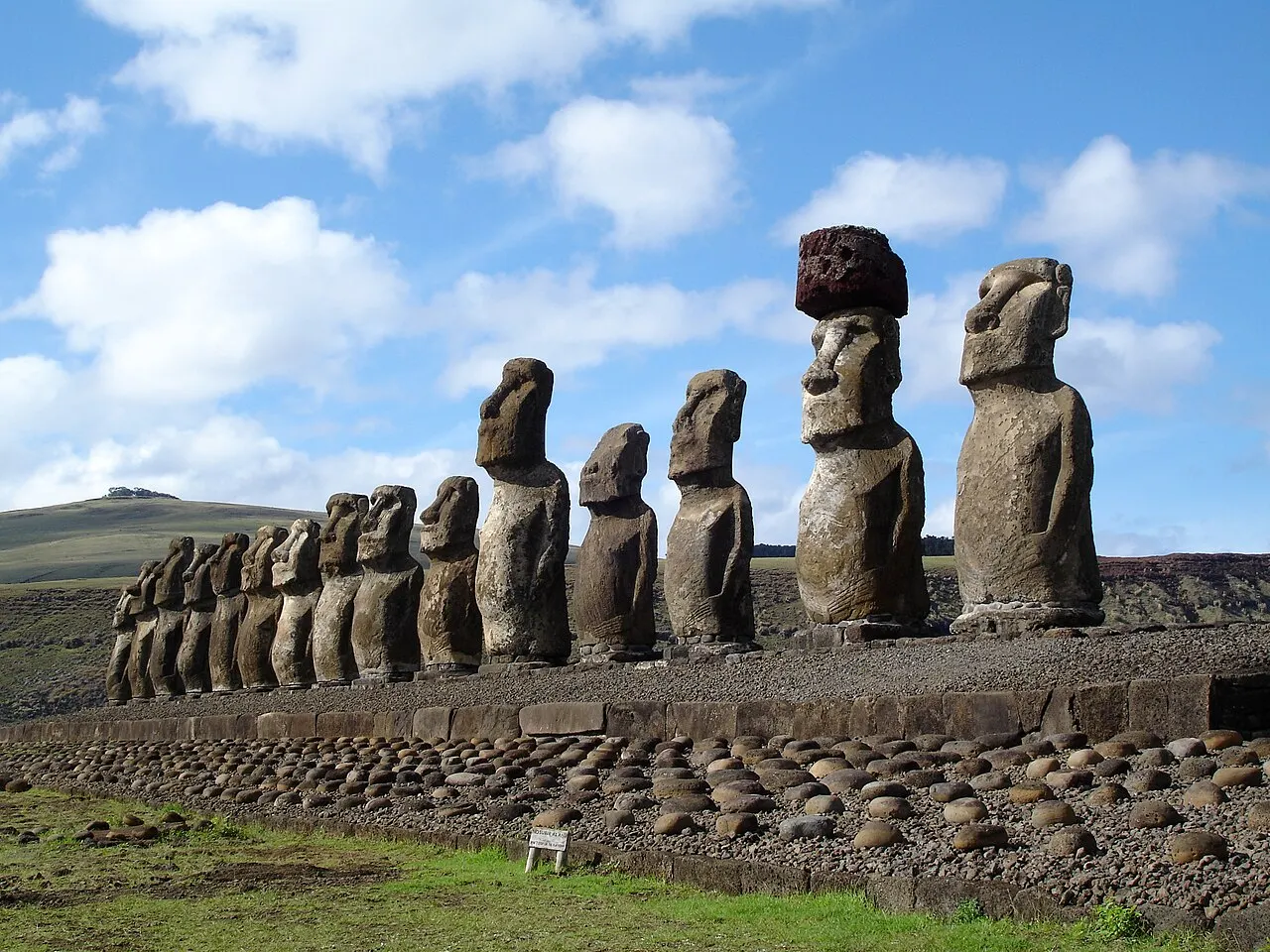
Set in the cove of Hotu Iti, about 20 km from Hanga Roa and five minutes by car from Rano Raraku, it is the largest ceremonial platform in Polynesia, about 200 m long, with fifteen moai raised side by side between 1992 and 1996, after being swept away by the tsunami of May 1960. The second moai from the right carries a pukao (a cylinder of red scoria on top of the head), and on the esplanade in front of the platform stands a lone moai that traveled to Japan for an exhibition before the restoration. It is the classic spot to watch the sunrise behind the fifteen moai; it requires the park ticket and a local guide or host.
Check access

Orongo
On top of the southwestern rim of the Rano Kau crater, 300 m up a vertical cliff that drops into the Pacific, this ceremonial village of 53 elliptical houses built from overlapping basalt slabs without mortar was occupied only during the weeks of the austral spring for the Birdman (Tangata Manu) competition. From the tip of the site you can see the three sea islets of Motu Nui, Motu Iti and Motu Kao Kao, where the competitors sought the egg of the manutara bird; to protect the petroglyphs carved into the rocks of the rim, part of the far end remains fenced off. Like Rano Raraku, Orongo allows a single entry per park ticket and requires an accredited guide.
Check access
Rano Kau
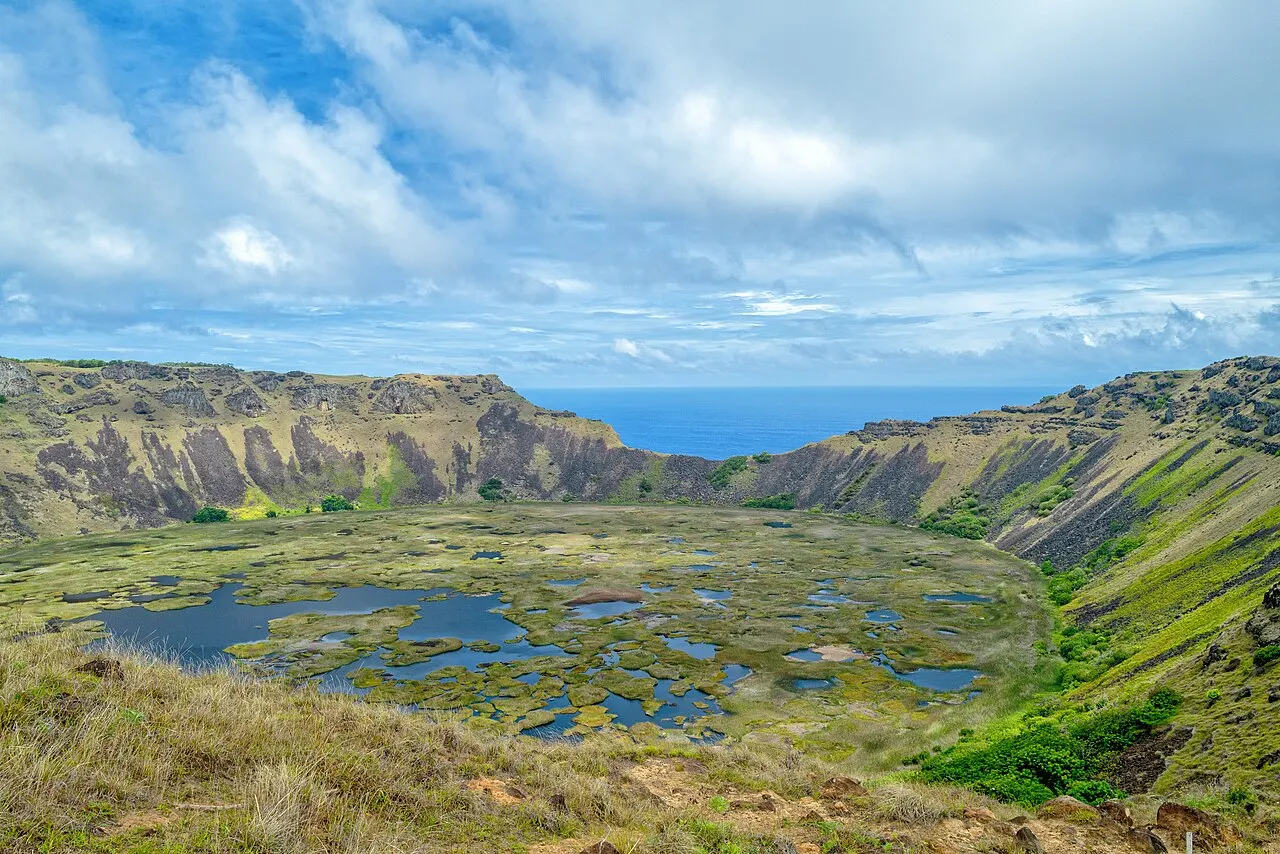
About 5 km from the center of Hanga Roa, before the Orongo gate, a viewpoint on the rim of the caldera opens onto the immense volcanic crater, 1.6 km across, whose floor holds a freshwater lagoon covered by a floating mosaic of totora and a wind-sheltered microclimate where fig trees, banana trees and ferns grow. On the opposite wall, a breach opened by marine erosion lets you see the open ocean through the edge of the volcano. The viewpoint lies in the part of the park visited with the ticket and the guide of the Orongo day; if you want to go up on your own, confirm the current rule with Ma'u Henua.
Check access

Playa de Anakena
Located 18 km northeast of Hanga Roa along the asphalt road that crosses the middle of the island, Anakena (Hanga Rau o Te Ariki) is the cove where tradition places the landing of the founding king Hotu Matu'a. It is Rapa Nui's main swimming beach, with white sand of coral origin, turquoise water calmer than the rest of the rocky coast and a grove of coconut palms introduced from Tahiti in the 1960s. At the entrance to the grove, kiosks run by local families sell empanadas, grilled fish and drinks; the strip of sand for swimming, which can be visited without a guide, lies beside the archaeological platforms of Ahu Nau Nau and Ahu Ature Huki, where a guide is required again.
Check access
Ahu Nau Nau
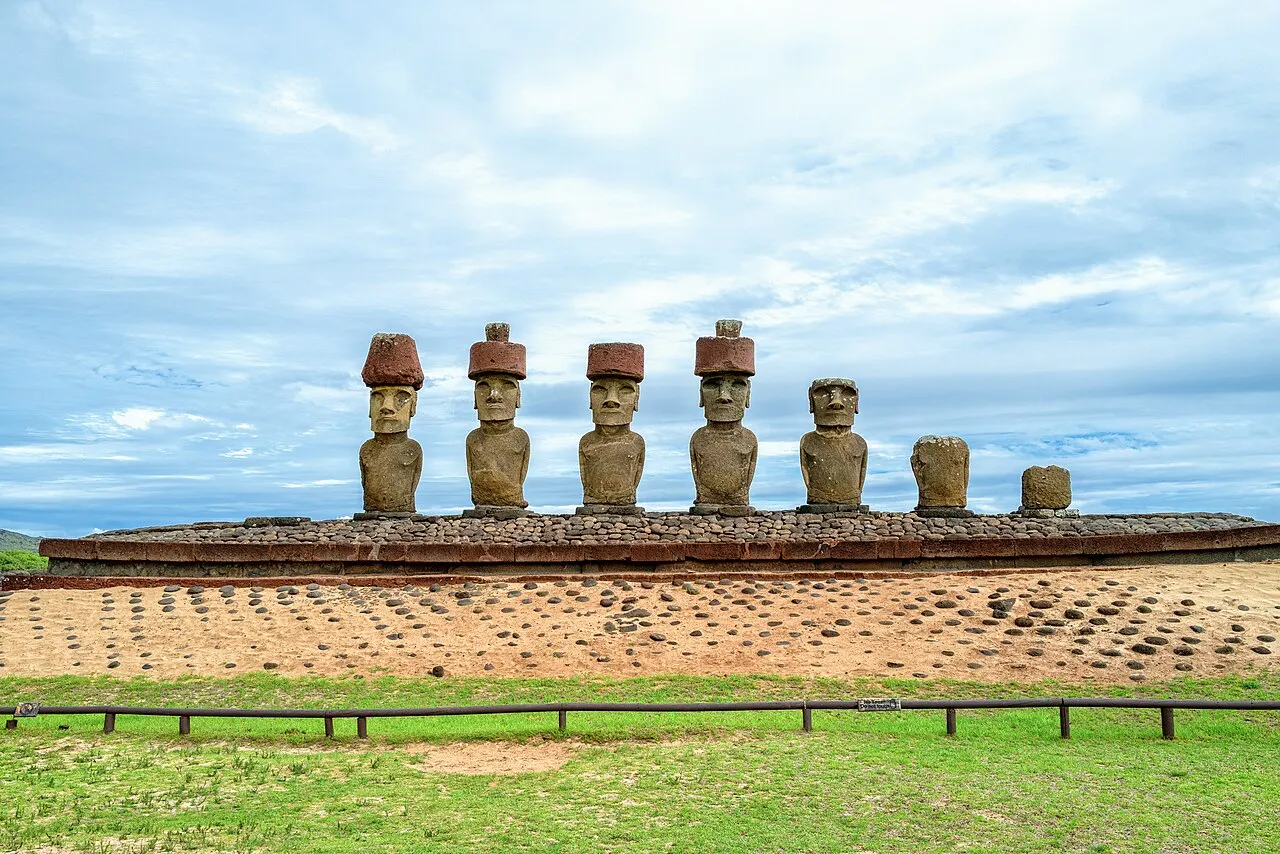
Built directly on the dune of Anakena beach and restored in 1978 by the team of the Rapa Nui archaeologist Sergio Rapu, this platform supports seven moai (five whole and two fragmentary), four of them crowned with their red pukao. Because they spent centuries buried in the pale sand of the beach, the moai of Ahu Nau Nau kept the sharpest carved reliefs on the island on their backs and ears. It was there, in the sand, that archaeologists found the original eye of white coral and red scoria that belongs to the collection of the Padre Sebastián Englert Anthropological Museum, closed to the public since July 2024. To enter the fenced perimeter of the ahu you must present the park ticket, with a guide.
Check access

Tahai Ceremonial Complex
A ten-minute walk north from the center of Hanga Roa, Tahai brings together three platforms restored by the American archaeologist William Mulloy between 1968 and 1974 on a wide open lawn above the sea: Ahu Vai Uri, with five moai of different sizes; Ahu Tahai, with a single eroded statue; and Ahu Ko Te Riku, whose moai received replicas of the eyes, white coral with a dark rock pupil, along with the red pukao. Around them you can still see the stone canoe ramp, foundations of boat-shaped houses (hare paenga) and Mulloy's tomb. Because it lies on the urban edge of Hanga Roa, the sunset-viewing lawn is freely accessible without using up the single entry to the closed sites; respect the cordons and do not climb on the stones.
Check access

Ahu Akivi
Located inland, about 10 km north of Hanga Roa on the gentle slopes of Terevaka, this ahu, restored in 1960 by William Mulloy and Gonzalo Figueroa, holds seven moai of very similar size, about 4.5 m tall. Because the platform lies more than 2 km inland, the seven moai look toward the old village that once stood in front of them and, as a geographic consequence, face the direction of the ocean and line up with the sunset at the spring and autumn equinoxes. It requires the park ticket and the company of a guide or host.
Check access

Puna Pau
A small secondary cone about 7 km east of Hanga Roa whose interior is made of porous volcanic scoria of intense red color (hani-hani). It was the exclusive quarry where the pukao were carved, large cylinders of up to 10 tons that represented the topknot of hair tied on top of the moai's heads in the final phase of the ahu. Around twenty to thirty unfinished cylinders remain scattered along the inner trail and the rim, which also offers an open view over Hanga Roa. It requires the park ticket and a guide.
Check access
Nilo’s itinerary
Start with the basic programme and choose extensions for the time you have.
Plan my days in the app ↗Day 1 · Arrival in Hanga Roa, the Hanga Piko waterfront and sunset at Tahai
Land at Mataveri Airport and, if you did not buy the Rapa Nui National Park ticket online with your arrival date, buy it at the airport counter; then check in at your guesthouse in Hanga Roa and confirm with the accredited guide the departure time for the next two days.
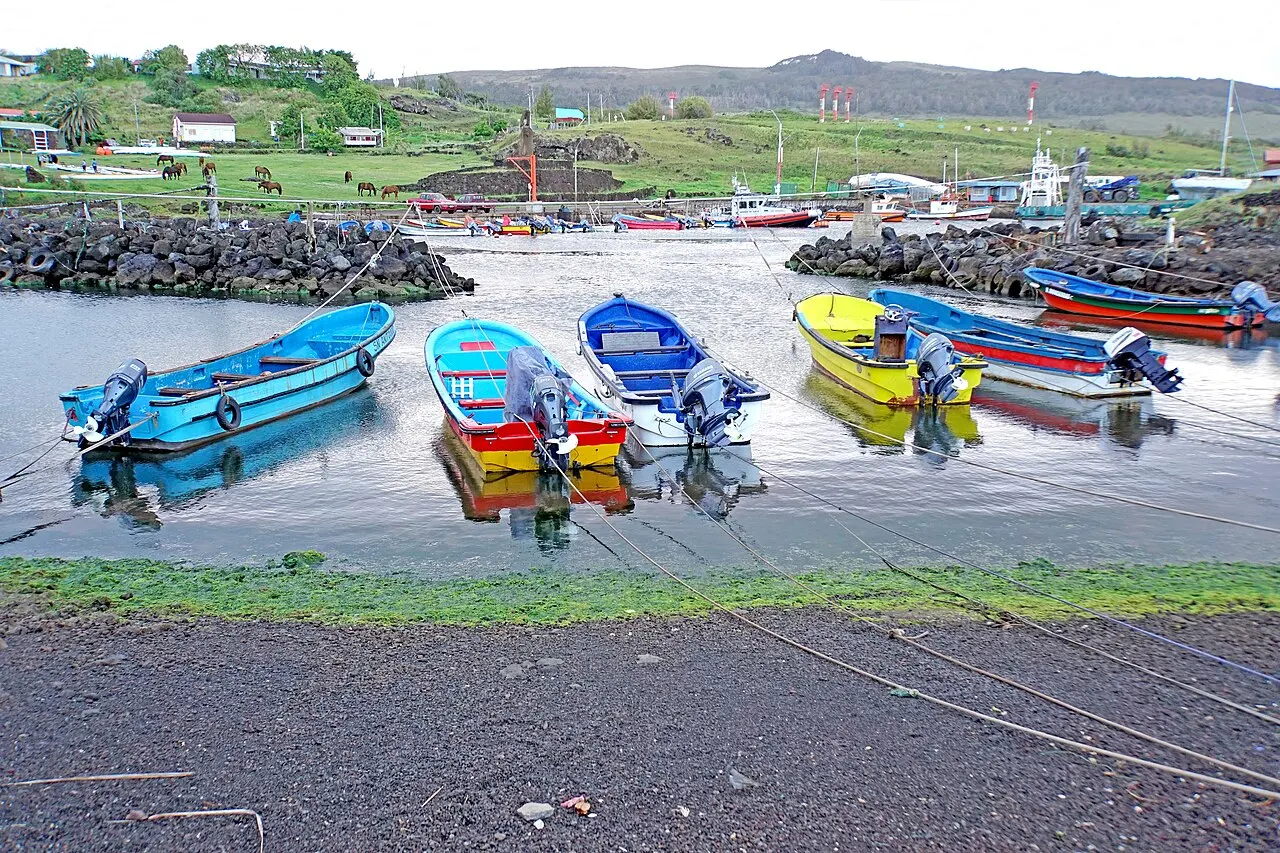
Have lunch on a tuna empanada or a Rapa Nui ceviche on the waterfront of Avenida Policarpo Toro and head down to Caleta Hanga Piko to see the fishing boats, the lone moai of Ahu Riata and, with luck, the turtles that come up to the rocks.
In the afternoon, walk north along the waterfront, past the cove of Pea and the caleta of Hanga Roa Otai, to the lawn of Tahai, which can be visited without a guide.
End the day at the Tahai Ceremonial Complex, watching the sun set over the Pacific behind the five moai of Ahu Vai Uri and the moai with eyes of Ahu Ko Te Riku.
Day 2 · Sunrise at Ahu Tongariki, the Rano Raraku quarry and Anakena beach
Set out before dawn with your accredited guide along the south road (take extra care with horses on the dark road) to watch the sun rise behind the fifteen aligned moai of Ahu Tongariki.
Right when the gate opens, use your single entry to Rano Raraku in the low morning light, walking unhurried along the trail of the nearly four hundred statues on the outer slope and to the viewpoint over the crater's inner lagoon.
Continue along the north coast to Ahu Te Pito Kura, where the gigantic fallen moai Paro lies beside the spherical stone Te Pito o Te Henua.
Spend the early afternoon at Playa de Anakena: visit with the guide the red-hatted moai of Ahu Nau Nau and the lone moai of Ahu Ature Huki, have lunch at the kiosks under the coconut palms and enjoy the island's only white-sand beach for a swim before returning to Hanga Roa by the central road.
Day 3 · The Rano Kau crater, the village of Orongo and the Ahu Akivi circuit
In the morning, accompanied by the guide, visit the fitted basalt walls of Ahu Vinapu, beside the head of the runway, and drive up the southwestern volcano road to the open viewpoint over the Rano Kau caldera, with its 1.6 km lagoon covered in totora.
Show your ticket at the Orongo gate (single entry) to walk among the basalt-slab houses on the cliff and see head-on the islets of Motu Nui, Motu Iti and Motu Kao Kao, the stage of the ancient Birdman ceremony.
After lunch in Hanga Roa, do the interior circuit: climb to the red scoria quarry of Puna Pau, where the pukao were carved, and continue to the seven moai of Ahu Akivi, which look toward the ocean.
In the evening, dine on grilled tuna or catch a traditional Rapa Nui music and dance performance in Hanga Roa.
Day 4 · The climb up Maunga Terevaka, the church of Hanga Roa and diving or the beach
Start early at the Ahu Akivi parking area for the climb of about 3.5 km to the summit of Maunga Terevaka (507 m), the island's highest point, from which you see the ocean in 360 degrees all around Rapa Nui; go with a local guide or confirm beforehand with Ma'u Henua whether the trail can be done without one.
Back in Hanga Roa, see the wood carvings of the Iglesia de la Santa Cruz (if it is Sunday morning, attend Mass with hymns in the Rapa Nui language) and walk through the craft market next door to see sculptures in wood and volcanic stone.
Save the afternoon for an introductory dive from Caleta Hanga Roa Otai, a boat trip from Hanga Piko or a second beach break at Anakena, and return to Tahai for one last sunset.


Food
Empanadas de atún
Unlike the Chilean empanadas of the mainland, the empanadas of Hanga Roa are large, fried to order until the dough is golden and crisp, and filled with generous cubes of fresh tuna (kahi) sautéed with onion, tomato or melted cheese.
Rapa Nui ceviche and po'e
The island's ceviche uses yellowfin tuna (kahi), mahi-mahi or toremo cut into large cubes, marinated with lime, red onion, cilantro and, in many homes, coconut milk, served with slices of sweet potato (kumara) or with po'e, a moist, dense Polynesian cake made with banana, pumpkin or grated cassava, flour and coconut, baked in the oven.
Umu Rapa Nui (Polynesian curanto)
A traditional feast stew prepared in a pit dug in the ground and lined with white-hot volcanic stones and banana leaves, where fish, chicken, meat, sweet potato (kumara), taro and po'e cook slowly. It is often part of evening dance performances or community orders.
Tunu ahi
Fresh fish roasted over hot volcanic stones by the sea, a fishermen's tradition that some coastal tours and restaurants in Hanga Roa reproduce.
Where to eat
- Avenida Policarpo Toro and the caletas of Hanga Roa
Seafront restaurants and terraces serving fresh tuna (kahi) grilled or crusted, Rapa Nui ceviche marinated with lime and coconut milk, sweet potato (kumara) and po'e. Book a table for the late afternoon, when the sun sinks over the Pacific.
- Avenida Atamu Tekena and Te Pito o Te Henua street
Family-run snack bars and bakeries where large empanadas are fried to order, filled with diced tuna and cheese or shrimp, ideal for an inexpensive lunch or for takeaway before the morning outing.
- The coconut grove at Playa de Anakena
Traditional kiosks under the trees at the entrance to the beach, serving tuna empanadas, anticuchos (grilled skewers), the fish of the day and fresh juices for those spending the day between Ahu Tongariki, Rano Raraku and a dip in the sea.
· 2026-10-17
Day trips
Poike and the southeast coast (Vaihu and Akahanga)
On the island itself, 10–15 km from Hanga Roa along the south road, the unrestored platforms of Vaihu and Akahanga (where oral tradition places the tomb of King Hotu Matu'a) show how all the island's ahu looked before the 20th-century restorations, with moai toppled face down and pukao rolled into the grass; farther east, the Poike volcano calls for its own guided hike.
Boating and diving at the islets of Motu Nui, Motu Iti and Motu Kao Kao
Leaving by boat from Caleta Hanga Piko or Hanga Roa Otai on calm-sea days (about 20 to 30 minutes of coastal sailing), you can round the 300 m cliff of Rano Kau from below and dive with a tank or snorkel in the crystal-clear water beside the three sacred islets of the Tangata Manu cult, without landing on the protected rocks.
Where to begin
Arrival in Hanga Roa, the Hanga Piko waterfront and sunset at Tahai
Land at Mataveri Airport and, if you did not buy the Rapa Nui National Park ticket online with your arrival date, buy it at the airport counter; then check in at your guesthouse in Hanga Roa and confirm with the accredited guide the departure time for the next two days.
Sunrise at Ahu Tongariki, the Rano Raraku quarry and Anakena beach
Set out before dawn with your accredited guide along the south road (take extra care with horses on the dark road) to watch the sun rise behind the fifteen aligned moai of Ahu Tongariki.
The Rano Kau crater, the village of Orongo and the Ahu Akivi circuit
In the morning, accompanied by the guide, visit the fitted basalt walls of Ahu Vinapu, beside the head of the runway, and drive up the southwestern volcano road to the open viewpoint over the Rano Kau caldera, with its 1.6 km lagoon covered in totora.
The climb up Maunga Terevaka, the church of Hanga Roa and diving or the beach
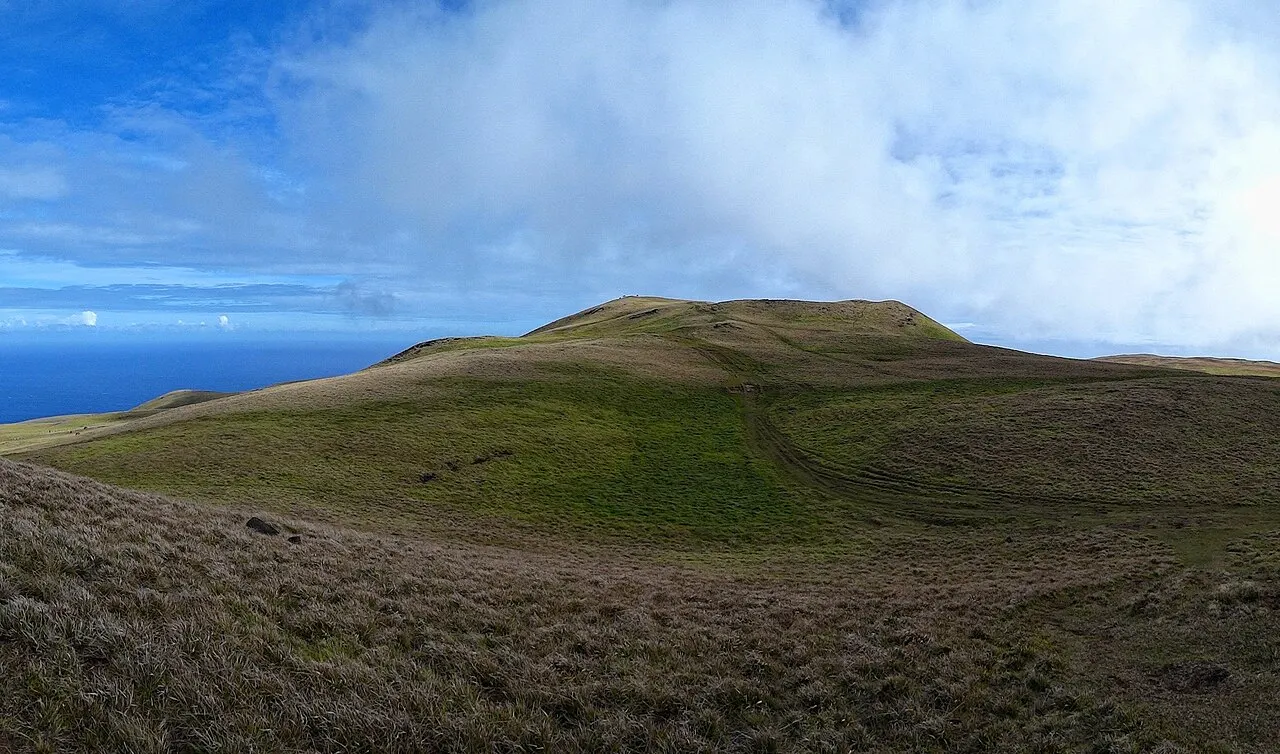
Start early at the Ahu Akivi parking area for the climb of about 3.5 km to the summit of Maunga Terevaka (507 m), the island's highest point, from which you see the ocean in 360 degrees all around Rapa Nui; go with a local guide or confirm beforehand with Ma'u Henua whether the trail can be done without one.
Money
The official currency is the Chilean peso (CLP), but US dollar (USD) bills in good condition are widely accepted to pay guides, dives, car rentals and the park's international entry ticket itself. The Rapa Nui National Park ticket, administered by Ma'u Henua, is mandatory to visit the archaeological sites, is named and is valid for 10 consecutive days from the date of issue. Under the fee schedule in force since October 1, 2025 (consulted in October 2026), it costs USD 100 for a foreign adult (USD 40 for foreign children aged 7 to 12) and CLP 40,000 for a Chilean adult or Chile resident (CLP 20,000 for national children aged 7 to 12); children under 7 are exempt. Because the Ma'u Henua notice counts validity from issue (and one local guide speaks of the "first check"), do not buy weeks ahead: if you use the official digital platform, confirm there whether you can choose the start date and set your arrival date; otherwise, buy on landing, at the counter in Mataveri airport or, for now, at the Ma'u Henua service office on Kiri Reva street in Hanga Roa (daily, 9 a.m. to 5 p.m.). Keep the ticket printed or on your phone, since without it you cannot enter any controlled site. In Hanga Roa there are BancoEstado and Santander branches with ATMs on Atamu Tekena street, but card payment can fail when the satellite internet wavers; bring a reserve of Chilean pesos and cash dollars from Santiago. Because almost all processed food, fuel and drinks arrive by plane or ship from Valparaíso, supermarket and restaurant prices are higher than on the mainland; save money by bringing permitted dry goods from Santiago in your checked luggage (respecting SAG phytosanitary control).
Getting there and around
Getting there: LATAM flights to Mataveri Airport (IPC)
The only regular commercial air link to Rapa Nui leaves from Santiago, Chile (SCL), operated by LATAM on wide-body aircraft (Boeing 787), on a flight of about 5h30 outbound against the wind and about 4h45 on the return. Before heading to the boarding gate in Santiago, every non-resident passenger goes through PDI control for Easter Island, where they must present an ID document or passport, a round-trip ticket with a maximum stay of 30 days (Law 21.070), a confirmed reservation at lodging registered with Sernatur (or an official invitation letter from the Provincial Presidential Delegation) and the completed Formulario Único de Ingreso (FUI). Mataveri International Airport (IPC) sits right against the southern edge of Hanga Roa, 5 minutes by car from the hotels; most guesthouses include the arrival transfer with a flower necklace.
Getting around the island: guide, rental car, taxi and walking
There is no public bus system on Rapa Nui. Within Hanga Roa, everything is done on foot or by short taxi rides at a fixed price in the village. To tour the National Park sites outside the village, there are two main choices: book small-group excursions or a private guide with a vehicle included, or rent a car or jeep from the agencies on Atamu Tekena street and hire the accredited local guide separately to ride along in your vehicle. Keep in mind that renting a car on your own does not waive the mandatory presence of the accredited guide at the gate of Rano Raraku, Orongo, Tongariki, Akivi and the other controlled sites. There are only two gas stations on the island, both in Hanga Roa, and outside the village there is no reliable cell signal.
Safety
Rapa Nui is an extremely safe destination in terms of urban crime, where you can walk calmly around Hanga Roa and Tahai. The real hazards are on the road, in the sun and in the sea: outside Hanga Roa there is no street lighting, no cell phone signal, and horses and cattle cross or sleep on the asphalt, especially in the small hours on the way to the sunrise at Ahu Tongariki. On the cliffs of Rano Kau, Orongo and the north coast, the wind blows hard and there are no continuous railings at the edge of the drop. The island's coast is almost entirely sharp volcanic rock and open-sea waves with no coral barrier; only enter the water at the beach of Anakena or the small Pea cove in Hanga Roa, and on dive outings with local instructors in the coves. Hanga Roa Hospital handles medical emergencies on the island, but highly complex cases depend on air medical evacuation more than 3,700 km to the mainland, so it is essential to travel with travel insurance that covers air evacuation.
Etiquette tips
Never climb on an ahu or touch the moai
The ahu are not stone stages but funerary and sacred monuments (tapu) that hold the remains of Rapa Nui ancestors, and the volcanic rock of the moai crumbles with the oils from hands. Walking on an ahu, touching a statue or crossing the cordons of white-painted stones is a serious offense subject to a heavy fine and expulsion from the park.
Hire an accredited guide and show your ticket to the muto'i
At the entrances to the archaeological sites, the Ma'u Henua rangers check the named ticket and the accreditation of the local guide or Rapa Nui host. Respect their instructions and the limit of a single entry to Rano Raraku and to Orongo.
Watch for loose horses on the roads
Thousands of horses roam freely on the island's roads and pastures, including at night, when there is no street lighting outside Hanga Roa. If you are driving, keep your speed low (a maximum of 40 to 60 km/h on the road) and take extra care when going to Ahu Tongariki before dawn.
Do not take stones, sand or shells from the island
Removing any fragment of volcanic rock, obsidian (mata'a), coral or sand from the beaches and sites is prohibited by law and checked by the X-ray at Mataveri airport.
Mistakes to avoid
Arriving at the Santiago airport without the FUI and without registered lodging
For non-residents, trying to board for Mataveri without having filled out the Formulario Único de Ingreso (FUI), or with a reservation at informal lodging outside the Sernatur registry and without an invitation letter from a resident certified by the Provincial Presidential Delegation, prevents boarding already at the PDI control in Santiago.
Renting a car thinking you can enter Rano Raraku and Tongariki on your own
A rental vehicle gives you freedom of movement, but it does not replace the Ma'u Henua rule: without an accredited guide or Rapa Nui host with you at the gate, entry to the controlled archaeological sites is not authorized.
Spending the single entry to Rano Raraku or Orongo on a rainy late afternoon
Since the 10-day ticket lets you through the turnstile at Rano Raraku and at Orongo only once each, avoid going in with an hour left before closing or under a heavy downpour.
Looking for the Ana Kai Tangata cave thinking the interior is open
The coastal cave south of Hanga Roa, famous for the rock paintings of manutara birds on its ceiling, has had its interior access closed for years because of the risk of falling rock; you can only look at the cove from the upper platform of the stairway.
Relying only on cards and mobile internet
Outside Hanga Roa there is no cell signal on the park roads, and inside the village card machines can go down when the connection wavers. Bring cash (CLP and USD) from the mainland.
Useful phrases
Iorana
Hello, good morning, good afternoon or welcome: the universal greeting in the Rapa Nui language.
Mauruuru
Thank you in the Rapa Nui language (pronounced ma-u-ru-u-ru).
Riva riva
Very good, fine or excellent, a common answer when someone asks Pehe koe? (How are you?).
Tapu
Sacred, off-limits or forbidden: when a sign says Tapu on an ahu or stone wall, never go past it.
Una empanada de atún queso, por favor
One tuna and cheese empanada, please: the classic order at the snack bars of Hanga Roa and Anakena.
Where to stay
- Central Hanga Roa and Avenida Atamu Tekena · Those who prioritize being a few steps from bakeries, supermarkets, a pharmacy, banks and tour agencies.: It lets you handle all your shopping and meals of the day on foot, with no need for a taxi at night. The downside is having no sea view from the room. In any area, check before paying that the lodging appears in the Sernatur registry: without that (or without an invitation letter from a certified resident), boarding in Santiago is refused.
- Waterfront (Avenida Policarpo Toro) and the Tahai area · Those who want to stroll by the sea in the late afternoon and walk to watch the sunset at Tahai.: It combines the Pacific breeze, restaurants with terraces over the waves and the moai of Tahai a few steps away. It is a ten- or fifteen-minute walk from the shops of Atamu Tekena street.
- Rural edges of Hanga Roa (Mataveri road, Orito and the Anakena road) · Those looking for cabins and hotels with large gardens, absolute quiet and dark night skies.: It offers more space and peace away from the motorbikes of the center, but requires a 20- to 30-minute walk along streets with no lit sidewalk, or calling a taxi every time you go to dinner in the village.
· 2026-10-17
Districts
Hanga Roa and Tahai
The island's only urban settlement, divided between the commercial axis of Avenida Atamu Tekena (markets, empanada bakeries, pharmacies, banks and shops), the waterfront of Avenida Policarpo Toro (restaurants, the fishing coves of Hanga Roa Otai and Hanga Piko, dive schools) and, at the northern end on foot, the open ceremonial complex of Tahai, next to the Padre Sebastián Englert Anthropological Museum, closed to the public since July 2024.
Rano Kau and Orongo
The island's southwestern tip, just south of the Mataveri airport runway. It holds the paved climb to the viewpoint over the Rano Kau crater, the ceremonial village of Orongo on the cliff facing the islets of Motu Nui, Motu Iti and Motu Kao Kao, and, at the eastern base of the runway, the platforms of Ahu Vinapu.
South Coast and Rano Raraku (Hotu Iti)
The southern coastal road leaving Hanga Roa and passing Vaihu, Akahanga, the quarry-crater of Rano Raraku and the cove of Hotu Iti, where the fifteen restored moai of Ahu Tongariki stand in a line.
Anakena and the North Coast
The island's northern shore, home to the site of Ahu Te Pito Kura (with the largest moai ever moved to a platform) and the bay of Anakena, the only large beach of white coral sand, lined with coconut palms brought from Tahiti in the 1960s and with the moai of Ahu Nau Nau and Ahu Ature Huki.
Volcanic Interior and Ahu Akivi
The center-west and the slopes of Maunga Terevaka, which hold the red scoria quarry of Puna Pau, the seven moai of Ahu Akivi, the caves of Ana Te Pahu and the trailhead for the climb to the top of Terevaka.
History
9th–12th centuries · Hotu Matu'a lands at Anakena
Polynesian navigators arrived in double canoes at the beach of Hanga Rau (Anakena), bringing yam, taro, sweet potato, banana, sugarcane and chickens, and dividing the island among clans (mata).
12th–16th centuries · The age of the ahu and the moai
For about five hundred years, the clans carved hundreds of moai in the crater of Rano Raraku to represent deified ancestors (aringa ora), raising them on stone platforms with their backs to the sea.
17th–19th centuries · Ecological crisis and the Birdman cult
With the native palm forest exhausted and internal conflicts toppling the moai from their ahu (the Huri Moai period), the annual political contest moved to the Tangata Manu ceremony in the village of Orongo.
April 5, 1722 · The arrival of Jakob Roggeveen
The Dutch navigator sighted the island on Easter Sunday of 1722 and named it Paasch-Eyland. In the following century came visits by James Cook (1774) and La Pérouse (1786).
1862–1877 · Slave raids and demographic collapse
Between 1862 and 1863, slave ships out of Peru kidnapped about 1,500 islanders, including the sages able to read the rongorongo tablets. The few who were repatriated brought smallpox and tuberculosis; by 1877 only 111 inhabitants remained on the island.
September 9, 1888 · The Agreement of Wills with Chile
The Chilean captain Policarpo Toro and the ariki Atamu Tekena signed the annexation treaty in Hanga Roa. In the following decades, the Chilean state leased almost the entire island to the Compañía Explotadora de la Isla de Pascua, linked to the Williamson-Balfour firm, for sheep ranching, and the Rapa Nui population was confined to Hanga Roa: under the company until 1953 and under Navy administration until the Pascua Law of 1966.
1960 and 1992–1996 · The Valdivia tsunami and the restoration of Tongariki
In May 1960, the tsunami generated by the Valdivia earthquake swept over the coast of Hotu Iti and dragged the moai of Ahu Tongariki as far as a hundred meters inland. Between 1992 and 1996, Chilean archaeologists with Japanese support raised the fifteen moai again.
1966 and 2017–2018 · Full citizenship, Ma'u Henua and the Residence Law
The Pascua Law of 1966 recognized the civil rights of the Rapa Nui. In 2017, administration of the National Park passed to the Ma'u Henua indigenous community, and in 2018 Law 21.070 came into force, limiting the stay of non-residents to 30 days.
October 2022 · The fire at Rano Raraku
A grassland fire burned more than a hundred hectares in the crater and on the slopes of Rano Raraku, thermally damaging the stone of dozens of moai and reinforcing the mandatory control of guided visits.
Complete history
The navel of the world and the engineering of the ancestors
Known in oral tradition as Te Pito o Te Henua (the navel of the earth) and Mata ki Te Rangi (eyes that look to the sky), Rapa Nui was the easternmost vertex of the Polynesian expansion across the Pacific. When Hotu Matu'a's canoes landed in the cove of Anakena, they found an island with no protective coral reefs and no permanent rivers, where fresh water collected only at the bottom of the three volcanic craters of Rano Kau, Rano Raraku and Rano Aroi and in underground caves. To grow sweet potato, taro and yam under the constant ocean wind, farmers invented the manavai, circular gardens walled with basalt stones that hold moisture in the soil. At the same time, each lineage raised its ceremonial platform (ahu) at the water's edge and carved the moai into the compacted tuff of Rano Raraku, statues that embodied the spiritual force (mana) of the ancestral chiefs and faced away from the ocean, protecting the villages.
From the Huri Moai period to the Orongo competition
Around the 17th century, the combination of overpopulation, the disappearance of the native giant palm (Paschalococos disperta) and disputes between the western (Tu'u) and eastern (Hotu Iti) clans brought the Rano Raraku workshop to a halt, leaving hundreds of unfinished statues fixed to the rock. During the internal wars of the Huri Moai period, rival tribes toppled the moai from their pedestals face down, so that by the 19th century no moai remained standing on the coastal ahu. Political order was reorganized around the cult of Make-Make, the creator god, in the stone village of Orongo, high on the cliff of Rano Kau: each spring, the clan representatives (hopu manu) climbed down the cliff and swam, supported by bundles of totora reed, to the islet of Motu Nui to collect the first egg of the sooty tern (manutara), and the winner was consecrated as Tangata Manu (Birdman) for a year.
Near extermination in the 19th century and the community's recovery
The tragedy that nearly erased Rapa Nui memory did not come from internal wars but from outside. Between December 1862 and 1863, Peruvian slaving fleets captured about 1,500 inhabitants to work in guano extraction and on farms in Peru. When diplomatic pressure forced the repatriation of the few survivors, the smallpox brought on board decimated those who had stayed on the island, and the later departure of residents for Tahiti reduced the total population to 111 people in 1877. In 1888, Chile annexed the island through the agreement signed between Policarpo Toro and Atamu Tekena, but handed the interior lands to the Compañía Explotadora de la Isla de Pascua, which turned Rapa Nui into an immense sheep farm and forbade the islanders themselves to move outside the wall of Hanga Roa without a pass. The lease ended in 1953, but the restriction continued under Navy administration. Only in 1966, after the peaceful movement led by the teacher Alfonso Rapu, did the Pascua Law give the Rapa Nui full citizenship. Today, the Ma'u Henua community directly administers the National Park and the ticket revenue.
Almost all the coastal ahu have their moai facing away from the sea and toward the interior: the statues did not watch the ocean but looked at the descendants of the village spread out at their feet. The known exception is Ahu Akivi, in the interior.
Geography and shape of the city
Three volcanoes at the corners of a triangle
At 163.6 km² and about 24 km along its longest diagonal, the island has the shape of a right triangle formed by three main extinct volcanoes, one at each corner: to the north, Maunga Terevaka (507 m), the island's highest point; to the southwest, the collapsed caldera of Rano Kau (about 324 m), with a lagoon 1.6 km across choked with totora reeds; and to the east, on the Poike peninsula, the oldest volcano (370 m). Between them are scattered about seventy secondary cones of scoria and tuff, among them Rano Raraku and Puna Pau, along with extensive underground lava tubes.
A single village, and the rest an archaeological park
Nearly all the urban infrastructure, the cargo port of Hanga Piko, the hotels, the restaurants and the 3,318 m runway of Mataveri International Airport lie in the southwest corner, in Hanga Roa. The runway, extended by NASA in the 1980s (work completed in 1987) as an emergency landing site for the space shuttle, cuts across the width of the isthmus south of the village. Outside Hanga Roa and the rural area of Vaitea, two main paved roads cross the island: one follows the south coast to Ahu Tongariki and skirts Rano Raraku to the beach of Anakena, in the north; the other cuts through the middle of the island, passing Vaitea, to connect Hanga Roa directly with Anakena.
Subtropical oceanic climate
Although it lies at latitude 27° S, outside the tropics, Rapa Nui has a mild subtropical maritime climate all year. In summer (December to March), highs are between 25 °C and 27 °C and lows near 19 °C; in winter (June to August), highs hover around 20 °C and lows rarely drop below 14 °C. It rains at any time of year (annual average near 1,100 mm), almost always in short downpours carried by the ocean wind that pass quickly, with May statistically the wettest month.
There is no permanent river or stream on the surface of Rapa Nui: rain seeps into the porous volcanic rock and forms freshwater lagoons only inside the three craters of Rano Kau, Rano Raraku and Rano Aroi.
Culture
A Polynesian island under the Chilean flag
Anyone landing at Mataveri notices within minutes that the human geography of Rapa Nui belongs to Polynesia, with direct kinship to Tahiti, the Marquesas, Mangareva and Maori New Zealand, and not to continental Hispanic America. People greet each other with Iorana, wear necklaces of flowers or shells at airport welcomes and farewells, paddle the six-person Polynesian canoe (hoe vaka) in the coves of Hanga Roa, and preserve wood carving (moai kavakava, reimiro and ceremonial paddles) and body painting with mineral pigments (kie'a) at festivals.
Ma'u Henua's community management and the muto'i
Since the administration of Rapa Nui National Park was transferred to the Ma'u Henua Polynesian Indigenous Community, the archaeological sites have been protected by the muto'i, local park rangers who staff the gates of Rano Raraku, Orongo, Tongariki, Anakena and Akivi. The requirement for an accredited local guide (or an adult Rapa Nui host) has applied since tourism reopened in August 2022, and is not merely a tourist formality: it keeps visitors from stepping on funerary platforms (the ahu hold the bones of ancestors) or touching the moai of porous tuff. The October 2022 fire at Rano Raraku later reinforced the control.
Festivals and events
Tapati Rapa Nui, first half of February
For about two weeks, the festival divides the Hanga Roa community into clans that compete in ancestral singing (riu and kai kai), wood and stone carving, totora canoe regattas, the traditional Tau'a Rapa Nui triathlon in the crater of Rano Raraku and the Haka Pei, in which young people slide down the steep slope of Mount Pu'i face down on two banana trunks lashed together at up to 70 km/h.
Rapa Nui Language Day (Mahana o te Re'o), November
A community celebration in the schools and public spaces of Hanga Roa devoted to oral transmission, music, patu'a poetry and theater in the Rapa Nui language.
Aringa Ora o Koro, June
The Rapa Nui new year festival, tied to the austral winter solstice, celebrates the annual cycle of life, fertility and productivity with community gatherings in Hanga Roa. The program varies from year to year; check with the Municipality of Isla de Pascua.
Books and films
La tierra de Hotu Matu'a (1948), by Padre Sebastián Englert
The classic study of history, ethnology and language, written by the Capuchin missionary who lived on Rapa Nui for more than thirty years and gave his name to the island's museum, recording genealogies, legends and place names directly from the elders of the first half of the 20th century.
Rapa Nui (1994), a film produced by Kevin Costner and directed by Kevin Reynolds
Although it takes great chronological liberties in compressing the carving of the moai and the Birdman race into the same era, the film was shot entirely in the real landscapes of Rano Raraku, Rano Kau and Anakena with the participation of island residents, and it is still remembered in local memory.
Frequently asked questions
Easter Island: how many days should I allow?
I'd set aside four days for Easter Island, counting the day of arrival: it is the minimum to make up for the more than five hours of flying from Santiago without rushing through the sites or missing the sunrise if it rains one morning. On the first day, after landing at Mataveri, I'd walk the Hanga Roa waterfront, from Hanga Piko to Tahai, to watch the sunset. I'd devote the second and third days in full to covering the National Park with an accredited local guide: one day for the sunrise at Ahu Tongariki, the Rano Raraku quarry, Ahu Te Pito Kura and a swim at Anakena; the other for Ahu Vinapu, the Rano Kau crater, the village of Orongo, Puna Pau and Ahu Akivi. On the fourth day, I'd climb to the summit of Maunga Terevaka in the morning, with a guide if the park requires one, and keep the afternoon for the church of Hanga Roa, a dive from Caleta Hanga Roa Otai or an easy return to Anakena. Anyone who can stay five days gains a valuable cushion against showers and wind.
Easter Island: how do I get there and what do I show when boarding in Santiago?
The only regular commercial air link to Rapa Nui leaves from Santiago, Chile (SCL), operated by LATAM on wide-body aircraft (Boeing 787), on a flight of about 5h30 outbound against the wind and about 4h45 on the return. Before heading to the boarding gate in Santiago, every non-resident passenger goes through PDI control for Easter Island, where they must present an ID document or passport, a round-trip ticket with a maximum stay of 30 days (Law 21.070), a confirmed reservation at lodging registered with Sernatur (or an official invitation letter from the Provincial Presidential Delegation) and the completed Formulario Único de Ingreso (FUI). Mataveri International Airport (IPC) sits right against the southern edge of Hanga Roa, 5 minutes by car from the hotels; most guesthouses include the arrival transfer with a flower necklace.
Easter Island: can I visit the moai with a rental car, or do I need a guide at every site?
There is no public bus system on Rapa Nui. To tour the National Park sites outside the village, there are two main choices: book small-group excursions or a private guide with a vehicle included, or rent a car or jeep from the agencies on Atamu Tekena street and hire the accredited local guide separately to ride along in your vehicle. Renting a car on your own does not waive the mandatory presence of the accredited guide at the gate of Rano Raraku, Orongo, Tongariki, Akivi and the other controlled sites. You do not need a paid guide for every hour of the day: the park's exemptions cover the lawn of Tahai, the village of Hanga Roa with its church and coves, and the strip of sand at Anakena (not the ahu area). The climb up Terevaka starts at the controlled site of Ahu Akivi: ask Ma'u Henua whether the climb also requires a guide. There are only two gas stations on the island, both in Hanga Roa, and outside the village there is no reliable cell signal.
Easter Island: how much is the park ticket and when should I buy it?
The Rapa Nui National Park ticket, administered by Ma'u Henua, is mandatory to visit the archaeological sites, is named and is valid for 10 consecutive days from the date of issue. Under the fee schedule in force since October 1, 2025 (consulted in October 2026), it costs USD 100 for a foreign adult (USD 40 for foreign children aged 7 to 12) and CLP 40,000 for a Chilean adult or Chile resident (CLP 20,000 for national children aged 7 to 12); children under 7 are exempt. Because the Ma'u Henua notice counts validity from issue (and one local guide speaks of the "first check"), do not buy weeks ahead: if you use the official digital platform, confirm there whether you can choose the start date and set your arrival date; otherwise, buy on landing, at the counter in Mataveri airport or, for now, at the Ma'u Henua service office on Kiri Reva street in Hanga Roa (daily, 9 a.m. to 5 p.m.). Keep the ticket printed or on your phone, since without it you cannot enter any controlled site. The ticket allows entry to Rano Raraku only once and to Orongo only once.
Easter Island: do cards work, or is it better to bring cash?
The official currency is the Chilean peso (CLP), but US dollar (USD) bills in good condition are widely accepted to pay guides, dives, car rentals and the park's international entry ticket itself. In Hanga Roa there are BancoEstado and Santander branches with ATMs on Atamu Tekena street, but card payment can fail when the satellite internet wavers, and card machines and ATMs can be unavailable for hours; outside the village there is no cell signal. I'd bring from the mainland enough cash, in Chilean pesos and dollars, to pay the guide, the kiosks at Anakena beach and any surprises. Supermarket and restaurant prices are higher than on the mainland, because almost everything arrives by plane or ship from Valparaíso.
Easter Island: when is the best time to go?
Rapa Nui can be visited all year thanks to its subtropical maritime climate with no harsh winter, but the best time runs from October to April. October, November, March and April combine pleasant temperatures between 22 °C and 25 °C, water already inviting for swimming at Anakena and for diving in the coves, good light for photographing the moai, and flight and lodging prices lower than at the summer peak. December to February is high season, with highs near 27 °C and a focus on the first half of February, when the Tapati Rapa Nui takes place: it is the liveliest time for local culture, but you must book flights and guesthouses many months ahead. From May to August (austral winter), highs are around 20 °C and lows near 14 °C, but the south wind gains strength and May usually records the largest monthly rainfall; even so, the showers are brief and the archaeological sites are almost empty.
Easter Island: what precautions should I take on the road and in the sea?
Rapa Nui is an extremely safe destination in terms of urban crime, where you can walk calmly around Hanga Roa and Tahai. The real hazards are on the road, in the sun and in the sea: outside Hanga Roa there is no street lighting, no cell phone signal, and horses and cattle cross or sleep on the asphalt, especially in the small hours on the way to the sunrise at Ahu Tongariki. On the cliffs of Rano Kau, Orongo and the north coast, the wind blows hard and there are no continuous railings at the edge of the drop. The island's coast is almost entirely sharp volcanic rock and open-sea waves with no coral barrier; only enter the water at the beach of Anakena or the small Pea cove in Hanga Roa, and on dive outings with local instructors in the coves. Hanga Roa Hospital handles medical emergencies on the island, but highly complex cases depend on air medical evacuation more than 3,700 km to the mainland, so it is essential to travel with travel insurance that covers air evacuation.
Easter Island: is the Padre Sebastián Englert Anthropological Museum open?
The museum, in the Tahai area, holds pieces that do not appear at the open sites, such as the original moai eye found in the Anakena excavations in 1978 and a female moai. It has been closed to the public for reasons of force majeure since July 19, 2024, and the notice on the official website (consulted on October 17, 2026) says only that reopening is being prepared, with no date. Before planning a visit, check the museum's website; while it is closed, the eye of Ahu Ko Te Riku, in Tahai, is a replica that can be seen outdoors.
Other cities in the country
Chile ↗- Days
- 2–3
- When
- Mar–May · Sep–Nov
- Per person/day
- Average 110,000 CLPMid-range · per person/day
Cost scope
Per person per day: accommodation, meals, urban transport, visits and a small allowance for extras. Flights excluded; larger purchases vary. Editorial estimate, not a quote.
- Days
- 1–2
- When
- Jan–Mar · Nov–Dec
- Per person/day
- Average 80–130 USDMid-range · per person/day
Cost scope
Per person per day: accommodation, meals, urban transport, visits and a small allowance for extras. Flights excluded; larger purchases vary. Editorial estimate, not a quote.
- Days
- 4–5
- When
- Apr–May · Sep–Nov
- Per person/day
- Average 66,200 CLPMid-range · per person/day
Cost scope
Per person per day: accommodation, meals, urban transport, visits and a small allowance for extras. Flights excluded; larger purchases vary. Editorial estimate, not a quote.
- Days
- 6–7
- When
- Jan–Mar · Nov–Dec
- Per person/day
- Average 99,900 CLPMid-range · per person/day
Cost scope
Per person per day: accommodation, meals, urban transport, visits and a small allowance for extras. Flights excluded; larger purchases vary. Editorial estimate, not a quote.
- Days
- 3
- When
- Jan–Apr · Oct–Dec
- Per person/day
- Average 121,000 CLPMid-range · per person/day
Cost scope
Per person per day: accommodation, meals, urban transport, visits and a small allowance for extras. Flights excluded; larger purchases vary. Editorial estimate, not a quote.