Chile
Torres del Paine
The W circuit, granite towers and the wind of Chilean Patagonia
Days Start with the basic programme and choose extensions for the time you have.
How the guide reaches this number
I'd do the W from west to east: Pudeto and the catamaran to Paine Grande, one night at Grey, two at the Francés campsite to climb the Valle del Francés with a light pack, and the last in the Central sector, to reach the Mirador Base Torres early on the last day and return to Natales on the evening bus. If you can, add a seventh day for the Cueva del Milodón or to wait for the wind to pass. Without a refugio or campsite reservation, there is no W: in that case I'd stay in Natales and do two days in the park without an overnight, one climbing to Base Torres and another by car through Pudeto, Salto Grande and Mirador Cuernos. For Base Torres, confirm the current cutoff with CONAF: the 2025–2026 bulletin gives entry until 10 a.m. from December to February, but the 2026 page gives 9 a.m. With that cutoff, the 7 a.m. bus, which takes about two hours to the Laguna Amarga gate, arrives right at the limit; I would choose a tour that leaves earlier. The O Circuit takes eight or nine days, includes the W and only opens from November to March; in 2026 CONAF closed it initially until October 31, and the reopening is announced through its channels. Don't come expecting a town to stroll around: Puerto Natales is small and serves the park, and what justifies the trip is two hours away by bus.
6–7
When November to March; that is when, in the 2025–2026 season, all the refugios and campsites run by the operators on the W and the O Circuit were open, and January and February are the busiest months; from May to September there is snow on the trails and several stretches of the W can only be done with a guide
How the guide reaches this number
The park is open all year, but the hiking season is the southern spring and summer. The climate is cold and damp, with no dry season: in January, the warmest month, the Puerto Natales climate table on Wikipedia gives an average high of 16.4 °C and an average low of 5.3 °C; in July the average low is −2.5 °C; and March and April are the rainiest months, with about 80 mm a month. The wind blows all year, with gusts of up to 150 km/h, and the weather changes within the same day. In the 2025–2026 season, the W ran from September to April (Las Torres opens it on September 15 and closes it on April 26), and the O Circuit from November 1 to March 31; the Los Cuernos and Serón refugios opened from November 1 to March 30. January and February are the busiest months: in 2023, each received more than 40,000 visitors, against fewer than 4,000 in each month from May to August. From May to September there is a risk of snow on most trails, several stretches of the W can only be done with a guide, and the stretch from Serón to Grey, on the O Circuit, closes. For 2026, the O is closed initially until October 31.
Per person/day Budget about 40,300 CLP; mid-range about 99,900 CLP; comfortable about 240,000 CLP per person, based on the spending travelers report to Budget Your Trip (checked in October 2026).
How the guide reaches this number
Per person per day: accommodation, meals, urban transport, visits and a small allowance for extras. Flights excluded; larger purchases vary. Editorial estimate, not a quote.
 What Nilo thinks
Stay six days: one in Puerto Natales to sort out bookings, food and gear, and five on the W circuit, with four nights in the park. I'd do the W from west to east: Pudeto and the catamaran to Paine Grande, one night at Grey, two at the Francés campsite to climb the Valle del Francés with a light pack, and the last in the Central sector, to reach the Mirador Base Torres early on the last day and return to Natales on the evening bus. If you can, add a seventh day for the Cueva del Milodón or to wait for the wind to pass. Without a refugio or campsite reservation, there is no W: in that case I'd stay in Natales and do two days in the park without an overnight, one climbing to Base Torres and another by car through Pudeto, Salto Grande and Mirador Cuernos. For Base Torres, confirm the current cutoff with CONAF: the 2025–2026 bulletin gives entry until 10 a.m. from December to February, but the 2026 page gives 9 a.m. With that cutoff, the 7 a.m. bus, which takes about two hours to the Laguna Amarga gate, arrives right at the limit; I would choose a tour that leaves earlier. The O Circuit takes eight or nine days, includes the W and only opens from November to March; in 2026 CONAF closed it initially until October 31, and the reopening is announced through its channels. Don't come expecting a town to stroll around: Puerto Natales is small and serves the park, and what justifies the trip is two hours away by bus.In Torres del Paine National Park, three granite spires rise to about 2,500 m, and to see them up close you have to hike about 4 hours 30 minutes uphill. Around them, the same massif holds the Cuernos, Lake Pehoé, crossed by catamaran, and Grey Glacier, which sheds blocks of ice into the lake of the same name. The W circuit links all of this in about 70 km, from the granite of the towers to the ice of Grey, and every night on the way is spent in a refugio or campsite booked in advance. The base is Puerto Natales, a town founded in 1911, when the region lived off sheep ranches, where the old Puerto Bories meatpacking plant became a museum and, 25 km away, the Cueva del Milodón holds the story of a giant sloth that led Bruce Chatwin to Patagonia.
Quick facts
- Population
- 24,152 inhabitants in the commune of Natales, which includes Puerto Natales, the gateway town (2024 Census, INE); the park has no urban population
- Founded
- Puerto Natales: May 31, 1911, by Decree No. 832; Torres del Paine National Park: created May 13, 1959
- Country and region
- Chile, Magallanes and Chilean Antarctica Region, Última Esperanza province; Puerto Natales is at 3 m elevation, on Seno Última Esperanza, 247 km from Punta Arenas
- Language
- Spanish
- Currency
- Chilean peso (CLP, written $); about 1,096 per euro (September 24, 2026)
- Time zone
- UTC−3 year-round; since 2017 the Magallanes region has kept its own time, with no change in winter
- Best time to visit
- November to March; that is when, in the 2025–2026 season, all the refugios and campsites run by the operators on the W and the O Circuit were open, and January and February are the busiest months; from May to September there is snow on the trails and several stretches of the W can only be done with a guide
- Average daily cost
- Budget about 40,300 CLP; mid-range about 99,900 CLP; comfortable about 240,000 CLP per person, based on the spending travelers report to Budget Your Trip (checked in October 2026).
When to go
November to March; that is when, in the 2025–2026 season, all the refugios and campsites run by the operators on the W and the O Circuit were open, and January and February are the busiest months; from May to September there is snow on the trails and several stretches of the W can only be done with a guide
How the year changes
The park is open all year, but the hiking season is the southern spring and summer. The climate is cold and damp, with no dry season: in January, the warmest month, the Puerto Natales climate table on Wikipedia gives an average high of 16.4 °C and an average low of 5.3 °C; in July the average low is −2.5 °C; and March and April are the rainiest months, with about 80 mm a month. The wind blows all year, with gusts of up to 150 km/h, and the weather changes within the same day. In the 2025–2026 season, the W ran from September to April (Las Torres opens it on September 15 and closes it on April 26), and the O Circuit from November 1 to March 31; the Los Cuernos and Serón refugios opened from November 1 to March 30. January and February are the busiest months: in 2023, each received more than 40,000 visitors, against fewer than 4,000 in each month from May to August. From May to September there is a risk of snow on most trails, several stretches of the W can only be done with a guide, and the stretch from Serón to Grey, on the O Circuit, closes. For 2026, the O is closed initially until October 31.
Nilo's tips
Book the nights before buying the entry ticket
A refugio or campsite reservation is mandatory for the W and the O and is what runs out first; the entry ticket, bought at pasesparques.cl at least 24 hours ahead, doesn't have that squeeze. That's why I'd secure the nights first and only then buy the entry ticket. The east and middle sectors of the W (Central, Chileno, Cuernos, Francés and Serón) belong to Las Torres; those in the west and north (Paine Grande, Grey, Dickson and Los Perros) belong to Vértice. Each sells on its own site.
Sleep in the Central sector the night before Base Torres
The Base Torres entry cutoff is counted at the Laguna Amarga gate and changes by month. Sleeping in the Central sector, next to Hotel Las Torres, you don't depend on the morning bus or on that cutoff: you start at 6 or 7 a.m., reach the viewpoint well before the month's exit time and still catch the 8:15 p.m. bus at Laguna Amarga.
Bring cash for the minibus and the catamaran
Entry is paid by card online, but the minibus from Laguna Amarga to the Centro de Bienvenida charges in cash. The Pehoé catamaran sells online at bookingpatagonia.travel, and Bus-Sur reports dock sales in cash. Withdraw cash in Natales before you go.
Keep the entry ticket as a screenshot
There is no internet at the gate, and, according to CONAF, the park's only cell signal is in Villa Monzino. Bring the receipt printed or saved on your device, and tell someone your itinerary before you go in.
Use the Natales day for the milodon
If you have a morning left before or after the park, the Cueva del Milodón is 25 km from Natales, and the short, 350 m trail to the cave accommodates wheelchairs with assistance up to the viewpoint inside the cave. It is a good plan for a day of strong wind, when rangers close mountain stretches.
Explore the map
Explore the map, read about the other places and plan your travel days in the app.
Open the appWhat to see
Torres del Paine: The massif and the granite
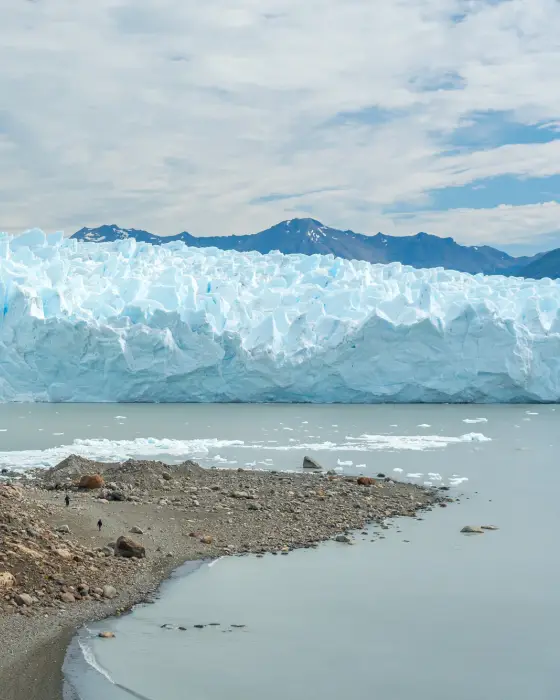
Grey ends in the lake of the same name in a front about 6 km wide, split in two, and sheds blocks of ice that float on the lake. To the east lies the cold steppe, with up to about 400 mm of rain a year according to CONAF, where guanacos, rheas and pumas live; the park also has Andean scrub and lenga forest. The blocks around the Plaza de Armas and Bories and Eberhard streets, with hostels, gear rental shops, supermarkets and restaurants.
Mirador Base Torres
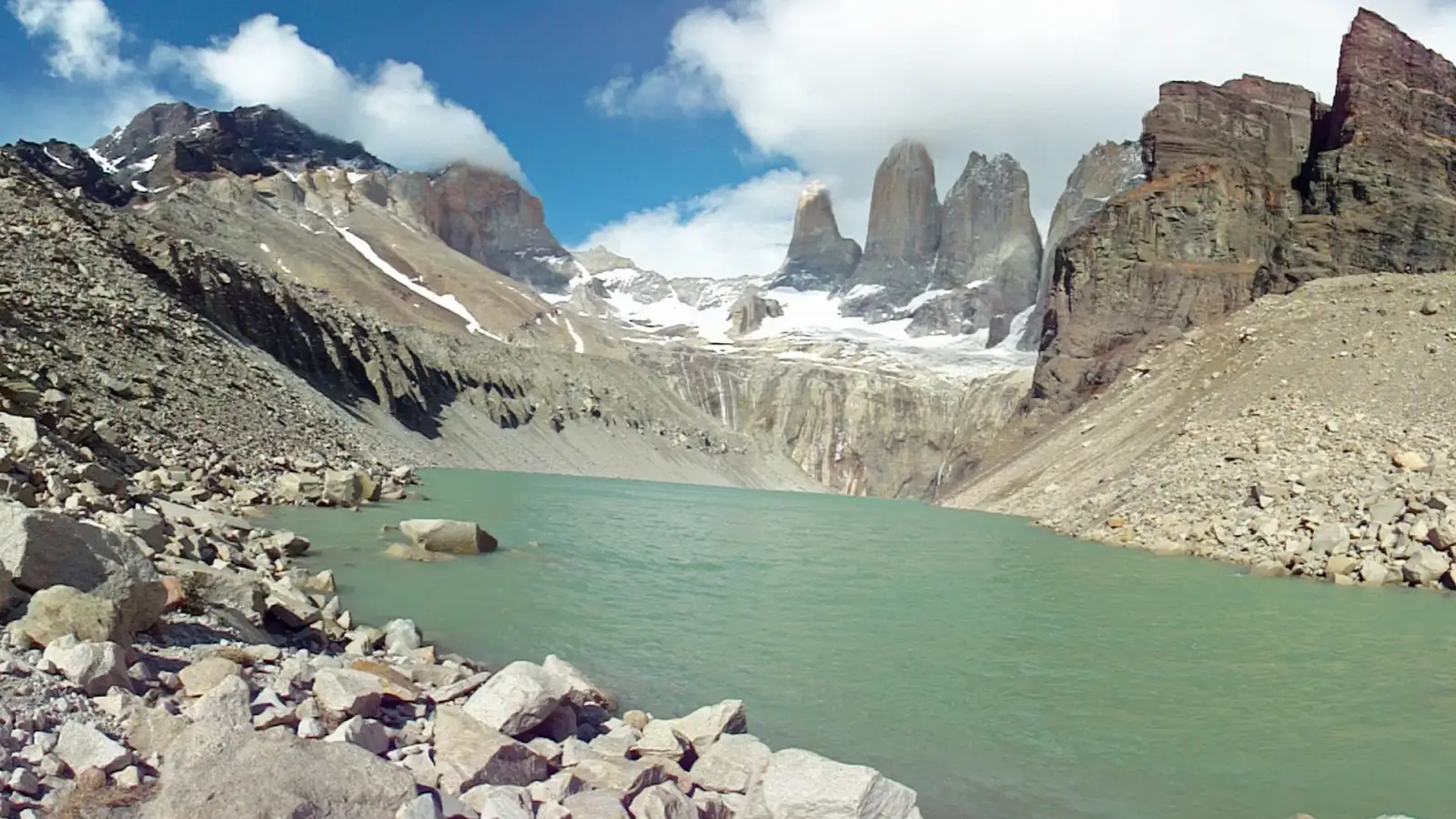
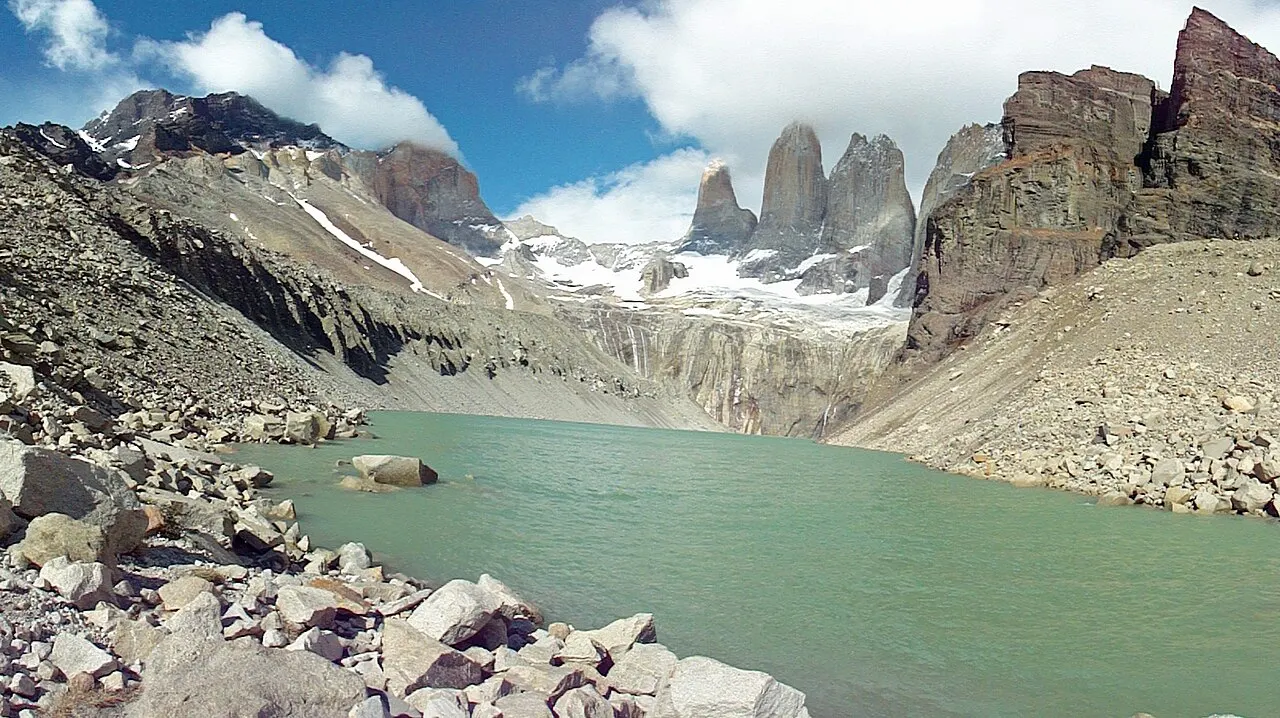
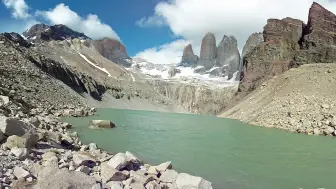
The viewpoint at the foot of the three granite towers. From Hotel Las Torres, CONAF counts 5 km and 2 hours to the Chileno refugio, another 3 km and 1 hour 30 minutes to the Torres guard station and 1.4 km and 1 hour of moraine to the viewpoint: about 4 hours 30 minutes of climbing. The last stretch is moraine terrain, which CONAF rates as demanding and with a risk of joint injury. The entry cutoff is counted at the Laguna Amarga gate and changes by month: in the 2025–2026 season bulletin, entry was until 10 a.m. in September, 9:30 a.m. in October and November, 10 a.m. from December to February and 9:30 a.m. in March and April, and exit from the viewpoint until 2 p.m., 3 p.m., 4 p.m. and 3 p.m., respectively. The 2026 fees and hours page lists a single pair, entry until 9 a.m. and exit at 3 p.m., without saying where it is counted from: check the hours in force before you go.
The view that gives the park its name: the three granite towers seen close up after about 4½ hours of climbing from Hotel Las Torres. Buy park admission in advance and confirm the entry cutoff and where it is counted, since the 2025–2026 season bulletin and the 2026 page differ.
Check access
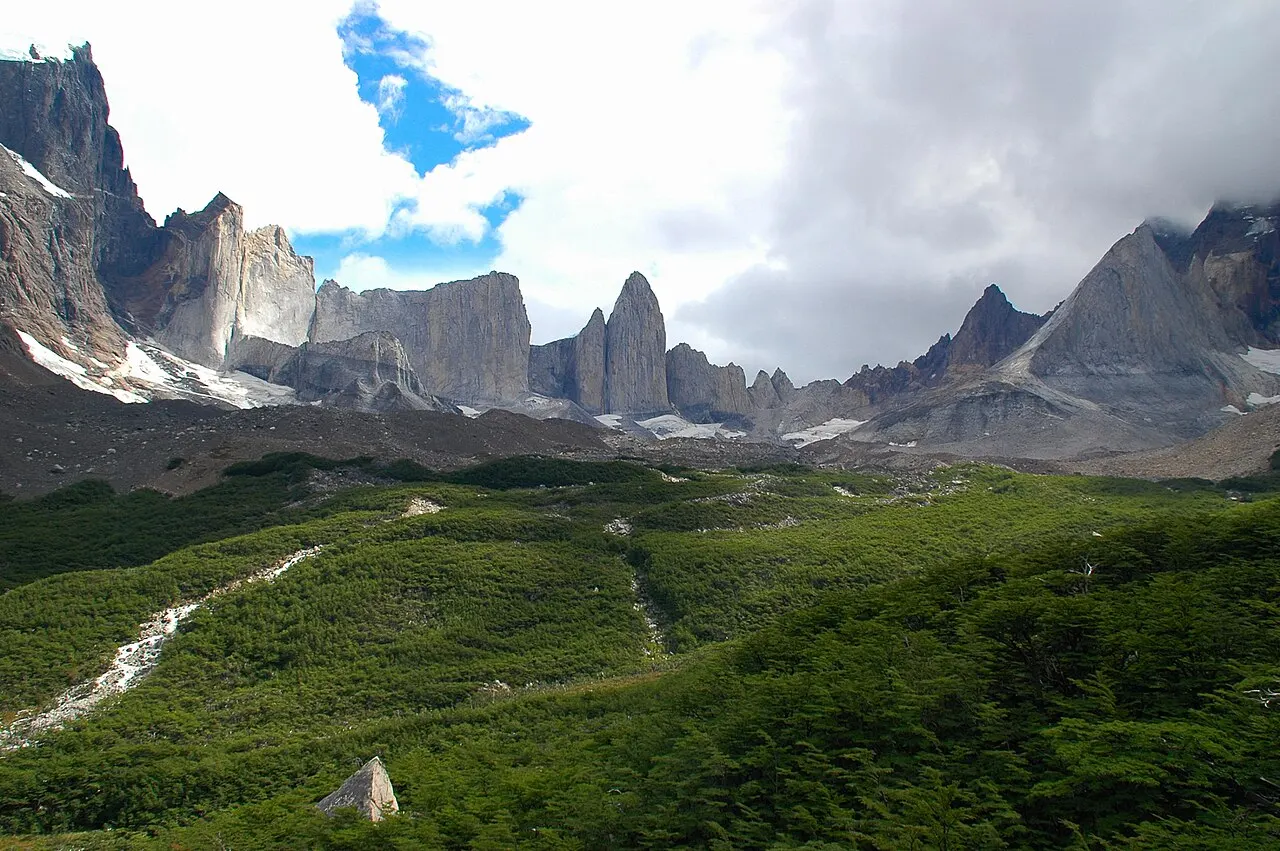
Valle del Francés and Mirador Británico
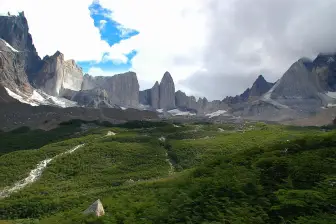
A valley between the Cuernos and Paine Grande, climbed from the Italiano campsite: 5.4 km and 3 hours to the Mirador Británico, rated demanding. In the 2025–2026 season bulletin, entry to the stretch was until 2 p.m. and exit from the viewpoint until 4 p.m. The CONAF Italiano campsite was closed, and the base used is the Francés campsite, 2 km and 30 minutes from Italiano.
The valley between the Cuernos and Paine Grande is the W’s most demanding stretch, with 5.4 km and 3 hours of climbing from Italiano to Mirador Británico. Walk it with a light pack, based on a reserved night at Francés.
Check access
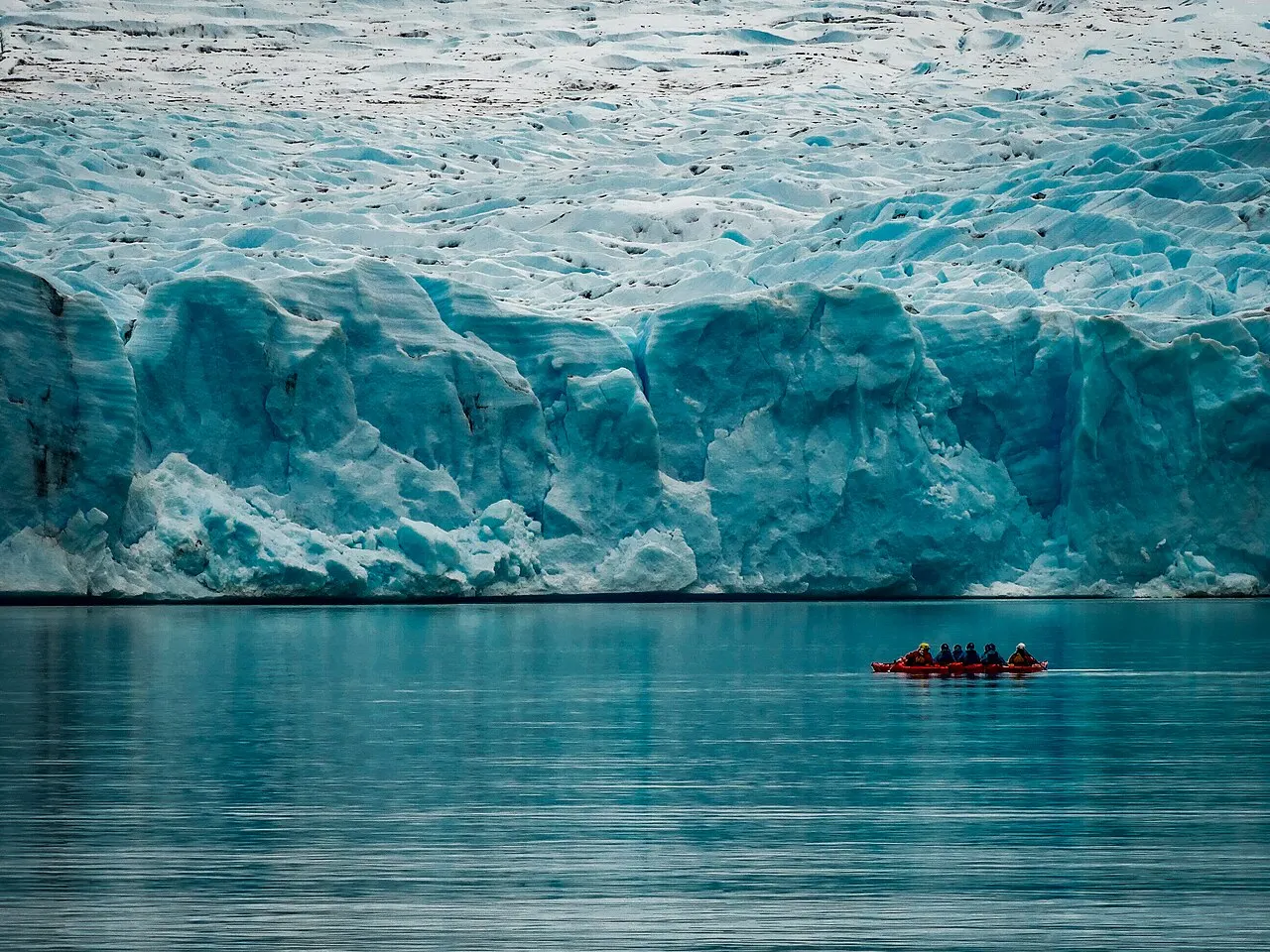
Grey Glacier
The tongue of ice that descends from the Southern Patagonian Ice Field to Lake Grey, in a front about 6 km wide split in two. You can see it three ways. On the W trail, it is 11 km and 3 hours 30 minutes from Paine Grande to the Grey refugio, and the 2025–2026 bulletin lists the Mirador Glaciar Grey in that mountain sector, with entry until 3 p.m. and exit until 5 p.m. The boat trip leaves from Hotel Lago Grey, lasts about 2 hours 45 minutes and starts with a 30 to 45 minute walk along the beach to the boat. On the road side, the Playa Grey trail has entry until 4 p.m. and exit until 7 p.m. in the same bulletin.
The glacier’s roughly 6 km front, split in two, is the western end of the W, where ice descending from the Southern Patagonian Ice Field ends in Lake Grey. Those not walking the W can see it on the boat trip from Hotel Lago Grey.
Check access
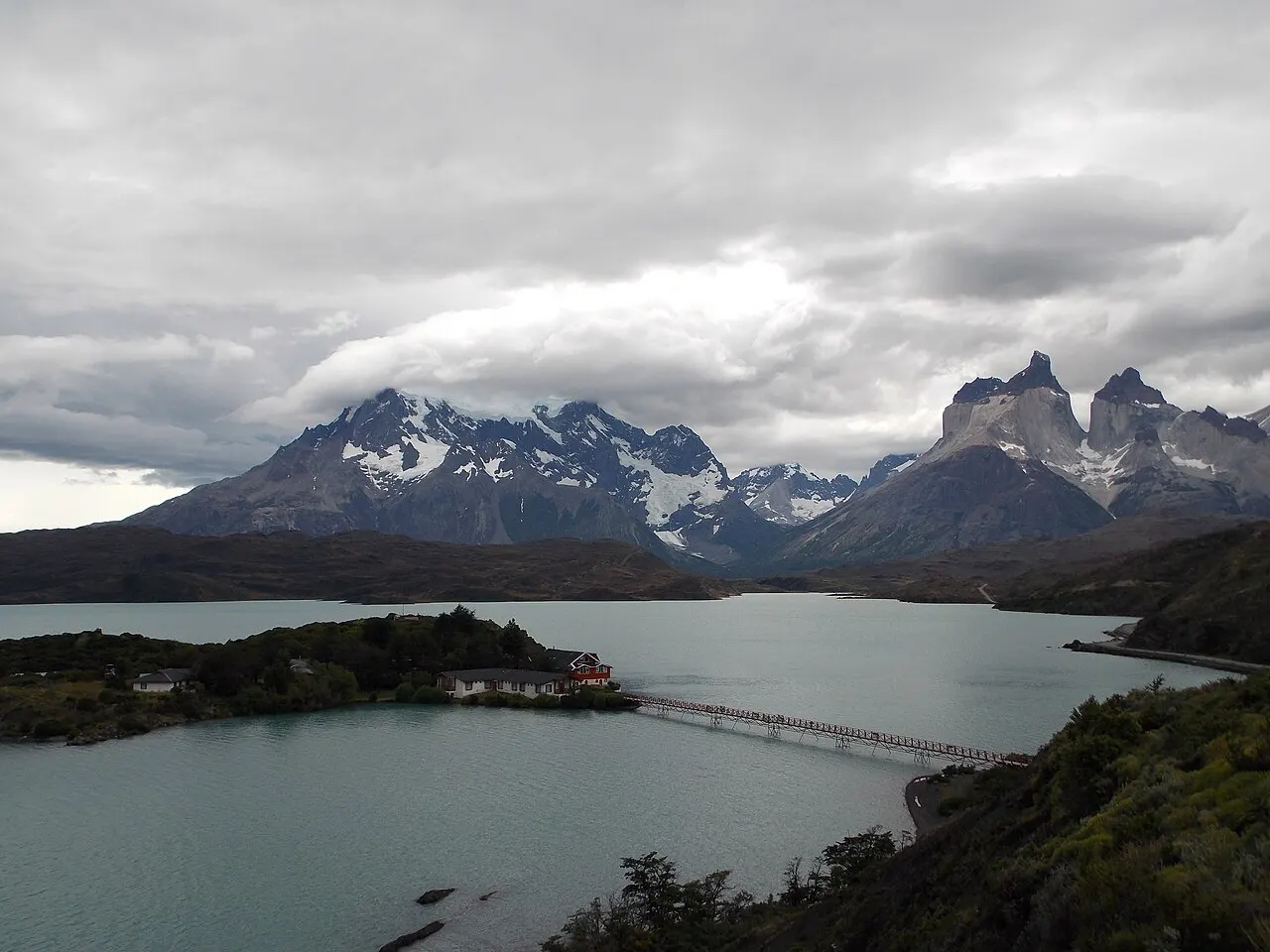
Lake Pehoé
The lake that separates Pudeto from Paine Grande, at the foot of the massif. The catamaran covers the roughly 11 km in about 30 minutes and links the road to the west side of the W. The official sales site is bookingpatagonia.travel, with times and prices by leg; Bus-Sur reports that tickets are sold at the dock, in cash. Check ahead and bring cash.
The catamaran crosses the lake in about 30 minutes, linking the road to the western side of the W. Official sales are through bookingpatagonia.travel, while Bus-Sur reports cash sales at the dock.
Check access
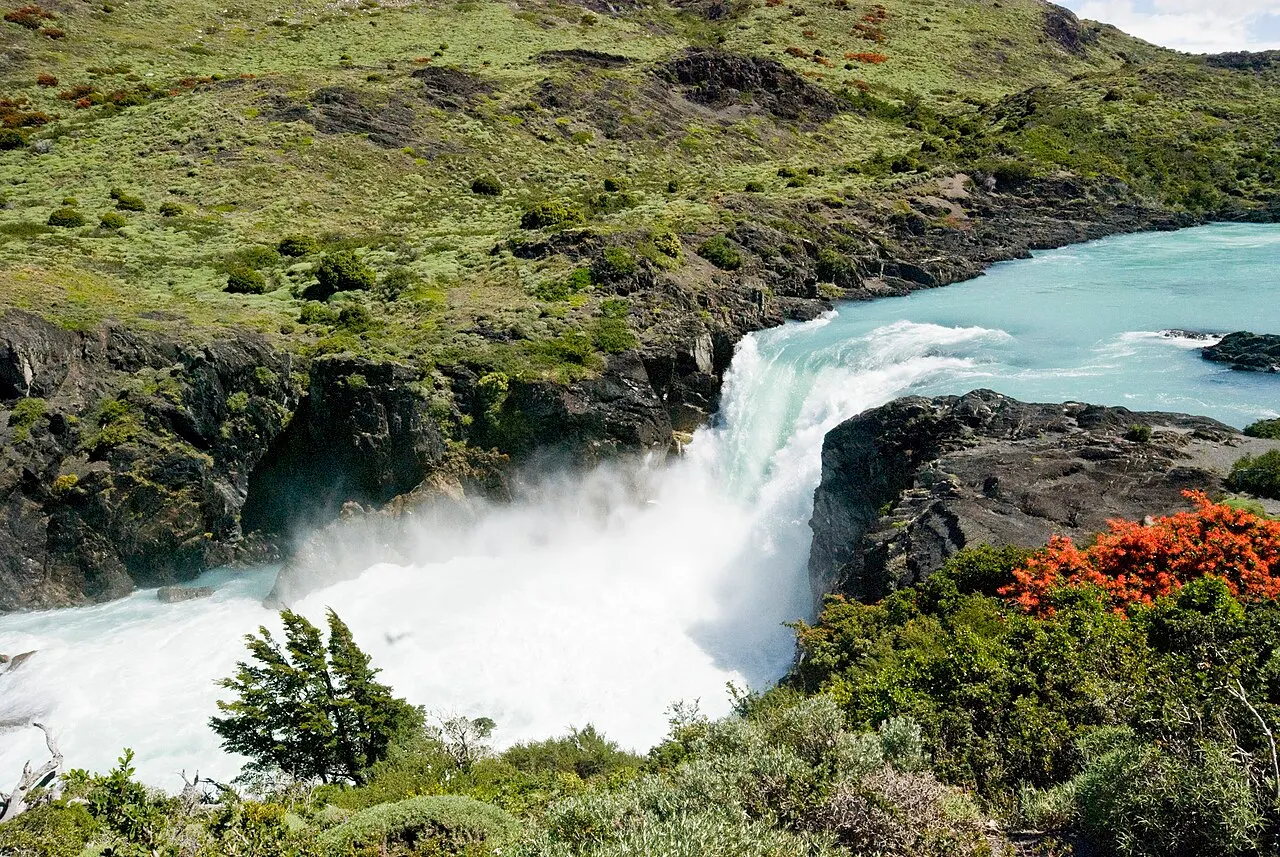
Salto Grande
The waterfall of the Paine River between lakes Nordenskjöld and Pehoé, a short walk from the Pudeto sector. In the 2025–2026 bulletin, entry to the trail was until 6 p.m. and exit until 6:30 p.m.
The Paine River waterfall is a short walk from Pudeto and fits the same outing as Mirador Cuernos, a good choice for those visiting the park by car.
Check access
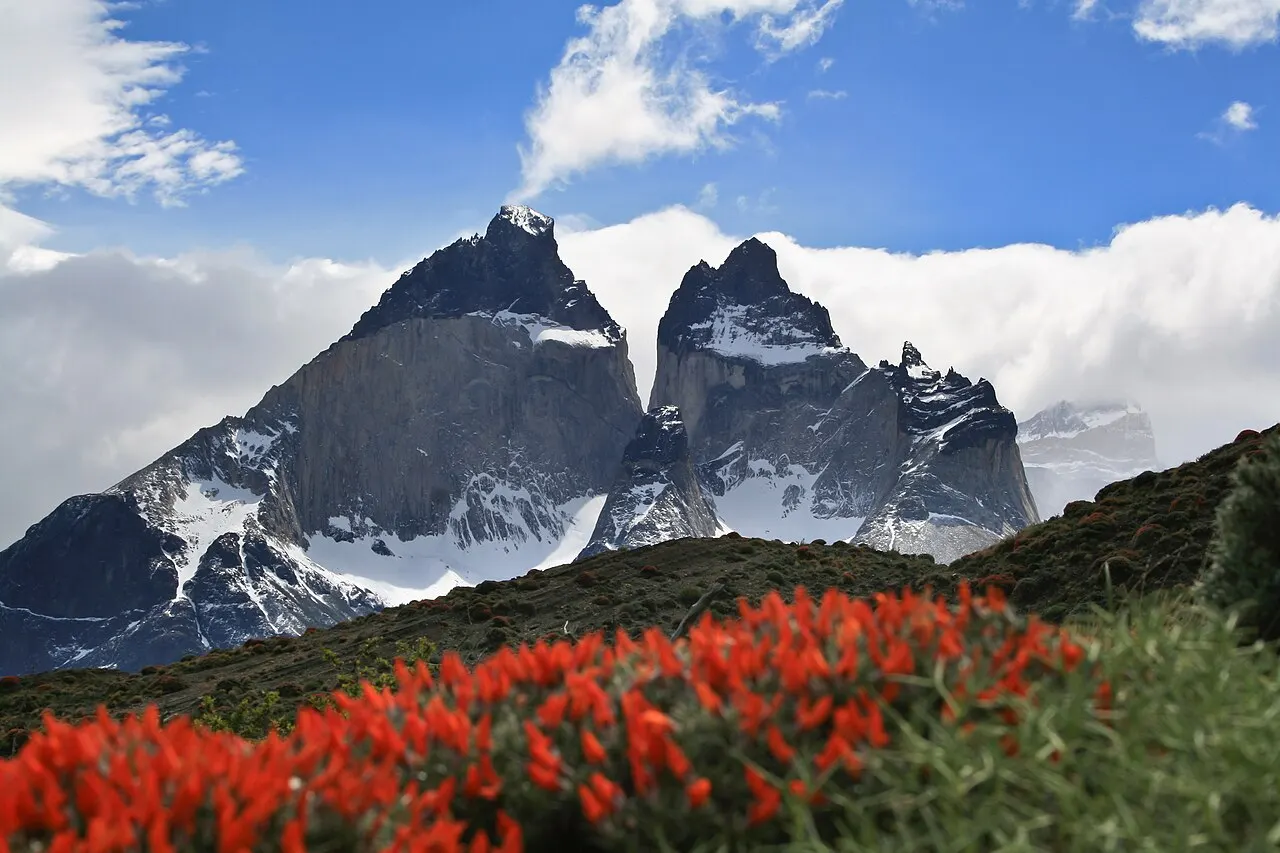
Mirador Cuernos
A continuation of the Salto Grande trail, on the shore of Lake Nordenskjöld, with the Cuernos del Paine straight ahead. In the 2025–2026 bulletin, entry was until 5 p.m.
A continuation of the Salto Grande trail, facing the Cuernos. For those not walking the W, it is a way to approach the massif on foot without an overnight reservation.
Check access
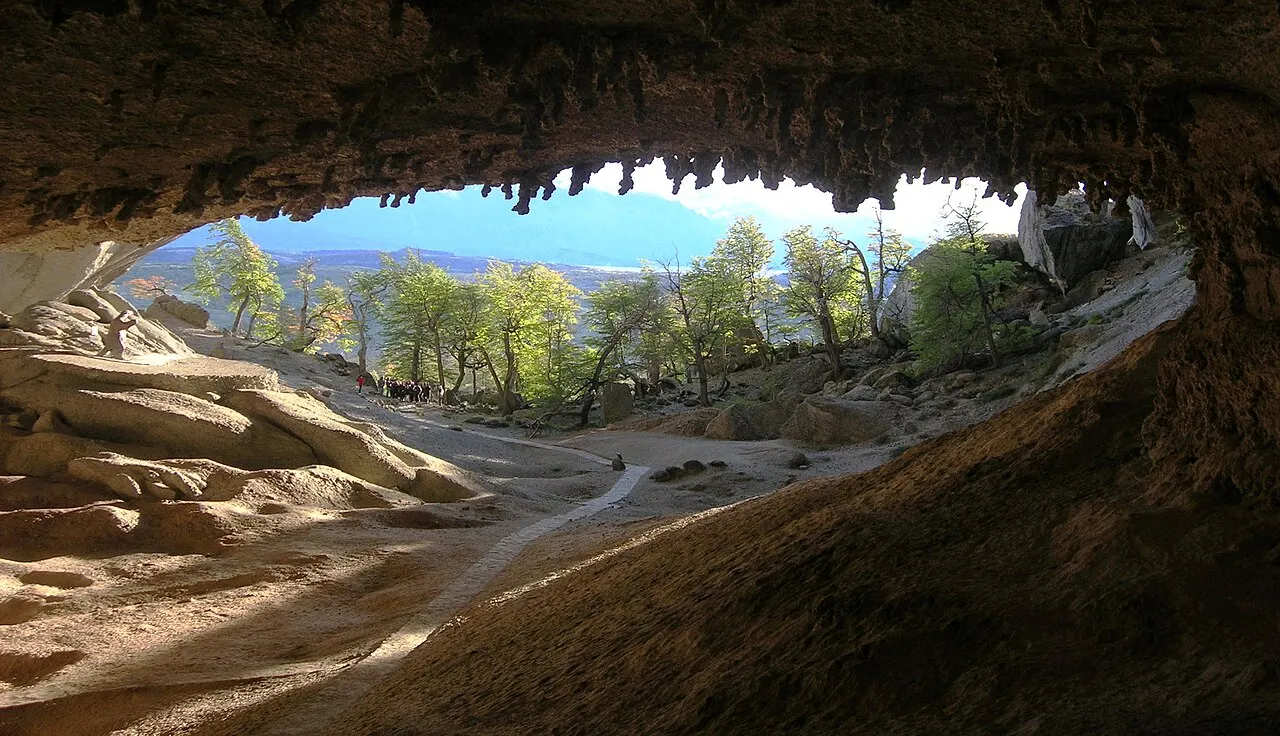
Cueva del Milodón Natural Monument
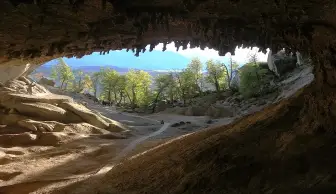
A cave about 30 m high, 80 m wide at the front and 200 m deep, 25 km north of Puerto Natales, where remains of Mylodon darwini, an extinct giant sloth, have been found since 1896. The Cueva Grande trail is 350 m long, takes 30 minutes and was designed for people with reduced mobility, and it accommodates wheelchairs with assistance up to the viewpoint inside the cave; the Cuevas y Aleros trail is 4.3 km. A section of the main trail is closed until December 31, 2026.
The 200 m-deep cave where Mylodon darwini remains were found lies 25 km from Natales and fits a morning before or after the park. Its trail was designed for assisted wheelchair access to the interior viewpoint, but a section of the main trail is closed until December 31, 2026; confirm what access is available.
Check access
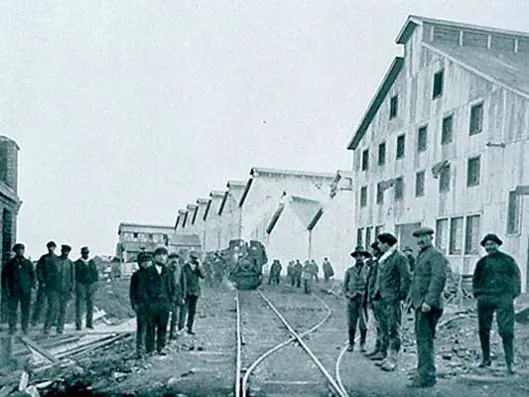
Puerto Bories
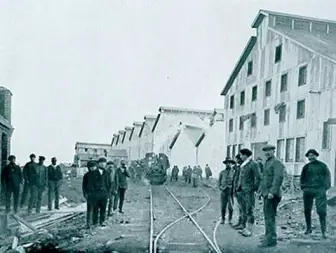
The old sheep meatpacking plant of the Sociedad Explotadora de Tierra del Fuego, in operation since 1915, with pavilions declared a National Monument in 1996. Today it is the hotel The Singular Patagonia, 5 minutes by car from Natales, and the plant museum is open to the public every day from noon to 5 p.m., with a CLP 10,000 entrance fee.
The meatpacking plant dating from 1915, a National Monument, explains Puerto Natales’ origins. Its museum opens to the public from noon to 5 p.m., with CLP 10,000 admission, and fits the arrival afternoon.
Check access
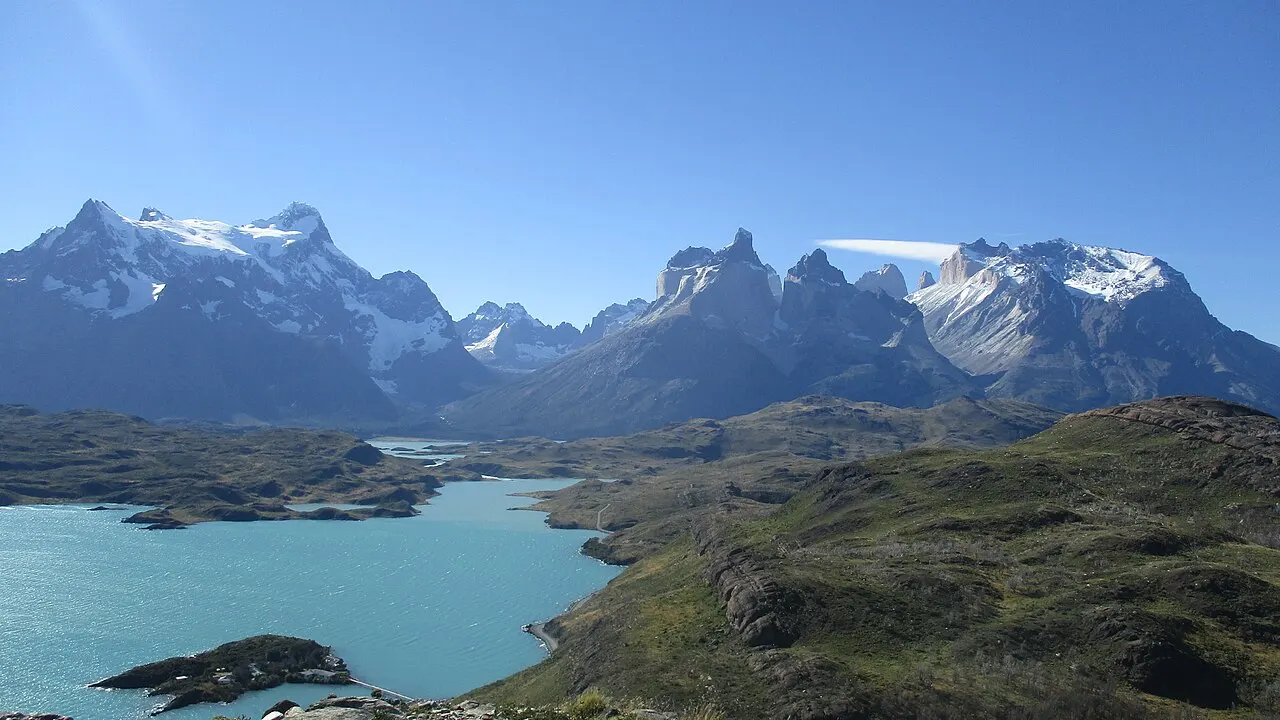
Mirador Cóndor
A viewpoint on the road near Hostería Pehoé, above Lake Pehoé. In the 2025–2026 bulletin, entry was until 4 p.m. Worth it for those who sleep in the roadside campsites and want to fill the end of the afternoon.
A viewpoint along the road near Hostería Pehoé, above Lake Pehoé. An extra stop for those staying at roadside campsites, but it adds little to what the W and Mirador Cuernos already show. In the 2025–2026 season bulletin, entry was until 4 p.m.; confirm the current hours before leaving the climb for late afternoon.
Check access
Nilo’s itinerary
Start with the basic programme and choose extensions for the time you have.
Plan my days in the app ↗Day 1 · Puerto Natales: bookings, shopping and Puerto Bories
Arrive in Puerto Natales by the aerodrome, 7 km to the north, or by bus from Punta Arenas, in 3 hours 15 minutes.
Confirm that you have the four nights booked in the park and the entry ticket bought at pasesparques.cl, saved as a screenshot.
In the center, buy the food for the trail days and rent whatever gear you're missing, such as poles and a stove.
Go to Puerto Bories, 5 minutes by car, for the plant museum, open from noon to 5 p.m. (CLP 10,000).
At the terminal on Avenida España, buy a one-way ticket for the 7 a.m. bus and sleep in Natales.
Day 2 · Pudeto, the catamaran and the trail to Grey
Take the 7 a.m. bus and get off at Pudeto, the second stop.
Cross Lake Pehoé on the catamaran to Paine Grande, in about 30 minutes. Buy the ticket and check the time at bookingpatagonia.travel, and bring cash, because Bus-Sur reports sales at the dock in cash.
Walk from Paine Grande to the Grey refugio, 11 km and 3 hours 30 minutes; in the 2025–2026 bulletin, entry on this stretch was until 3:30 p.m.
If the catamaran time doesn't let you leave Paine Grande before the cutoff, sleep at Paine Grande and swap days 2 and 3.
Sleep at the Grey refugio, the westernmost point of the W.
Day 3 · From Grey to the Francés campsite
Walk back from Grey to Paine Grande, 11 km and 3 hours 30 minutes.
Continue from Paine Grande to the Italiano campsite, 7.5 km and 2 hours 30 minutes.
Continue 2 km, about 30 minutes, to the Francés campsite; in the 2025–2026 bulletin, entry on the Paine Grande to Francés stretch was until 4 p.m.
Sleep at Francés, where you stay two nights.
Day 4 · The Valle del Francés to the Mirador Británico
Leave early with a light pack and go back to Italiano, 30 minutes.
Climb the Valle del Francés to the Mirador Británico, 5.4 km and 3 hours.
Respect the cutoff: in the 2025–2026 bulletin, entry on the stretch was until 2 p.m. and exit from the viewpoint until 4 p.m.
Come down the same way and sleep at Francés again.
Day 5 · Along the Nordenskjöld shore to the Central sector
Walk east along Lake Nordenskjöld to the Los Cuernos refugio. Francés is on the way between Italiano and Cuernos, 2 km from Italiano; from Italiano to Cuernos, CONAF counts 5 km and 2 hours 30 minutes, so from Francés to Cuernos about 3 km remain.
From Cuernos to Hotel Las Torres is another 11.6 km and 4 hours 30 minutes. Add the two stretches together before you set out: it is a long day.
Arrival times in this private sector are set by Las Torres: check with the operator.
Sleep at the Central refugio or campsite, next to Hotel Las Torres.
Day 6 · Mirador Base Torres and the return to Natales
Start before 7 a.m., with a headlamp and a windbreaker: it is about 4 hours 30 minutes of climbing to the viewpoint.
Before setting out, ask Las Torres where to leave your big pack: the operator says it has a tent where guests can store their pack while they climb to Base Torres.
Climb 5 km to the Chileno refugio, 3 km to the Torres guard station and the last 1.4 km of moraine to the viewpoint, at the foot of the towers.
Come down the same way and leave the viewpoint before the month's cutoff: 3 p.m. or 4 p.m. in the 2025–2026 bulletin, depending on the month, and 3 p.m. on the 2026 page.
Report to the Centro de Bienvenida 30 minutes before the bus departs, as Bus-Sur asks, and pay for the minibus to Laguna Amarga in cash.
Return to Natales on the bus that passes Laguna Amarga at 8:15 p.m. and arrives at 9:30 p.m.

If you stay longer
Day 7 · Cueva del Milodón Natural Monument
Day trip
25 km north of Puerto Natales: 17 km on Ruta 9 Norte to the turnoff and another 8 km on Ruta Y-290 to the parking lot, by car, taxi or agency tour. The Cueva Grande trail takes 30 minutes; the Cuevas y Aleros trail, 4.3 km, 3 to 4 hours. It fits in a morning before or after the park.
Food
Magellanic lamb
Lamb is the base of Chilean Patagonian cooking, a legacy of the sheep ranches that founded the economy of Última Esperanza. Patagonia is the region of Chile where lamb weighs most on the table, alongside seafood and wild fruits.
Centolla
The king crab of the cold waters of southern Chile, which reaches about 19 cm of carapace and is the crustacean of greatest culinary importance in the Magallanes region. Chupe de centolla is one of the Chilean ways of serving it.
Calafate
The dark blue berry of a thorny Patagonian shrub. In Magallanes it becomes chocolate, jam, syrup and liqueur, sold in the shops in the center of Natales.
Mate
The yerba mate infusion drunk from a gourd with a bombilla, common in the rural areas of southern Chile and Chilean Patagonia, unlike the rest of the country, which prefers black tea.
Baguales beer
The craft beer of Puerto Natales, served at the Baguales brewpub, across from the Plaza de Armas, which presents itself as the first brewpub in Patagonia, from 2010.
Trail food
At the Vértice refugios there is a restaurant and a minimarket, except at Los Perros, which only has a minimarket. Campers usually buy their trail food in Natales and bring a gas stove, because wood fires are prohibited.
Where to eat
- Baguales Brewpub · Puerto Natales center · $$
The house craft beer and pub food, across from the Plaza de Armas, at Bories 430.
Source · 2026-10-15
- Paine Grande, Grey and Dickson · $$$
Restaurant and bar of the Vértice refugios, in all its sectors except Los Perros, where there is only a minimarket.
- Pudeto · $
The sector's cafeteria, at the catamaran exit, for those visiting the park by car.
- Camping Pehoé and Camping Serrano · $$
Restaurants at the roadside campsites, open in season.
$: coffee, a snack and food bought at a Natales supermarket · $$: a main course at a restaurant or parrilla in the center of Natales · $$$: a meal at a refugio or hotel restaurant inside the park · 2026-10-15
Day trips
Cueva del Milodón Natural Monument
25 km north of Puerto Natales: 17 km on Ruta 9 Norte to the turnoff and another 8 km on Ruta Y-290 to the parking lot, by car, taxi or agency tour. The Cueva Grande trail takes 30 minutes; the Cuevas y Aleros trail, 4.3 km, 3 to 4 hours. It fits in a morning before or after the park.
Mirador Base Torres without sleeping in the park
If you don't have a reservation to sleep, you can climb to Base Torres in a day, because the mandatory reservation applies only to overnight stays. The 7 a.m. bus takes about 2 hours to the Laguna Amarga gate, where the entry cutoff is counted; from there, the minibus takes another 25 minutes to the Centro de Bienvenida, and the climb from Hotel Las Torres takes about 4 hours 30 minutes. By the 2025–2026 bulletin, from December to February (entry until 10 a.m. and exit from the viewpoint at 4 p.m.) the bus arrives with room to spare, and the day closes with the 8:15 p.m. return. In October, November, March and April (9:30 a.m. and 3 p.m.) the margin is short, and if the 2026 page's pair applies, entry until 9 a.m., the scheduled bus arrives right at the limit: then an agency tour that leaves earlier is safer.
A drive around the park
CONAF calls the route by car or tour through the interior of the park the full day, with six viewpoints on the road. It combines Salto Grande and Mirador Cuernos, at Pudeto, with Lake Pehoé and Lago Grey, and suits those who are not going to hike for several days. There is no fuel in the park: leave Natales with a full tank.
Where to begin
Puerto Natales: bookings, shopping and Puerto Bories
Arrive in Puerto Natales by the aerodrome, 7 km to the north, or by bus from Punta Arenas, in 3 hours 15 minutes.
Pudeto, the catamaran and the trail to Grey
Take the 7 a.m. bus and get off at Pudeto, the second stop.
The Valle del Francés to the Mirador Británico
Leave early with a light pack and go back to Italiano, 30 minutes.
Along the Nordenskjöld shore to the Central sector
Walk east along Lake Nordenskjöld to the Los Cuernos refugio. Francés is on the way between Italiano and Cuernos, 2 km from Italiano; from Italiano to Cuernos, CONAF counts 5 km and 2 hours 30 minutes, so from Francés to Cuernos about 3 km remain.
Mirador Base Torres and the return to Natales
Start before 7 a.m., with a headlamp and a windbreaker: it is about 4 hours 30 minutes of climbing to the viewpoint.
Money
The currency is the Chilean peso (CLP, written $), at about 1,096 per euro on September 24, 2026. What defines the trip's cost is the park: entry, lodging in the mountains and transport. In CONAF's 2026 fee table, a foreign adult pays CLP 32,400 for the one-day pass and CLP 48,500 for the pass of more than two days, and a Chilean adult pays CLP 9,400 and CLP 14,200; children under 12 do not pay. Entry is bought online only, at pasesparques.cl, by card, at least 24 hours ahead. In the park, bring cash: the minibus from Laguna Amarga to the Centro de Bienvenida charges in cash (CLP 4,500 or US$6 per leg in the 2025–2026 bulletin), and the Pehoé catamaran, which Vértice cites at CLP 35,000 per leg in August 2026, sells online at bookingpatagonia.travel and, according to Bus-Sur, at the dock, in cash. The bus from Natales to the park, round trip, costs CLP 17,000 by the same source. The refugios and campsites sell beds, tent pitches, equipped tents and meals, with prices on each operator's site; Vértice's complete W package, 5 days and 4 nights with transport, entry, catamaran, lodging and food, started at CLP 1,123,000 in August 2026. In Puerto Natales, the Puerto Bories museum charges CLP 10,000.
Getting there and around
Getting to Puerto Natales
The Teniente Julio Gallardo aerodrome (PNT) is 7 km north of Puerto Natales. Sky Airline has flown nonstop to Santiago and Puerto Montt year-round since 2023, and LATAM flies from Santiago in high season; check the year's routes with the airlines. The other gateway is Punta Arenas (PUQ), 247 km away: Bus-Sur buses cover the stretch in 3 hours 15 minutes, with several departures a day. By sea, Navimag connects Puerto Natales with Puerto Montt once a week. From Argentina, the Río Don Guillermo border crossing, in Villa Cerro Castillo, is 52 km from the park's Sarmiento gate, according to CONAF.
Buses from Puerto Natales to the park
Buses leave from the bus terminal at Avenida España 1455, in Natales: Bus-Sur, Buses Base Torres, Buses JB, Buses Gómez and Turismo Zaahj. Bus-Sur lists daily departures at 7 a.m. and noon and about 2 hours to the first stop, the Laguna Amarga gate; then they continue to Pudeto, the administration headquarters and Hotel Lago Grey. On the way back, Bus-Sur buses pass Laguna Amarga at 3 p.m. and 8:15 p.m. and reach Natales at 4:30 p.m. and 9:30 p.m. Vértice cites CLP 17,000 round trip (August 2026); check the price when you buy.
Inside the park
From the Laguna Amarga gate to the Las Torres Centro de Bienvenida it is 7 km and about 25 minutes on a minibus that, in the 2025–2026 bulletin, charged CLP 4,500 or US$6 per leg, in cash. The Lake Pehoé catamaran links Pudeto to Paine Grande in about 30 minutes; Vértice cites CLP 35,000 per leg (August 2026). The official sales site is bookingpatagonia.travel, where the times are posted; Bus-Sur reports that tickets are sold at the dock, in cash. There is no gas station inside the park or near it, and, according to CONAF, cell signal exists only in Villa Monzino. Between sectors, you get around on foot: bicycles are not allowed on the W and O trails.
In Puerto Natales
The town is small and you get around on foot; the bus terminal is a walk from the center. For the Cueva del Milodón, 25 km away, and for Puerto Bories, you need a car, a taxi or an agency tour.
Safety
The risks CONAF highlights in the park are weather, rivers and terrain. The wind blows hard all year and reaches 150 km/h in gusts: in February 2016, a bus overturned in the wind and eleven passengers were injured. The weather changes fast, with rain, wind and snow on the same day, so bring layers and don't hike in the dark, which is prohibited, or alone, which CONAF advises against. On the interior trails there is no cell signal or internet, and the nearest medical center is in Puerto Natales. Respect the cutoff times and don't cross a river with water above the knee. Swimming is prohibited in all lakes, lagoons and rivers of the park, because of the high risk of drowning, according to CONAF. If you meet a puma, don't run: back away slowly looking at it, stand up straight, look bigger, make noise and pick up children. In an emergency, call 133 (Carabineros), 131 (ambulance) or 132 (fire department); for a wildfire, the CONAF number is 130, and in the park the emergency radio frequency is VHF 143.800 MHz. In winter, the road has ice and frost along much of the route, and CONAF recommends studded tires.
Etiquette tips
Register at every ranger station
CONAF requires registration on arrival at every ranger station. At the Paso and Los Perros campsites, on the O Circuit, you must also report your departure.
No fire, not even for cooking
Any heat source outside designated areas is prohibited by Law 20,653, with a fine of up to CLP 2,000,000 or up to three years in prison. Cook only with a stove that does not burn plant material and only where the park allows it.
Don't leave the trail or camp outside marked areas
Any activity off the official trails is prohibited, and you may only spend the night in designated areas. Watch wildlife only in daylight and from the trail.
Take your trash back out
All trash produced during the visit leaves the park with you; the fine goes up to CLP 200,000 under Law 21,123.
No speaker music and no drones
The park does not allow music on speakers. Recreational drones are prohibited, and anyone using one is expelled and reported to the aeronautical authority.
Facing a puma
Stay calm, do not approach and do not run; back away slowly while looking the animal in the eyes, stand up straight, try to look bigger and make noise. With children, pick them up and don't let them run. This is CONAF's guidance. Do not feed or disturb any animal.
Mistakes to avoid
Arriving without a booking to sleep
Counting on a spot at the last minute. To do the W or the O, a refugio or campsite reservation is mandatory before arriving, and without it you can't enter the mountain area. In January and February the spots go first.
Leaving the entry ticket to buy at the gate
Park entry is bought online, at pasesparques.cl, at least 24 hours ahead. There is no internet at the gate: bring the receipt printed or as a screenshot.
Planning the W with the CONAF campsites
In the 2025–2026 season, the free CONAF campsites (Torres, Italiano and Paso) were closed. The nights of the W are in the Las Torres and Vértice refugios and campsites.
Not checking the Base Torres cutoff for your month of travel
The latest entry time, counted at the Laguna Amarga gate, and the exit time from the viewpoint change by month, and the park ranger only authorizes hiking outside the hours in an exceptional situation. In the 2025–2026 bulletin, exit from the viewpoint ran from 2 p.m. in September to 4 p.m. in summer; the 2026 page lists entry until 9 a.m. and exit at 3 p.m. Check the hours in force before you fix the day.
Booking the O Circuit for October
The O closes in winter. In 2026 it has been closed since May, initially until October 31, and in the previous season it opened from November 1 to March 31.
Crossing a swollen river
After heavy rain or snowmelt, the rivers rise. CONAF advises not to cross if the water goes above knee height.
Useful phrases
Tengo reserva en el refugio
I have a reservation at the refugio. What you say at the ranger station when you register
¿A qué hora sale el último bus a Natales?
What time does the last bus to Natales leave?
¿Se paga en efectivo?
Do you pay in cash? Useful on the minibus and the catamaran
¿Está abierto el sendero?
Is the trail open? Rangers close stretches in extreme wind or flooding
¿Hasta qué hora puedo subir?
Until what time can I go up? The question about the cutoff time
Where to stay
- Puerto Natales center · Those arriving the day before the park who want to sort everything out on foot · $: It concentrates hostels, gear rental, a supermarket and the bus terminal within a walk. It is where you sleep before catching the 7 a.m. bus.
- Costanera and Puerto Bories · Those who want comfort and a view of Seno Última Esperanza before or after the trail · $$$: The waterfront and the old Puerto Bories meatpacking plant, now a hotel, are outside the core of the center and call for a taxi to the terminal.
- Central sector (Las Torres) · Those who will climb to the Mirador Base Torres early · $$: Las Torres refugio and campsite next to Hotel Las Torres, at the foot of the Base Torres trail. It requires a reservation, like every overnight stay in the mountain area.
- Paine Grande and Grey · Those doing the west side of the W · $$: Vértice refugios and campsites, with a restaurant, a minimarket and gear rental. Paine Grande is at the catamaran dock; Grey, at the far west end of the W.
- Camping Pehoé and Camping Serrano · Those traveling by car or motorhome who are not doing the W · $: Roadside campsites, with bathrooms and showers and, depending on the season, a restaurant, outside the mandatory reservation rule of the mountain area. They are far from the Base Torres trails.
- Roadside hotels in the park · Those who want to sleep inside the park with car access · $$$: Hotel Las Torres, Hotel Lago Grey and Explora were in operation in the 2025–2026 bulletin. Hotel Las Torres is at the foot of the Base Torres trail, and Lago Grey is the departure point for the boat trip to the glacier.
$: a dorm bed at a hostel in Natales or a spot at a roadside campsite · $$: a private room in Natales or a bed in a W refugio · $$$: a roadside hotel inside the park or a hotel in Puerto Bories · 2026-10-15
Districts
Puerto Natales center
The blocks around the Plaza de Armas and Bories and Eberhard streets, with hostels, gear rental shops, supermarkets and restaurants. This is where you sleep before and after the park and where you buy your trail food.
Costanera and Puerto Bories
The Pedro Montt street waterfront, open to Seno Última Esperanza, continues to Puerto Bories, about 5 minutes by car, where the old meatpacking plant now operates as a hotel and museum.
Laguna Amarga and the Las Torres sector
The east gate, where the buses from Natales stop, and, 7 km further on, the Las Torres reserve's Centro de Bienvenida, Hotel Las Torres and the Central sector. The trail to the Mirador Base Torres starts here.
Cuernos and Francés
The middle stretch of the W, on the shore of Lake Nordenskjöld, with the Los Cuernos and Francés refugios and campsites. It is the base for climbing the Valle del Francés.
Pudeto and Paine Grande
The two sides of Lake Pehoé, linked by the catamaran: Pudeto, on the road, with the bus stop, the cafeteria and the short trails to Salto Grande and Mirador Cuernos; Paine Grande, on the other side, with a refugio, a campsite and the start of the trail to Grey.
Grey and Lago Grey
The far west end of the W, with the Grey refugio on the shore of Lake Grey. By road, on the other side of the lake, are Hotel Lago Grey and the beach where the boat trip to the glacier departs.
Administration headquarters and roadside campsites
The CONAF administration headquarters, with the environmental information center. Along the road are also the Serrano and Pehoé campsites, which you reach by car. According to CONAF, the park's only cell signal is in Villa Monzino (Movistar), where there is also a public phone.
History
about 10,000 BC · The first inhabitants of the Cueva del Milodón
CONAF dates human presence in the Cueva del Milodón, 25 km north of Puerto Natales, to about 12,000 years ago; the cave also held remains of Mylodon darwini, an extinct herbivorous giant sloth.
before 1870 · Aonikenk territory
The steppe east of the Paine massif was the land of the Aonikenk, or Tehuelche, with records of occupation going back more than 3,500 years. The word paine means “blue” in their language.
1557 · Ladrillero in the channels
The Spanish navigator Juan Ladrillero explores the channel region where Puerto Natales would be founded three and a half centuries later.
1870–1900 · Colonization and sheep ranches
Colonization from about 1870 leads to the expulsion and disappearance of the Aonikenk from the area. Around 1900, the land of today's park is divided into 12 livestock properties, from 600 to over 10,000 hectares.
1893–1896 · Eberhard and the milodon cave
The German settler Hermann Eberhard begins the European occupation of Última Esperanza in 1893 and, exploring the lands he was granted, finds the cave now called Cueva del Milodón. Remains of Mylodon darwini are found from 1896.
1911 · Founding of Puerto Natales
Decree No. 832, of May 31, 1911, creates the settlement of Puerto Natales at the mouth of the Natales River, named in 1894 because it was sighted on a December 24.
1915–1919 · The Puerto Bories meatpacking plant
The Sociedad Explotadora de Tierra del Fuego puts the Puerto Bories meatpacking plant into operation in 1915, processing the sheep from the ranches. In January 1919, a labor dispute at the plant ends in repression.
1959 · The national park is born
On May 13, 1959, under the government of Jorge Alessandri, the first protected area around the Paine massif is created.
1958–1963 · The first climbs of the towers
Guido Monzino's expedition reaches the summit of the North Tower in 1958. In 1963, Chris Bonington and Don Whillans climb the Central Tower, and Armando Aste, the South Tower.
1977–1978 · Monzino's donation and UNESCO
Monzino donates 12,000 hectares to the Chilean state in 1977, and the park's final boundaries are set. On April 28, 1978, UNESCO declares the park a Biosphere Reserve.
1985–2012 · Three fires caused by visitors
A cigarette butt not put out properly in 1985, a knocked-over camp stove in 2005 and toilet paper burned in a prohibited place at the end of 2011 start the park's three big fires. The 2011–2012 fire burned about 17,600 ha.
2024–2026 · Record visitors and the O Circuit closed
The park received 367,426 visitors in 2024, after the drop of 2020 and 2021. In May 2026, CONAF closed the Circuito Macizo Paine, the O, initially until October 31, 2026.
Complete history
Before the sheep
The steppe you now cross by bus between Puerto Natales and the park was for millennia the territory of the Aonikenk, hunters who followed the guanacos and have records of occupation going back more than 3,500 years. Before them, about 12,000 years ago, people sheltered in the Cueva del Milodón, the same cave where the skin and bones of an extinct giant sloth were found. The massif's name comes from this history: paine means “blue” in the Aonikenk language, and the color makes sense in front of the lakes and ice that surround the towers.
The ranches and the meatpacking plant
The colonization of the region, from about 1870, expelled the Aonikenk, who disappeared from the area, and reached Última Esperanza in 1893, with the German settler Hermann Eberhard. Within a few decades, the land was divided into sheep ranches. Puerto Natales was born in 1911 in the middle of that economy: the Puerto Bories meatpacking plant, run by the Sociedad Explotadora de Tierra del Fuego, began operating in 1915, linked to the town by a railway, and in January 1919 a labor dispute there ended in repression. Four of the plant's pavilions and the wooden pier have been a National Monument since 1996 and now house a hotel and a museum open to the public.
From pasture to park
The area around the massif became a national park in 1959, and the donation of 12,000 hectares by Guido Monzino, whose expedition climbed the North Tower in 1958, set the current boundaries in 1977. In the meantime, the land reform of Eduardo Frei Montalva's government (1964–1970), with the 1967 law, weakened livestock farming, and many Natales workers went to the Río Turbio coal mines, across the Argentine border. Part of the most visited trail is still on private land: the stretch from Hotel Las Torres to the base of the towers crosses the Las Torres reserve, which operates the sector's refugios and campsites.
Tourism, fire and limits
The park went from 197,503 visitors in 2014 to 367,426 in 2024, and Puerto Natales grew along with it, with tourism as the main engine of its economy. The price of that success is marked on the landscape: three fires caused by visitors, in 1985, 2005 and 2011, burned whole stretches of forest and steppe, and the response was a simple rule, the ban on any heat source outside designated areas, with fines and prison provided for by law. The other response was mandatory booking: today only those with a place reserved in a refugio or campsite sleep in the mountain area, and CONAF publishes cutoff times for each trail.
The remains of a giant sloth found in the Cueva del Milodón, near Natales, led Bruce Chatwin to write In Patagonia.
Geography and shape of the city
The massif and the granite
The Paine massif is a laccolith, a body of magma that pushed into sedimentary rock and cooled inside it about 12.5 million years ago. Erosion exposed the pale, steep granite walls, and on part of the massif the dark sedimentary rock, folded in the Cretaceous, remains on top. The Cuernos del Paine reach about 2,100 m. The three towers are about 2,500 m (the South), 2,460 m (the Central) and 2,260 m (the North), and the highest point of the massif is Paine Grande, measured by GPS in 2011 at 2,884 m.
Ice to the west, steppe to the east
To the west, the Southern Patagonian Ice Field feeds the Grey, Dickson, Zapata and Tyndall glaciers. Grey ends in the lake of the same name in a front about 6 km wide, split in two, and sheds blocks of ice that float on the lake. To the east lies the cold steppe, with up to about 400 mm of rain a year according to CONAF, where guanacos, rheas and pumas live; the park also has Andean scrub and lenga forest. CONAF counts more than 274 plant species and 126 bird species in the park.
Puerto Natales and the wind
Puerto Natales sits at 3 m elevation, at the mouth of the Señoret Channel, between the Almirante Montt Gulf and Seno Última Esperanza, 247 km north of Punta Arenas. The town is compact and faces the water, with the costanera along Pedro Montt street. The wind blows from the west and southwest all year: in Natales the average is 15 to 20 km/h, with summer storms of up to 120 km/h, and in the park gusts reach 150 km/h.
Paine means “blue” in the language of the Aonikenk, who lived on the steppe east of the massif.
Culture
Ranch culture
The identity of Última Esperanza came out of the sheep ranches and the Puerto Bories meatpacking plant: livestock dominated the region's economy in the first half of the 20th century. Mate in the countryside, lamb and the plant's pavilions, now a museum, are what remains in view of that era.
Mountaineering and travel writing
The towers have drawn climbers since the 1950s: Guido Monzino in 1958, Chris Bonington and Don Whillans in 1963, and in 2017 the first free climb of the roughly 1,200 m wall of the Central Tower, by Nico Favresse, Siebe Vanhee and Sean Villanueva O'Driscoll. The Cueva del Milodón entered literature in 1977, with In Patagonia, by Bruce Chatwin, who set off in search of a piece of milodon skin sent by a relative, and returned to the screen in 2019 in Werner Herzog's documentary about Chatwin.
Festivals and events
Fiestas Patrias, September 18 and 19
Chile's national holidays commemorate the first government junta of 1810 on September 18, and the army on the 19th; depending on the year, the holiday extends to a neighboring day. They are celebrated with fondas, the festival tents with food and music, cueca, the national dance, asado and empanadas.
Start of the trekking season, September to November
It isn't a festival, but it is the calendar that Natales and park services depend on: in the 2025–2026 season, Las Torres opened the Centro de Bienvenida on September 1, buses to the park resumed between September and November, and the O Circuit opened on November 1.
Books and films
In Patagonia (1977), Bruce Chatwin
Chatwin sets off in search of a piece of milodon skin that Charles Milward, a relative of the family, had sent from southern Chile, and the journey passes through Punta Arenas, Puerto Natales and the Cueva del Milodón. It explains why this cave became a destination.
Nomad: In the Footsteps of Bruce Chatwin (2019), Werner Herzog
The documentary's first segment returns to Punta Arenas, the Cueva del Milodón and Seno Última Esperanza, and shows the landscape that Chatwin described.
Frequently asked questions
Torres del Paine: How do you get to Puerto Natales and the park?
The Puerto Natales aerodrome (PNT) is 7 km north of town, and from Punta Arenas (PUQ), 247 km away, Bus-Sur buses take 3 hours 15 minutes. From Natales to the park, Bus-Sur lists daily departures at 7 a.m. and noon and about 2 hours to the Laguna Amarga gate.
Torres del Paine: How much is the park entrance?
In CONAF's 2026 fee table, a foreign adult pays CLP 32,400 for the one-day pass and CLP 48,500 for the pass of more than two days; children under 12 don't pay.
Torres del Paine: How many days should you stay?
Six days: one in Puerto Natales to sort out bookings, food and gear, and five on the W circuit, with four nights in the park. The O Circuit takes eight or nine days, includes the W and only opens from November to March. In 2026, CONAF closed it initially until October 31; confirm reopening through the official channels before booking.
Torres del Paine: Can you climb to Base Torres without sleeping in the park?
Yes, because the mandatory reservation applies only to overnight stays. The 7 a.m. bus takes about 2 hours to Laguna Amarga, where the entry cutoff is counted; from there it is another 25 minutes by minibus to the Centro de Bienvenida and about 4 hours 30 minutes uphill from Hotel Las Torres. The December-to-February margin depends on the 2025–2026 bulletin’s 10 a.m. cutoff; the 2026 page lists 9 a.m., when the bus arrives at the limit. Confirm the current cutoff; a tour leaving earlier may be needed.
Torres del Paine: When is the best time to go?
November to March, when all the refugios and campsites run by the operators on the W and the O Circuit were open in the 2025 to 2026 season; January and February are the busiest months, and from May to September there is snow on the trails and several stretches of the W can only be done with a guide.
Other cities in the country
Chile ↗- Days
- 2–3
- When
- Mar–May · Sep–Nov
- Per person/day
- Average 110,000 CLPMid-range · per person/day
Cost scope
Per person per day: accommodation, meals, urban transport, visits and a small allowance for extras. Flights excluded; larger purchases vary. Editorial estimate, not a quote.
- Days
- 1–2
- When
- Jan–Mar · Nov–Dec
- Per person/day
- Average 80–130 USDMid-range · per person/day
Cost scope
Per person per day: accommodation, meals, urban transport, visits and a small allowance for extras. Flights excluded; larger purchases vary. Editorial estimate, not a quote.
- Days
- 4–5
- When
- Apr–May · Sep–Nov
- Per person/day
- Average 66,200 CLPMid-range · per person/day
Cost scope
Per person per day: accommodation, meals, urban transport, visits and a small allowance for extras. Flights excluded; larger purchases vary. Editorial estimate, not a quote.
- Days
- 4
- When
- Jan–Apr · Oct–Dec
- Per person/day
- Average 93,600 CLPMid-range · per person/day
Cost scope
Per person per day: accommodation, meals, urban transport, visits and a small allowance for extras. Flights excluded; larger purchases vary. Editorial estimate, not a quote.
- Days
- 3
- When
- Jan–Apr · Oct–Dec
- Per person/day
- Average 121,000 CLPMid-range · per person/day
Cost scope
Per person per day: accommodation, meals, urban transport, visits and a small allowance for extras. Flights excluded; larger purchases vary. Editorial estimate, not a quote.