France
Paris
Museums, Seine, walkable neighborhoods, bakeries and bistros
Days Start with the basic programme and choose extensions for the time you have.
How the guide reaches this number
From April to October, make the fourth day Giverny, Monet’s house. After Giverny’s season ends in early November, the house and garden close until spring, so use the fourth day for Versailles, which needs a whole day and closes on Mondays. Between April and October, add Versailles too if you have a fifth day. Do not expect a warm welcome: service is polite and formal from the first counter. With just one day, start on the Île de la Cité, with booked slots for Notre-Dame and Sainte-Chapelle. Have a set lunch menu on a side street off rue Mouffetard. In the afternoon, walk through the Marais and finish at Bir-Hakeim bridge. From there, you can watch the Eiffel Tower sparkle for five minutes at the start of each hour after dark. The disappointment is the tourist trade: the Champs-Élysées has become an avenue of chain stores and the Trocadéro a plaza of street vendors. In August, half the good bakeries close for vacation too.
4–5
When Mid-April to mid-June and September to mid-October
How the guide reaches this number
The climate is oceanic and mild, but the heat waves of recent years have brought extremes: the city's all-time record is 42.6 °C, on July 25, 2019, and most older apartments and hotels have no air conditioning. January and February hover between 3 and 8 °C, with gray skies and short days, and in December the sun sets around 5pm. It's the low season, with hotels 30% to 40% cheaper and empty museums. From mid-April to mid-June is the best window: 12 to 24 °C, long days until 9:30pm and café terraces full. July and August are hot, expensive and crowded, and in August many bistros, bakeries and neighborhood shops close for two or three weeks of vacation, a custom less common than it used to be but still real. From September to mid-October the weather repeats the spring, with fewer people and the rentrée cultural season in full swing. Rain is light and spread out, about 640 mm a year over about 110 days, with no dry season, so it's worth packing a small umbrella in any month.
Per person/day Budget €85–120; mid-range €170–240; comfortable from €320 up, not counting the tourist tax (2026 figures, approximate)
How the guide reaches this number
Per person per day: accommodation, meals, urban transport, visits and a small allowance for extras. Flights excluded; larger purchases vary. Editorial estimate, not a quote.
 What Nilo thinks
Stay four days: the island and the Left Bank on one, a museum and the Marais on another, and Montmartre and the Eiffel Tower on the third. From April to October, make the fourth day Giverny, Monet’s house. After Giverny’s season ends in early November, the house and garden close until spring, so use the fourth day for Versailles, which needs a whole day and closes on Mondays. Between April and October, add Versailles too if you have a fifth day. Do not expect a warm welcome: service is polite and formal from the first counter. With just one day, start on the Île de la Cité, with booked slots for Notre-Dame and Sainte-Chapelle. Have a set lunch menu on a side street off rue Mouffetard. In the afternoon, walk through the Marais and finish at Bir-Hakeim bridge. From there, you can watch the Eiffel Tower sparkle for five minutes at the start of each hour after dark. The disappointment is the tourist trade: the Champs-Élysées has become an avenue of chain stores and the Trocadéro a plaza of street vendors. In August, half the good bakeries close for vacation too.Paris is best discovered on foot, along the Seine's quays from bridge to bridge and down the stone-fronted boulevards Haussmann cut through the city. In the middle of the river, the Île de la Cité holds the nave of Notre-Dame, reopened in December 2024, and the stained glass of the Sainte-Chapelle. From the island, cross over to the bistros of the Latin Quarter and Saint-Germain, on the Left Bank. Save time for the museums: the Louvre doesn't fit in a single day, and the Orsay holds the world's largest Impressionist collection. Beyond them, the plan is to walk the neighborhoods: the Marais around the Place des Vosges, the steep streets of Montmartre up to the Sacré-Cœur, and the Champ-de-Mars, at the foot of the Eiffel Tower. Eat like the Parisians, with the formule du midi at lunch, bread from the neighborhood bakery, and bistro dinners, always with a “bonjour” before any order. Come between mid-April and mid-June, or from September to mid-October, and set aside four days.
Quick facts
- Population
- about 2.05 million in the city proper (20 arrondissements); about 7.2 million in the Métropole du Grand Paris; about 11.3 million in the urban area; about 12.3 million in the Île-de-France region
- Founding
- Settled by the Parisii in the 3rd c. BCE; Roman city of Lutetia from 52 BCE; capital of the Franks under Clovis in 508
- Country and region
- France: Île-de-France region; the city is at once a commune and a department (code 75)
- Language
- French; English works in hotels, museums, and restaurants downtown, much less so in bakeries, post offices, and administration
- Currency
- Euro (€)
- Time zone
- CET, UTC+1; UTC+2 during daylight saving, from the last Sunday of March to the last Sunday of October
- Best time to visit
- Mid-April to mid-June and September to mid-October
- Average daily cost
- Budget €85–120; mid-range €170–240; comfortable from €320 up, not counting the tourist tax (2026 figures, approximate)
When to go
Mid-April to mid-June and September to mid-October
January
3° to 8°C
48 mm of rain
February
3° to 9°C
42 mm of rain
March
6° to 13°C
45 mm of rain
July
16° to 26°C
59 mm of rain
August
16° to 26°C
58 mm of rain
November
6° to 11°C
54 mm of rain
December
4° to 8°C
62 mm of rain
How the year changes
The climate is oceanic and mild, but the heat waves of recent years have brought extremes: the city's all-time record is 42.6 °C, on July 25, 2019, and most older apartments and hotels have no air conditioning. January and February hover between 3 and 8 °C, with gray skies and short days, and in December the sun sets around 5pm. It's the low season, with hotels 30% to 40% cheaper and empty museums. From mid-April to mid-June is the best window: 12 to 24 °C, long days until 9:30pm and café terraces full. July and August are hot, expensive and crowded, and in August many bistros, bakeries and neighborhood shops close for two or three weeks of vacation, a custom less common than it used to be but still real. From September to mid-October the weather repeats the spring, with fewer people and the rentrée cultural season in full swing. Rain is light and spread out, about 640 mm a year over about 110 days, with no dry season, so it's worth packing a small umbrella in any month.
The same numbers as a table
| Month | Temperature °C | Rain mm |
|---|---|---|
| January | 3 to 8 | 48 |
| February | 3 to 9 | 42 |
| March | 6 to 13 | 45 |
| April · | 8 to 17 | 46 |
| May · | 11 to 20 | 69 |
| June · | 14 to 23 | 51 |
| July | 16 to 26 | 59 |
| August | 16 to 26 | 58 |
| September · | 13 to 22 | 45 |
| October · | 10 to 17 | 55 |
| November | 6 to 11 | 54 |
| December | 4 to 8 | 62 |
Nilo's tips
At the counter, coffee costs half the table price
An express at the counter costs €1.50–2.50, and at a sidewalk table, double that. The law requires the price list with both rates to be posted on the wall, and it's worth reading before choosing between the counter and the table.
At the airport, join the official taxi line
Ignore anyone offering a ride inside the terminal, because that offer doesn't follow the official rate. From CDG, the flat fare runs about €56 to the Right Bank and €65 to the Left Bank. From Orly, about €36 and €44. The city sets the rate. From Orly, metro line 14 reaches Châtelet in about 30 minutes, for about €13, and since June 24, 2024, it beats the taxi in late-afternoon traffic.
Buy the Navigo Easy, about €2, before your first ride
The paper t+ ticket was discontinued on November 1, 2025. Buy the card at the ticket window of a big station, because the machine may refuse a foreign card without a chip. A single ride is about €2.55 on the metro or RER and €2.05 on the bus or tram. On days with five rides or more, switch to the Navigo Jour, about €12.50.
At the Louvre, use the Carrousel or the Porte des Lions
Enter through the Carrousel du Louvre or the Porte des Lions: both use the same ticket and have a much shorter line than the pyramid. Since January 14, 2026, admission costs €22 for residents of the European Economic Area and €32 for everyone else. If you're short on time, go to the Orsay instead, on the Left Bank, with a leaner collection and closed on Mondays.
Book the Catacombs, the Tower and Notre-Dame’s towers ahead
The Catacombs and Notre-Dame's towers sell paid tickets only online, with a timed slot; the Eiffel Tower has a ticket office, but the summit ticket sells out first. At the Catacombs, slots open seven days ahead and go fast, so buy the day sales open; anyone entitled to free admission doesn't book and picks up the ticket on-site, on the day of the visit. Notre-Dame's towers reopened on September 20, 2025, and cost about €16, with 424 steps and no elevator.
Climb Montmartre from the north side, before 10am
Climb up through the alleys on the north side, starting from the Lamarck-Caulaincourt metro stop, rather than the south slope, with its crowded staircases and the funicular, where some try to tie a string bracelet onto passersby's wrists. Before 10am the northern streets are empty, and you reach the Sacré-Cœur without crossing the crowd.
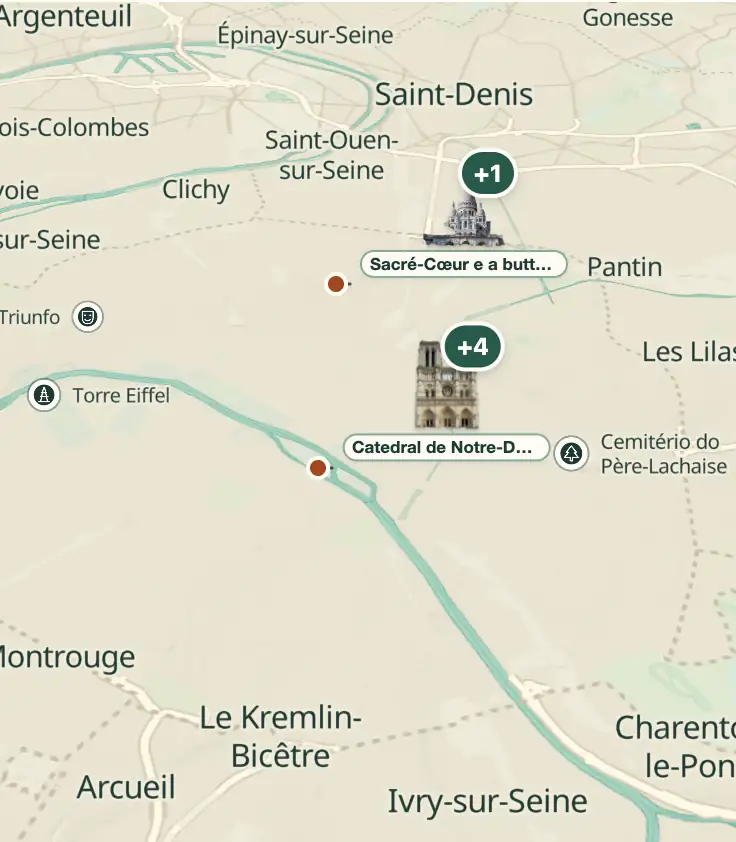
Explore the map
© OpenStreetMap · OpenFreeMap · © OpenMapTiles
Explore the map, read about the other places and plan your travel days in the app.
Open the appWhat to see
Paris: The Seine's bend at the bottom of the basin
Paris sits at the bottom of a sedimentary basin, the Paris Basin, cut by a bend of the Seine that enters from the southeast and exits to the southwest, dividing the city into the Rive Droite, to the north, and the Rive Gauche, to the south, with two islands in between: the Île de la Cité and the Île Saint-Louis. The Marais is the only central district Haussmann didn't tear down to open boulevards, and it holds medieval streets, 16th- and 17th-century mansions, and the Place des Vosges, from 1612.

Eiffel Tower
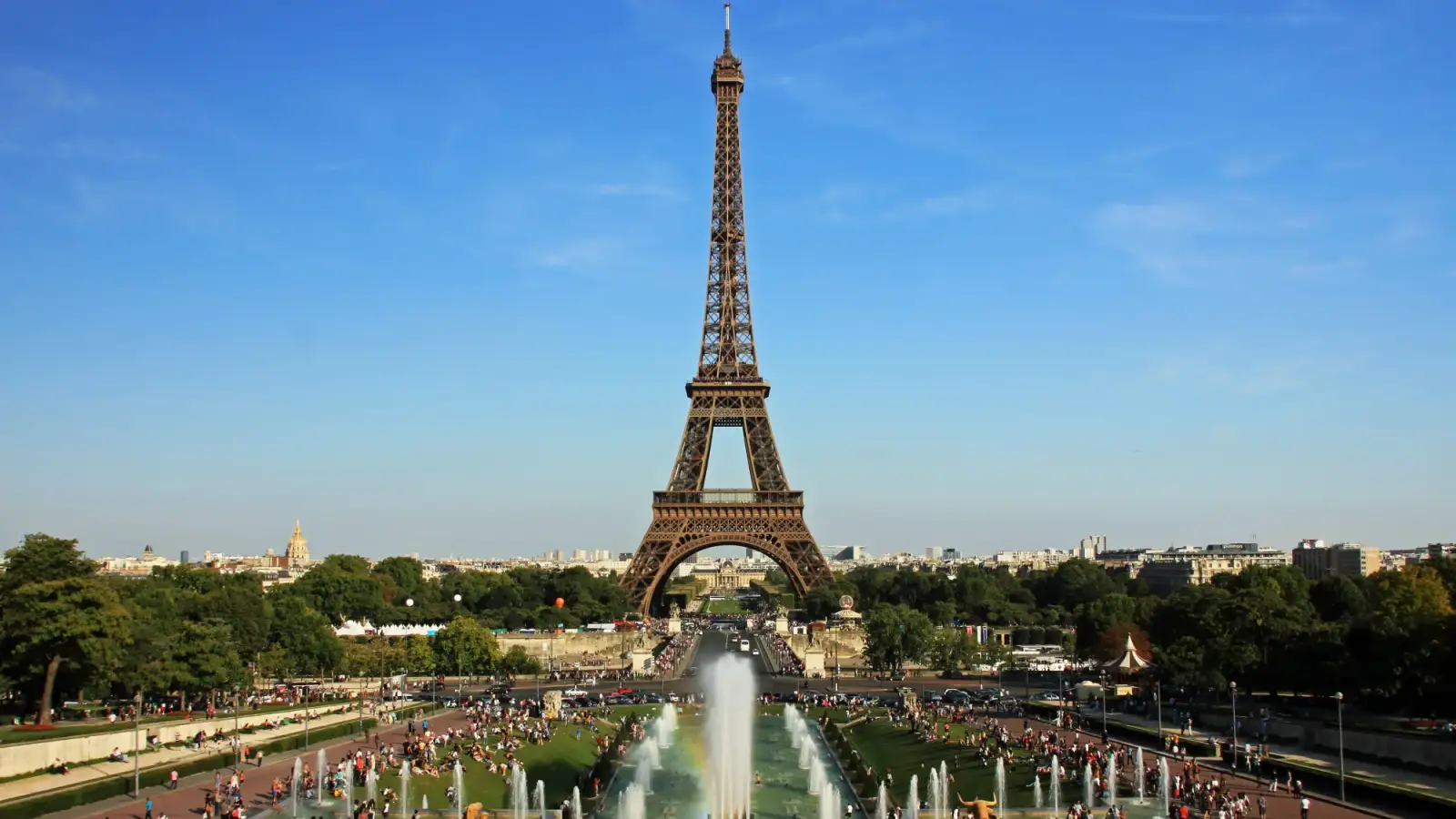
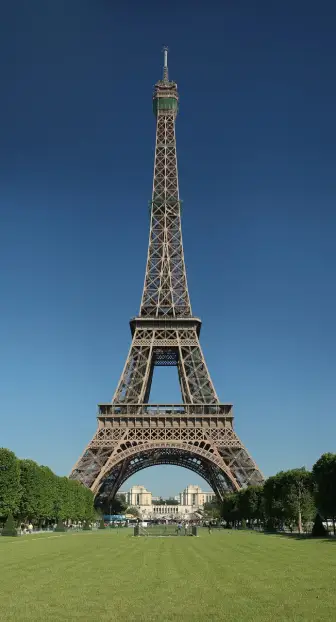
Raised in 26 months for the 1889 World's Fair, it stands 330 m with the antennas, made of 7,300 metric tons of puddled iron, 18,038 parts, and 2.5 million rivets, and is hand-repainted every seven years. Book a time slot on the official site; the elevator to the top usually sells out first, and on the hour, after dark, it sparkles for five minutes.
Book the summit elevator weeks ahead, because it sells out first. Without a booking, watch the tower from the Bir-Hakeim bridge or the Champ-de-Mars when it sparkles, at the top of each hour after sunset, and skip the Trocadéro, overrun by street vendors.
Check access

Louvre Museum
A fortress built by Philip Augustus in 1190, later a royal palace and a public museum since 1793, the Louvre displays about 35,000 works across 73,000 m², and it's impossible to see it all in one visit. I. M. Pei's glass pyramid dates from 1989, and the entrance through it has the museum's longest line. The Louvre is closed on Tuesdays.
It's essential for the collection, and only pays off with planning ahead: book a time slot on the official site, allow at least three hours, and decide beforehand which two wings you'll see.
Check access

Notre-Dame Cathedral
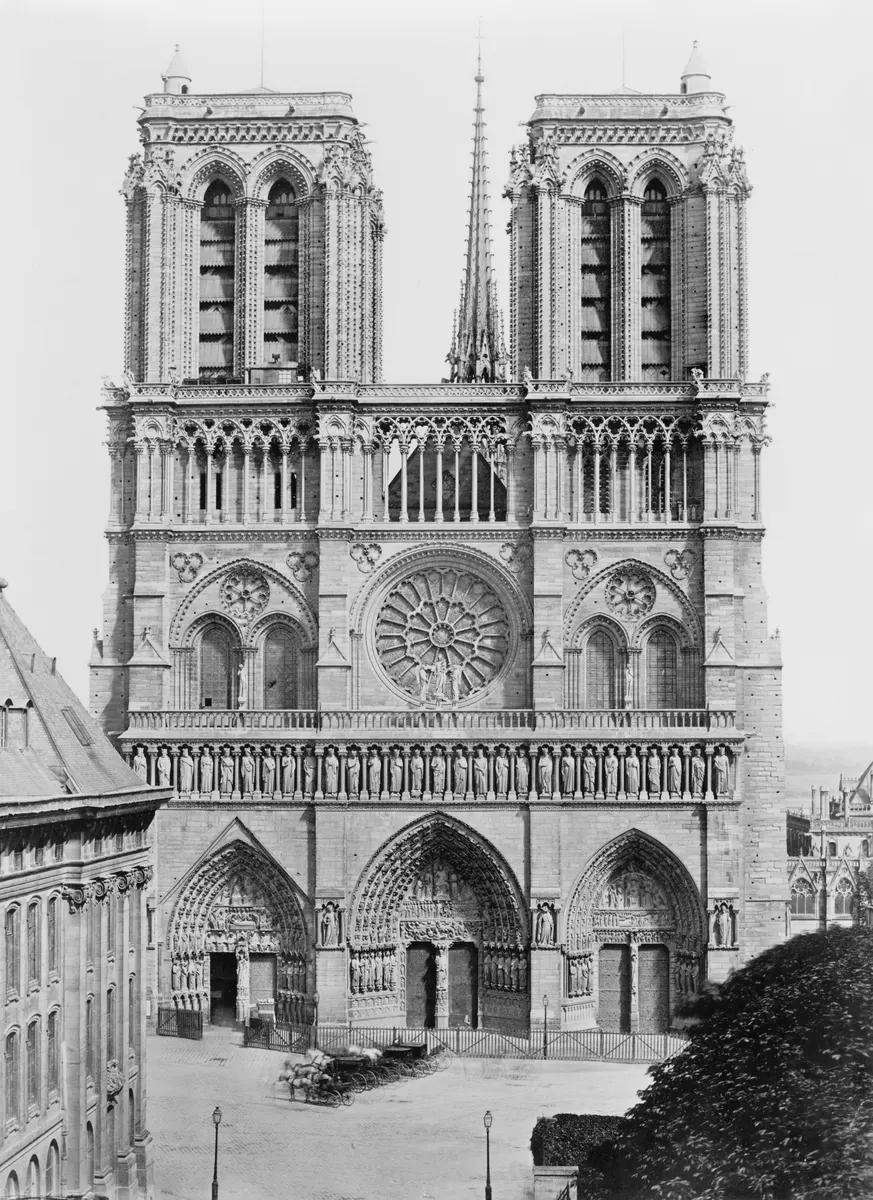
Begun in 1163 and completed in 1345, it lost its spire in the fire of April 15, 2019, and reopened on December 7, 2024, with the pale stone cleaned for the first time in centuries. Entry to the nave is free, but it's worth booking a time slot on the official site; the tower climb reopened on September 20, 2025, costs about €16, and has 424 steps with no elevator.
The cathedral, reopened in 2024 with its pale stone cleaned for the first time in centuries, deserves an hour. Go early and with a booked time slot, because the afternoon line stays long.
Check access
Sainte-Chapelle
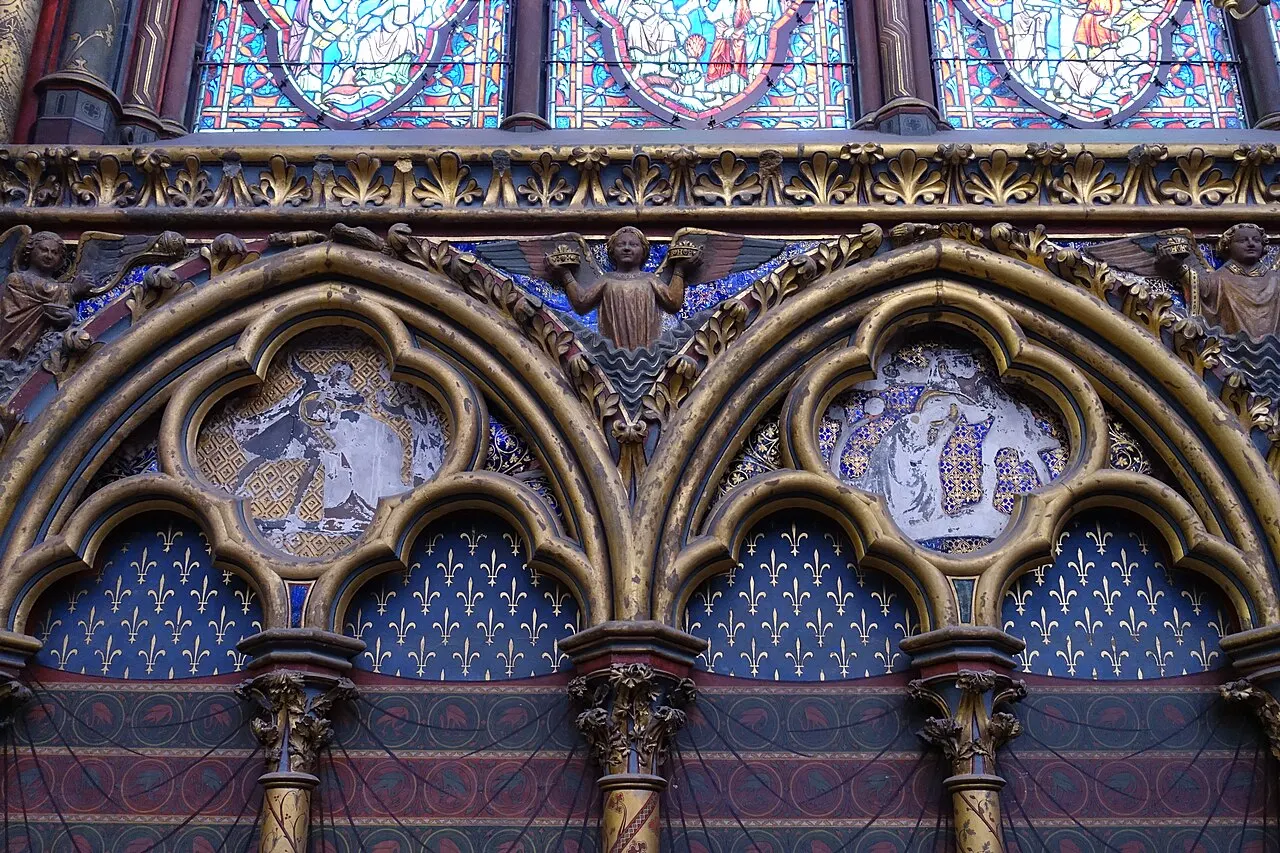
Built between 1242 and 1248 by Louis IX to house the Crown of Thorns, it's a Gothic glass box with 1,113 scenes across about 600 m² of stained glass, two-thirds of it original from the 13th century. It sits inside the Palais de Justice complex and requires a security check; the combined ticket with the Conciergerie, Marie Antoinette's prison, works out cheaper.
The roughly 600 m² of stained glass, two-thirds of it from the 13th century, can be seen in half an hour on the Île de la Cité. Add fifteen minutes to the visit for the security check at the entrance.
Check access

Musée d'Orsay
A rail station built between 1898 and 1900 for the World's Fair, decommissioned because its platforms were too short for modern trains, and converted into a museum in 1986. The collection covers 1848–1914 and holds the world's largest Impressionist collection on the fifth floor, where the glass clock facing the Seine also sits; it closes on Mondays.
It's closed on Mondays, unlike the Louvre, and the 1848-to-1914 collection fits into a morning, with the Impressionists gathered on a single floor.
Check access

Sacré-Cœur and the Montmartre butte
A basilica built from 1875 to 1914, designed by Paul Abadie, raised in travertine from Château-Landon, a stone that sweats calcite in the rain and so stays white. The nave is free; the climb to the dome costs about €7 and runs about 300 steps, with the highest view in the north of the city. The hillside funicular takes a regular metro ticket.
The Sacré-Cœur is worth it for the climb up the north side, starting at the Lamarck-Caulaincourt metro stop, and for the stone that stays white because it exudes limestone in the rain. Arrive before 10am, while the butte is still quiet.
Check access

Père-Lachaise Cemetery
Opened in 1804 and expanded to 44 hectares, it holds about 70,000 graves along named, signposted lanes on steep cobbled ground. Chopin, Oscar Wilde (whose tomb got a glass barrier in 2011 against lipstick marks), Jim Morrison and Édith Piaf are buried here; admission is free, and the map at the gates is essential.
Admission is free, but the cemetery is a long, cobbled slope, and without the map from the gates you won't find Chopin, Wilde, Morrison, or Piaf. Allow an hour and a half.
Check access

Catacombs of Paris
An ossuary set up starting in 1786 in old limestone quarries, where the remains of about 6 million people were moved from the center's overcrowded cemeteries. The section open to the public runs 1.5 km at a depth of 20 m, with 131 steps down and 112 up, and a constant temperature of 14°C, so bring a jacket even in July. The paid ticket is sold only online, with a timed slot, and sales open seven days ahead; anyone entitled to free admission picks up the ticket on-site, on the day of the visit.
An ossuary holding the remains of about 6 million people in old quarries, set up starting in 1786. For the paid ticket, book a time slot online; anyone entitled to free admission picks up the ticket on-site.
Check access

Arc de Triomphe and Champs-Élysées
Commissioned by Napoleon in 1806 and finished in 1836, it stands 50 m tall and has held the tomb of the Unknown Soldier since 1921, whose flame is relit every day at 6:30pm. Approach through the underground passage, never crossing the twelve-avenue roundabout, and climb the 284 steps to the terrace to see Haussmann's star from above.
The Champs-Élysées has become an avenue of chain stores, with food at double the fair price. What still pays off is the 284 steps to the Arc's terrace, which overlooks the star of Haussmann's streets, and the Unknown Soldier's flame, relit every day at 6:30pm.
Check access
Nilo’s itinerary
Start with the basic programme and choose extensions for the time you have.
Plan my days in the app ↗Day 1 · The island, the river, and the Left Bank
Start at 8am at a bakery with a croissant and an express at the counter; pick one with a line of locals and a visible oven.
Head to the Île de la Cité and enter the nave of Notre-Dame with a time slot booked on the official website; right after, visit the Sainte-Chapelle, whose stained glass is at its best in the morning sun.
Cross into the Latin Quarter, have the formule du midi for €15–22 on a side street off Mouffetard, and climb up to the Panthéon.
Spend the late afternoon in the Jardin du Luxembourg, on one of the green metal chairs, which you can drag wherever you like.
Have dinner at a bistro in Saint-Germain or the 5th and walk back along the quays, between the Pont Neuf, from 1607, and the Pont des Arts.
Day 2 · Museum in the morning, the Marais in the afternoon
Enter the Louvre through the Porte des Lions or the Carrousel right at opening, with a timed ticket, and pick two wings instead of trying the whole museum, or swap in the Orsay, smaller and more coherent.
Exit through the Jardin des Tuileries and have a jambon-beurre or a falafel from rue des Rosiers, standing up.
Spend the afternoon in the Marais: Place des Vosges, the Musée Carnavalet, which tells the city's history and is free for the permanent collection, and the streets of the 3rd arrondissement.
Have an apéritif around 6:30pm at a café in the 11th, between rue Oberkampf and rue Saint-Maur.
At night, catch a repertory film screening on rue Champollion or a concert at the Philharmonie, in the 19th.
Day 3 · Montmartre, a cemetery, and the Eiffel Tower
Climb Montmartre from the north side: take the metro to Lamarck-Caulaincourt, walk up through the residential streets and reach Sacré-Cœur before 10am, while the steps are still empty.
Walk down to Pigalle and take the metro to Père-Lachaise; set aside an hour and a half and bring the map from the gates.
Have lunch in Belleville (Chinese, Vietnamese, or Tunisian cooking along the rue de Belleville) then climb to the lookout at the Parc de Belleville.
End the afternoon on the Champ-de-Mars, with the Eiffel Tower; if you want to go up, book weeks ahead and choose the sunset slot.
After dark, watch the tower sparkle at the top of each hour, from the Champ-de-Mars or the Bir-Hakeim bridge.
Day 4 · Giverny
Day trip
Giverny is 75 km northwest: the train leaves Gare Saint-Lazare direct for Vernon in about 45 minutes, and from there a 15-minute shuttle bus reaches the house where Claude Monet lived from 1883 to 1926. The water garden with the Japanese bridge is the direct subject of the Water Lilies series; it's open from April 1 to November 1, and the flowers change completely between May and September.
If you stay longer
Day 5 · Versailles
Day trip
20 km southwest, Versailles is reached by RER C to Versailles Château Rive Gauche, in 40 to 50 minutes, or by train from Gare Montparnasse to Versailles Chantiers. Louis XIV's palace, occupied starting in 1682, has 2,300 rooms and an 800-hectare park; it closes on Mondays, requires a timed booking, and takes a full day if you include the Trianon and Marie Antoinette's hamlet. On Grandes Eaux days, when the fountains run, entry to the gardens is paid.
Food
 AI illustration
Baguette de tradition
Flour, water, salt, and yeast, no additives, never frozen. The recipe is fixed by the bread decree of September 13, 1993, and only that recipe may be called “tradition”. It weighs about 250 g, comes out of the oven several times a day, and costs €1.30–1.70; ask for “bien cuite” for a darker crust. Paris's annual best-baguette contest hands the winner the contract to supply the Élysée Palace.
 AI illustration
Croissant and viennoiseries
Laminated dough with butter layered in, baked in the morning and generally eaten before 10am with a coffee at the counter. A “pur beurre” croissant usually has straight tips; the margarine version has curved ones. It costs €1.30–2.20, and the chocolate version is called pain au chocolat in Paris and chocolatine in the southwest. The argument is taken seriously.
 AI illustration
Jambon-beurre
Half a baguette, cooked ham and butter, nothing more: it's the best-selling sandwich in France, at something like 1 billion a year nationwide. It costs €5–7 at any bakery and is the standard lunch for anyone with 20 minutes to spare. Quality depends entirely on the bread and the butter, not on the filling.
 AI illustration
Steak-frites and the bistro menu
Entrecôte, bavette, or onglet with fries and a sauce au poivre or herb butter, the baseline dish of any bistro for €18–28. The doneness is ordered in French: bleu (nearly raw), saignant, à point, bien cuit, and French “à point” usually comes out rarer than the Brazilian equivalent. Steak tartare and confit de canard are the menu's other two pillars.
 AI illustration
Oysters and the plateau de fruits de mer
From September on, ice counters appear on brasserie sidewalks, with the écailler shucking oysters right there on the street. They're numbered by size, from no. 5 (smallest) to no. 0 (largest); they come with rye bread, butter, and shallot vinegar, and a dozen costs €18–35. Never ask for too much lemon, and never pour out the liquor in the shell.
 AI illustration
Paris-Brest
A ring of choux pastry filled with hazelnut praline cream, created in 1910 by Louis Durand for the Paris–Brest–Paris bicycle race: its shape mimics a wheel. It's the Parisian pastry par excellence, costs €5–8 at a pâtisserie, and weighs more than it looks.
 AI illustration
Falafel on rue des Rosiers
In the Jewish heart of the Marais, the counters on rue des Rosiers serve pita with fried chickpea balls, eggplant, cabbage, and spicy sauce for €9–11, eaten standing on the street. The line is long on Sundays, and the street closes from late Friday afternoon to Saturday sundown, for Shabbat.
 AI illustration
Coffee and the formule du midi
Asking for “un café” gets you an express, not an americano, and a “noisette” is an express with a dash of milk; drunk standing at the counter, it costs less than at a table. At midday, the formule (starter and main, or main and dessert) is the way to go, served from 12pm to 2:30pm for €15–22, and usually runs about half the price of dinner.
Day trips
Versailles
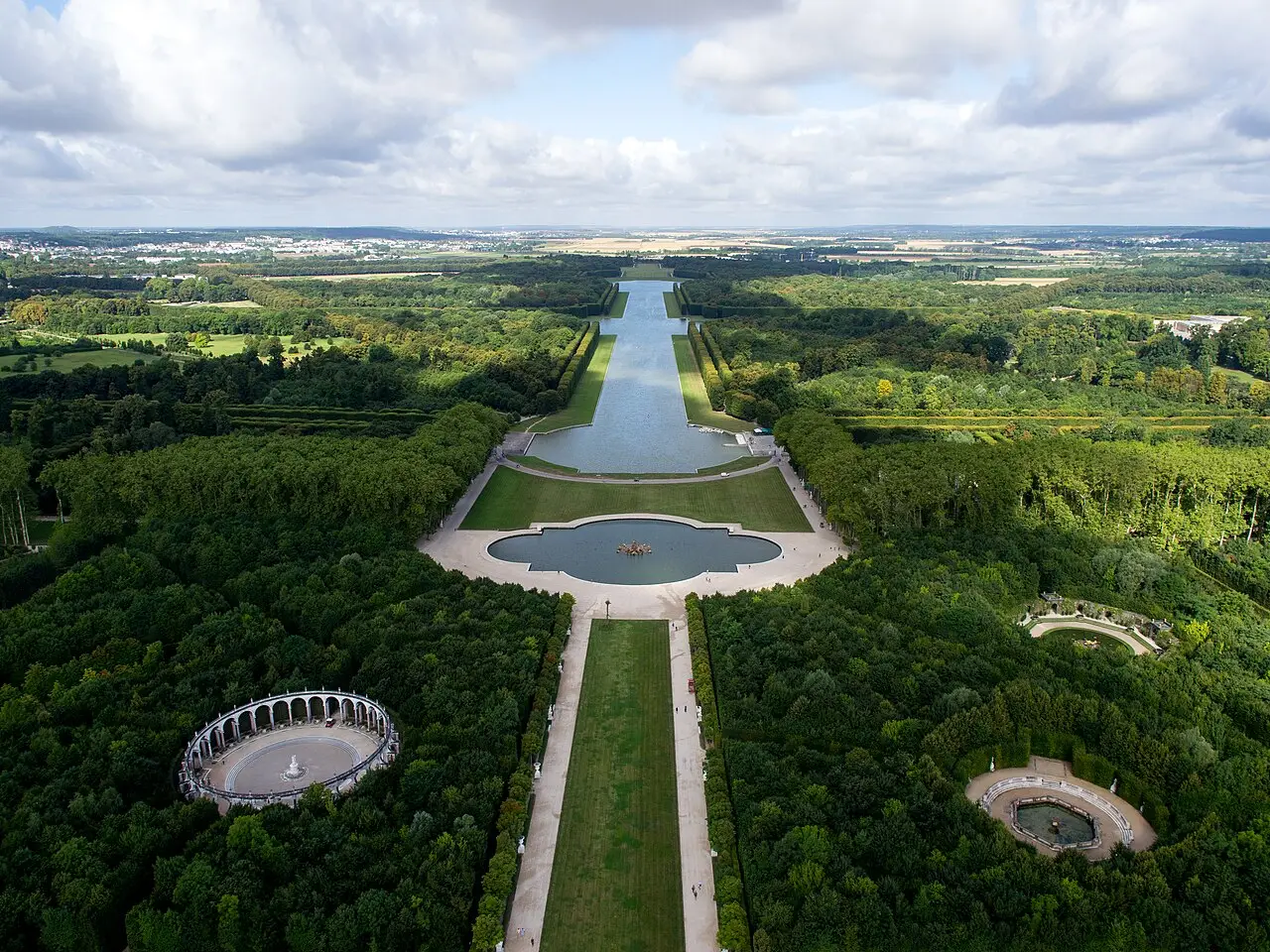
20 km southwest, Versailles is reached by RER C to Versailles Château Rive Gauche, in 40 to 50 minutes, or by train from Gare Montparnasse to Versailles Chantiers. Louis XIV's palace, occupied starting in 1682, has 2,300 rooms and an 800-hectare park; it closes on Mondays, requires a timed booking, and takes a full day if you include the Trianon and Marie Antoinette's hamlet. On Grandes Eaux days, when the fountains run, entry to the gardens is paid.
Giverny
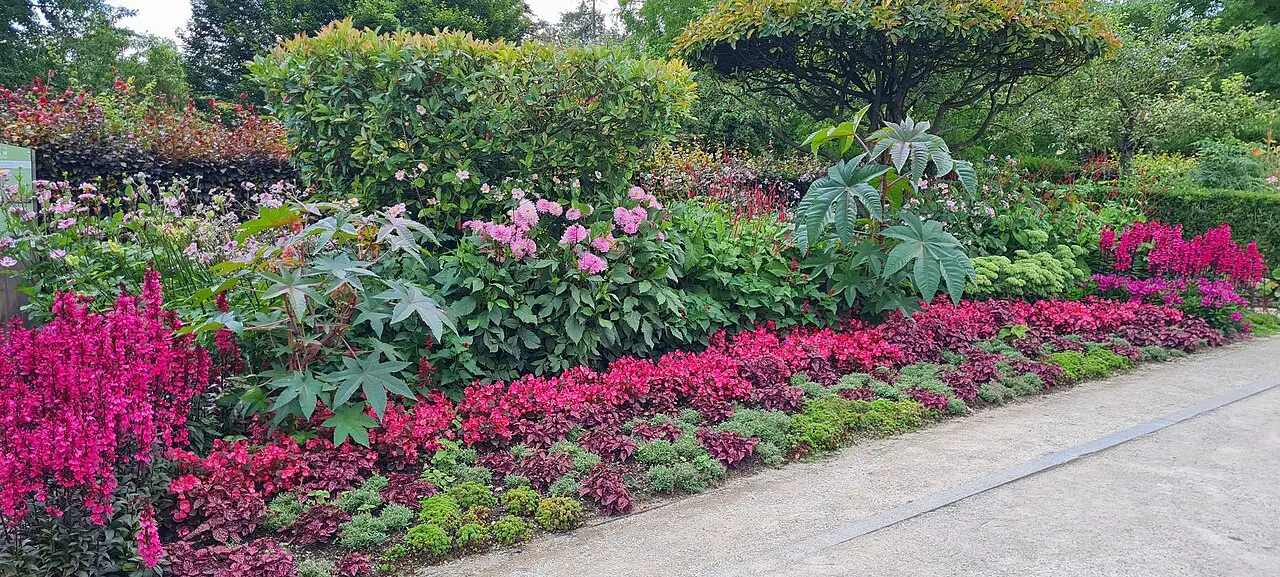
Giverny is 75 km northwest: the train leaves Gare Saint-Lazare direct for Vernon in about 45 minutes, and from there a 15-minute shuttle bus reaches the house where Claude Monet lived from 1883 to 1926. The water garden with the Japanese bridge is the direct subject of the Water Lilies series; it's open from April 1 to November 1, and the flowers change completely between May and September.
Chartres
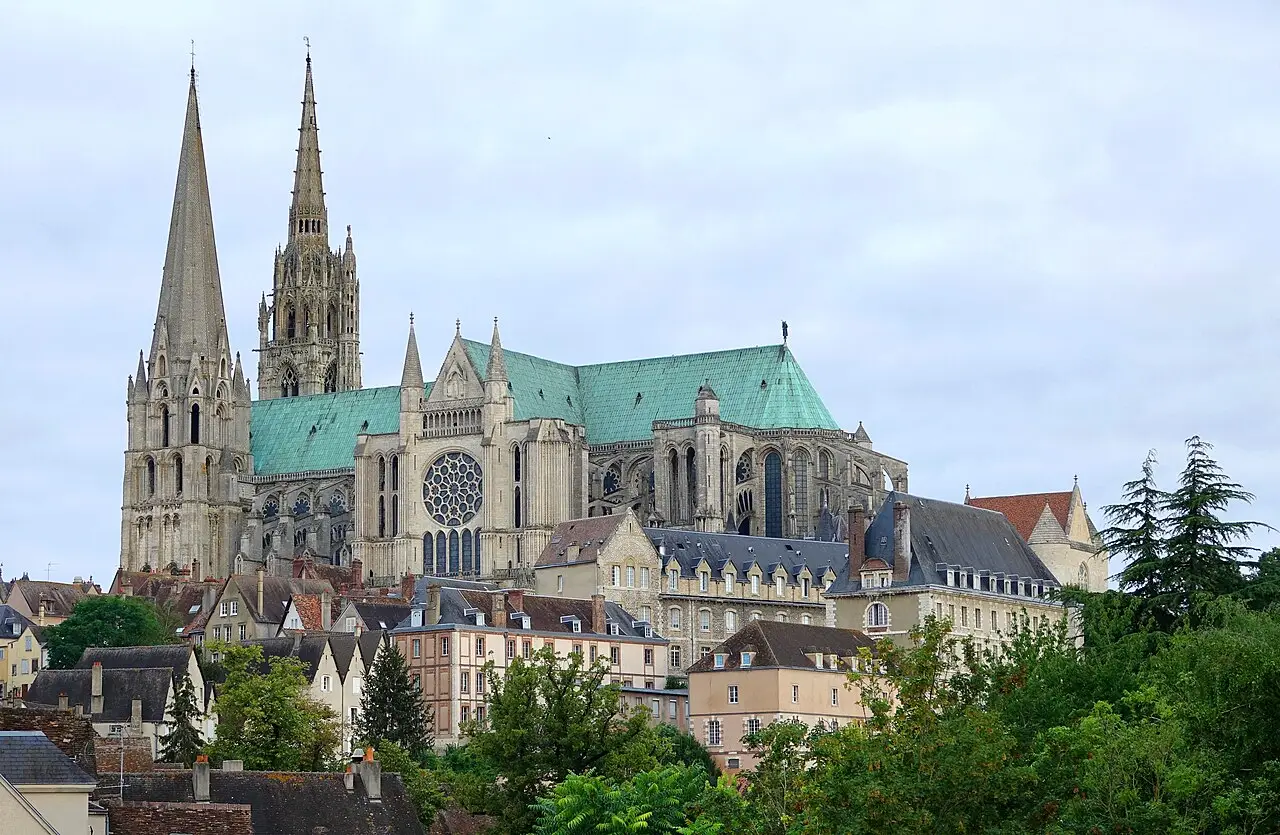
90 km to the southwest, direct train from Gare Montparnasse in 1 hour 5 minutes to 1 hour 20 minutes. The cathedral, rebuilt after the 1194 fire and finished in about 26 years, keeps 172 stained-glass windows from the 12th and 13th centuries, the largest original medieval set in the world, and a 1200 stone labyrinth set into the nave floor, open on Fridays for much of the year.
Where to begin
The island, the river, and the Left Bank
Start at 8am at a bakery with a croissant and an express at the counter; pick one with a line of locals and a visible oven.
Museum in the morning, the Marais in the afternoon
Enter the Louvre through the Porte des Lions or the Carrousel right at opening, with a timed ticket, and pick two wings instead of trying the whole museum, or swap in the Orsay, smaller and more coherent.
Montmartre, a cemetery, and the Eiffel Tower
Climb Montmartre from the north side: take the metro to Lamarck-Caulaincourt, walk up through the residential streets and reach Sacré-Cœur before 10am, while the steps are still empty.
Money
The currency is the euro, and contactless cards work almost everywhere, even at bakeries and street markets. The exceptions are some bars, which require a minimum of €10–15, and the metro ticket machines, which reject foreign cards without a chip. In 2026 prices, a baguette tradition costs €1.30–1.70, a jambon-beurre €5–7 and a lunch formule €15–22. Dinner at a bistro runs €30–50 per person without wine, with a glass of wine at €5–9 and a half-pint of beer at €4–8. A metro ride costs about €2.55, admission to a national museum €12–22 (at the Louvre, €32 for anyone not living in the European Economic Area) and a three-star hotel €160–260 a night. The tourist tax is charged per person per night, on top of the room rate, and ranges from about €2.60 at a one-star hotel to about €16 at a palace, with a cap of €15.93 in 2026 for unrated lodging. It's the highest in France, because of a 200% surcharge earmarked for Île-de-France public transportation. Service has been legally included in the bill since 1987, so tipping is optional: rounding up, leaving €1–2 at a café or 5% after a dinner that was worth it is already generous. National museums are free for European Union residents under 26, and several open for free on the first Sunday of the month, with long lines.
Getting there and around
Getting downtown from each airport
Paris has three airports, Charles-de-Gaulle (Roissy), Orly and Beauvais, and choosing the wrong one can cost you up to an hour and a half more each way. Charles-de-Gaulle is 25 km northeast: the RER B runs to Châtelet, via Gare du Nord, in 30–40 minutes for about €13, and the Roissybus reaches the Opéra in 60 to 75 minutes for about €17. Orly is 14 km south and has metro line 14 running straight to the center. Beauvais is 85 km away and only pays off for the price of the flight, with a bus to Porte Maillot in 1 hour 15 minutes for about €17. By taxi, only Charles-de-Gaulle and Orly have flat fares, set by the city.
Metro: sixteen lines, and almost nowhere is far from a station
The network has 16 metro lines (1 to 14, plus 3bis and 7bis), with 321 stations, so dense that almost no point is more than 500 m from an entrance. Rounding out the system are five RER lines (A to E), Transilien trains, thirteen tram lines and the Noctilien night bus. The metro runs from about 5:30am to 1:15am, with later hours on weekends, and you pay with the Navigo Easy card. The city has more than a thousand kilometers of bike lanes, and Vélib' has about 20,000 bikes, two in every five electric, for a few euros a single ride; e-scooter rental was banned after a referendum in 2023. In the center, walking often beats the metro, and the city is about 10 km from east to west inside the Périphérique.
Safety
Paris is a safe city for violent crime by the standards of a capital whose region holds about 12.3 million people, and the real risk is theft without confrontation. Pickpockets work metro line 1, the RER B between downtown and Charles-de-Gaulle, Châtelet–Les Halles, the area around the Eiffel Tower, the Sacré-Cœur steps, and the Louvre's corridors: a backpack worn on the front of the body, a phone kept off the sidewalk table, and a wallet in the front pocket handle most of it. The scams are standardized and each one is recognizable: the gold ring “found” on the ground near the Seine, the clipboard petition for a fake deaf charity, the string bracelet tied to your wrist at the foot of Montmartre, and the three-cup game on the bridges, always staged with accomplices. All of them are defused with a “non, merci” said without breaking stride; what costs money is stopping. At night, avoid deserted RER station corridors, the area around Porte de la Chapelle, and stretches of the northern 18th arrondissement, and take a taxi or ride-hailing app after the last metro. Emergencies: 112 general, 17 police, 15 SAMU (ambulance), 18 fire department; a police report for insurance can be filed at any station, and there's a dedicated tourist police post near the 1st arrondissement.
Etiquette tips
Say “bonjour” before anything else
On entering a bakery, pharmacy, shop, or taxi, greet before you order; after 6pm, “bonsoir”. Starting with the question, even in perfect French, reads as rude and changes the tone of the service. It's the city's most important social rule and the easiest to follow.
Never call the waiter “garçon”
Use “excusez-moi” with eye contact, or “s'il vous plaît, monsieur/madame”. In France, waiting tables is a stable career, and the treatment reflects that experience; nobody comes to the table to ask if everything's okay, and the check only arrives when you ask for it: “l'addition, s'il vous plaît”.
Speak quietly in enclosed spaces
Restaurants, the metro, elevators, and building stairwells all run at low volume. Loud speakerphone calls and loud laughter in a train car draw attention immediately, and the usual response is a disapproving look, without a spoken comment.
Use “vous” until told otherwise
With strangers, shopkeepers, colleagues, and anyone older, use the formal second person. “Tu” is offered explicitly (“on peut se tutoyer”) and using it before that sounds too intimate, especially at work.
Bread: straight on the tablecloth, beside the plate
Bread goes straight on the tablecloth, next to your plate, and is for eating with the meal and mopping up the sauce at the end, not for eating with butter before the food arrives. Nor do you take a knife to salad that already comes in foldable leaves.
Metro: stand right on the escalator and let riders off before boarding
On the metro, stand on the right and keep the left clear for passing; let people off before you get on, and take your backpack off your back once inside the car. On the flip-up seats, lift the seat when the car is full.
Mistakes to avoid
The carnet was discontinued in November 2025
Counting on paper tickets. The magnetic carnet of ten rides no longer exists and has been replaced by the Navigo Easy card. Without it in your pocket, or without the app loaded, you're stuck at a machine that may simply not accept your foreign card.
Time-slot booking sells out weeks in advance
Showing up at the Louvre and the other big museums without a time slot. They sell tickets by time slot, and in busy months the slots sell out weeks ahead; without a booking, you're left with a two-hour line, or no ticket at all. Notre-Dame is the exception to the rule: the nave is free and lets in those who didn't book too, who just wait longer at the door.
Visiting on Monday or Tuesday without checking
Planning a visit on a Monday or Tuesday without checking. The Louvre is closed on Tuesdays, the Orsay and Versailles are closed on Mondays, and many neighborhood bistros close on Sunday night and all day Monday, which can knock out an entire day of sightseeing.
Walk three blocks to escape the trap
Eating at the highest-traffic addresses. Cafés on the Champs-Élysées, on the Trocadéro esplanade, and on the square facing Notre-Dame charge double for factory food. Walk three blocks off the tourist axis: the price drops by half, with real cooking.
The last train leaves around 1:15am
Thinking the metro runs all night. The last train leaves around 1:15am, or 2:15am on Friday and Saturday nights, and after that you're left with the Noctilien buses and taxis. Anyone staying outside the Périphérique, forty minutes by RER from the center, feels this most on the way back.
Useful phrases
Bonjour / Bonsoir
Good morning/afternoon / good evening: mandatory when entering any establishment
S'il vous plaît / Merci beaucoup
Please / thank you very much
Excusez-moi, parlez-vous anglais ?
Excuse me, do you speak English? Always after the bonjour, never instead of it
Une baguette tradition, s'il vous plaît
A baguette de tradition, please: the standard order at the bakery
L'addition, s'il vous plaît
The check, please: it never comes on its own
Je regarde, merci
Just looking, thanks: a polite reply to a shop assistant
Districts
Le Marais (3rd and 4th)
The only central district Haussmann didn't tear through, with medieval streets and 16th- and 17th-century mansions, among them the Place des Vosges, from 1612. It holds the Jewish quarter of the rue des Rosiers, the LGBT nightlife of the rue Sainte-Croix-de-la-Bretonnerie, and the Carnavalet and Picasso museums; it's one of the few areas where almost everything opens on Sunday.
Latin Quarter (5th)
University district since the 13th century, where the Latin of the lectures gave the streets their name. It gathers the Sorbonne, the Panthéon, the rue Mouffetard market, the Jardin des Plantes, and Europe's densest concentration of art-house cinemas around the rue Champollion.
Saint-Germain-des-Prés (6th)
Around the oldest church in Paris, begun in 1014, this was the address of the existentialist cafés, Flore and Deux Magots, and it's still home to the Gallimard, Grasset, and Seuil publishing houses and dozens of galleries. Today it's expensive and quiet, with the Jardin du Luxembourg, 23 hectares, serving as the district's backyard.
Montmartre (18th)
A village annexed in 1860 on a 130 m hill, with the Sacré-Cœur at the top and the city's last urban vineyard, the Clos Montmartre. The touristy side is the southern staircases; the side where people actually live is to the north, around the rue Caulaincourt and Place des Abbesses, and at the foot lies Pigalle, today more cocktail bar than sex shop.
Canal Saint-Martin and Oberkampf (10th and 11th)
The canal was dug between 1802 and 1825 to supply the city with water and today is where people sit on the curb with a bottle and cheese on warm nights, among nine locks and iron footbridges. The rue Oberkampf, the rue Saint-Maur, and the rue de Charonne form Paris's densest strip of bars.
Belleville and Ménilmontant (19th and 20th)
A hill of successive immigration (Armenian, Tunisian Jewish, Maghrebi, Chinese, and Vietnamese) with a street market on avenue Simon-Bolivar on Tuesdays and Fridays and the city's largest concentration of legal street art on the rue Dénoyez. The Parc de Belleville has the highest lookout point in the east and Père-Lachaise sits on its southern edge; rents here are the lowest inside the Périphérique.
Batignolles (17th)
A former working-class village annexed in 1860, organized around the Square des Batignolles and an organic market on Saturdays. Next door, the Clichy-Batignolles eco-district raised the Parc Martin-Luther-King and Renzo Piano's new Palais de Justice, from 2018 and 160 m tall, over former rail yards.
13th: Butte-aux-Cailles and Chinatown
Between avenue d'Ivry and avenue de Choisy sits Europe's largest Asian neighborhood, built in the 1970s in thirty-story towers for refugees from Southeast Asia. A few blocks further, the Butte-aux-Cailles holds low houses and cobblestone streets, and by the Seine are the Bibliothèque François-Mitterrand and the Station F startup campus, opened in 2017 with 34,000 m².
History
3rd c. BCE · The Parisii on the island
The Celtic Parisii tribe settles the banks of the Seine at a crossing point and mints its own gold coins. The city's name comes from the tribe's name.

52 BCE · Rome takes Lutetia
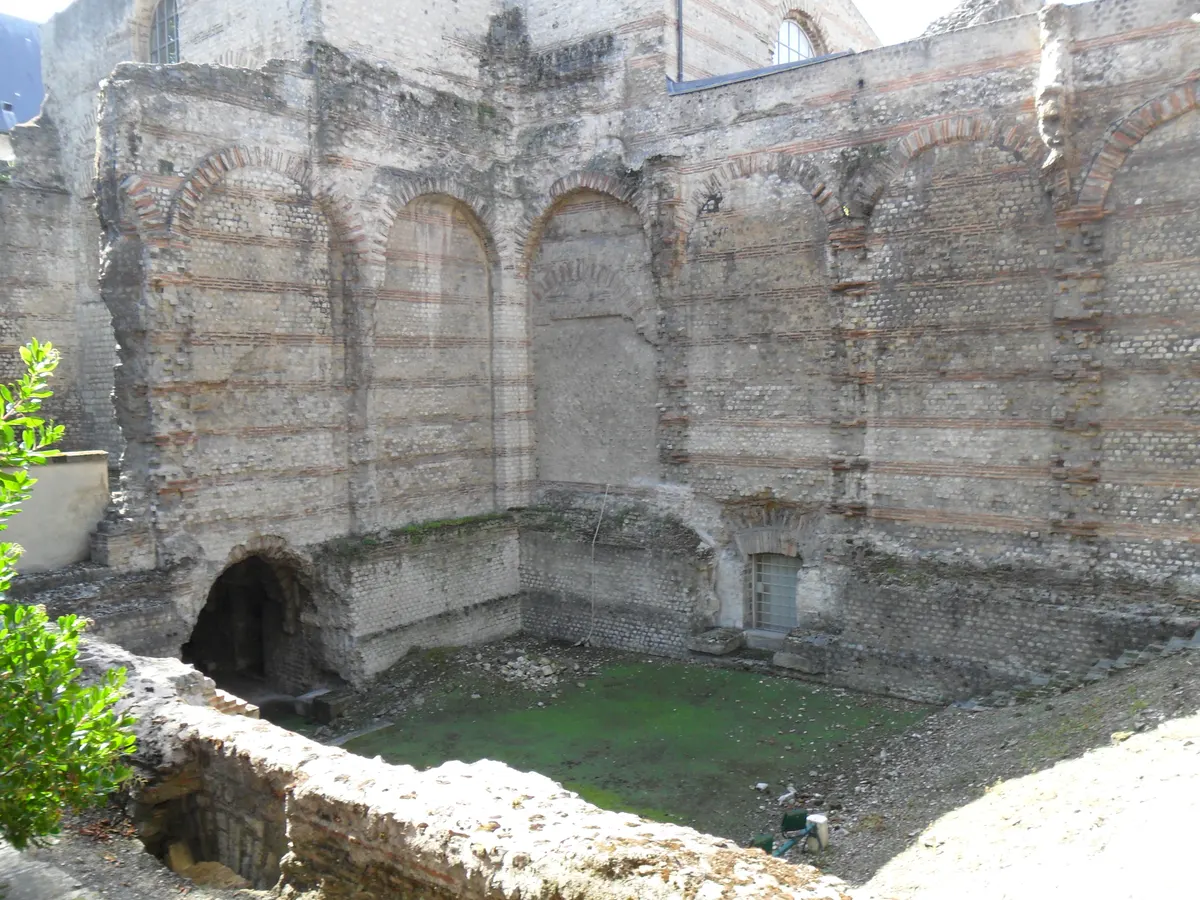
The legate Labienus defeats the Parisii, and Rome rebuilds the city on the Left Bank, with a forum, baths, and an amphitheater. The Cluny baths and the Arènes de Lutèce still stand in the 5th arrondissement.
508–987 · From Clovis to the Capetians
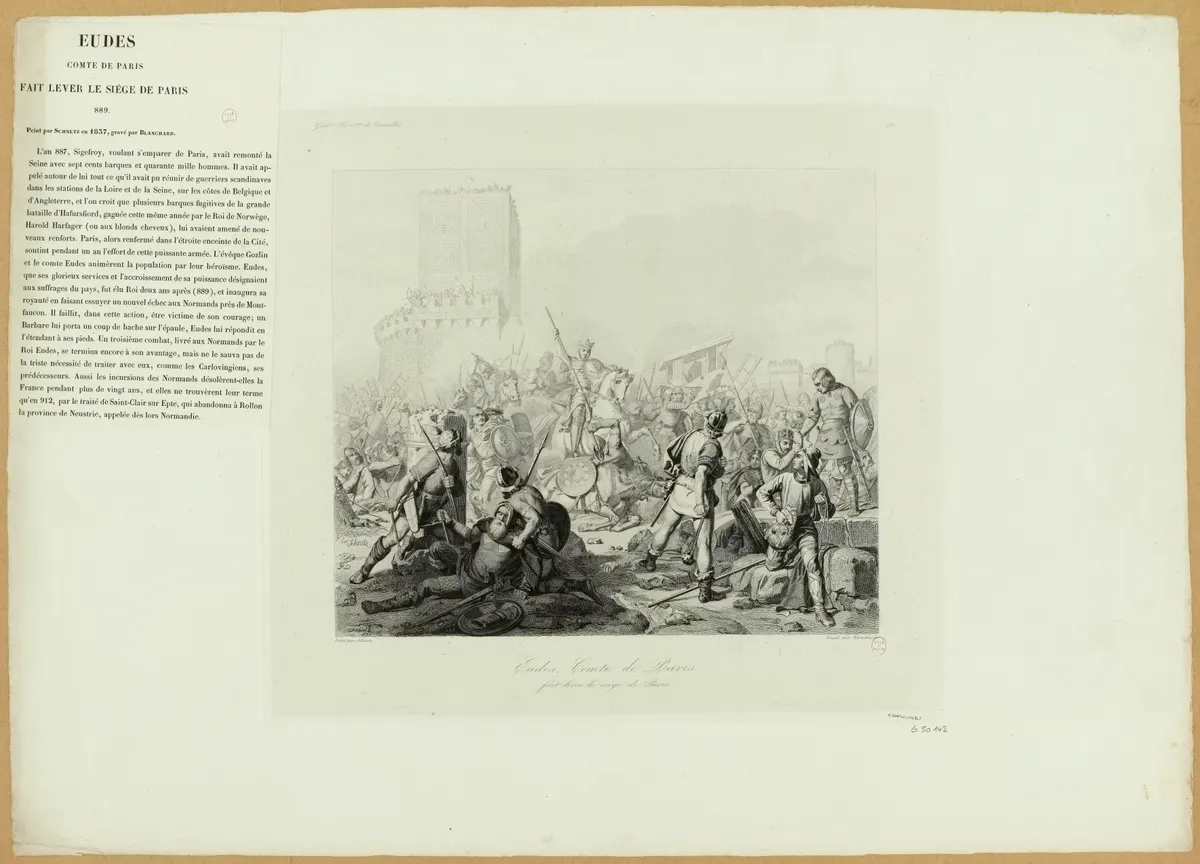
Clovis makes Paris the capital of the Frankish kingdom in 508. After the Viking siege of 885–886, defended by Odo, the family that held out reaches the throne with Hugh Capet in 987 and settles the court in the city.
1163–1345 · Notre-Dame and the university
Maurice de Sully launches the cathedral in 1163, completed in 1345. Around 1200 Philip Augustus recognizes the university corporation, and in 1257 Robert de Sorbon founds the college that gives the Sorbonne its name. The Latin spoken in the streets names the Latin Quarter.
1572 · St. Bartholomew's Day Massacre
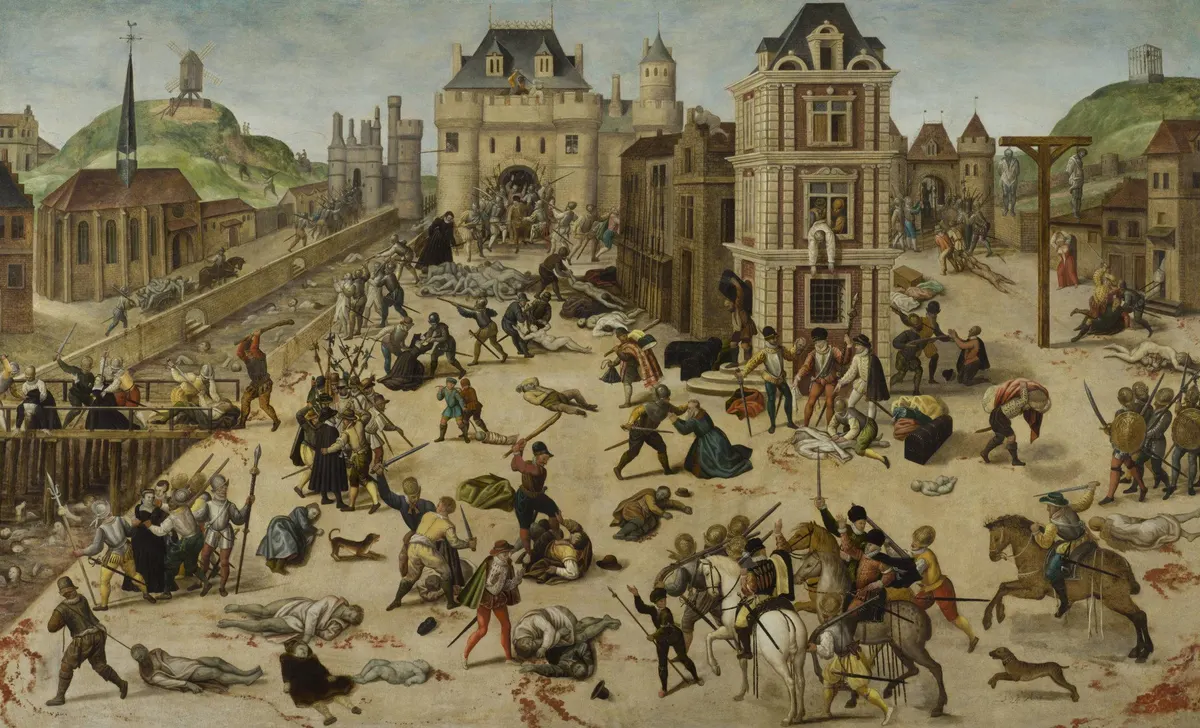
On the night of August 24, 1572, thousands of Huguenots are killed in Paris during the Wars of Religion. The conflict only ends when Henry of Navarre converts and enters the city in 1594.
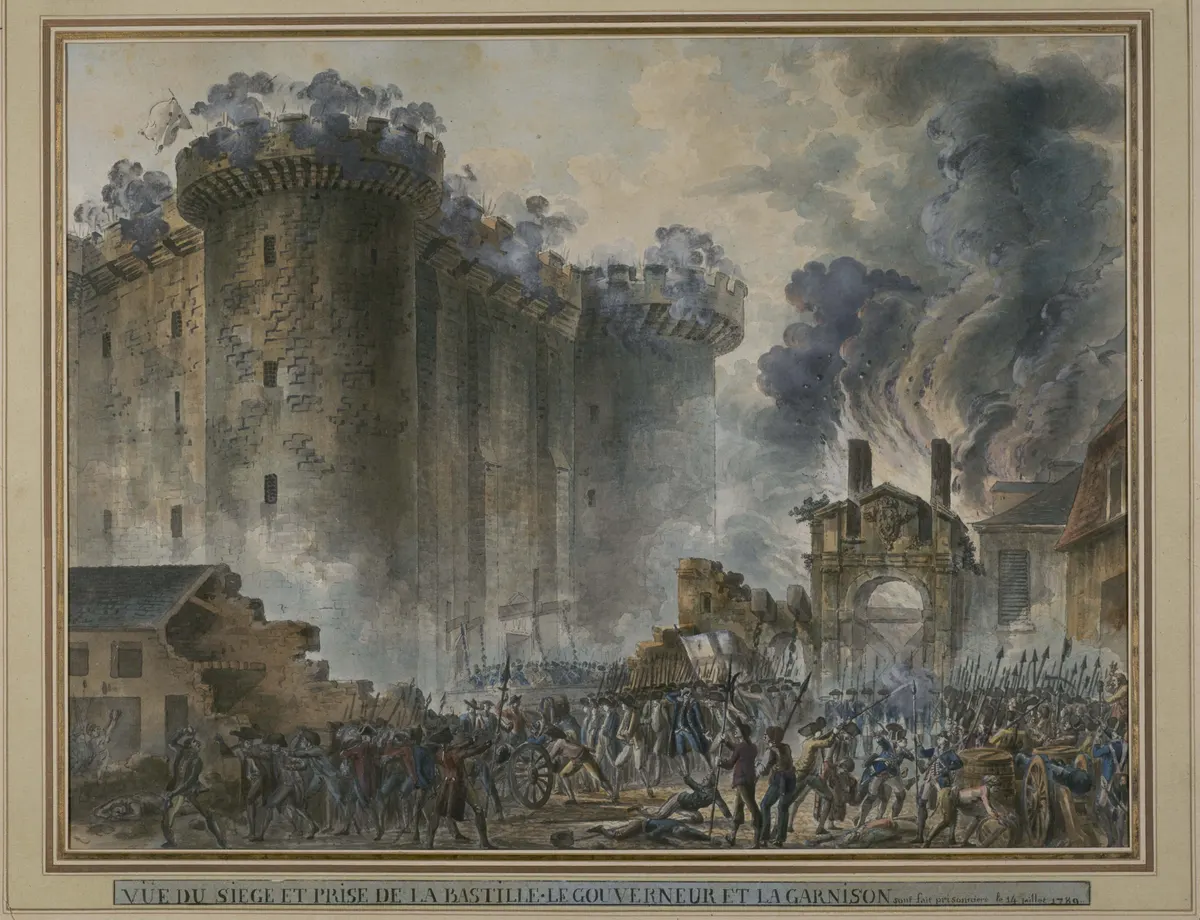
1789 · The storming of the Bastille
On July 14, 1789, the crowd storms the Bastille fortress-prison, which held seven prisoners, and demolishes it over the following months. Today the square only shows the towers' outline traced on the ground.
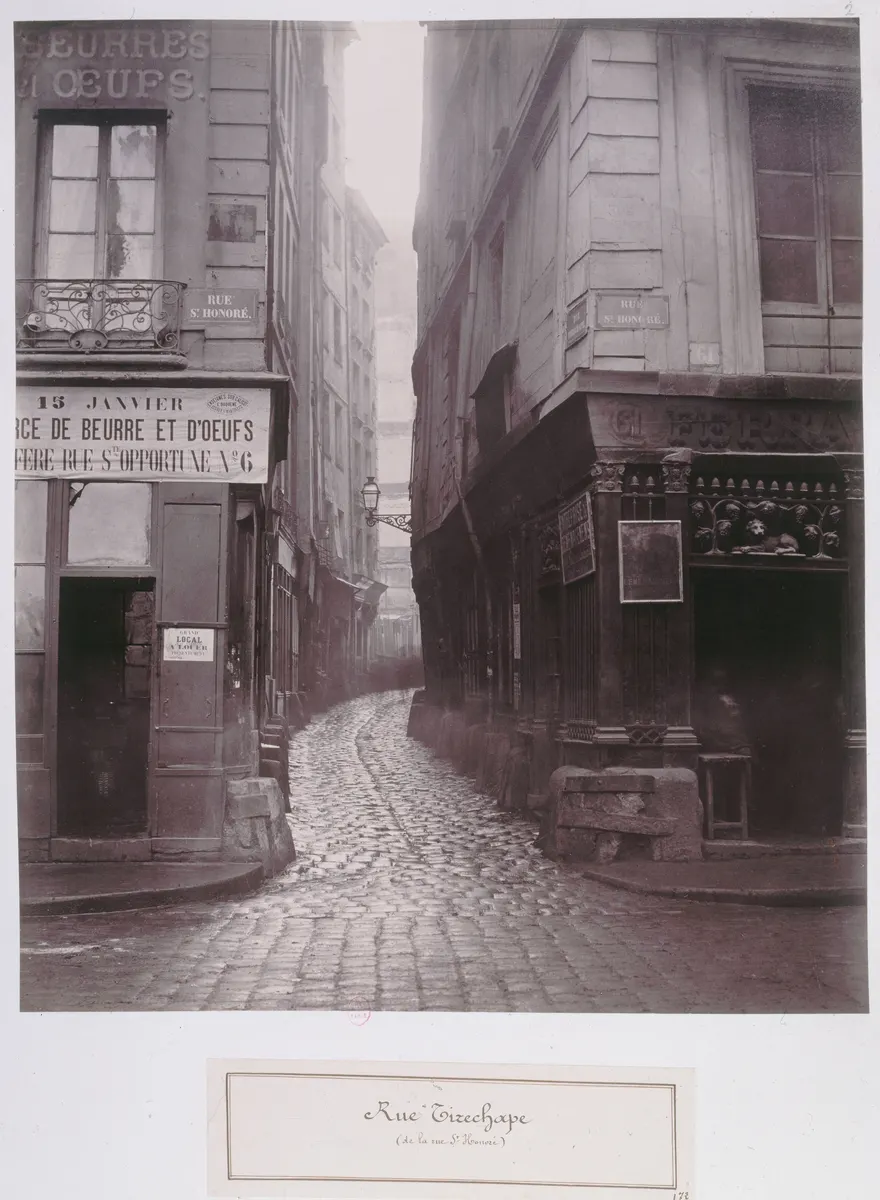
1853–1870 · Haussmann's boulevards
Napoleon III and Prefect Haussmann cut straight avenues through the medieval fabric, lay 600 km of sewers, create parks, and impose the standard limestone facade with zinc roof. In 1860 the annexation of the suburbs takes the city from 12 to 20 arrondissements.
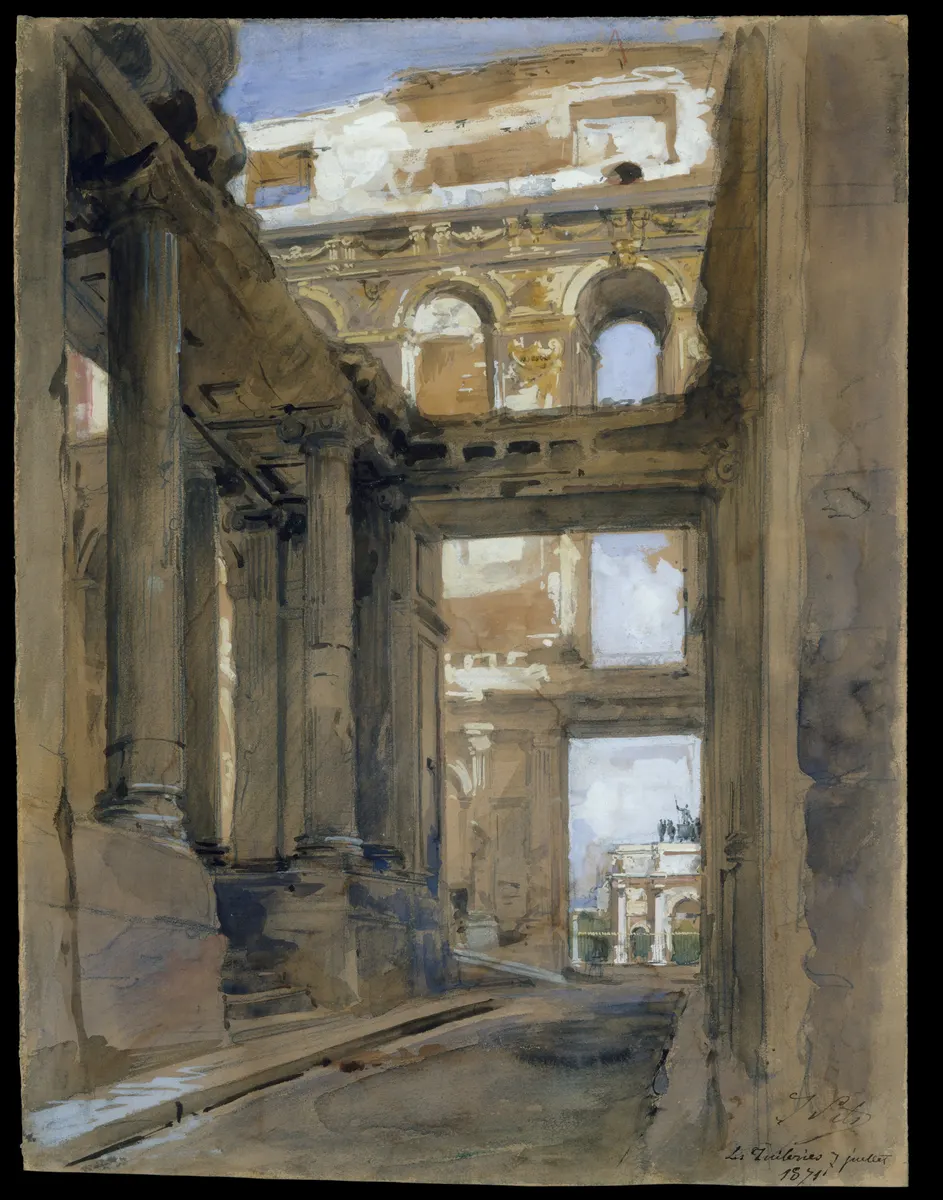
1871 · The Paris Commune
From March 18 to May 28, 1871, an insurrectionary government controls the city and is crushed in the Bloody Week, with thousands dead. The Tuileries Palace and the Hôtel de Ville burn; only the latter was rebuilt.
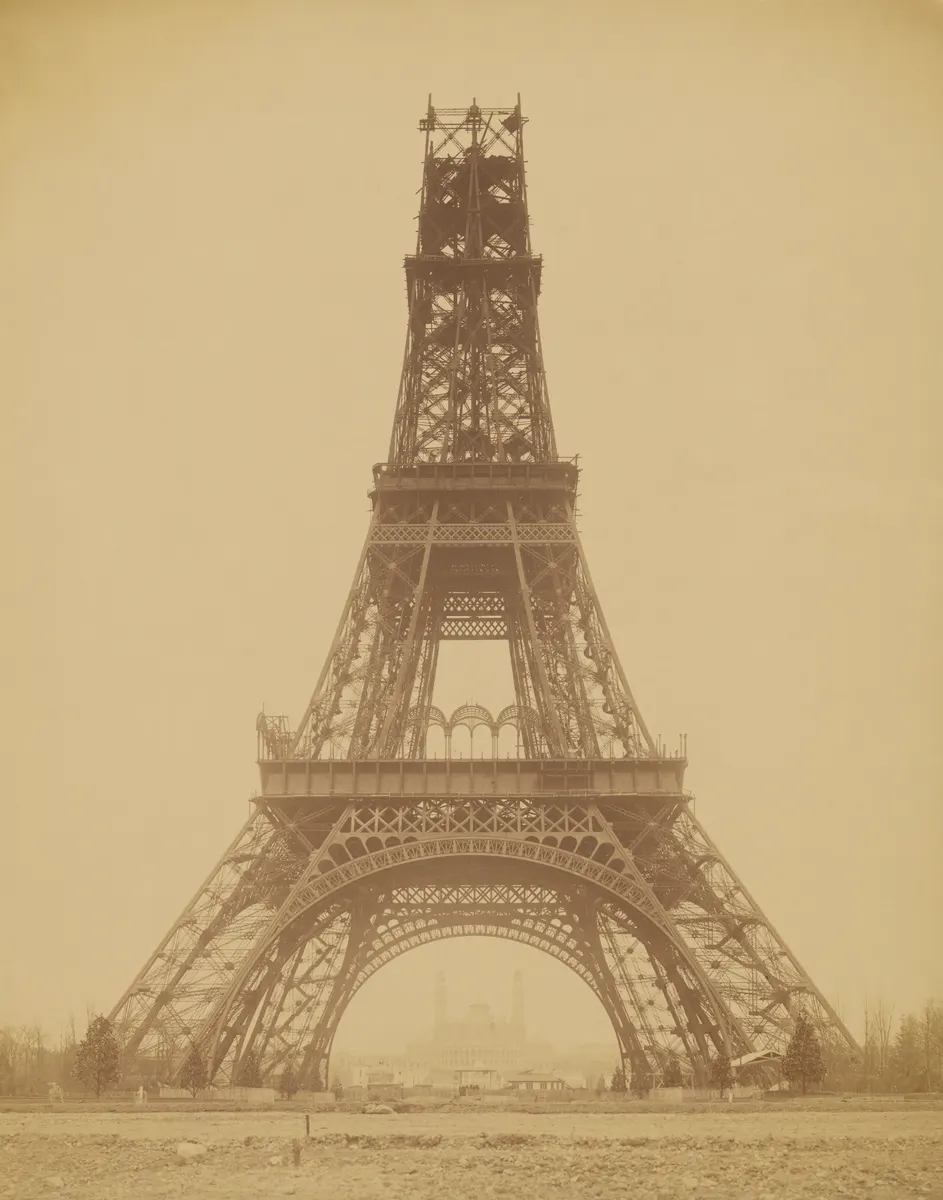
1889–1900 · The Eiffel Tower and line 1
Gustave Eiffel's tower is raised in 26 months for the 1889 World's Fair and was meant to be dismantled in 1909. The radiotelegraphy antenna saved it. Metro line 1 opens on July 19, 1900, with Hector Guimard's cast-iron entrances.
1940–1944 · Occupation and Liberation
The Wehrmacht enters Paris on June 14, 1940, and the city stays occupied for 1,532 days. The Vel' d'Hiv roundup, on July 16 and 17, 1942, arrests 13,152 Jews; Leclerc's 2nd Armored Division enters the city on August 25, 1944.
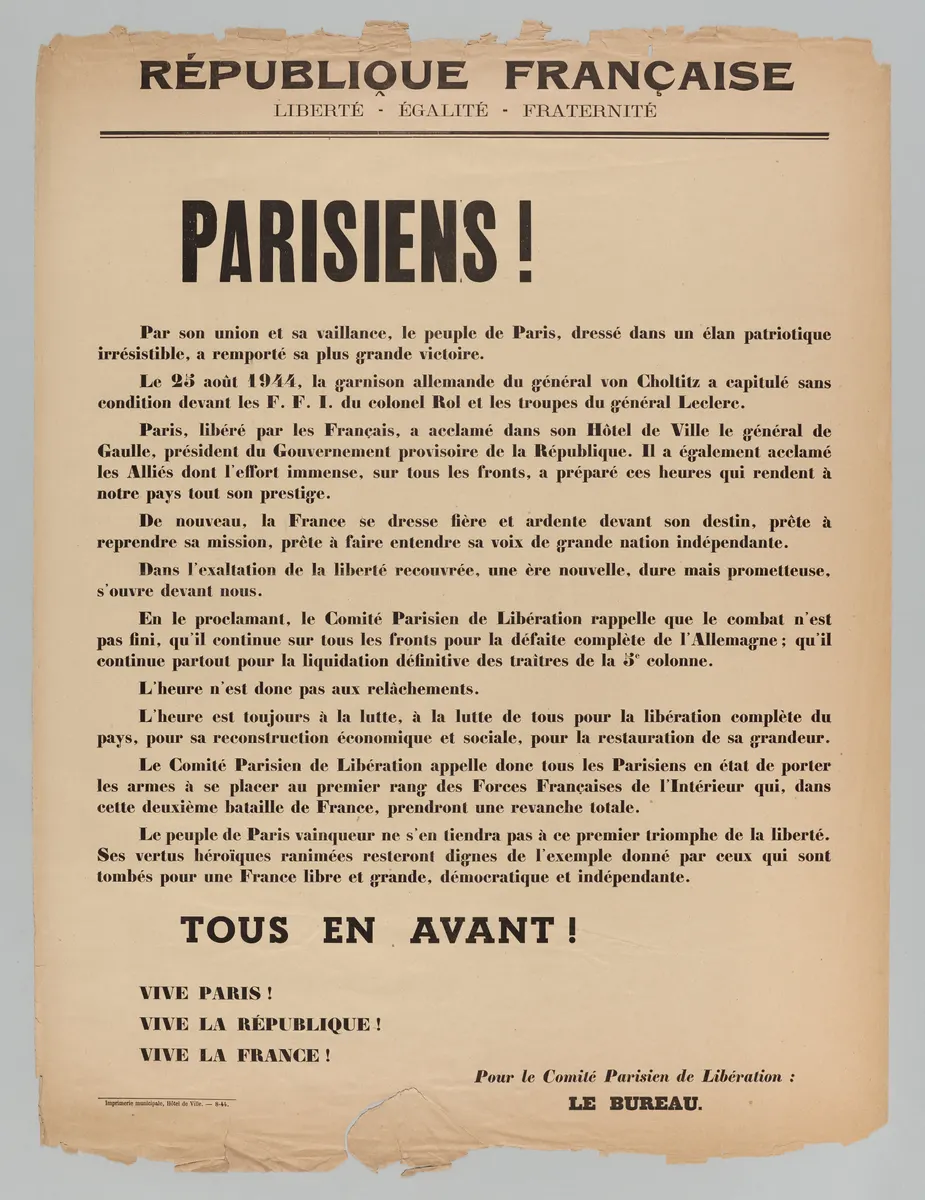
2019–2024 · Fire, restoration, and the Games
Notre-Dame burns on April 15, 2019, and loses its spire; it reopens on December 7, 2024, after five years of work. On July 26, 2024, the Olympic opening ceremony takes place on the Seine, whose public bathing is allowed again in the summer of 2025.

Complete history
A crossing point on the Seine
Paris begins as a crossing point. The Parisii, a Celtic tribe, settle the banks of the Seine in the 3rd century BCE at a spot where islands split the river into narrow branches, which makes the crossing cheap to build and easy to charge for. Rome wins the battle of 52 BCE and rebuilds the city on the left-bank slope, today's Sainte-Geneviève hill, with a forum, baths, and a 15,000-seat amphitheater; the Roman name, Lutetia, disappears, the tribe's name stays. With the empire's fall the population retreats to the island, which is walled, and it's this island that Clovis chooses in 508 as the capital of the Frankish kingdom. The Viking siege of 885–886 is the founding moment of local autonomy: Count Odo holds the city against hundreds of boats while the Carolingian king negotiates, and the legitimacy he earns there carries his family to the throne with Hugh Capet in 987.
The largest city in Europe
Between the 12th and 14th centuries, Paris becomes the largest city in Christian Europe and organizes the division of functions that still holds: power on the island, trade on the right bank, study on the left bank. Philip Augustus paves streets, raises the 1190 wall, and builds the Louvre as a fortress; Notre-Dame cathedral occupies the island from 1163; the university is chartered around 1200 and the Sorbonne in 1257. The Black Death of 1348 and the Hundred Years' War interrupt the growth, the English occupy the city from 1420 to 1436, and the 16th-century wars of religion produce the St. Bartholomew's Day massacre, on August 24, 1572. Henry IV closes the cycle in 1594 and opens the era of planned squares: Place des Vosges, from 1612, is the city's first planned residential complex.
The Revolution, Haussmann and the Commune, 1789 to 1871
The Revolution turned Paris into the place where French politics is decided in the street, and that reputation shaped the entire 19th century. The Bastille fell on July 14, 1789; the Terror set up the guillotine on what is now Place de la Concorde; then came the revolutions of 1830 and 1848 and the 1832 uprising that Victor Hugo tells in Les Misérables. It was against all this that Napoleon III acted from 1853, when he put Prefect Georges-Eugène Haussmann in charge of rebuilding the city: seventeen years of works opened the grand boulevards, laid 600 km of sewers and a drinking water system, created the Bois de Boulogne and the Bois de Vincennes and imposed a facade code of Lutetian limestone, six to seven stories, continuous balconies on the second and fifth floors and zinc roofs at 45 degrees. The straight avenues eased traffic and air flow, and artillery too. The annexation of 1860 swallowed Montmartre, Belleville, Passy and Batignolles and created the 20 arrondissements in a spiral. The Commune of 1871 governed the city for two months and ended crushed in the Bloody Week, which left a lasting distrust between Paris and the central government; the Sacré-Cœur basilica, built afterward at the top of Montmartre, became associated with that repression.
Cultural capital and occupied city
The 20th century made Paris both a cultural capital and an occupied city. Between 1900 and 1930 painters, writers and musicians arrived from everywhere: Picasso and Modigliani in Montmartre and later Montparnasse, Hemingway and Joyce in the cafés of the Left Bank, and the city exported Cubism, Surrealism and cinema. The German occupation lasted from June 14, 1940, to August 25, 1944, and included the Vel' d'Hiv roundup in July 1942, when the French police arrested 13,152 Jews, among them more than 4,000 children. After the war, France chose to house its immigrant workforce in housing projects outside the Périphérique, a decision that produced the divide between Paris intramuros and the banlieue and that explains much of French politics ever since. May 1968 began at the universities of Nanterre and the Sorbonne and became a general strike of about 10 million workers; in the years that followed, successive presidents used architecture as a program of government, from the Centre Pompidou (1977) to the Louvre pyramid (1989) and the Bibliothèque François-Mitterrand (1996).
2015: street security after the attacks
The contemporary city was reshaped by three shocks and a policy. The 2015 attacks, in January with 17 dead and on November 13 with 130, changed policing and the security architecture of the streets. The fire at Notre-Dame, on April 15, 2019, mobilized about 850 million euros in donations, and the cathedral reopened on December 7, 2024. The 2024 Olympic Games, with an opening ceremony on the Seine on July 26, funded the cleanup of the river, which allowed public swimming again at three points in the summer of 2025, for the first time since 1923. In parallel, the administration of Anne Hidalgo (2014–2026) systematically took space from cars: the closure of the right-bank expressway in 2016, the rue de Rivoli closed to private cars since 2020, more than a thousand kilometers of bike lanes, a ban on rental scooters by referendum on September 1, 2023, tripled parking fees for SUVs in 2024, and a new referendum in 2025 to pedestrianize 500 more streets. Hidalgo did not run for a third term in the municipal elections of March 2026.
Sacré-Cœur was pledged as penance for the 1870 defeat by Prussia and built at the top of Montmartre, the hill where the Commune began, in March 1871.
Geography and shape of the city
The Seine's bend at the bottom of the basin
Paris sits at the bottom of a sedimentary basin, the Paris Basin, cut by a bend of the Seine that enters from the southeast and exits to the southwest, dividing the city into the Rive Droite, to the north, and the Rive Gauche, to the south, with two islands in between: the Île de la Cité and the Île Saint-Louis. It covers 105 km², or 87 km² without the Bois de Boulogne and Bois de Vincennes, which gives about 20,000 residents per km² and makes Paris one of the densest cities in the world outside Asia. The terrain is gentle: the highest natural point is the Montmartre hill, at 130 m, followed by Belleville, at 128 m, and the river runs at about 26 m of elevation.
The limestone below and the spiral
Below the surface is Lutetian limestone, quarried since the Middle Ages to build the city itself, which left about 300 km of empty galleries under the southern arrondissements and forced the creation, in 1777, of a quarry inspectorate that still exists today. The 20 arrondissements are arranged in a clockwise spiral from the Louvre, and the district number always appears in the last two digits of the postal code, which turns the address into a coordinate.
The ring-border and the gray sky
The administrative boundary is the Boulevard Périphérique, a 35 km ring completed in 1973 and limited to 50 km/h since October 2024, which works less as a road and more as a social border between the city and the banlieue. The climate is degraded oceanic: cold, gray winters without significant snow, mild summers with increasingly frequent heat waves, and about 640 mm of rain spread across the whole year, generally light and persistent.
The last two digits of a Paris postal code give the number of the arrondissement, the district.
Culture
Literature: the 19th-century novel and Proust
Paris organized much of modern European literature and still lives off that. Victor Hugo, Balzac, and Zola wrote the city street by street in the 19th century; Proust reconstructed the 8th and 16th arrondissements from memory between 1913 and 1927; Georges Perec and Patrick Modiano made the address and the archive the raw material of the novel in the 20th century. The city has about 700 independent bookstores, more than any other European capital, protected by a fixed-book-price law in force since 1981 that bans discounts above 5%; the bouquinistes along the banks of the Seine have sold used books from green boxes since the 16th century and are a UNESCO heritage site along with the riverbanks themselves.
Impressionism (1874) and the birth of cinema
In art and film, the standard was set here and is still run from here. The first Impressionist exhibition took place in April 1874 at the studio of the photographer Nadar, on boulevard des Capucines, and the Lumière brothers' first paid public film screening was on December 28, 1895, in the Salon indien of the Grand Café, on the same boulevard. Paris today has the highest density of cinemas in the world (about 400 screens across a bit more than 80 theaters, many of them repertory houses) plus the Cinémathèque Française in Bercy. In music, the chanson of Piaf, Brel, and Gainsbourg coexists with French rap, which has become the country's most-listened-to genre and was born mostly in the northern and eastern periphery; the Philharmonie de Paris, designed by Jean Nouvel and opened in 2015 in Parc de la Villette, shifted classical music to the 19th arrondissement.
Sport and religious life: PSG, at the Parc des Princes since 1974
In sport and religious life, the city is at once concentrated and divided. Paris Saint-Germain has played at the Parc des Princes since 1974 and became France's biggest club after the Qatari fund bought it in 2011; Roland-Garros occupies the west of the city for two weeks between late May and early June; the Tour de France traditionally finishes with a lap on the Champs-Élysées circuit. France has been officially secular since the separation law of 1905, meaning no religious symbols in schools or public offices; even so, Paris holds the largest Jewish and Muslim communities in Western Europe, with the Grand Mosque of Paris built in 1926 as a thank-you to the Muslim soldiers killed in the First World War, and the city owns 85 Catholic churches, nationalized in 1905 and maintained with municipal money.
The green boxes along the banks of the Seine have been used-book stalls, the bouquinistes, since the 16th century.
Festivals and events

Fête de la Musique
June 21, every year since 1982: anyone can play music in the street without a permit, and the whole city becomes a stage until the small hours, with the metro running past its normal hours.

Bastille Day (July 14)
Military parade on the Champs-Élysées in the morning and fireworks over the Eiffel Tower seen from the Champ-de-Mars and the Trocadéro around 11pm. On the eve and the following night, the bals des pompiers take place, open parties inside fire stations.
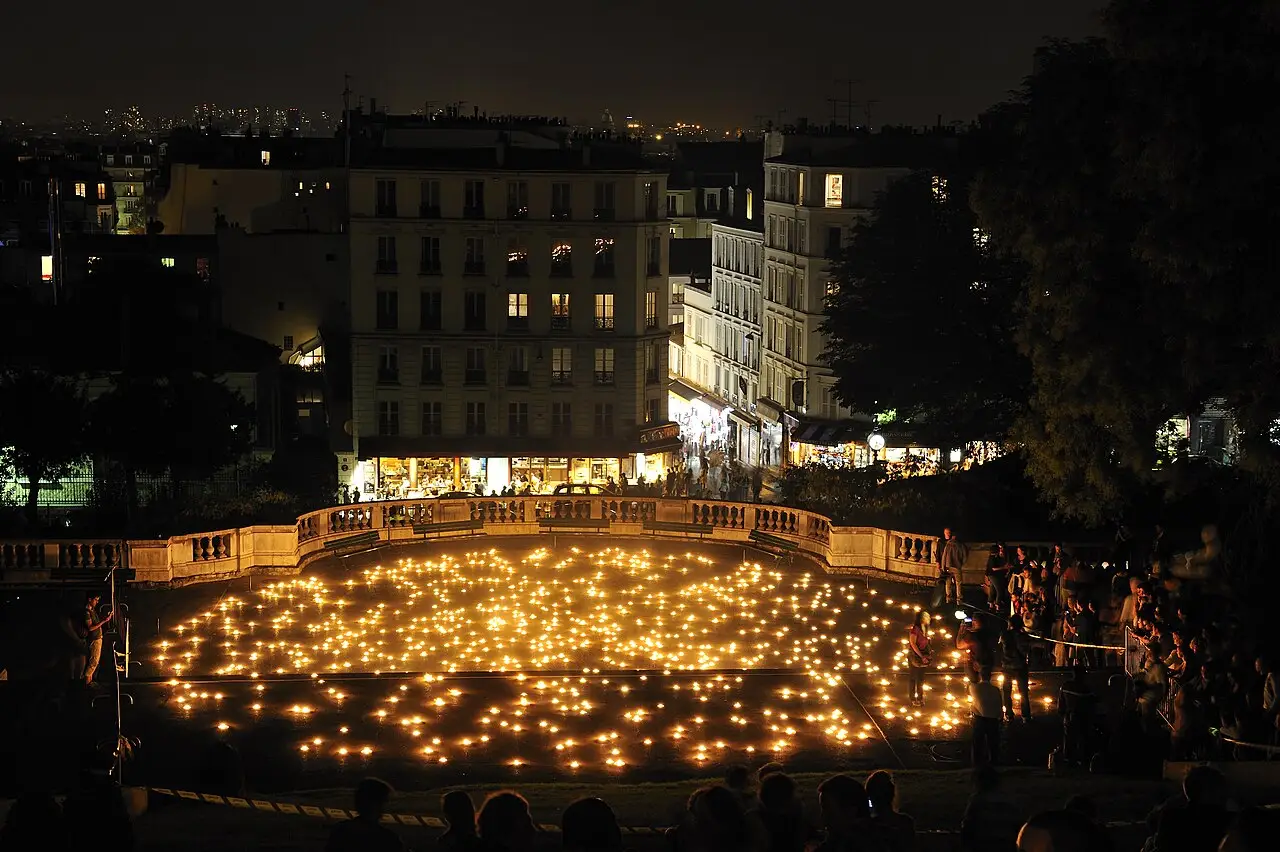
Nuit Blanche
At Nuit Blanche, which since 2023 falls on the first Saturday of June, museums, churches, swimming pools and public buildings open for free all night long with contemporary art installations, and some public transportation runs until morning. The event has existed since 2002 and until 2022 took place on the first Saturday of October.
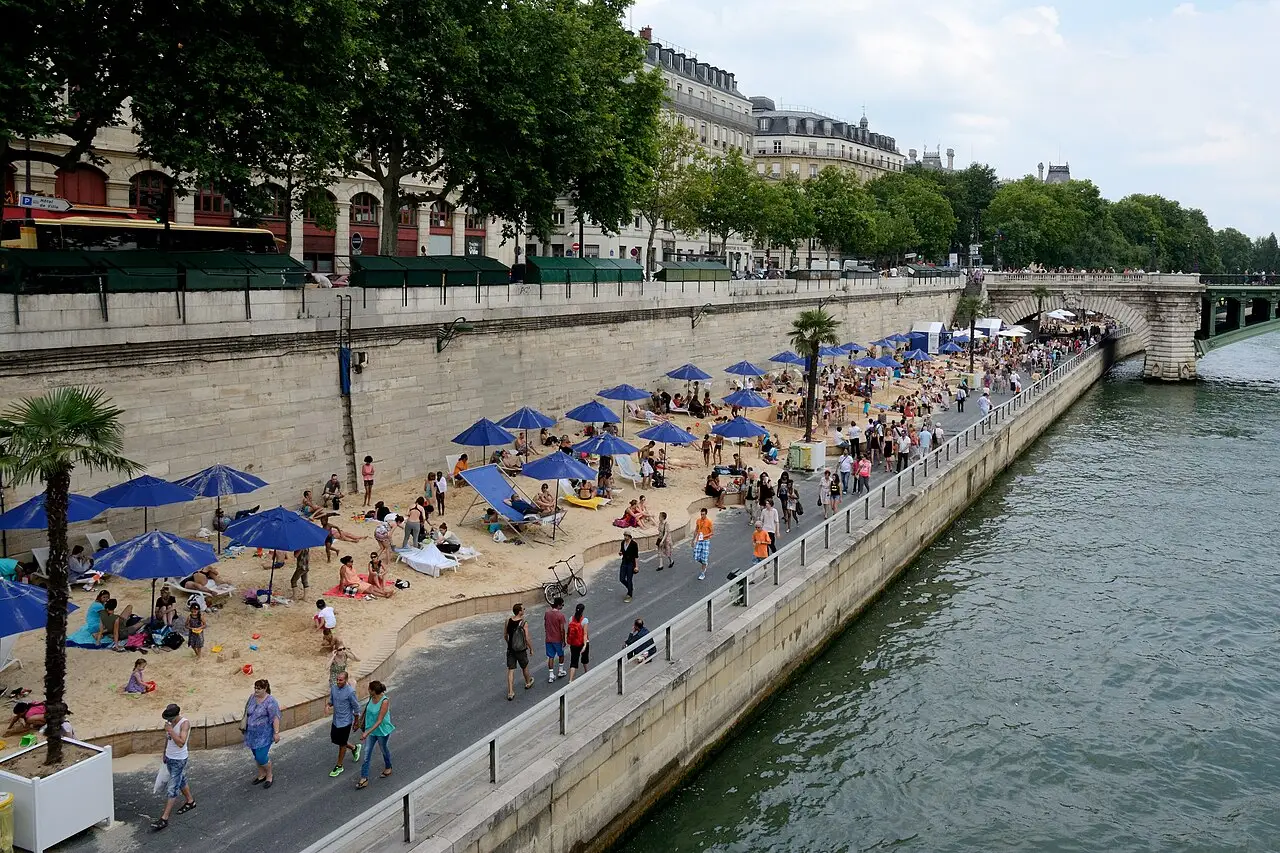
Paris Plages
From mid-July to mid-August, the banks of the Seine and the Bassin de la Villette get sand, deck chairs, and temporary pools. Since 2025 there are also three official river bathing spots, open in summer and subject to daily water testing.

Fashion weeks
Two ready-to-wear seasons, in late February/early March and late September/early October, plus haute couture in January and July. The shows are closed to the public, but hotels in the 1st and 8th arrondissements fill up and rates rise 30% to 60%.
Books and films
Les Misérables, by Victor Hugo (1862)
Describes the pre-Haussmann city street by street, sewers and the 1832 uprising included, and explains why the straight boulevards were cut just a few years after the book.
La Haine, by Mathieu Kassovitz (1995)
It films twenty-four hours between a housing project on the outskirts and downtown Paris, and shows what the Périphérique separates: the fracture that has organized French politics since the 1970s.
An Attempt at Exhausting a Place in Paris, by Georges Perec (1975)
Three days sitting in the Place Saint-Sulpice noting buses, pigeons, and people: a manual for how to look at a European city without searching for a monument.
Frequently asked questions
Paris: Has the ten-ride metro carnet been discontinued?
Yes. The magnetic carnet of ten rides no longer exists, and the paper ticket was discontinued on November 1, 2025; the fare now goes on the Navigo Easy card, about €2, or in the app. Buy the card at the ticket window of a big station, because the machine may refuse a foreign card without a chip.
Paris: How do you get from Charles-de-Gaulle airport to downtown?
Charles-de-Gaulle is 25 km northeast: the RER B runs to Châtelet, via Gare du Nord, in 30 to 40 minutes for about €13, and the Roissybus reaches the Opéra in 60 to 75 minutes for about €17.
Paris: How do you get to Versailles?
Versailles is 20 km southwest: take the RER C to Versailles Château Rive Gauche, in 40 to 50 minutes, or a train from Gare Montparnasse to Versailles Chantiers. The palace closes on Mondays and requires a timed booking.
Paris: How much does it cost per day?
Plan on €85–120 a day on a budget, €170–240 on a mid-range budget, and from €320 on a comfortable one, not counting the city tax, which runs from about €2.60 to about €16 per person per night. The currency is the euro, and contactless cards work almost everywhere, even at bakeries and street markets.
Paris: When's the best time to go?
The best windows run from mid-April to mid-June, with 12 to 24°C and long days until 9:30pm, and from September to mid-October, with the same weather and fewer crowds. July and August are hot, expensive, and packed, and most older apartments and hotels have no air conditioning.
Other cities in the country
France ↗- Days
- 3–5
- When
- May–Jun · Sep
- Per person/day
- Average 169 EURMid-range · per person/day
Cost scope
Per person per day: accommodation, meals, urban transport, visits and a small allowance for extras. Flights excluded; larger purchases vary. Editorial estimate, not a quote.
- Days
- 5–6
- When
- May–Jun · Sep–Oct
- Per person/day
- Explore costsGuide estimate
Cost scope
Per person per day: accommodation, meals, urban transport, visits and a small allowance for extras. Flights excluded; larger purchases vary. Editorial estimate, not a quote.


Itineraries through here
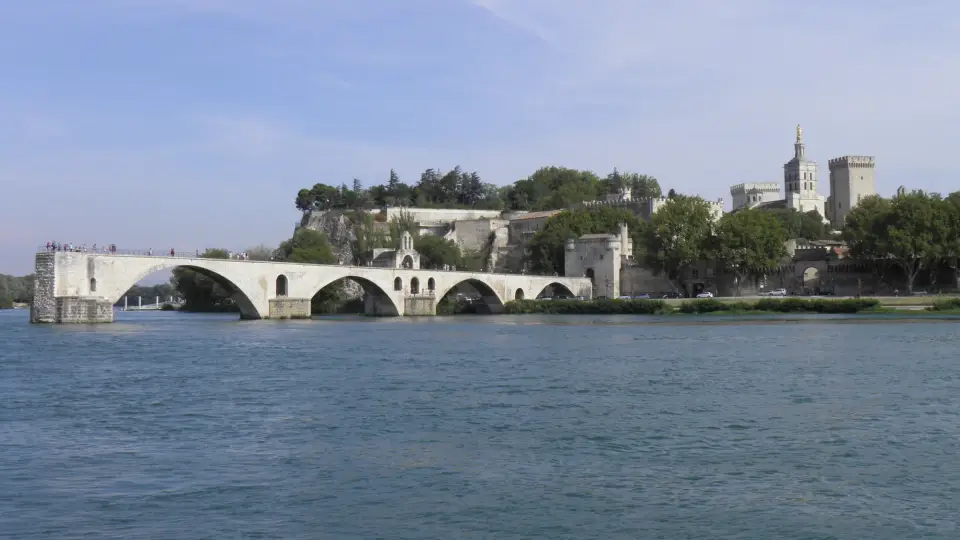
 The Netherlands, Belgium and Paris in 10 daysFrom the canals to the SeineAmsterdam · Brussels · Paris8–10 days3 cities
 Paris and London in 7 daysUnder the ChannelParis · London7–9 days2 cities
 France and Italy in 10 daysThe Louvre, the Uffizi and the VaticanParis · Florence · Rome9–13 days3 cities
 Classic Europe in 15 daysFirst time in EuropeLondon · Paris · Florence · Rome12–17 days4 cities
 London, Paris and Amsterdam in 10 daysLondon to Amsterdam by trainLondon · Paris · Amsterdam10–12 days3 cities
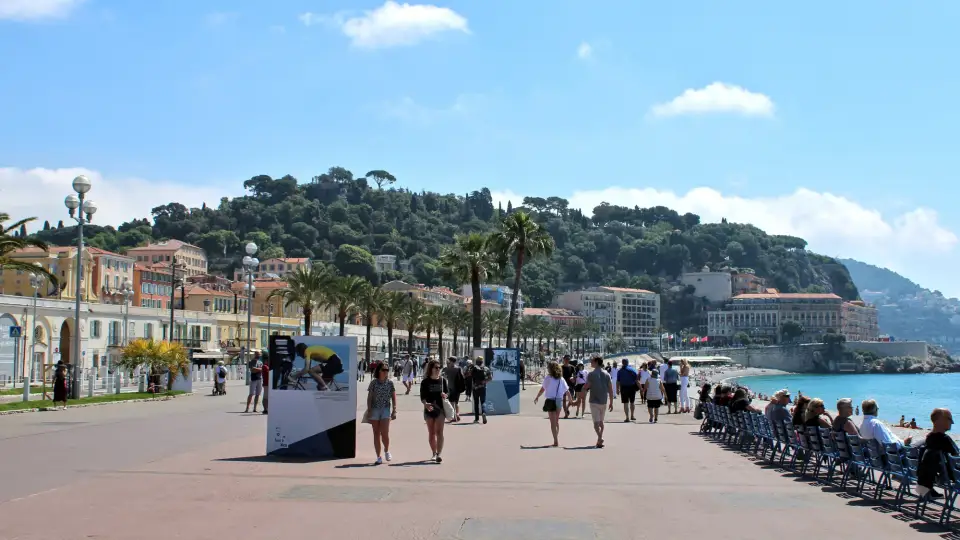
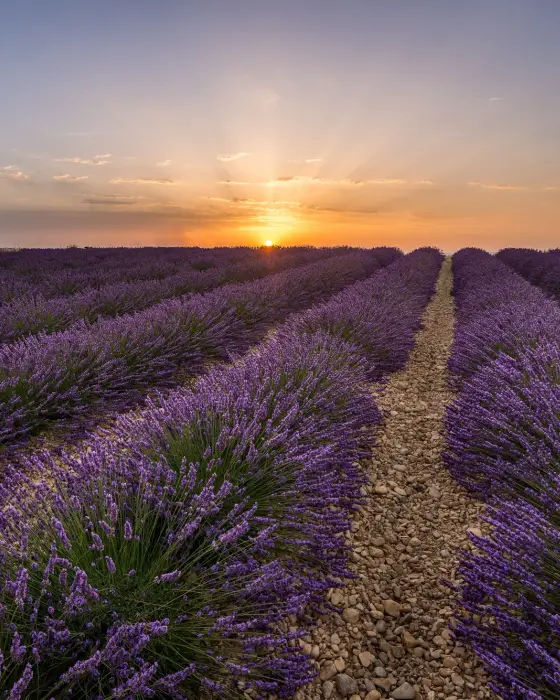 France in 15 daysParis to the Riviera through ProvenceParis · Provence · Nice12–16 days3 cities
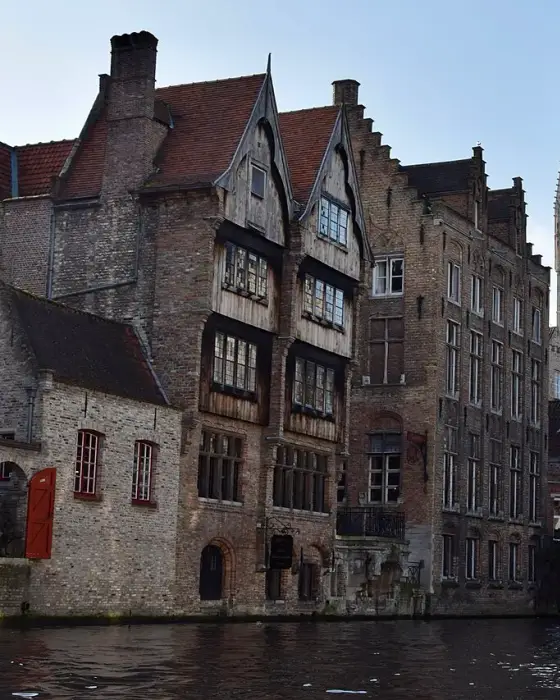 Amsterdam, Bruges and Paris in 10 daysA night in Bruges on the way to ParisAmsterdam · Brussels · Bruges · Paris9–13 days4 cities