Brazil
Alter do Chão
River beach in the Amazon that appears from August to December, and standing forest an hour away by boat
Days Start with the basic programme and choose extensions for the time you have.
How the guide reaches this number
Three in Alter do Chão: one for the village, Ilha do Amor and the late-afternoon climb of Serra da Piraoca; one by boat on Lago Verde and the Canal do Jari, ending at Ponta do Cururu if it's beach season; and one in the Tapajós National Forest, with a trail led by people from the community, which is the day that best explains the region. The fourth I'd spend in Santarém, about 15 km from the airport, to see the Tapajós running beside the Amazon without mixing from the waterfront and to pass through the Mercadão 2000 before a night flight. With three days, I'd cut Santarém; the Flona I wouldn't cut. With more time and a willingness to sleep out, I'd go up the Arapiuns River and spend a night in a community. And I'd pick the month before the hotel: August to December for a beach, February to June to see the flooded forest.
3–4
When August to December, at low water on the Tapajós, when Ilha do Amor and the sandbars appear; from February to June the beaches are submerged and the visit shifts to canoeing in the flooded forest, and January and July are transition months
How the guide reaches this number
Alter do Chão changes its face over the year, and the month you choose decides the trip. From August to December, at low water, the Tapajós drops and Ilha do Amor and sandbars such as Cururu appear; the strip grows from September, and it is also the driest season, with October the month with the least rain. From February to June, at high water, the beaches are submerged and the flooded forest becomes the outing: canoeing through the Floresta Encantada, deeper igapós and the forest seen up close; the heaviest rains fall from February to May, peaking in March. July and January are transitions: in July the river starts to fall and the first beaches appear, still small; in January the rains return and part of the sand still holds out. Crowds follow another calendar: July, a school vacation month in Brazil, opens the high season, which runs until January, and the week of the Çairé, in September, is the busiest of the year. The Tapajós Flona can be visited year-round, but at high water some stretches of trail are flooded and call for shoes that can get wet. The river level varies from one year to the next; before buying your ticket, ask a pousada or agency in the village how the beach looks.
Per person/day Add up lodging per night, meals per person, and the boat trips and National Forest visit you choose; July and the Çairé, in September, change the total considerably.
How the guide reaches this number
Per person per day: accommodation, meals, urban transport, visits and a small allowance for extras. Flights excluded; larger purchases vary. Editorial estimate, not a quote.
 What Nilo thinks
I'd stay four days. Three in Alter do Chão: one for the village, Ilha do Amor and the late-afternoon climb of Serra da Piraoca; one by boat on Lago Verde and the Canal do Jari, ending at Ponta do Cururu if it's beach season; and one in the Tapajós National Forest, with a trail led by people from the community, which is the day that best explains the region. The fourth I'd spend in Santarém, about 15 km from the airport, to see the Tapajós running beside the Amazon without mixing from the waterfront and to pass through the Mercadão 2000 before a night flight. With three days, I'd cut Santarém; the Flona I wouldn't cut. With more time and a willingness to sleep out, I'd go up the Arapiuns River and spend a night in a community. And I'd pick the month before the hotel: August to December for a beach, February to June to see the flooded forest.In Alter do Chão, it is the level of the Tapajós that defines what you do: at low water, a tongue of white sand, Ilha do Amor, appears in front of the village between the river and Lago Verde; at high water, the same sand sinks and the visit becomes a canoe ride among the trunks of a flooded forest. From the top of Serra da Piraoca you grasp the whole layout. Around it, the Tapajós National Forest receives visitors at the hands of those who live in it: community guides lead you to a nearly thousand-year-old sumaúma and to streams for swimming, and lunch comes from the home kitchen, with fish from the river. In the village the food is also from the river, with tambaqui and tucunaré over embers, tacacá in a cuia and açaí served beside the fish. In September, everything turns toward the Çairé, a festival of processions, litanies and masts that has, on weekend nights, the contest between two dolphins.
Quick facts
- Population
- 9,834 inhabitants in the Alter do Chão district (IBGE, 2022 Census); the municipality of Santarém has 364,298 (IBGE, 2026 estimate)
- Founded
- Official date: March 6, 1758, when Governor Francisco Xavier de Mendonça Furtado raised a religious mission in Borari territory to the status of a village; local tradition speaks of a settlement from 1626, attributed to Pedro Teixeira
- Country and region
- Brazil, North; western Pará, a district of the municipality of Santarém, on the right bank of the Tapajós River
- Language
- Portuguese
- Currency
- Real (BRL, R$)
- Time zone
- UTC−3 year-round, no daylight saving time (one hour ahead of Manaus)
- Best time to go
- August to December, at low water on the Tapajós, when Ilha do Amor and the sandbars appear; from February to June the beaches are submerged and the visit shifts to canoeing in the flooded forest, and January and July are transition months
- Average daily cost
- Add up lodging per night, meals per person, and the boat trips and National Forest visit you choose; July and the Çairé, in September, change the total considerably.
When to go
August to December, at low water on the Tapajós, when Ilha do Amor and the sandbars appear; from February to June the beaches are submerged and the visit shifts to canoeing in the flooded forest, and January and July are transition months
How the year changes
Alter do Chão changes its face over the year, and the month you choose decides the trip. From August to December, at low water, the Tapajós drops and Ilha do Amor and sandbars such as Cururu appear; the strip grows from September, and it is also the driest season, with October the month with the least rain. From February to June, at high water, the beaches are submerged and the flooded forest becomes the outing: canoeing through the Floresta Encantada, deeper igapós and the forest seen up close; the heaviest rains fall from February to May, peaking in March. July and January are transitions: in July the river starts to fall and the first beaches appear, still small; in January the rains return and part of the sand still holds out. Crowds follow another calendar: July, a school vacation month in Brazil, opens the high season, which runs until January, and the week of the Çairé, in September, is the busiest of the year. The Tapajós Flona can be visited year-round, but at high water some stretches of trail are flooded and call for shoes that can get wet. The river level varies from one year to the next; before buying your ticket, ask a pousada or agency in the village how the beach looks.
Nilo's tips
Ask about the river before you buy
The Tapajós level changes from one year to the next. A message to a pousada or agency in the village asking how Ilha do Amor looks is worth more than the generic calendar.
Book the Flona with the community
The guides at Maguari, Jamaraquá and São Domingos are contacted directly. Arrange the trail, lunch and time in advance and leave Alter early, to do the hike before the heat.
Book the boat the day before
The tours to Lago Verde, Canal do Jari and the Flona leave in the morning. Arranging with the boatman the night before secures the time, the life jacket and what is included.
Withdraw cash in Santarém
The village has few ATMs. Arrive with cash and Pix working for stalls, boatmen and communities.
Explore the map
Explore the map, read about the other places and plan your travel days in the app.
Open the appWhat to see
Alter do Chão: Between the Tapajós and Lago Verde
The climate is hot and humid all year. In the INMET 1961 to 1990 climate normal for the Taperinha station, in Santarém, the monthly average ranges from 25.4 °C in July to 26.9 °C in October and November, and rainfall totals about 2,119 mm a year, concentrated from February to May, with a peak in March (382.9 mm); January is already rainy, and the driest month is October (53.8 mm). Almost everything can be done on foot here.

Ilha do Amor
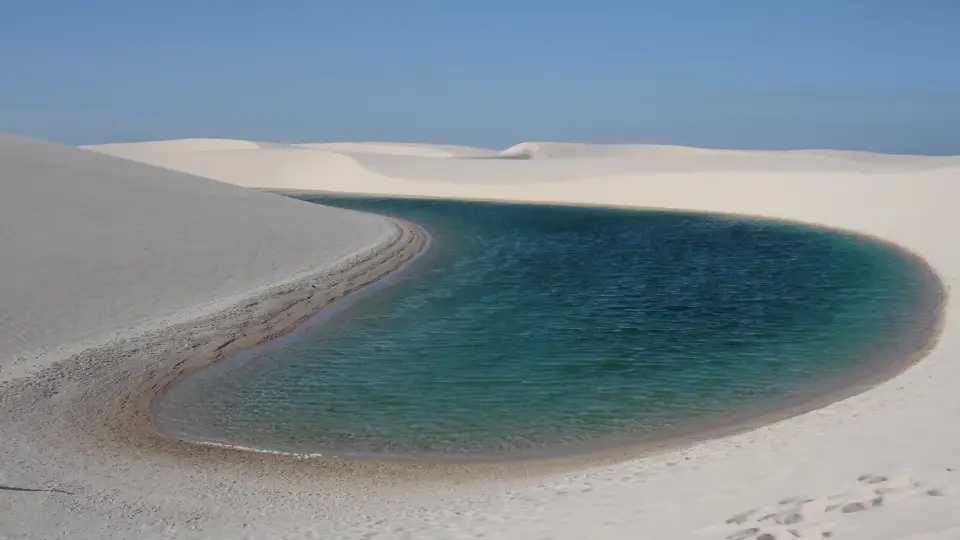
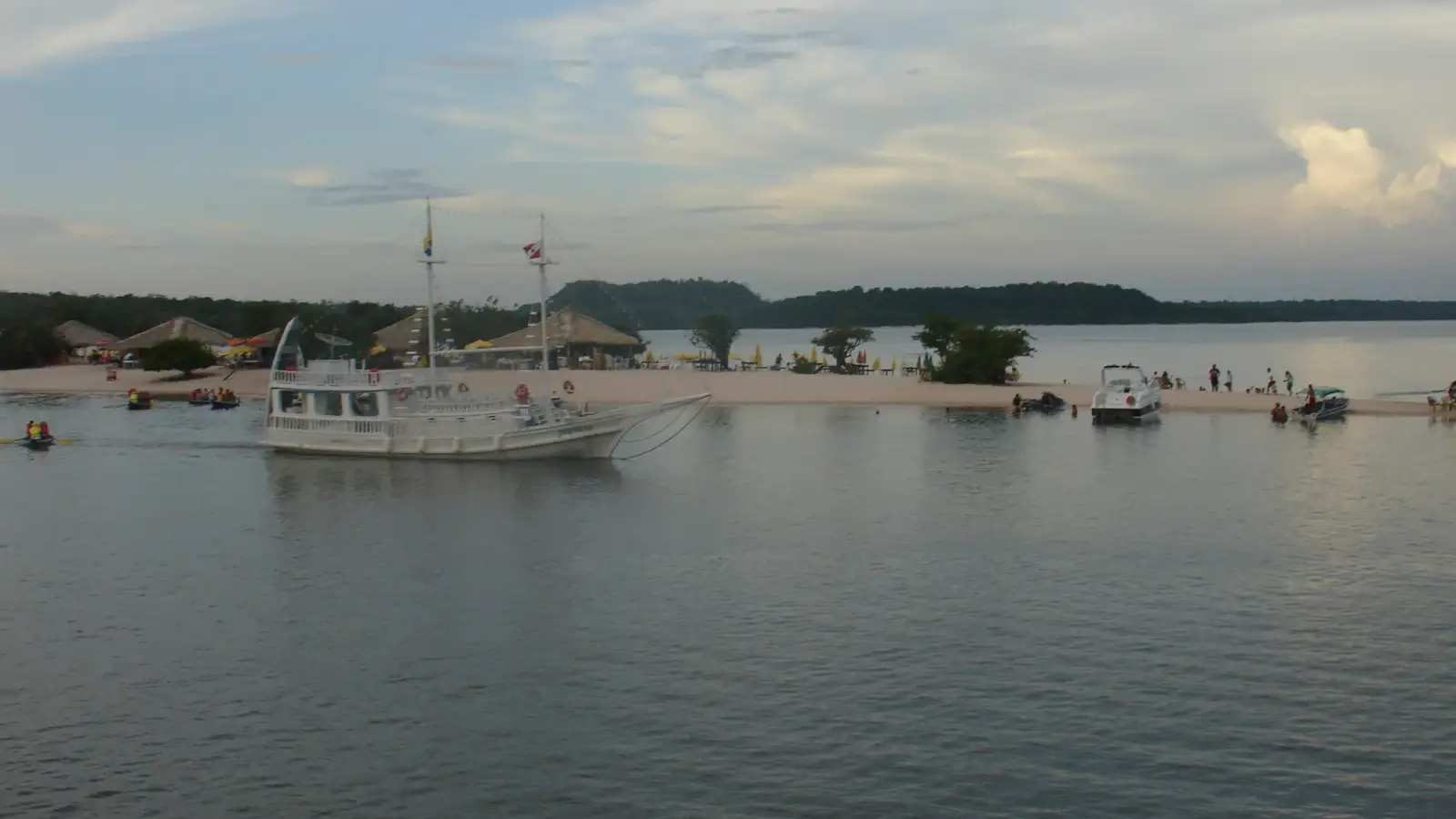
The strip of white sand in front of the village, between the Tapajós and Lago Verde, is a peninsula that the river covers for part of the year. It appears at low water, from August to December, and grows larger from September, with beach stalls serving grilled fish and clear water for swimming; the crossing is short, on small boats that leave from the village pier. It fills up on weekends and during the Çairé; on weekdays it is calmer. From February to June it is submerged, and in July it begins to reappear.
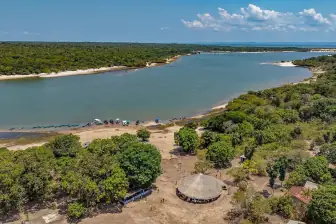
The village occupies the right bank of the Tapajós, a clear-water river carrying little sediment.
Check access
Lago Verde
The lake that the peninsula separates from the Tapajós is the gateway to the Floresta Encantada, an igapó (flooded forest) explored by canoe after a motorboat ride to the entrance. At high water, from February to June, the canoe goes deep among the trees; in the dry season, only the first stretch is navigable. The tours leave from the waterfront with boatmen from the village.
Behind the peninsula rises Serra da Piraoca, the hill from which you can see the whole scene.
Check access
Tapajós National Forest
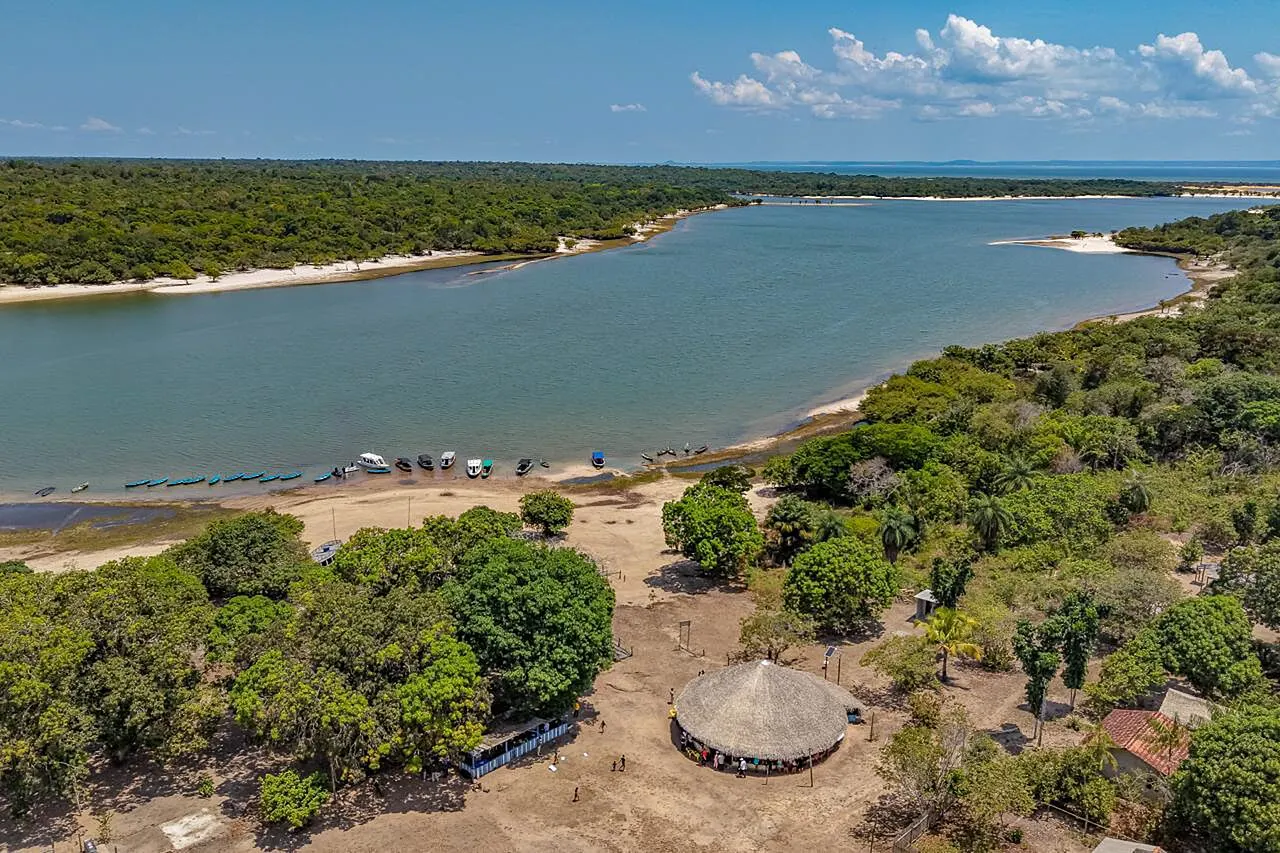
Created in 1974, the Flona covers 530,620.65 hectares and, according to a 2023 news report, about a thousand families in 28 communities, who run the tourism. The most popular trails leave from the communities on the banks of the Tapajós: at Maguari, about 14 km to a nearly thousand-year-old sumaúma (kapok) tree, with a stream swim; at Jamaraquá, about 10 km among centuries-old trees; at São Domingos, about 10 km to a lookout over the river. The guide and lunch are arranged directly with the community. You get there by boat from Alter or by road, via Belterra and the BR-163.
In front of Santarém, about 37 km from Alter by road, the Tapajós meets the Amazon, muddy and loaded with sediment from the Andes, and the two waters run side by side for about 8 km before mixing.
Check access

Serra da Piraoca
The hill behind Ilha do Amor has a short, steep trail, about an hour round trip, to a lookout with views of the Tapajós, Lago Verde and the forest canopy. It's worth climbing late in the afternoon, when the heat eases, and coming down before dark, with water and closed shoes; travel guides recommend going in a group or with a guide. The access starts on the other side of the crossing.
In front of it, a flood-prone sand peninsula separates the river from Lago Verde, also called Lago dos Muiraquitãs; this strip of sand is what becomes the Ilha do Amor beach at low water.
Check access
Canal do Jari
An arm of water among igapós, in a várzea (floodplain) area, where boat trips look for birds, sloths and caimans and, for part of the year, giant water lilies. It is a full-day outing, arranged in the village, that usually ends with sunset on a sandbar.
The center of Alter can be covered on foot. For Ilha do Amor, small boats make the short crossing from the pier at low water.
Check access
Ponta do Cururu
A sandbar that appears at low water, from August to December, sometimes into January if the river is still low, and the most sought-after spot in the region to watch the sun set over the Tapajós. It is usually the end of the boat trips. It has no facilities at all: water, snacks and your trash go back and forth on the boat.
The tours to Lago Verde, Canal do Jari, Ponta do Cururu and the Flona leave by boat from the waterfront and are booked with boatmen and agencies in the village; agree in advance on the route, the return time and whether there are life jackets for everyone.
Check access
Praça do Sairé
The square where the Çairé's barracão (festival hall) and stages stand. In the third week of September it hosts processions, litanies and the festival's concerts; outside that week, it is a village square on the way between the waterfront and the restaurants.
The core around the main square and Praça do Sairé, with restaurants, bars, craft shops and the pier where boats leave for Ilha do Amor and the tours.
Check access

Praia do Pindobal
A river beach in Belterra, on the bank of the Tapajós, that makes a good stop on the way back from the Flona by road. Like Ilha do Amor, it changes size with the river level.
Very early departure from Alter, by boat to the chosen community (Jamaraquá, Maguari or São Domingos) or by car via Belterra and the BR-163.
Check access
Nilo’s itinerary
Start with the basic programme and choose extensions for the time you have.
Plan my days in the app ↗Day 1 · The village, Ilha do Amor and Serra da Piraoca
Coffee in the village and a walk around the main square and the Tapajós waterfront, to arrange the next days' tours at the pier.
Short boat crossing to Ilha do Amor (at low water) and a morning at the beach, with a grilled-fish lunch at a stall.
Early afternoon free at the beach or the pousada, away from the strongest sun.
Late in the afternoon, climb Serra da Piraoca, about an hour round trip, in a group or with a guide, with water and closed shoes, coming down before dark.
Boat back to the village and dinner in the center, with tacacá as a starter.
At high water (February to June), swap the beach for a short canoe ride on Lago Verde and ask at the pier what access to Piraoca is like.
Day 2 · By boat on Lago Verde and the Canal do Jari
Early departure from the waterfront on a boat trip booked the day before, with route, lunch and return time agreed.
Floresta Encantada, on Lago Verde: motorboat to the entrance and canoe among the trees (deeper at high water, only the first stretch in the dry season).
Canal do Jari, among igapós, with stops to watch for birds, sloths and caimans.
From August to December (and in January, if the river is still low), late afternoon at Ponta do Cururu for the sunset, with water and snacks brought on the boat.
Return to the Alter pier and an evening in the village.
Day 3 · Tapajós National Forest
Very early departure from Alter, by boat to the chosen community (Jamaraquá, Maguari or São Domingos) or by car via Belterra and the BR-163.
A 10 to 14 km trail with the community guide booked by phone: the giant sumaúma at Maguari, the centuries-old trees and the stream at Jamaraquá, or the lookout over the Tapajós at São Domingos.
Home-cooked lunch in the community, arranged in advance, and a visit to the community shop for biojewelry or oils.
On the way back by road, a stop at Praia do Pindobal, in Belterra, if the river is low.
Arrival in Alter in the late afternoon and a last night in the village.


If you stay longer
Day 4 · Santarém and the meeting of the waters
Day trip
Santarém is about 37 km from Alter on the PA-457, by taxi, ride-hailing app or scheduled bus, and the airport is about 15 km from the city center. From the Santarém waterfront you can see the clear-water Tapajós run alongside the muddy Amazon for about 8 km without mixing. The Mercadão 2000 gathers fish, fruit and herbs from the region. It works as a last day, with luggage, before a night flight, or as an overnight stop before an early-morning flight.
Food
Fish grilled over embers
Tambaqui and tucunaré grilled whole over embers, served with manioc flour and vinaigrette, are the beach stalls' lunch. When the fish is grilled on the beach itself, around the fire, the meal has a name: piracaia.
Pirarucu
One of the largest freshwater scaled fish, with firm flesh, it appears fried, stewed or shredded in the regional restaurants of the village and Santarém.
Tacacá
A hot broth of tucupi (the yellow liquid extracted from grated manioc) served in a cuia with manioc starch, jambu and dried shrimp. The jambu numbs the mouth for a few minutes, and that is exactly why it is there.
Maniçoba
Ground manioc leaves, cooked for about a week to remove the hydrocyanic acid and then for several more days with salted and smoked pork. Called the Pará feijoada, it comes with rice, flour and hot pepper.
Açaí
In Pará, açaí is blended thick and often comes to the table unsweetened, next to fish and flour, as part of the meal.
Community lunch
In the Flona communities, lunch is home-cooked, with fish from the Tapajós; it is arranged in advance, together with the trail guide.
Where to eat
- Ilha do Amor · $$
Tambaqui or tucunaré grilled whole over embers, with flour and vinaigrette, at the beach stalls during low water; it is the lunch of those who spend the day on the sand.
- Village center · $
Tacacá in a cuia at the end of the day, and pirarucu and Tapajós fish dishes at the regional restaurants around the square.
- Restaurante Conceição · Jamaraquá community (Tapajós Flona)
Home-cooked lunch with fish, arranged by phone before the trail; the July 2026 Flona program listed Restaurante Conceição and Restaurante Socorro in the community.
Source · 2026-07-17
- Santarém · $
Fresh fish, fruit and herbs at the Mercadão 2000, for those spending their last day in the city before the flight.
$: tacacá in a cuia, açaí or a snack in the village center · $$: grilled fish at a beach stall or a regional dish at a village restaurant · 2026-04-13
Day trips
Santarém and the meeting of the waters
Santarém is about 37 km from Alter on the PA-457, by taxi, ride-hailing app or scheduled bus, and the airport is about 15 km from the city center. From the Santarém waterfront you can see the clear-water Tapajós run alongside the muddy Amazon for about 8 km without mixing. The Mercadão 2000 gathers fish, fruit and herbs from the region. It works as a last day, with luggage, before a night flight, or as an overnight stop before an early-morning flight.
Arapiuns River and the communities
From Santarém, about three and a half to four hours by scheduled boat to communities in the Arapiuns reserve, such as Anã and Urucureá, where there are a community hammock house, tucumã craft workshops and trails; the Turiarte Amazônia cooperative puts together itineraries with community guides. It calls for an overnight stay and falls outside the days based in Alter.
Where to begin
The village, Ilha do Amor and Serra da Piraoca
Coffee in the village and a walk around the main square and the Tapajós waterfront, to arrange the next days' tours at the pier.
Tapajós National Forest
Very early departure from Alter, by boat to the chosen community (Jamaraquá, Maguari or São Domingos) or by car via Belterra and the BR-163.
Money
The currency is the real (R$). Cards and Pix are accepted in most village businesses, but ATMs are few (in 2023, a travel guide counted only one working 24 hours), so it's worth withdrawing what you need in Santarém; boatmen, beach stalls and Flona communities may prefer cash or Pix, and cell coverage outside the village is weak. Lodging, per night for two and starting price: in April 2026, a survey of pousadas listed from R$ 209 at the cheapest, R$ 248 to R$ 441 in the center and R$ 281 to R$ 1,210 in the outlying ones, in the middle of the forest; in September 2026, another guide gave waterfront pousadas from R$ 238. Hotels get more expensive from July to January, when more people arrive. In the July 2026 trail program in the São Domingos, Maguari and Jamaraquá communities, the guide cost R$ 200 per group of up to five people, without a meal. Boat tours have a price agreed per person or per boat, depending on the route and the number of people: compare two or three offers on the waterfront and confirm what is included.
Getting there and around
Getting there
The gateway is Maestro Wilson Fonseca International Airport (STM), in Santarém, run by Aena, with direct flights to Belém, Manaus and Brasília; since September 1, 2026, Azul also flies direct to Belo Horizonte (Confins), three times a week in each direction, departing Santarém on Wednesdays, Fridays and Sundays, in the early hours. From the airport to Alter it is about 33 km on a paved road; from Santarém to the village, the trip takes about 45 minutes by car or van. Taxis and ride-hailing apps make the trip directly, and the price varies a lot between sources: a 2023 guide gave R$ 90 to R$ 120 for a taxi and about R$ 70 for a ride-hailing app, and another, revised in September 2026, estimates the Coopetáxi ride, the airport cooperative, on the meter, at R$ 190 or more; agree on the fare before getting in the car. By bus there is no direct line: the Airport–Center line runs from 6 a.m. to 10 p.m., and the Alter line passes along Avenida Fernando Guilhon, near the Rio Tapajós Shopping, where you transfer. Those coming from Manaus or Belém can also reach Santarém by riverboat, a trip of days on the river; note that Manaus is one hour behind (UTC−4).
Buses and fares
The Santarém urban fare rose to R$ 4.80 for a full fare on January 12, 2026 (Decree 010/2026), and the same decree raised intramunicipal lines by the same proportion, with values in an annex that news coverage of the increase does not reproduce. Alter do Chão is a district of Santarém, but the fare and schedule of the village line were not published in that coverage; confirm with the fare collector, at the terminal or with the Municipal Secretariat of Mobility and Traffic before relying on the bus, especially at night.
In the village and on the tours
The center of Alter can be covered on foot. For Ilha do Amor, small boats make the short crossing from the pier at low water. The tours to Lago Verde, Canal do Jari, Ponta do Cururu and the Flona leave by boat from the waterfront and are booked with boatmen and agencies in the village; agree in advance on the route, the return time and whether there are life jackets for everyone. The Flona can also be reached by car or scheduled bus via Belterra and the BR-163, with the last stretch on a dirt road.
Safety
Alter do Chão is a calm village, and the most important precautions concern the river, the sun and insects. At low water, freshwater stingrays lie in the shallow sand, and the accidents recorded in the village are more frequent from September to January; when entering the water, shuffle your feet along the bottom instead of lifting them, as the Pará fire department advises, and seek medical care after a sting. On a boat, wear a life jacket and agree on the return time before dark. The sun is strong all year, and there is no shade on the sandbars. The CDC recommends the yellow fever vaccine, from 9 months of age, for those traveling to Pará, and lists the state among those with malaria transmission; repellent, long clothing in the late afternoon and mosquito nets in the forest pousadas also help against dengue. In an emergency, call 192 (Samu), 193 (Fire Department) or 190 (Military Police).
Etiquette tips
Community tourism is arranged in advance
In the communities of the Flona and the Arapiuns, guide, lunch and overnight stay are arranged directly with the residents, ahead of time. Showing up unannounced may mean no guide and no food.
Sandbars without trash cans
The sandbars have no facilities or garbage collection. What goes on the boat comes back on the boat, including cans and cigarette butts.
Fire in the dry season
From August to December the vegetation around the village is dry, and a fire already burned about 1,200 hectares in 2019. No campfires or cigarette butts thrown into the woods.
The Çairé is also a religious rite
Processions, litanies and Mass are as much a part of the festival as the Festival dos Botos. During the rites, follow along without crossing the procession and ask before taking close-up photos.
Mistakes to avoid
Going in April for the beach photo
The best-known images of Ilha do Amor are from low water. From February to June the sand is underwater, and in July there is still little; if you want a beach, go from August to December.
Going to the Flona without booking a guide
The trails are led by guides from the communities, contacted directly by phone. Without a booking, the day can turn into just the boat ride.
Going to Ponta do Cururu without water
There is no stall and no shade. Water, snacks and sunscreen go on the boat.
Counting on an ATM in the village
There are few ATMs in Alter. Withdraw in Santarém and carry a reserve for those who don't take cards.
Leaving Çairé lodging for later
In the third week of September the village fills up for the Çairé. For those dates, lodging guides recommend booking up to six months ahead.
Useful phrases
Quanto é a travessia para a Ilha do Amor?
Asking the price of the small boat that crosses from the pier to the beach
A que horas o barco volta?
The question to ask before boarding any tour
Tem colete para todo mundo?
To confirm there is a life jacket before setting out
Igarapé
A narrow stream that runs through the forest; on the Flona trails, it is where you swim
Igapó
Forest flooded by the high water, like the Floresta Encantada on Lago Verde
Vazante e cheia
The river falling (vazante, August to December) and the river high (cheia, February to June); these are the words that decide the outing
Where to stay
- Village center · First-timers without a car who want to walk to the pier, the restaurants and the square: It concentrates pousadas of various sizes near the square and the waterfront, and the boats to Ilha do Amor and the tours leave a few minutes away. The downside is the noise from bars and, during the Çairé week, from the festival stages.
- Tapajós waterfront · Those who want the river at the door and the beach in front when they wake up: There are simple pousadas and hostels facing the water, such as in front of Cajueiro beach, a short walk from the center. At high water, the beach in front shrinks or disappears, and the view is of river.
- Lago Verde and surroundings · Those who seek quiet, forest all around, and don't mind depending on a long walk, a bike or transport: The pousadas and houses amid the vegetation are the quietest and include the region's highest nightly rates. They have more mosquitoes and are farther from the pier and restaurants, which matters on the way back at night.
- Santarém · Those arriving or leaving in the early hours, or who want to combine the trip with the meeting of the waters and the boat to the Arapiuns: It is closer to the airport and the port and has more services. The downside is the distance: about 37 km of road to the beaches and tours of Alter.
$: up to R$ 300 a night for two (starting price) · $$: R$ 300 to R$ 450 a night for two (starting price) · $$$: from R$ 600 a night for two (starting price) · 2026-04-13
Districts
Village center
The core around the main square and Praça do Sairé, with restaurants, bars, craft shops and the pier where boats leave for Ilha do Amor and the tours. Almost everything can be done on foot here.
Tapajós waterfront
The streets along the river, with pousadas and houses facing the water and beaches such as Cajueiro. It suits those who want the river at the door and don't mind walking a few minutes to the square.
Lago Verde and surroundings
Streets farther out and tree-lined toward Lago Verde, with pousadas in the middle of the woods. They are quieter and have more mosquitoes, and require a longer walk, a bike or a car to reach the center.
Santarém
The municipal seat, about 37 km away, with the airport, the waterfront from which you can see the meeting of the waters, the Mercadão 2000 and the widest range of services. It works as an overnight stop for those arriving or leaving on a late-night or early-morning flight.
History
Before 1758 · Borari territory
Until the 18th century the area was inhabited mainly by the Borari people; pottery shards, pipes and polished stone axes found in the region are traces of that occupation.
1661 · The Tapajós village
The Jesuit João Felipe Bettendorff founds the village that gave rise to Santarém, at the mouth of the Tapajós; religious missions spread along the river in the 17th and 18th centuries.
1758 · The village gets a Portuguese name
On March 6, Governor Francisco Xavier de Mendonça Furtado raises the mission to the status of a village and names it Alter do Chão, after a Portuguese town in the Alentejo. The date is the district's official anniversary.
1927–1934 · Fordlândia and Belterra
Henry Ford's company founds Fordlândia, upriver, to plant rubber trees, and in 1934 moves the project to Belterra, closer to Santarém. Between the 1920s and 1940s, the latex from these plantations also passed through Alter.
1945 · End of the Ford project
In December, the Brazilian government buys the company's assets in the region; synthetic rubber had taken away the plantations' economic purpose.
1943–1973 · The Çairé banned and revived
The festival, whose origins are tied to the Borari and to Jesuit catechesis, is banned by the Catholic Church for three decades and returns in 1973, with a secular side that grows in the following decades.
1974 · The Tapajós National Forest
Decree 73,684, of February 19, creates the Tapajós Flona, now covering 530,620.65 hectares with traditional communities living inside it.
1990s · Tourism and the river dolphins
With the decline of extractive activity since the 1950s, tourism becomes the village's main bet; the contest between the Tucuxi and Cor de Rosa dolphins enters the Çairé.
2019 · The fire and the brigade members
In September, a fire that started at three points burns about 1,200 hectares near the village. Four volunteer firefighters are arrested in November and released the same month; the federal investigation was closed without identifying who was responsible.
2022 · Pará heritage
State Law 9,543, of April 28, declares the district of Alter do Chão a tangible and intangible cultural heritage of the State of Pará.
Complete history
Borari, mission and village
Before it had a Portuguese name, the bank of the Tapajós where Alter do Chão stands was the territory of the Borari people, and the pottery and polished stone axes found in the region are the trace of that occupation. In the 17th and 18th centuries, Catholic missions were set up along the river; the one at Santarém, the Tapajós village founded by the Jesuit João Felipe Bettendorff in 1661, is the best known. On March 6, 1758, in the Pombaline period, Governor Francisco Xavier de Mendonça Furtado turned the mission into a village and gave it the name of a village in the Alentejo, as he did with other localities in the Amazon. Local historians disagree on the earlier details, but the Indigenous and missionary origin is common ground, and 1758 is the date the district celebrates.
Rubber, decline and tourism
Alter already lived off the comings and goings of the river during the rubber cycle, and between the 1920s and 1940s it was on the latex route of the plantations that Henry Ford's company opened at Fordlândia in 1927 and moved to Belterra in 1934. The project failed, synthetic rubber reduced demand, and in 1945 the Brazilian government bought the company's assets. With the end of the extractive cycle, the village lost income from the 1950s on and found in tourism, since the 1990s, its main way out. It was also in this period that the Çairé, banned by the Church between 1943 and 1973, came back bigger and gained the dolphin contest.
Forest, fire and recognition
The Tapajós National Forest, created in 1974, showed a path in which standing forest generates income: community-based tourism, cooperative forest management and products such as biojewelry and oils. In September 2019, a fire burned about 1,200 hectares near the village; the arrest of four volunteer firefighters in November became a national case, they were released the same month, and the federal investigation ended up closed with no one identified as responsible. In 2022, a state law declared the district cultural heritage of Pará, and since 2024 the Çairé has been recognized by law as an expression of national culture.
Those going to the Flona by road pass through Belterra, the town that Henry Ford's company founded in 1934 to plant rubber trees, with American-model houses.
Geography and shape of the city
Between the Tapajós and Lago Verde
The village occupies the right bank of the Tapajós, a clear-water river carrying little sediment. In front of it, a flood-prone sand peninsula separates the river from Lago Verde, also called Lago dos Muiraquitãs; this strip of sand is what becomes the Ilha do Amor beach at low water. Behind the peninsula rises Serra da Piraoca, the hill from which you can see the whole scene.
The year in two waters
The climate is hot and humid all year. In the INMET 1961–1990 climate normal for the Taperinha station, in Santarém, the monthly average ranges from 25.4 °C in July to 26.9 °C in October and November, and rainfall totals about 2,119 mm a year, concentrated from February to May, with a peak in March (382.9 mm); January is already rainy, and the driest month is October (53.8 mm). The river follows with a delay: from February to June it is high, covers the beaches and enters the forest; in July it starts to fall; from August to December, at low water, the sand appears. January is a transition, with the river starting to rise again.
The meeting of the waters and the Flona
In front of Santarém, about 37 km from Alter by road, the Tapajós meets the Amazon, muddy and loaded with sediment from the Andes, and the two waters run side by side for about 8 km before mixing. To the south, upriver and along the BR-163, the Tapajós National Forest begins, on the outskirts of Belterra.
Santarém is on UTC−3 and Manaus on UTC−4. If you combine the two trips, check flight and boat times with that in mind.
Culture
The Çairé
The festival blends Catholic rites inherited from Jesuit catechesis with traditions of Indigenous origin: dawn procession, the search for the masts, litanies, folias, beija-fita and, on the last day, the sweeping and the felling of the masts. The secular part includes the Festival dos Botos, in which the Boto Tucuxi and Boto Cor de Rosa associations stage the legend of the river dolphin in an arena called Lago dos Botos, as well as popular music concerts. The spelling varies between Çairé and Sairé, and both refer to the same festival.
Carimbó
Carimbó, a music and circle dance from Pará, was registered by Iphan as intangible cultural heritage of Brazil on September 11, 2014. In Santarém and the region it shows up in performances and festivals; it's worth asking in the village where there is a roda this week.
Crafts and forest
The village sells Indigenous and riverside crafts, and the communities of the Flona and the Arapiuns River produce biojewelry from seeds such as morotó, jutaí and açaí, copaíba and andiroba oils, and tucumã fiber pieces with natural pigments. Buying there, directly from the makers, is part of community-based tourism.
Festivals and events
Çairé (Sairé)
Third week of September, in Alter do Chão; in 2026 it ran from September 17 to 21. Religious rites in the morning and afternoon, the Festival dos Botos at night and concerts on the village stages. It is the busiest week of the year.
Alter do Chão anniversary
March 6, the date of the elevation to village status in 1758, with events in the village; it falls at high water, when the beaches are submerged.
Books and films
Fordlandia: The Rise and Fall of Henry Ford's Forgotten Jungle City, by Greg Grandin (2009)
The story of Henry Ford's rubber plantations on the Tapajós, from Fordlândia to Belterra, helps explain the road, Belterra's American-style houses and the rubber cycle that passed through Alter.
Frequently asked questions
Alter do Chão: in which months is Ilha do Amor above water?
From August to December, at low water, and the strip of sand grows from September. From February to June the beaches are submerged and the outing becomes canoeing through the flooded forest; July and January are transition months.
Alter do Chão: how do I get there from Santarém airport?
It is about 33 km on a paved road. Taxis and ride-hailing apps make the trip directly, at prices that vary a lot: agree on the fare first. By bus there is no direct line: the airport-to-center line runs from 6 a.m. to 10 p.m., and you transfer on Avenida Fernando Guilhon; the village line's schedule is not published, so confirm it, especially at night.
Alter do Chão: how many days should I stay?
Four days: three in Alter, one for the village, Ilha do Amor and Serra da Piraoca, one by boat on Lago Verde and the Canal do Jari and one in the Tapajós National Forest, and the fourth in Santarém, before the flight. With three days, cut Santarém, not the Flona.
Alter do Chão: how do I visit the Tapajós National Forest?
Arrange the guide and lunch by phone, directly with the community: at Maguari the trail is about 14 km, at Jamaraquá and São Domingos about 10 km. You get there by boat from Alter or by road, via Belterra. In July 2026 the guide cost R$ 200 per group of up to five people, without a meal.
Alter do Chão: which vaccines and health precautions are recommended?
The CDC recommends the yellow fever vaccine, from 9 months of age, for those traveling to Pará, and lists the state among those with malaria transmission. Repellent, long clothing in the late afternoon and mosquito nets in the forest pousadas also help against dengue.
Other cities in the country
Brazil ↗- Days
- 4
- When
- Apr–Jun
- Per person/day
- Average 615 BRLMid-range · per person/day
Cost scope
Per person per day: accommodation, meals, urban transport, visits and a small allowance for extras. Flights excluded; larger purchases vary. Editorial estimate, not a quote.
- Days
- 2–3
- When
- Apr–May · Sep
- Per person/day
- Average 400–700 BRLMid-range · per person/day
Cost scope
Per person per day: accommodation, meals, urban transport, visits and a small allowance for extras. Flights excluded; larger purchases vary. Editorial estimate, not a quote.
- Days
- 2–3
- When
- Jan–Mar · Sep–Dec
- Per person/day
- Average 350–550 BRLMid-range · per person/day
Cost scope
Per person per day: accommodation, meals, urban transport, visits and a small allowance for extras. Flights excluded; larger purchases vary. Editorial estimate, not a quote.
- Days
- 1–2
- When
- May–Sep
- Per person/day
- Average 260–520 BRLMid-range · per person/day
Cost scope
Per person per day: accommodation, meals, urban transport, visits and a small allowance for extras. Flights excluded; larger purchases vary. Editorial estimate, not a quote.
- Days
- 3–4
- When
- Jun–Sep
- Per person/day
- Average 400–700 BRLMid-range · per person/day
Cost scope
Per person per day: accommodation, meals, urban transport, visits and a small allowance for extras. Flights excluded; larger purchases vary. Editorial estimate, not a quote.
- Days
- 2–3
- When
- Apr–Jun
- Per person/day
- Average 350–550 BRLMid-range · per person/day
Cost scope
Per person per day: accommodation, meals, urban transport, visits and a small allowance for extras. Flights excluded; larger purchases vary. Editorial estimate, not a quote.
- Days
- 3–5
- When
- Mar–Apr · Nov
- Per person/day
- Average 397 BRLMid-range · per person/day
Cost scope
Per person per day: accommodation, meals, urban transport, visits and a small allowance for extras. Flights excluded; larger purchases vary. Editorial estimate, not a quote.
- Days
- 2–4
- When
- Mar–May · Sep
- Per person/day
- Explore costsGuide estimate
Cost scope
Per person per day: accommodation, meals, urban transport, visits and a small allowance for extras. Flights excluded; larger purchases vary. Editorial estimate, not a quote.
- Days
- 4–5
- When
- Aug–Nov
- Per person/day
- Explore costsGuide estimate
Cost scope
Per person per day: accommodation, meals, urban transport, visits and a small allowance for extras. Flights excluded; larger purchases vary. Editorial estimate, not a quote.
- Days
- 3–4
- When
- Jul–Sep
- Per person/day
- Explore costsGuide estimate
Cost scope
Per person per day: accommodation, meals, urban transport, visits and a small allowance for extras. Flights excluded; larger purchases vary. Editorial estimate, not a quote.
- Days
- 3–4
- When
- Sep–Nov
- Per person/day
- Explore costsGuide estimate
Cost scope
Per person per day: accommodation, meals, urban transport, visits and a small allowance for extras. Flights excluded; larger purchases vary. Editorial estimate, not a quote.
- Days
- 2–4
- When
- May–Sep
- Per person/day
- Explore costsGuide estimate
Cost scope
Per person per day: accommodation, meals, urban transport, visits and a small allowance for extras. Flights excluded; larger purchases vary. Editorial estimate, not a quote.
- Days
- 3–5
- When
- Jun–Sep
- Per person/day
- Explore costsGuide estimate
Cost scope
Per person per day: accommodation, meals, urban transport, visits and a small allowance for extras. Flights excluded; larger purchases vary. Editorial estimate, not a quote.
- Days
- 3–4
- When
- Jun–Aug
- Per person/day
- Explore costsGuide estimate
Cost scope
Per person per day: accommodation, meals, urban transport, visits and a small allowance for extras. Flights excluded; larger purchases vary. Editorial estimate, not a quote.
- Days
- 4–5
- When
- Jan–Mar · Sep–Dec
- Per person/day
- Explore costsGuide estimate
Cost scope
Per person per day: accommodation, meals, urban transport, visits and a small allowance for extras. Flights excluded; larger purchases vary. Editorial estimate, not a quote.
- Days
- 3–4
- When
- Oct–Dec
- Per person/day
- Average 1,110 BRLMid-range · per person/day
Cost scope
Per person per day: accommodation, meals, urban transport, visits and a small allowance for extras. Flights excluded; larger purchases vary. Editorial estimate, not a quote.
- Days
- 3–4
- When
- Aug–Sep
- Per person/day
- Explore costsGuide estimate
Cost scope
Per person per day: accommodation, meals, urban transport, visits and a small allowance for extras. Flights excluded; larger purchases vary. Editorial estimate, not a quote.
- Days
- 4–7
- When
- Apr–Sep
- Per person/day
- Explore costsGuide estimate
Cost scope
Per person per day: accommodation, meals, urban transport, visits and a small allowance for extras. Flights excluded; larger purchases vary. Editorial estimate, not a quote.
- Days
- 3–4
- When
- Jan · Sep–Dec
- Per person/day
- Explore costsGuide estimate
Cost scope
Per person per day: accommodation, meals, urban transport, visits and a small allowance for extras. Flights excluded; larger purchases vary. Editorial estimate, not a quote.
- Days
- 2
- When
- Aug–Dec
- Per person/day
- Average 442 BRLMid-range · per person/day
Cost scope
Per person per day: accommodation, meals, urban transport, visits and a small allowance for extras. Flights excluded; larger purchases vary. Editorial estimate, not a quote.
- Days
- 3–5
- When
- Jan–Feb · Sep–Dec
- Per person/day
- Explore costsGuide estimate
Cost scope
Per person per day: accommodation, meals, urban transport, visits and a small allowance for extras. Flights excluded; larger purchases vary. Editorial estimate, not a quote.
- Days
- 3–5
- When
- May–Sep
- Per person/day
- Explore costsGuide estimate
Cost scope
Per person per day: accommodation, meals, urban transport, visits and a small allowance for extras. Flights excluded; larger purchases vary. Editorial estimate, not a quote.
- Days
- 2–3
- When
- Apr–Sep
- Per person/day
- Average 484 BRLMid-range · per person/day
Cost scope
Per person per day: accommodation, meals, urban transport, visits and a small allowance for extras. Flights excluded; larger purchases vary. Editorial estimate, not a quote.
- Days
- 3
- When
- Apr–May · Aug
- Per person/day
- Average 478 BRLMid-range · per person/day
Cost scope
Per person per day: accommodation, meals, urban transport, visits and a small allowance for extras. Flights excluded; larger purchases vary. Editorial estimate, not a quote.
- Days
- 2
- When
- Apr–May · Sep
- Per person/day
- Explore costsGuide estimate
Cost scope
Per person per day: accommodation, meals, urban transport, visits and a small allowance for extras. Flights excluded; larger purchases vary. Editorial estimate, not a quote.
- Days
- 3
- When
- Sep–Dec
- Per person/day
- Explore costsGuide estimate
Cost scope
Per person per day: accommodation, meals, urban transport, visits and a small allowance for extras. Flights excluded; larger purchases vary. Editorial estimate, not a quote.
- Days
- 3–5
- When
- Apr–Nov
- Per person/day
- Average 427 BRLMid-range · per person/day
Cost scope
Per person per day: accommodation, meals, urban transport, visits and a small allowance for extras. Flights excluded; larger purchases vary. Editorial estimate, not a quote.
- Days
- 4
- When
- Jul–Sep
- Per person/day
- Explore costsGuide estimate
Cost scope
Per person per day: accommodation, meals, urban transport, visits and a small allowance for extras. Flights excluded; larger purchases vary. Editorial estimate, not a quote.
- Days
- 4–5
- When
- May–Sep
- Per person/day
- Explore costsGuide estimate
Cost scope
Per person per day: accommodation, meals, urban transport, visits and a small allowance for extras. Flights excluded; larger purchases vary. Editorial estimate, not a quote.
- Days
- 3
- When
- May–Sep
- Per person/day
- Explore costsGuide estimate
Cost scope
Per person per day: accommodation, meals, urban transport, visits and a small allowance for extras. Flights excluded; larger purchases vary. Editorial estimate, not a quote.