Brazil
Northern Pantanal
Northern Pantanal: the Transpantaneira from Poconé to Porto Jofre, and the boats that search for jaguars
Days Start with the basic programme and choose extensions for the time you have.
How the guide reaches this number
The first is a road day: asphalt to Poconé, the entrance to the Transpantaneira and a night at a lodge in the first half, with the late-afternoon outing. The second begins with birds at dawn and ends in Porto Jofre, after driving down the road at an easy pace. The third is entirely on the river, with two boat outings to look for the jaguar in Encontro das Águas State Park. The fourth has one last early boat and the return to Cuiabá. Since a jaguar sighting is never guaranteed, I'd give the river those three or four outings: three days allow the round trip, but that leaves a single afternoon on the boat, and I wouldn't make the trip for that. I'd go between July and September, and I'd only consider Chapada dos Guimarães as another part of the trip, from Cuiabá.
4
When July to September; May and June are already in the dry season, before the window most sought after for jaguars, October brings strong heat and the first rains, and from November to April the road can be difficult for an ordinary car.
How the guide reaches this number
The Pantanal changes its face with the water. From May to September come the receding waters and the dry season: the road is passable, the vegetation is less dense, and ICMBio indicates that wildlife viewing improves from May, when the waters begin to drop. For jaguars, the most sought-after window runs from July to October, peaking in August and September, when lodgings and boats in Porto Jofre fill up and need to be booked in advance; even in the best season, a sighting is not guaranteed. September and October are the hottest months, with average highs above 35 °C in Cuiabá, and smoke from fires can blanket the landscape. The rains start in October and last until March or April, with January and February as the wettest months; from December the mosquitoes increase, the heat is intense and the final stretch of the Transpantaneira may become impassable. Anyone going to fish needs to check the piracema calendar, which in 2026/27 closes recreational fishing from October 1 to January 31. May and June, already in the dry season and before the window most sought after for jaguars, suit those who prioritize birds and scenery.
Per person/day Add up lodging with full board per night, the boat trips and viewing outings you choose, and transport from Cuiabá; the jaguar season, from July to October, changes the total considerably.
How the guide reaches this number
Per person per day: accommodation, meals, urban transport, visits and a small allowance for extras. Flights excluded; larger purchases vary. Editorial estimate, not a quote.
 What Nilo thinks
I'd stay four days in the northern Pantanal, not counting the trip to Cuiabá. The first is a road day: asphalt to Poconé, the entrance to the Transpantaneira and a night at a lodge in the first half, with the late-afternoon outing. The second begins with birds at dawn and ends in Porto Jofre, after driving down the road at an easy pace. The third is entirely on the river, with two boat outings to look for the jaguar in Encontro das Águas State Park. The fourth has one last early boat and the return to Cuiabá. Since a jaguar sighting is never guaranteed, I'd give the river those three or four outings: three days allow the round trip, but that leaves a single afternoon on the boat, and I wouldn't make the trip for that. I'd go between July and September, and I'd only consider Chapada dos Guimarães as another part of the trip, from Cuiabá.Many lodges in the northern Pantanal are former cattle ranches that began receiving visitors, and they are the way into the rhythm of the place: on horseback through the fields, by canoe in the corixos, from the top of observation towers. In the dry season, the Transpantaneira itself serves as a viewing spot, and guides stop at the roadsides and bridges to point out jabirus, caimans and capybaras. Poconé, the gold and cattle town at the entrance to the road, keeps the saints' festivals and, in June, the Cavalhada of Moors and Christians. At the end, in Porto Jofre, the road meets the Cuiabá River, and the boats continue to Encontro das Águas State Park, where jaguars hunt capybaras and caimans along the banks.
Quick facts
- Population
- Poconé: 31,138 inhabitants (IBGE estimate for 2026; the 2022 Census counted 31,217). Cuiabá, where the arrival airport is: 698,917 (IBGE estimate for 2026).
- Founded
- Poconé was founded on January 21, 1781, as Arraial de São Pedro d'El-Rei. The Transpantaneira was opened in 1972 and declared an Estrada Parque in 1996.
- Country and region
- Brazil, state of Mato Grosso. The Transpantaneira lies entirely within the municipality of Poconé, about 100 km from Cuiabá.
- Language
- Portuguese.
- Currency
- Real (R$).
- Time zone
- UTC−4, Mato Grosso time.
- Best time to visit
- July to September; May and June are already in the dry season, before the window most sought after for jaguars, October brings strong heat and the first rains, and from November to April the road can be difficult for an ordinary car.
- Average daily cost
- Add up lodging with full board per night, the boat trips and viewing outings you choose, and transport from Cuiabá; the jaguar season, from July to October, changes the total considerably.
When to go
July to September; May and June are already in the dry season, before the window most sought after for jaguars, October brings strong heat and the first rains, and from November to April the road can be difficult for an ordinary car.
How the year changes
The Pantanal changes its face with the water. From May to September come the receding waters and the dry season: the road is passable, the vegetation is less dense, and ICMBio indicates that wildlife viewing improves from May, when the waters begin to drop. For jaguars, the most sought-after window runs from July to October, peaking in August and September, when lodgings and boats in Porto Jofre fill up and need to be booked in advance; even in the best season, a sighting is not guaranteed. September and October are the hottest months, with average highs above 35 °C in Cuiabá, and smoke from fires can blanket the landscape. The rains start in October and last until March or April, with January and February as the wettest months; from December the mosquitoes increase, the heat is intense and the final stretch of the Transpantaneira may become impassable. Anyone going to fish needs to check the piracema calendar, which in 2026/27 closes recreational fishing from October 1 to January 31. May and June, already in the dry season and before the window most sought after for jaguars, suit those who prioritize birds and scenery.
Nilo's tips
Split the nights between the ranch and the river
I'd use the lodges at the start of the road for birds, horseback riding and scenery, and Porto Jofre for the jaguar. I'd sleep one night at the start and two at the end, rather than four in the same place.
Book lodging and boat together
In Porto Jofre, the boat trip may be charged separately from the daily rate, and in high season the spots run out months ahead. I'd settle both in the same conversation, with what is included in writing.
Use the cool hours
Outings are concentrated in the early morning and late afternoon, away from the strongest heat. I'd plan the long drives for late morning and save the first hours for watching.
Binoculars and a telephoto lens
I'd bring binoculars for the road and the boat, and anyone who photographs wildlife benefits from a long lens.
June has the Cavalhada
If the trip falls in the first weeks of June, I'd set aside an afternoon in Poconé to see the Moorish and Christian knights; it is the only time of year the town asks for more than a stop.
Explore the map
Explore the map, read about the other places and plan your travel days in the app.
Open the appWhat to see
Northern Pantanal: A plain that floods and dries
The climate is hot all year. In Cuiabá, the nearest reference station, the average high ranges from 31.6 °C in May to 35.6 °C in September (INMET normal for 1991 to 2020); July is the driest month, with 10.2 mm of rain, and February the wettest, with 261.9 mm. The city's heat record is 44.2 °C, in October 2023. The capital of Mato Grosso and the neighboring city where the airport is. They are the places to arrive, rent a car and sleep before or after the road; they are also the base for Chapada dos Guimarães.
Transpantaneira
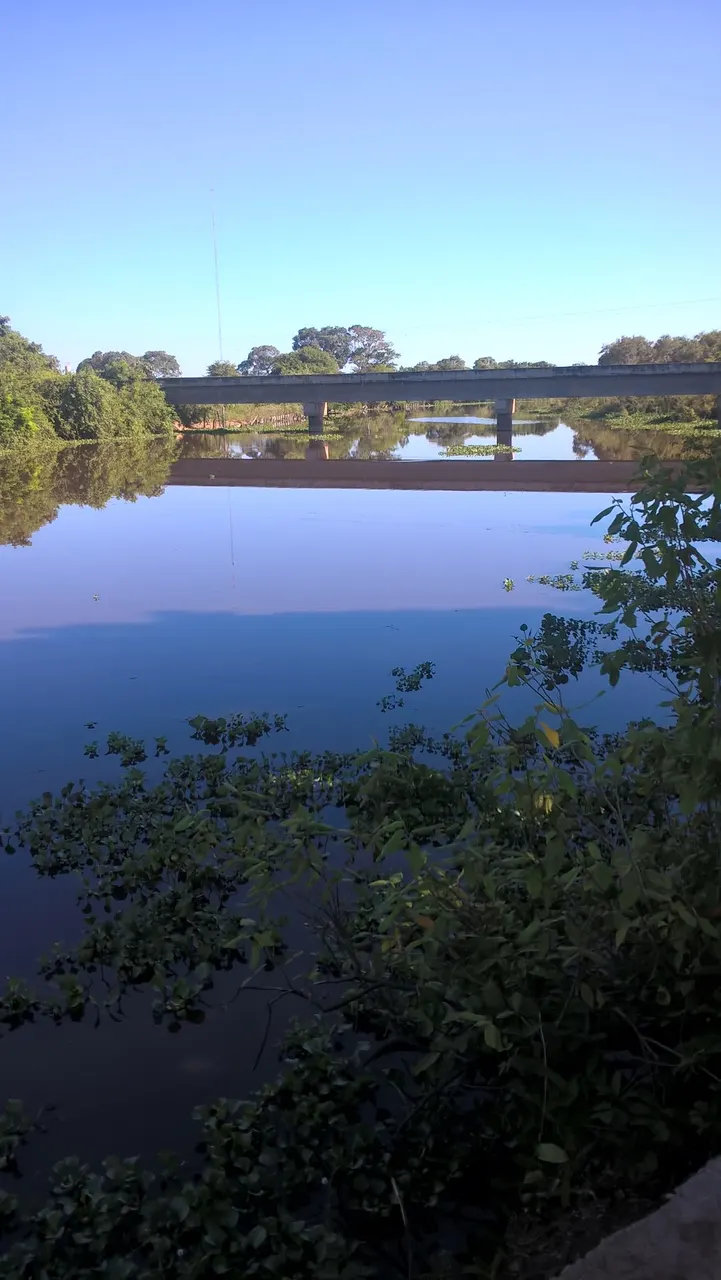
Highway MT-060 between Poconé and Porto Jofre is 147 km long, according to the state infrastructure secretariat, and has been an Estrada Parque since 1996: the protected area begins at the inspection post at km 17 and protects the strip around the roadway. The Pantanal stretch is unpaved and crosses more than a hundred bridges, some of them wooden and some already replaced with concrete. The road is not only the way in: in the dry season wildlife viewing improves, and guides use the roadsides and bridges as stops to point out birds, caimans and capybaras. In the heat of September and October, outings are concentrated in the early morning and late afternoon; driving slowly is part of the visit.
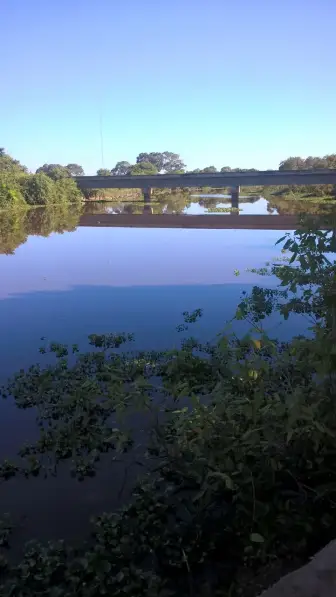
A mining and cattle town at the entrance to the Transpantaneira.
Check access
Encontro das Águas State Park
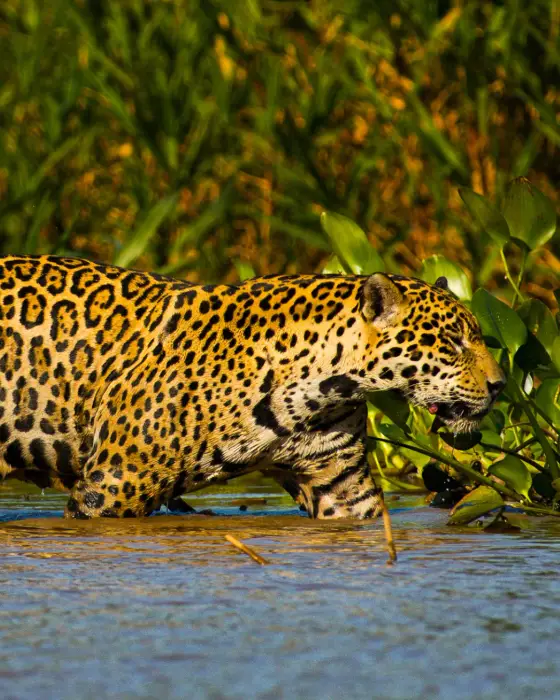
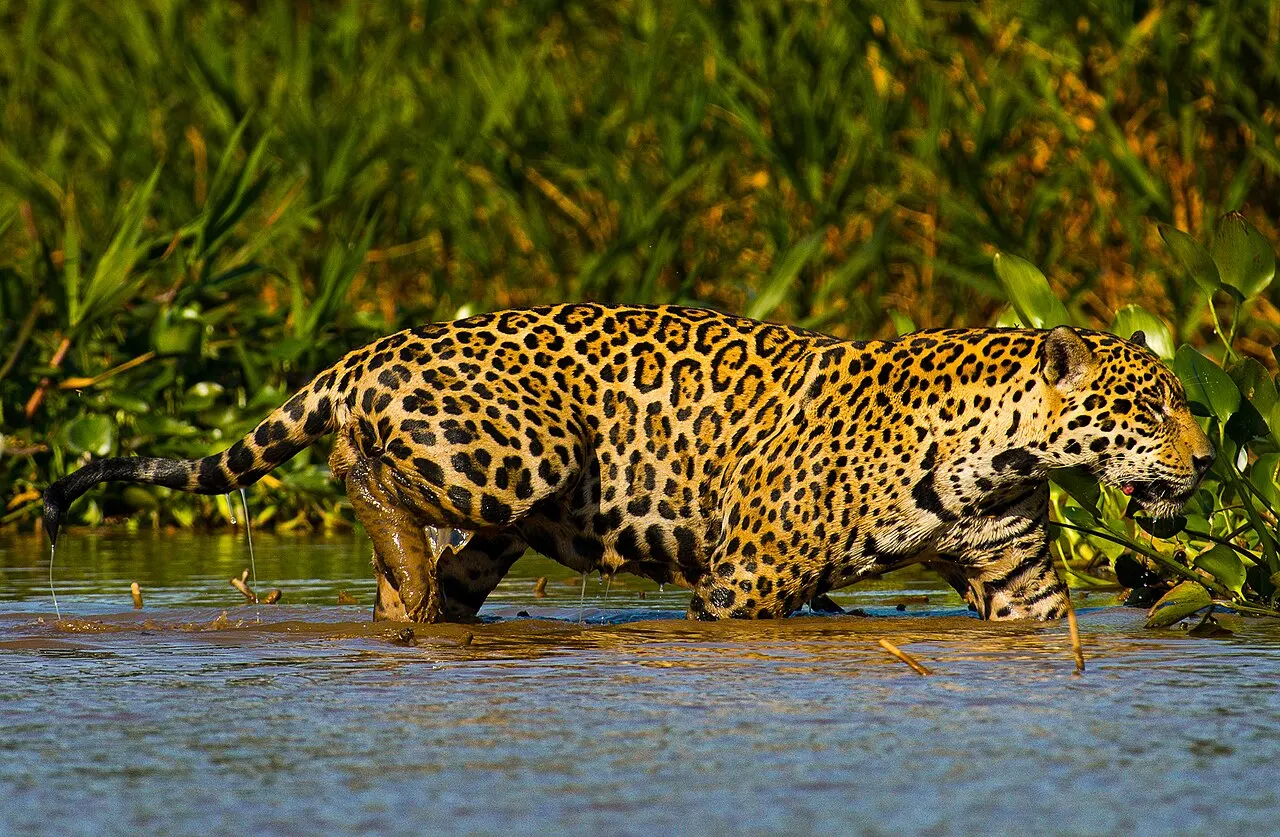
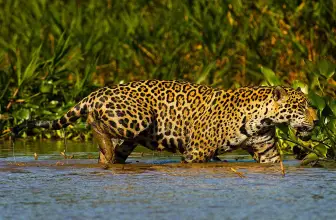
Created in 2004, the park covers 108,960 hectares between Poconé and Barão de Melgaço, at the point where the Cuiabá River joins the São Lourenço. It shelters many jaguars, which hunt capybaras and caimans along the banks, and for that reason it has become one of the most sought-after places to see them. The visit is by boat from Porto Jofre, with a boat pilot and guide arranged through your lodging or an operator; the most common format has two outings a day, one early in the morning and another after lunch. Demand is highest from July to October, in the dry season. Even then a sighting is not guaranteed: it depends on where the animals are that day, and each additional outing raises the chance. Conduct on the boat is covered in «Etiquette».
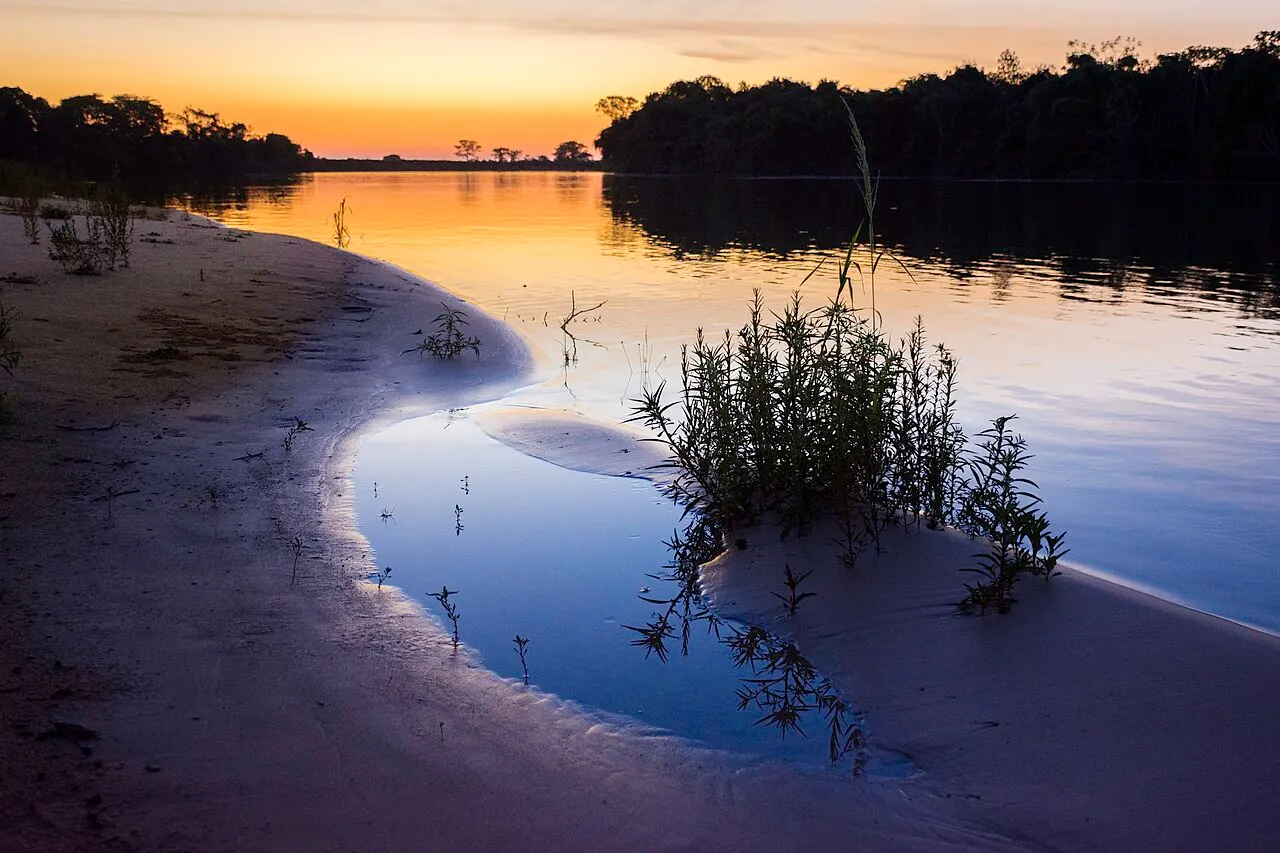
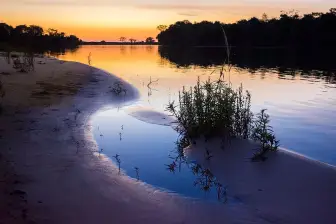
Porto Jofre sits on the bank of the Cuiabá River.
Check access
Porto Jofre
A settlement at the end of the Transpantaneira, on the bank of the Cuiabá River, within the municipality of Poconé. It is the departure point for jaguar trips, for fishing and for the hotel boats, known in the Pantanal as chalanas. The Hotel Porto Jofre Pantanal Norte has operated there since 1984, and there is a private airstrip. Sleeping here removes the round trip by car to the river and lets you be on the boat at dawn.
A little farther on, inside Encontro das Águas State Park, the Cuiabá joins the São Lourenço, and the Piquiri River marks the boundary with Mato Grosso do Sul. These rivers and their branches, such as the Três Irmãos, are the territory of the boat trips.
Check access
Poconé
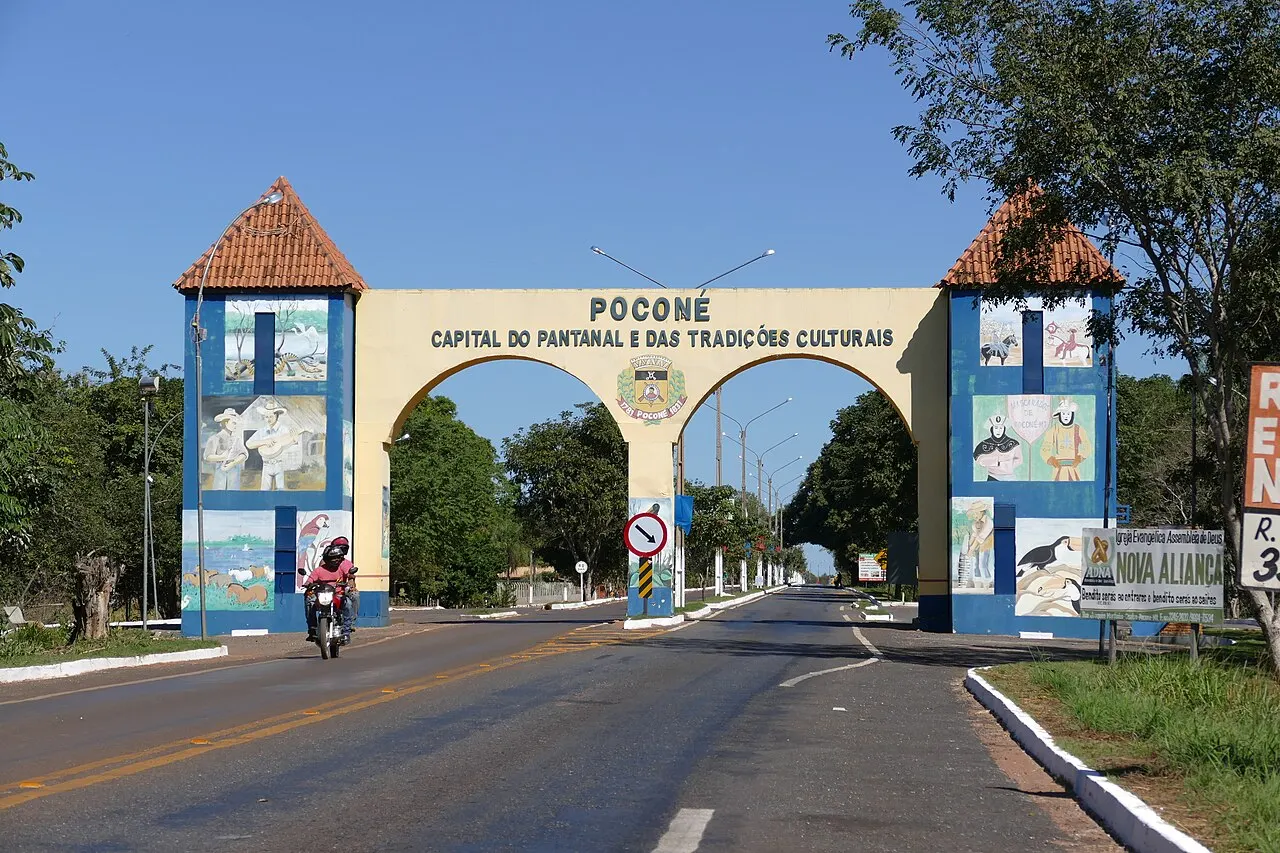
The gateway town to the Transpantaneira was born of gold in 1781 and still lives alongside mining, visible in the craters around the center. For the visitor, it is the stop to fill the car, buy whatever is missing and eat fried fish with banana farofa or the local baguncinha. In the first weeks of June, during the Feast of São Benedito, the Cavalhada turns the town into a tournament between Moorish knights, in red, and Christians, in blue.
The Pantanal is a low plain (Poconé is at an altitude of 142 m) that receives water from the higher lands around it. Rains fall hard from October to March; the water takes months to drain, widens the rivers and fills the corixos, streams that run all year. From May to September come the receding waters and the dry season: the water drops, the vegetation thins and wildlife viewing improves.
Check access

Pantanal Matogrossense National Park
Created in 1981 with about 135,000 hectares, it is Poconé's largest fully protected area and is part of the World Heritage site. It lies downriver from Porto Jofre, and ICMBio cites the bird roosting and resting sites of Baía do Burro and wildlife viewing by boat among its attractions. Anyone who wants to include it must arrange boat transport and confirm visiting conditions with ICMBio, which manages the park.
The Pantanal has hundreds of recorded bird species, along with caimans, capybaras, marsh deer, giant otters and the jaguar.
Check access
Nilo’s itinerary
Start with the basic programme and choose extensions for the time you have.
Plan my days in the app ↗Day 1 · From Cuiabá to the start of the Transpantaneira
Arrive early at Cuiabá airport (CGB) and pick up the rental car or the lodge's transfer.
Follow about 100 km of asphalt to Poconé; fill up and have lunch with fish and banana farofa or a baguncinha.
Enter the Transpantaneira and continue to a lodge in the first half of the road before dark: Pousada Piuval is at km 10; Araras Eco Lodge is farther south, already past the inspection post at km 17, where the Estrada Parque begins.
In the late afternoon, take the lodge's guided outing through the fields and, if it offers one, the night caiman spotting (focagem).
Day 2 · Dawn in the fields and the drive down to Porto Jofre
Wake before the sun for the lodge's birdwatching, horseback ride or canoeing, during the coolest hours of the day.
After breakfast, head south along the Transpantaneira, stopping at the bridges and the pools beside the road to see birds, caimans and capybaras.
Reach Porto Jofre, at the end of the road, in daylight, and leave your bags at your lodging.
If your lodging offers a late-afternoon boat outing, use it as a first look at the Cuiabá River.
Day 3 · A full day on the river, after the jaguar
Board the morning outing toward Encontro das Águas State Park, along the Cuiabá and Três Irmãos rivers and their branches.
Return to Porto Jofre in the hottest hour, have lunch and rest.
Take the second boat outing, after lunch.
Have dinner at your lodging and go to bed early, because the next day starts on the river.
Day 4 · Last boat and the return to Cuiabá
Take a short boat outing at dawn, if your lodging offers it.
Take the road back by late morning so you drive the 147 km of the Transpantaneira in daylight.
Fill up and eat in Poconé, then continue on the asphalt to Cuiabá.
Book the flight for the evening or, with more margin, for the next morning, sleeping in Cuiabá.
Food
River fish
Pacu, pintado, tambaqui and other river fish are the foundation of regional cooking, fried or roasted and served with banana farofa, rice and pirão. They appear in restaurants in Poconé and Cuiabá.
Maria Isabel
Rice cooked with dried beef, also called arroz carreteiro. It appears in Cuiabá cooking and at Poconé's festivals: the one for São João Batista, in the Areião neighborhood, on June 24, has Mass, a bonfire and Maria Isabel.
Banana farofa
Manioc flour with fried banana, the side dish that goes next to fish on Cuiabá and Pantanal tables.
Baguncinha poconeana
Poconé's hamburger, which has fried plantain in the filling. The banana also goes into pizza and into the sausage the town calls pantaneiras.
Furrundum
A sweet of grated green papaya with rapadura and cinnamon, typical of Cuiabá cooking.
Pixé
Toasted corn flour with cinnamon and sugar, a traditional dry sweet from Cuiabá.
Pequi
A fruit of the cerrado used in Cuiabá cooking and in pequi liqueur.
Where to eat
- Lodges on the Transpantaneira and in Porto Jofre
Along the road, you eat where you sleep: lodges and hotel boats usually include breakfast, lunch and dinner in the daily rate. Mention dietary restrictions when booking, because there is no alternative nearby.
- Poconé
The stop before the road. Fried or roasted fish with banana farofa, the baguncinha with fried plantain and, on a festival day, Maria Isabel. It works for lunch on the first and last days.
- Cuiabá
Cuiabá cooking in its full version: pacu, pintado and piranha broth, Maria Isabel, banana farofa and sweets such as furrundum and pixé. It is where you have the most options for trying river fish before or after the Transpantaneira.
$: Snack bars and simple restaurants in Poconé and Cuiabá, with set plates, fried fish and baguncinha, paid per meal. · $$: Regional-cuisine restaurants in Cuiabá, with river fish served in portions to share. · 2026-10-16
Day trips
Chapada dos Guimarães National Park
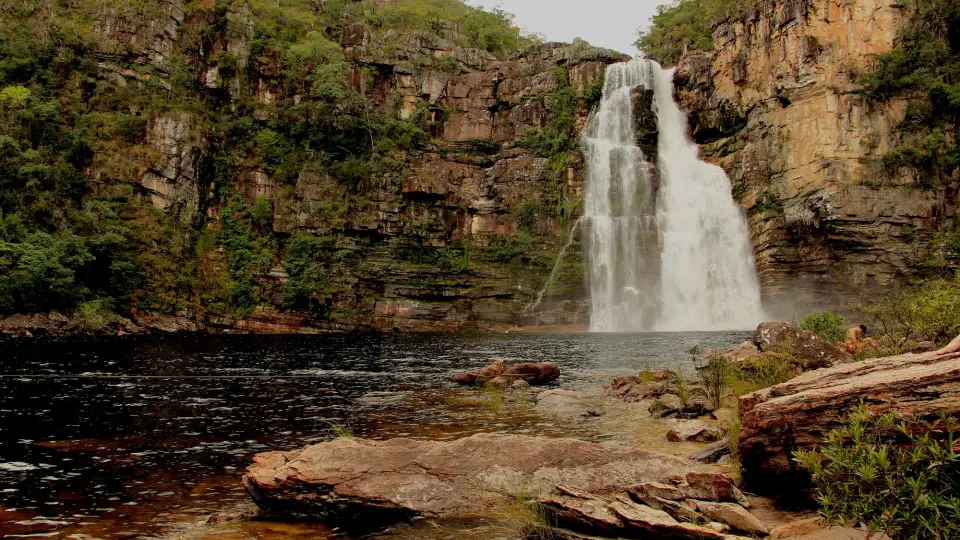
Outside the Pantanal, on the sandstone plateau above Cuiabá. The Véu de Noiva waterfall, on the Coxipó River, is the park's best-known landscape, and the park's address, in the Véu de Noiva area, is km 50 of MT-251, the highway that climbs from Cuiabá. It is a day separate from the Transpantaneira, done by car or with an agency from Cuiabá; visiting rules, hours and the guide requirement on each trail should be confirmed with ICMBio.
Where to begin
From Cuiabá to the start of the Transpantaneira
Arrive early at Cuiabá airport (CGB) and pick up the rental car or the lodge's transfer.
Dawn in the fields and the drive down to Porto Jofre
Wake before the sun for the lodge's birdwatching, horseback ride or canoeing, during the coolest hours of the day.
A full day on the river, after the jaguar
Board the morning outing toward Encontro das Águas State Park, along the Cuiabá and Três Irmãos rivers and their branches.
Money
The currency is the real (R$). The region runs on packages: most lodges and hotel boats sell the daily rate with full board (breakfast, lunch and dinner) and a guided outing, and packages with transfer and guide are put together by the lodges themselves or by agencies in Cuiabá. Poconé's Municipal Tourism Plan, with 2022 data, recorded an average daily rate of R$300 per person, calculated across all hotels, lodges and hotel boats in the region and already combining high and low season; it is not the price of a category or of a season, and lodgings in Porto Jofre during the jaguar season fall in the most expensive range. The same plan recorded fishing packages on a hotel boat averaging R$15,000 per person for 7 to 10 days. These are 2022 figures, and current prices should be confirmed when booking. Municipal law provides for a sustainable tourism fee (Law 1,869, of 2017), collected by the establishments, and an ecological conservation fee per person, charged with a voucher, at half price for day use (Laws 1,553, of 2009, and 1,588, of 2010); ask when booking which fees the daily rate already includes. Drinks, transfers and the boat trip in Porto Jofre may also be charged separately. Bring cash from Poconé and confirm with the lodge whether it accepts cards.
Getting there and around
Arriving via Cuiabá
The region's airport is Marechal Rondon (CGB), in Várzea Grande, next to Cuiabá. From there to Poconé it is about 100 km of asphalt. If you drive, rent a car in Cuiabá. If you don't, you depend on the transfer that several lodges and agencies offer from Cuiabá, included in some packages and charged separately in others; also arrange with your lodging how to get around along the road.
Filling up in Poconé
Poconé is the last place with a gas station before the road: there is no station along the Transpantaneira. Leave with a full tank and cash.
The Transpantaneira
The Estrada Parque begins at the inspection post at km 17, and the Pantanal stretch continues unpaved to Porto Jofre, 147 km after Poconé, over more than a hundred bridges. In the dry season, from May to September, an ordinary car usually suffices if driven carefully. October is a transition: the first rains may arrive. In the rainy season, a 4x4 is advised, and from December the road can become practically impassable near Porto Jofre. Driving at night is not recommended: potholes and wooden bridges demand attention, and cell signal is weak or nonexistent along much of the route.
By boat
The road ends at Porto Jofre. From there on, everything is by boat: jaguar trips, fishing and hotel boats. The trips are booked through your lodging, an operator or local guides.
Safety
The main risks come from the road and the weather. On the Transpantaneira, drive slowly, avoid the night and cross the wooden bridges with care; bring water and tell your lodging your arrival time, because cell signal is weak or nonexistent along much of the route. Caimans and jaguars are wild animals: do not get out of the boat or car near them, do not feed any animal and follow the guide's instructions. The heat is intense in September and October, with average highs above 35 °C in Cuiabá; wear a hat and sunscreen and drink water often. Fires tend to increase at the end of the dry season; follow the news and the INMET forecast, and do not light fires or toss cigarette butts. For health, the US CDC recommends the yellow fever vaccine for those going to Mato Grosso and lists the state among those with malaria transmission, with rare cases in Cuiabá; consult a travel medicine service before going and use repellent, especially from December, when mosquitoes increase.
Etiquette tips
Let the boat keep its distance from the jaguar
Researchers report that frequent boat traffic can alter jaguar behavior. Don't ask the boat pilot to get closer, keep your voice low, and accept it when the group decides to leave.
Cattle have the right of way
The Transpantaneira passes through working ranches, and cattle handling uses the road. Stop the car, turn off the engine if the herd is large, and wait for the drive to pass.
A saint's festival is devotion
Novenas and sung prayers are part of local faith. Ask permission before photographing people and altars, and follow the pace of the celebration.
Fishing has a calendar and a species list
In the rivers of the Paraguay basin, the piracema closes recreational fishing every year on dates set by the state fishing council: in 2026/27, from October 1, 2026 to January 31, 2027 (Cepesca Resolution No. 1, of April 24, 2026), when only subsistence fishing from the shore by riverside populations is permitted. Outside the piracema, the Zero Transport Law (state Law 12,434, of 2024) remains in force, banning until 2029 the catching, transport, storage and sale of twelve native species: cachara, caparari, dourado, jaú, matrinchã, pintado, piraíba, piraputanga, pirarara, pirarucu, trairão and tucunaré. Confirm the rules currently in force with SEMA-MT or with the lodge before bringing equipment.
Mistakes to avoid
Counting on a day trip to Porto Jofre
It is about 100 km of asphalt to Poconé and another 147 km of Transpantaneira each way, at low speed. Leaving Cuiabá and returning the same day leaves almost no time on the river, which is where you look for jaguars.
Leaving Poconé with half a tank
There is no gas station on the Transpantaneira. Fill up in Poconé and calculate fuel for the trip out and back.
Driving after sunset
Potholes and wooden bridges are hard to see in the dark. Plan to reach the lodge in daylight.
Going in flood season with an ordinary car
From December on, rain can make the road impassable near Porto Jofre. In the rainy season, prefer a 4x4 or the lodge's transfer, and confirm that the lodging is open.
Leaving the booking to the last minute in high season
Between July and October, lodgings in Porto Jofre and viewing boats are in demand. Book lodging and outing together, months ahead.
Confusing the Northern and Southern Pantanal
They are different trips. The North, covered in this guide, starts from Cuiabá; the South is reached via Miranda, in Mato Grosso do Sul, about 130 km from Bonito.
Useful phrases
Corixo
A perennial stream that runs all year.
Chalana
A hotel boat used mainly by fishing groups.
Piloteiro
The person who pilots the boat on outings and fishing trips.
Comitiva
A group of ranch hands who drive cattle from one pasture to another.
Focagem
A night outing to watch caimans and other animals.
Tuiuiú
A large stork, considered the emblematic bird of the Pantanal.
Vazante
The period when the water begins to drop after the flood.
Where to stay
- Transpantaneira, first half · For those who want the Pantanal of the ranches: birds, horseback rides, canoeing and guided safaris, with meals included.: The lodges sit along the first kilometers of the road, among them Pousada Piuval, at km 10, and Araras Eco Lodge, with observation towers. The drawback is the distance to the jaguar river: from here to Porto Jofre it is more than a hundred kilometers of unpaved road, which is why they work best as the first nights of the trip.
- Porto Jofre · For those going for the jaguar who want to be on the boat at dawn.: It is the end of the road, on the bank of the Cuiabá River, and it removes the commute to the departure point. The Hotel Porto Jofre Pantanal Norte has operated there since 1984, and hotel boats are anchored. The drawback is the competition for beds between July and October; in the rainy season, access by road can be difficult.
- Estrada Parque Poconé-Porto Cercado · For those short on time or who prefer a structured hotel near town.: The park road runs from Poconé to the Hotel Sesc Porto Cercado. It lies outside the Transpantaneira and far from Porto Jofre, the area most sought after for seeing jaguars.
- Cuiabá · For those who arrive late or leave early, or want to add Chapada dos Guimarães.: It has the region's largest selection of hotels and restaurants and is next to the airport. It does not work as a base for the Pantanal: Poconé is about 100 km away, and Porto Jofre, the jaguar river, another 147 km of Transpantaneira beyond that.
$: Simple hotels in Poconé and Cuiabá, charged per room, without meals or outings included. · $$: Ranch lodges in the first half of the Transpantaneira, generally charged per person, with full board and one guided outing. · $$$: Lodgings in Porto Jofre geared to jaguar watching and fishing hotel boats, charged per person in packages. · 2026-10-16
Districts
Cuiabá and Várzea Grande
The capital of Mato Grosso and the neighboring city where the airport is. They are the places to arrive, rent a car and sleep before or after the road; they are also the base for Chapada dos Guimarães. They lie about 100 km of asphalt from Poconé.
Poconé
A mining and cattle town at the entrance to the Transpantaneira. It has the last gas stations before the road, shops, hotels in town and a calendar of saints' festivals that peaks with the Cavalhada in June.
Transpantaneira, first half
The first kilometers of the road, before and after the inspection post at km 17, with ranch lodges and observation towers. In the dry season, this is where most visitors concentrate, because the vegetation is less dense and the guides use the roadsides as stops to watch birds, caimans and capybaras.
Porto Jofre
The end of the road, on the bank of the Cuiabá River, with a hotel, an airstrip and hotel boats. From here onward you continue only by boat, and it is the base for searching for jaguars in Encontro das Águas State Park.
Estrada Parque Poconé-Porto Cercado
The municipality's second park road, linking Poconé to the Hotel Sesc Porto Cercado. It is an alternative to the Transpantaneira for anyone who wants a Pantanal closer to town.
History
1719 · Cuiabá's gold
The discovery of gold near the Cuiabá River led bandeirantes to found Cuiabá on April 8, 1719, and turned the river, which feeds the Pantanal, into a route for people and goods.
1781 · Arraial de São Pedro d'El-Rei
After gold finds around 1777, the founding charter of the settlement was drawn up on January 21, 1781. The name Poconé comes from the Beripoconé people, who lived in the region.
1831 · Vila de Poconé
A decree of the regency government created the municipality of Villa de Poconé; the town received city status in 1863.
1972 · The Transpantaneira
The highway was opened with the plan of reaching Corumbá. Flooded areas and environmental concerns stopped the work at Porto Jofre, and nature tourism began to grow in the 1970s.
1981 · Pantanal Matogrossense National Park
Created by decree on September 24, 1981, with about 135,000 hectares downriver from Porto Jofre.
1996 · Estrada Parque
State Decree 1,028, of July 26, 1996, turned the Transpantaneira into a protected area of 8,646 hectares, all within Poconé.
2000 · World Heritage
UNESCO inscribed the Pantanal Conservation Area, which brings together the national park and neighboring reserves, as a World Natural Heritage Site.
2004 · Encontro das Águas State Park
Decree 4,881, of December 22, 2004, created the 108,960-hectare park between Poconé and Barão de Melgaço, where the Cuiabá River meets the São Lourenço.
2020 · The year of fire
An unprecedented fire season burned about a quarter of the Pantanal, and fire prevention began to appear in Poconé's tourism plans.
Complete history
Gold and cattle
The history of the northern Pantanal begins with gold. In 1719, the discovery of gold near the Cuiabá River drew bandeirantes and turned the river into a highway of canoes. Around 1777 gold also turned up near where Poconé stands today, and in 1781 the Arraial de São Pedro d'El-Rei was born. The work in the mines relied on wage workers and enslaved people, who also worked on the cattle ranches created to feed the mining camps. The natural grasslands let the herd grow until it supplied other states.
The pantaneiros
From this mix of Indigenous peoples, Portuguese and Spanish colonizers, and enslaved Africans came the population the Pantanal calls pantaneira. Cattle ranching on natural grasslands sustained the region for more than two centuries, and many of today's lodges are former cattle ranches that began receiving visitors.
The road that stopped at the river
The Transpantaneira was opened in 1972 to connect Poconé to Corumbá, on the other side of the Pantanal. Water and environmental debates halted the work at Porto Jofre, on the border with Mato Grosso do Sul, and the road was left with no continuation by land: it enters the plain and ends on the bank of the Cuiabá River. It was this road that made the northern Pantanal accessible: tourism began in the 1970s and grew in the 1990s, when the biome gained international visibility. Before the covid-19 pandemic, according to business owners consulted for the municipal tourism plan, more than 70% of the guests at Poconé's lodges came from outside Brazil.
Protection and fire
Starting in the 1980s the state created layers of protection: Pantanal Matogrossense National Park in 1981, the Estrada Parque Transpantaneira in 1996 and Encontro das Águas State Park in 2004. In 2000 UNESCO inscribed the Pantanal Conservation Area as a World Heritage Site. Gold mining remains active around Poconé and coexists with tourism, and the fires of 2020, which burned about a quarter of the Pantanal, showed how heavily drought weighs on the region.
Geography and shape of the city
A plain that floods and dries
The Pantanal is a low plain (Poconé is at an altitude of 142 m) that receives water from the higher lands around it. Rains fall hard from October to March; the water takes months to drain, widens the rivers and fills the corixos, streams that run all year. From May to September come the receding waters and the dry season: the water drops, the vegetation thins and wildlife viewing improves.
The rivers at the end of the road
Porto Jofre sits on the bank of the Cuiabá River. A little farther on, inside Encontro das Águas State Park, the Cuiabá joins the São Lourenço, and the Piquiri River marks the boundary with Mato Grosso do Sul. These rivers and their branches, such as the Três Irmãos, are the territory of the boat trips.
Climate
The climate is hot all year. In Cuiabá, the nearest reference station, the average high ranges from 31.6 °C in May to 35.6 °C in September (INMET normal for 1991 to 2020); July is the driest month, with 10.2 mm of rain, and February the wettest, with 261.9 mm. The city's heat record is 44.2 °C, in October 2023.
Wildlife
The Pantanal has hundreds of recorded bird species, along with caimans, capybaras, marsh deer, giant otters and the jaguar. The jabiru, a stork more than 1.4 m long, is considered the region's emblematic bird, and the hyacinth macaw is threatened by trafficking.
Cuiabá is about 100 km from Poconé, and from Poconé to Porto Jofre, on the river where people look for jaguars, it is 147 km of Transpantaneira. Sleeping in Porto Jofre lets you board at dawn without driving first.
The Southern Pantanal, on the Mato Grosso do Sul side, pairs with Bonito from Miranda. The North is a different trip, arriving via Cuiabá, and I wouldn't try to combine the two on a short trip.
Culture
Cururu, siriri and viola de cocho
The region's traditional music is played on the viola de cocho, made from a single trunk hollowed out like a trough; the way of making the instrument is registered in the Book of Knowledge of Brazil's intangible heritage. It accompanies cururu and siriri, rhythms sung and danced at popular festivals in Mato Grosso and Mato Grosso do Sul.
Saints' festivals
In Poconé, the calendar revolves around the saints: the Divine Holy Spirit, São Benedito, Santo Antônio, São João and São Pedro, with novenas, sung prayers in backyard chapels and visits to folk healers. The Dança dos Mascarados, performed only by men in masks and feathered hats, appears on these festival days.
Pantanal life
The pantaneira population was born of a mix of Indigenous peoples, colonizers and enslaved Africans, and cattle remain at the center of rural life: along the Transpantaneira, herd management shares the road with tourism. In Poconé, the quilombola community of São Benedito keeps up the production of manioc flour.
Manoel de Barros
The poet was born in Cuiabá in 1916 and made the Pantanal the backdrop of his poetry from the 1940s on. He died in 2014, in Campo Grande.
Festivals and events
Cavalhada de Poconé
In the first weeks of June, during the Feast of São Benedito. Twelve Moorish knights, in red, face twelve Christians, in blue, in a sequence of mounted contests on the track of the Cidade Rosa club, in the upper part of town. It is one of the biggest cultural events in Mato Grosso and splits the town into rival camps of supporters.
Feast of São Benedito (Poconé)
In June, the festival of the patron saint of the people of Poconé, during which the Cavalhada takes place.
Feast of the Divine Holy Spirit (Poconé)
Preceded by a novena, with a festive dawn serenade, fireworks, shows and the banner of the Divine visiting homes. The date changes every year; check the city hall's calendar.
São João and São Pedro (Poconé)
São João Batista in the Areião neighborhood, on June 24, with Mass, a bonfire and Maria Isabel; São Pedro in the Jurumirim neighborhood, on June 29.
Feast of São Benedito (Cuiabá)
In July, at the Church of Rosário and São Benedito, founded by enslaved people in 1764.
Books and films
Livro de Pré-Coisas, by Manoel de Barros (1985)
The poet was born in Cuiabá and made the Pantanal the backdrop of his poetry; it is a good read to bring along on the trip.
Pantanal (TV Globo, 2022)
A remake of the 1990 telenovela from Rede Manchete, written by Benedito Ruy Barbosa and adapted by Bruno Luperi. It was filmed in the Pantanal of Mato Grosso do Sul, in Nhecolândia and Aquidauana; it portrays the biome and ranch life, not the Transpantaneira.
Frequently asked questions
Pantanal: How do you get to the Transpantaneira?
The airport is Marechal Rondon (CGB), in Várzea Grande, next to Cuiabá. From there to Poconé it is about 100 km of asphalt, by rental car or on the transfer that lodges and agencies offer; after that, the Pantanal stretch continues unpaved to Porto Jofre.
Pantanal: How many days should you stay?
Four days, not counting the trip to Cuiabá: one night at a lodge at the start of the road and two in Porto Jofre, with three or four boat outings to look for the jaguar. Three days allow the round trip, but that leaves a single afternoon on the boat.
Pantanal: Are you guaranteed to see a jaguar?
No: a sighting is never guaranteed, not even in the most sought-after season, from July to October. It depends on where the animals are that day, and each additional boat outing from Porto Jofre raises the chance.
Pantanal: Can you go in an ordinary car?
In the dry season, from May to September, an ordinary car usually suffices if driven carefully; October is a transition, and the first rains may arrive. In the rainy season, prefer a 4x4 or the lodge's transfer and confirm it is open: from December, the road can become impassable near Porto Jofre.
Pantanal: When is the best time to go?
July to September, in the dry season, with the road passable and the most sought-after time for jaguars; in September, average highs in Cuiabá exceed 35 °C and there may be smoke from fires. May and June suit those who prioritize birds and scenery; October brings the first rains.
Pantanal: Can you go from Cuiabá to Porto Jofre and back in one day?
It is not worth it: it is about 100 km of asphalt to Poconé and another 147 km of Transpantaneira each way, at low speed. Leaving Cuiabá and returning the same day leaves almost no time on the river, where you look for jaguars.
Pantanal: What does the daily rate usually include?
Most lodges and hotel boats sell the daily rate with full board and a guided outing. Drinks, transfers and the boat in Porto Jofre may be charged separately; when booking, also ask which municipal fees the daily rate already includes.
Pantanal: Do you need a vaccine?
The US CDC recommends the yellow fever vaccine for those going to Mato Grosso and lists the state among those with malaria transmission. Consult a travel medicine service before going and use repellent, especially from December.
Other cities in the country
Brazil ↗- Days
- 4
- When
- Apr–Jun
- Per person/day
- Average 615 BRLMid-range · per person/day
Cost scope
Per person per day: accommodation, meals, urban transport, visits and a small allowance for extras. Flights excluded; larger purchases vary. Editorial estimate, not a quote.
- Days
- 2–3
- When
- Apr–May · Sep
- Per person/day
- Average 400–700 BRLMid-range · per person/day
Cost scope
Per person per day: accommodation, meals, urban transport, visits and a small allowance for extras. Flights excluded; larger purchases vary. Editorial estimate, not a quote.
- Days
- 2–3
- When
- Jan–Mar · Sep–Dec
- Per person/day
- Average 350–550 BRLMid-range · per person/day
Cost scope
Per person per day: accommodation, meals, urban transport, visits and a small allowance for extras. Flights excluded; larger purchases vary. Editorial estimate, not a quote.
- Days
- 1–2
- When
- May–Sep
- Per person/day
- Average 260–520 BRLMid-range · per person/day
Cost scope
Per person per day: accommodation, meals, urban transport, visits and a small allowance for extras. Flights excluded; larger purchases vary. Editorial estimate, not a quote.
- Days
- 3–4
- When
- Jun–Sep
- Per person/day
- Average 400–700 BRLMid-range · per person/day
Cost scope
Per person per day: accommodation, meals, urban transport, visits and a small allowance for extras. Flights excluded; larger purchases vary. Editorial estimate, not a quote.
- Days
- 2–3
- When
- Apr–Jun
- Per person/day
- Average 350–550 BRLMid-range · per person/day
Cost scope
Per person per day: accommodation, meals, urban transport, visits and a small allowance for extras. Flights excluded; larger purchases vary. Editorial estimate, not a quote.
- Days
- 3–5
- When
- Mar–Apr · Nov
- Per person/day
- Average 397 BRLMid-range · per person/day
Cost scope
Per person per day: accommodation, meals, urban transport, visits and a small allowance for extras. Flights excluded; larger purchases vary. Editorial estimate, not a quote.
- Days
- 2–4
- When
- Mar–May · Sep
- Per person/day
- Explore costsGuide estimate
Cost scope
Per person per day: accommodation, meals, urban transport, visits and a small allowance for extras. Flights excluded; larger purchases vary. Editorial estimate, not a quote.
- Days
- 4–5
- When
- Aug–Nov
- Per person/day
- Explore costsGuide estimate
Cost scope
Per person per day: accommodation, meals, urban transport, visits and a small allowance for extras. Flights excluded; larger purchases vary. Editorial estimate, not a quote.
- Days
- 3–4
- When
- Jul–Sep
- Per person/day
- Explore costsGuide estimate
Cost scope
Per person per day: accommodation, meals, urban transport, visits and a small allowance for extras. Flights excluded; larger purchases vary. Editorial estimate, not a quote.
- Days
- 3–4
- When
- Sep–Nov
- Per person/day
- Explore costsGuide estimate
Cost scope
Per person per day: accommodation, meals, urban transport, visits and a small allowance for extras. Flights excluded; larger purchases vary. Editorial estimate, not a quote.
- Days
- 2–4
- When
- May–Sep
- Per person/day
- Explore costsGuide estimate
Cost scope
Per person per day: accommodation, meals, urban transport, visits and a small allowance for extras. Flights excluded; larger purchases vary. Editorial estimate, not a quote.
- Days
- 3–5
- When
- Jun–Sep
- Per person/day
- Explore costsGuide estimate
Cost scope
Per person per day: accommodation, meals, urban transport, visits and a small allowance for extras. Flights excluded; larger purchases vary. Editorial estimate, not a quote.
- Days
- 3–4
- When
- Jun–Aug
- Per person/day
- Explore costsGuide estimate
Cost scope
Per person per day: accommodation, meals, urban transport, visits and a small allowance for extras. Flights excluded; larger purchases vary. Editorial estimate, not a quote.
- Days
- 4–5
- When
- Jan–Mar · Sep–Dec
- Per person/day
- Explore costsGuide estimate
Cost scope
Per person per day: accommodation, meals, urban transport, visits and a small allowance for extras. Flights excluded; larger purchases vary. Editorial estimate, not a quote.
- Days
- 3–4
- When
- Oct–Dec
- Per person/day
- Average 1,110 BRLMid-range · per person/day
Cost scope
Per person per day: accommodation, meals, urban transport, visits and a small allowance for extras. Flights excluded; larger purchases vary. Editorial estimate, not a quote.
- Days
- 3–4
- When
- Aug–Sep
- Per person/day
- Explore costsGuide estimate
Cost scope
Per person per day: accommodation, meals, urban transport, visits and a small allowance for extras. Flights excluded; larger purchases vary. Editorial estimate, not a quote.
- Days
- 4–7
- When
- Apr–Sep
- Per person/day
- Explore costsGuide estimate
Cost scope
Per person per day: accommodation, meals, urban transport, visits and a small allowance for extras. Flights excluded; larger purchases vary. Editorial estimate, not a quote.
- Days
- 3–4
- When
- Jan · Sep–Dec
- Per person/day
- Explore costsGuide estimate
Cost scope
Per person per day: accommodation, meals, urban transport, visits and a small allowance for extras. Flights excluded; larger purchases vary. Editorial estimate, not a quote.
- Days
- 2
- When
- Aug–Dec
- Per person/day
- Average 442 BRLMid-range · per person/day
Cost scope
Per person per day: accommodation, meals, urban transport, visits and a small allowance for extras. Flights excluded; larger purchases vary. Editorial estimate, not a quote.
- Days
- 3–5
- When
- Jan–Feb · Sep–Dec
- Per person/day
- Explore costsGuide estimate
Cost scope
Per person per day: accommodation, meals, urban transport, visits and a small allowance for extras. Flights excluded; larger purchases vary. Editorial estimate, not a quote.
- Days
- 3–5
- When
- May–Sep
- Per person/day
- Explore costsGuide estimate
Cost scope
Per person per day: accommodation, meals, urban transport, visits and a small allowance for extras. Flights excluded; larger purchases vary. Editorial estimate, not a quote.
- Days
- 2–3
- When
- Apr–Sep
- Per person/day
- Average 484 BRLMid-range · per person/day
Cost scope
Per person per day: accommodation, meals, urban transport, visits and a small allowance for extras. Flights excluded; larger purchases vary. Editorial estimate, not a quote.
- Days
- 3
- When
- Apr–May · Aug
- Per person/day
- Average 478 BRLMid-range · per person/day
Cost scope
Per person per day: accommodation, meals, urban transport, visits and a small allowance for extras. Flights excluded; larger purchases vary. Editorial estimate, not a quote.
- Days
- 3–4
- When
- Aug–Dec
- Per person/day
- Explore costsGuide estimate
Cost scope
Per person per day: accommodation, meals, urban transport, visits and a small allowance for extras. Flights excluded; larger purchases vary. Editorial estimate, not a quote.
- Days
- 2
- When
- Apr–May · Sep
- Per person/day
- Explore costsGuide estimate
Cost scope
Per person per day: accommodation, meals, urban transport, visits and a small allowance for extras. Flights excluded; larger purchases vary. Editorial estimate, not a quote.
- Days
- 3
- When
- Sep–Dec
- Per person/day
- Explore costsGuide estimate
Cost scope
Per person per day: accommodation, meals, urban transport, visits and a small allowance for extras. Flights excluded; larger purchases vary. Editorial estimate, not a quote.
- Days
- 3–5
- When
- Apr–Nov
- Per person/day
- Average 427 BRLMid-range · per person/day
Cost scope
Per person per day: accommodation, meals, urban transport, visits and a small allowance for extras. Flights excluded; larger purchases vary. Editorial estimate, not a quote.
- Days
- 4–5
- When
- May–Sep
- Per person/day
- Explore costsGuide estimate
Cost scope
Per person per day: accommodation, meals, urban transport, visits and a small allowance for extras. Flights excluded; larger purchases vary. Editorial estimate, not a quote.
- Days
- 3
- When
- May–Sep
- Per person/day
- Explore costsGuide estimate
Cost scope
Per person per day: accommodation, meals, urban transport, visits and a small allowance for extras. Flights excluded; larger purchases vary. Editorial estimate, not a quote.