Brazil
Ilha Grande
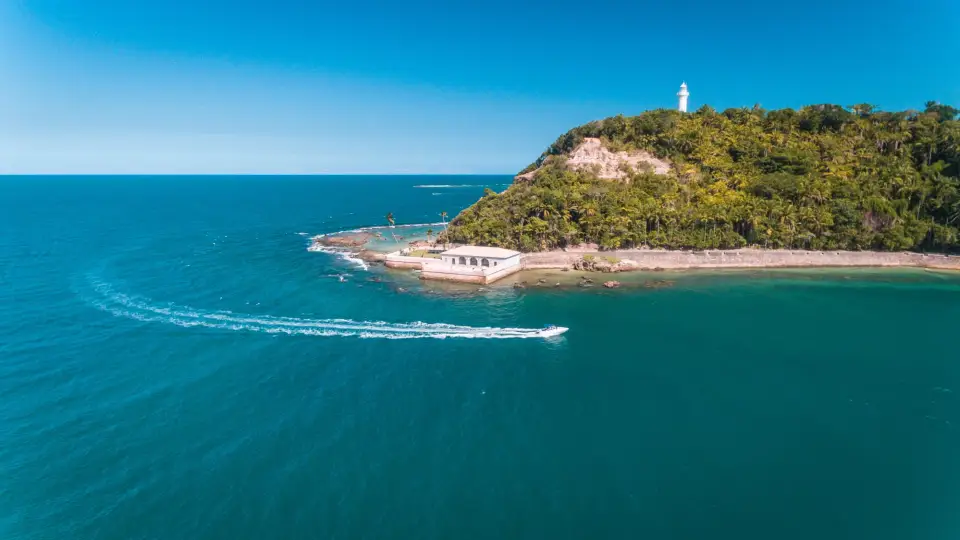
Ilha Grande: a car-free island on Rio de Janeiro's Costa Verde, with Atlantic Forest trails, Lopes Mendes and the shallow lagoons of the north coast
Days Start with the basic programme and choose extensions for the time you have.
How the guide reaches this number
The first day, after the crossing, belongs to the Abraão Circuit, with the Lazareto ruins, Praia Preta and the aqueduct. The second is for Lopes Mendes, by schooner to Pouso or on trail T10. The third is for Lagoa Azul and Lagoa Verde on the half-island tour. On a day trip from Rio, without staying overnight, only one of those halves fits. With a fourth day, I'd walk to Dois Rios, or climb Pico do Papagaio if the summit were clear; with a fifth, I'd do the speedboat tour around the island to Aventureiro, on a calm-sea day. The return to the mainland is for the morning after the last day.
3–5
When April to November; December to March brings the heat and the rains, and summer, with New Year's Eve and Carnival, is the busiest time
How the guide reaches this number
The island is hot and humid all year, and what changes the trip is the rain, the sea and the crowds. By the INMET normal for Angra dos Reis, December to March are the hottest and rainiest months, with average highs near 30 °C and between 188 and 258 mm of rain a month; it is also summer, with New Year's Eve, school vacations and Carnival, when boats, trails and pousadas fill up. From April to November it rains less, and June to August are the driest and coolest months, with average highs around 24 °C, good for long trails such as Dois Rios and Papagaio. In winter, cold fronts can stir up the sea and cancel speedboats and the round-the-island tour, so leave half a day to spare before a scheduled flight or bus.
Per person/day Budget about 187 BRL; mid-range about 427 BRL; comfortable about 816 BRL per person, based on spending reported by travelers to Budget Your Trip (consulted in October 2026).
How the guide reaches this number
Per person per day: accommodation, meals, urban transport, visits and a small allowance for extras. Flights excluded; larger purchases vary. Editorial estimate, not a quote.
 What Nilo thinks
I'd stay three days, sleeping in Vila do Abraão and arriving on the first morning. The first day, after the crossing, belongs to the Abraão Circuit, with the Lazareto ruins, Praia Preta and the aqueduct. The second is for Lopes Mendes, by schooner to Pouso or on trail T10. The third is for Lagoa Azul and Lagoa Verde on the half-island tour. On a day trip from Rio, without staying overnight, only one of those halves fits. With a fourth day, I'd walk to Dois Rios, or climb Pico do Papagaio if the summit were clear; with a fifth, I'd do the speedboat tour around the island to Aventureiro, on a calm-sea day. The return to the mainland is for the morning after the last day.For more than a century, people who landed on Ilha Grande came to serve quarantine or a sentence. The Empire built a lazaretto in Abraão cove to isolate ship passengers in times of epidemic, which later became a prison, and on the ocean side the Dois Rios colony received everyone from misdemeanor offenders to political prisoners such as Graciliano Ramos, until it was blown up in 1994. Today the ruins lie along the trails, and the island, with no passenger cars, is entirely inside conservation units. What you do here changes from one side to the other: on the bay, shallow lagoons where you swim among fish; on the ocean, the 3 km of white sand at Lopes Mendes, without a single building in sight.
Quick facts
- Population
- 5,216 residents in the Abraão district, where IBGE places Ilha Grande (2022 Census). The municipality of Angra dos Reis has 179,152 residents (IBGE estimate for 2026)
- Founding
- The island has no founding date. It was Tamoio territory before colonization, became the parish of Santana da Ilha Grande de Fora in 1803, and the imperial government built the Lazareto in Abraão cove between 1884 and 1886
- Country and region
- Brazil, Southeast; Costa Verde of the state of Rio de Janeiro, in the municipality of Angra dos Reis
- Language
- Portuguese
- Currency
- Real (BRL, R$)
- Time zone
- UTC−3 year-round, no daylight saving time
- Best time to go
- April to November; December to March brings the heat and the rains, and summer, with New Year's Eve and Carnival, is the busiest time
- Average daily cost
- Budget about 187 BRL; mid-range about 427 BRL; comfortable about 816 BRL per person, based on spending reported by travelers to Budget Your Trip (consulted in October 2026).
When to go
April to November; December to March brings the heat and the rains, and summer, with New Year's Eve and Carnival, is the busiest time
How the year changes
The island is hot and humid all year, and what changes the trip is the rain, the sea and the crowds. By the INMET normal for Angra dos Reis, December to March are the hottest and rainiest months, with average highs near 30 °C and between 188 and 258 mm of rain a month; it is also summer, with New Year's Eve, school vacations and Carnival, when boats, trails and pousadas fill up. From April to November it rains less, and June to August are the driest and coolest months, with average highs around 24 °C, good for long trails such as Dois Rios and Papagaio. In winter, cold fronts can stir up the sea and cancel speedboats and the round-the-island tour, so leave half a day to spare before a scheduled flight or bus.
Nilo's tips
Each side of the island on its own day
Lopes Mendes, on the ocean side, and the lagoons, on the bay side, take a day each. I'd book both tours on arrival, saving the open-sea one for the day with the steadiest weather.
All your water from the village
On the trails to Lopes Mendes there is no source of drinking water, and on the beach there is no kiosk. I'd leave Abraão with all the day's water and food, even when going by schooner.
Confirm the return on arrival
Outside summer, boat schedules shrink with little warning, and the Angra ferry leaves Abraão only at 10 a.m. I'd confirm the return boat on the first day and leave half a day to spare before the flight.
The fee before the pier
I'd issue the TTS voucher on the Viva Angra website before boarding, one per person, including children up to 12 and people 60 or older, who are exempt but need the free voucher. For a day trip, I'd check the amount in the simulator.
Explore the map
Explore the map, read about the other places and plan your travel days in the app.
Open the appWhat to see
Ilha Grande: Hills and coves
At the INMET station in Angra dos Reis (1981 to 2010 normal), about 1,796 mm of rain falls per year. December is the wettest month, with 258 mm, and August the driest, with 54 mm. Average highs range from 30.1 °C in February to 24 °C in July. It concentrates pousadas, campsites, restaurants, agencies and the church of São Sebastião, on dirt and sand streets that can be crossed on foot in about ten minutes.
Praia de Lopes Mendes
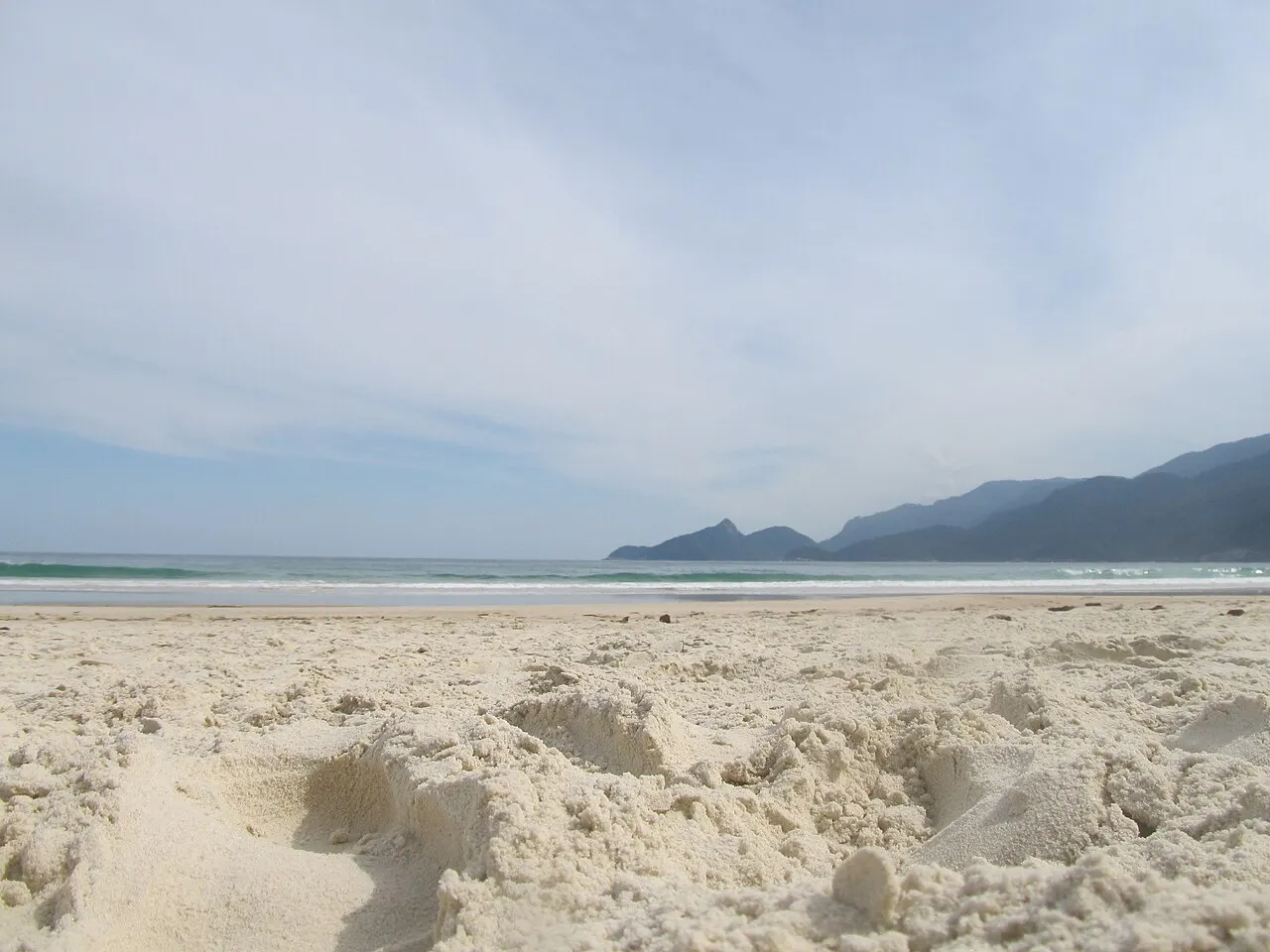
The island's best-known beach has about 3 km of fine white sand on the ocean side, with no houses, no permanent bars and no kiosks, sea-almond trees in the restinga and little shade. The sea has surf, sought out by surfers, and in high season boards can be rented; on a calm day, the shallow water is fine for swimming. Most people arrive by schooner at Praia do Pouso, which has simple restaurants and vendors, and continue about half an hour on foot along trail T11. Those who want to walk leave Abraão on T10 to Pouso, in 2.5 to 3 hours, and add T11: 3 to 3.5 hours one way, with no source of drinking water on the way. Bring all the day's water and food from the village: on a cloudy day or in low season, the beach may have no vendors at all.
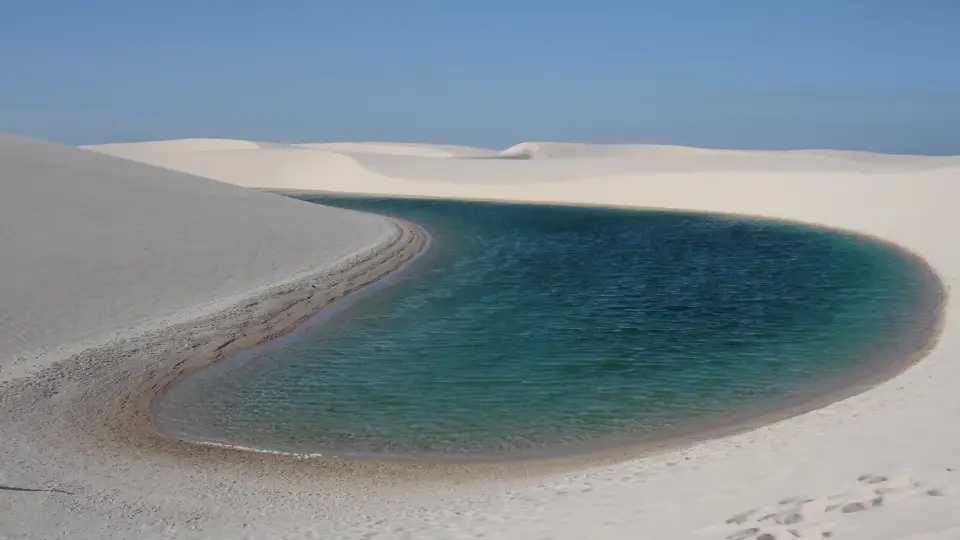
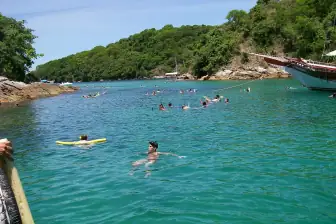
The north side, facing the bay and the mainland, has sheltered coves, calm water and Lagoa Azul and Lagoa Verde, shallow pools between the island and nearby islets.
Check access
Lagoa Azul
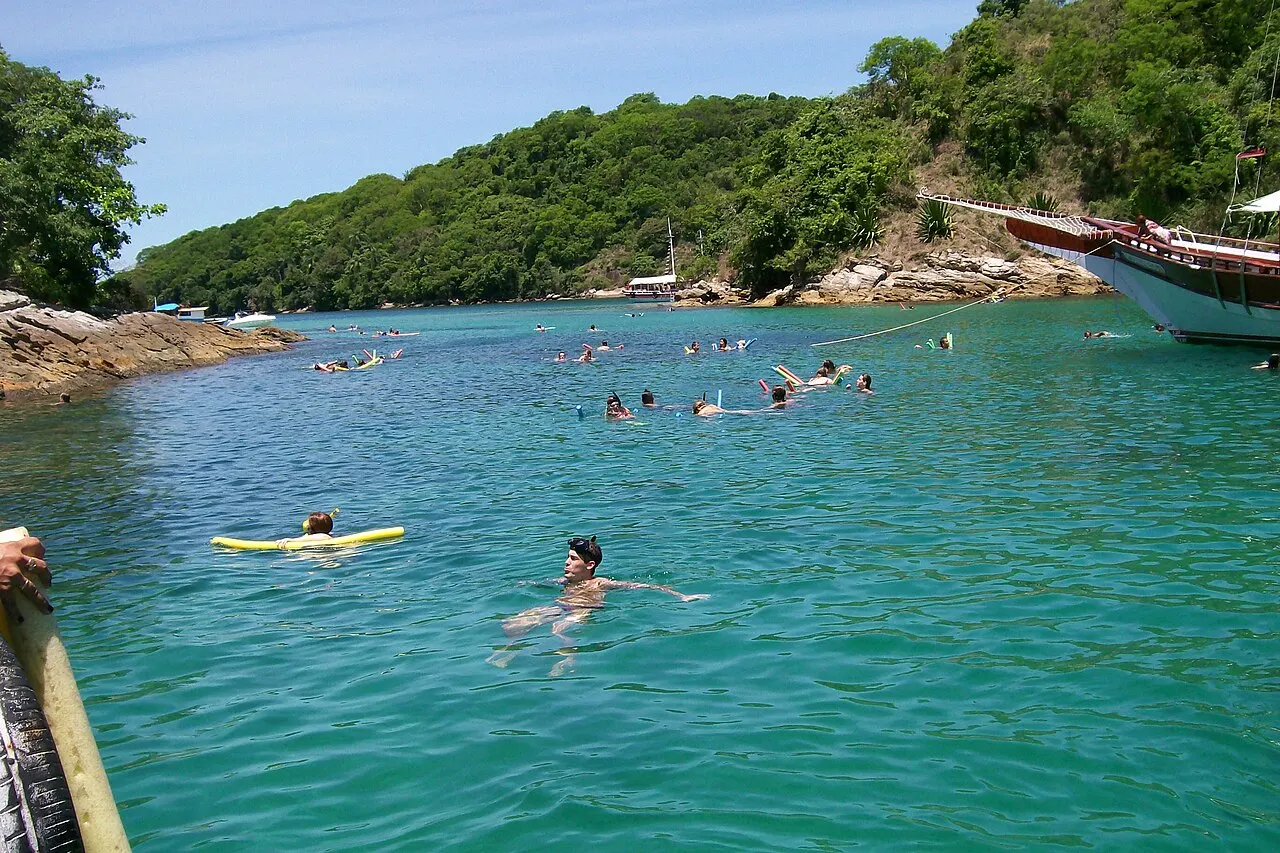
A natural pool of shallow, transparent water in a small archipelago on the north coast, the most popular stop on the boat tours that leave from Abraão. It can only be reached by boat, and the tours stop there for about 50 minutes.
The south side faces the ocean: here are the long beaches with surf, such as Lopes Mendes and Dois Rios, and the Praia do Sul Biological Reserve, closed to recreational visits.
Check access
Lagoa Verde
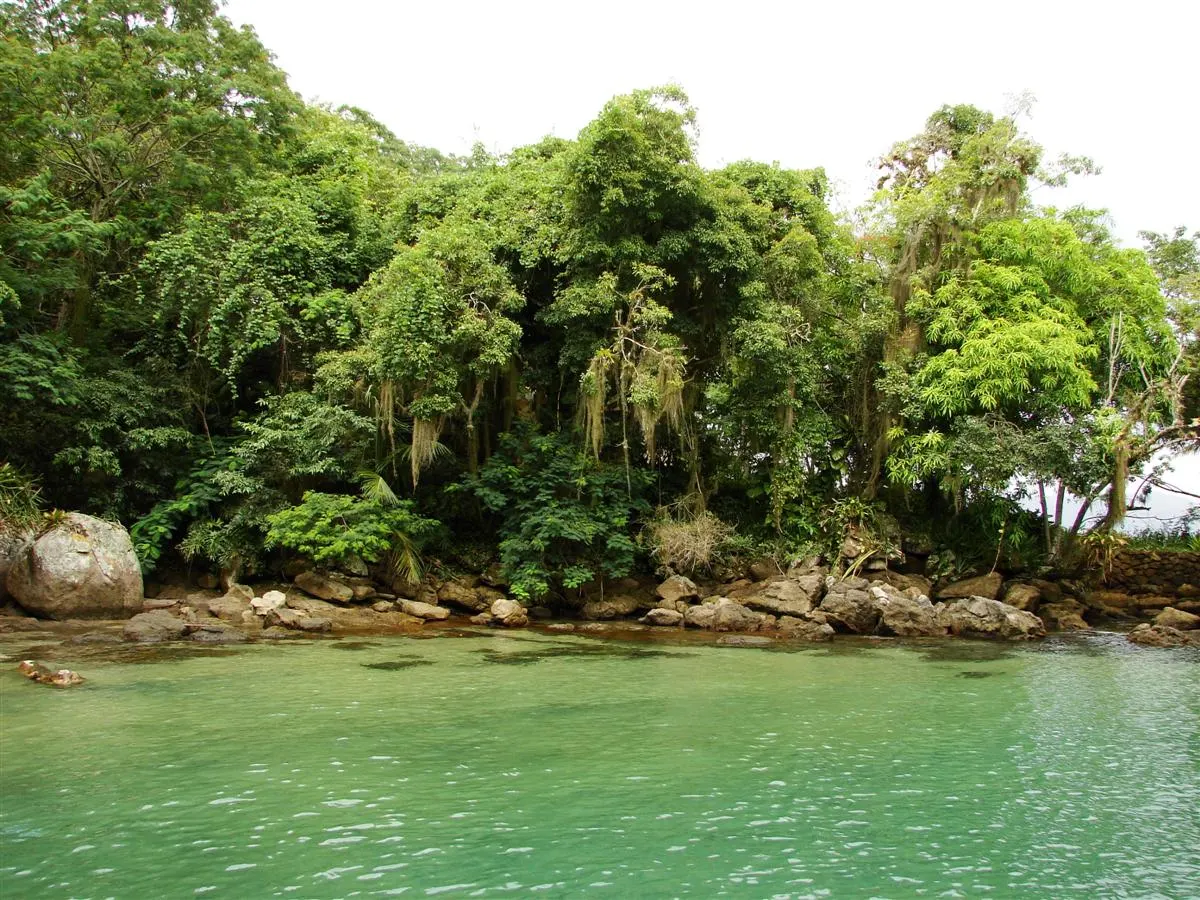
A shallow natural pool between Ilha Grande and Ilha da Longa, with corals and lots of fish. It is usually the first stop of the half-island tour, before Lagoa Azul.
The shoreline facing the bay, between Freguesia de Santana, Japariz and Saco do Céu: calm coves, Lagoa Azul and Lagoa Verde, and beach restaurants where the boat tours stop for lunch.
Check access
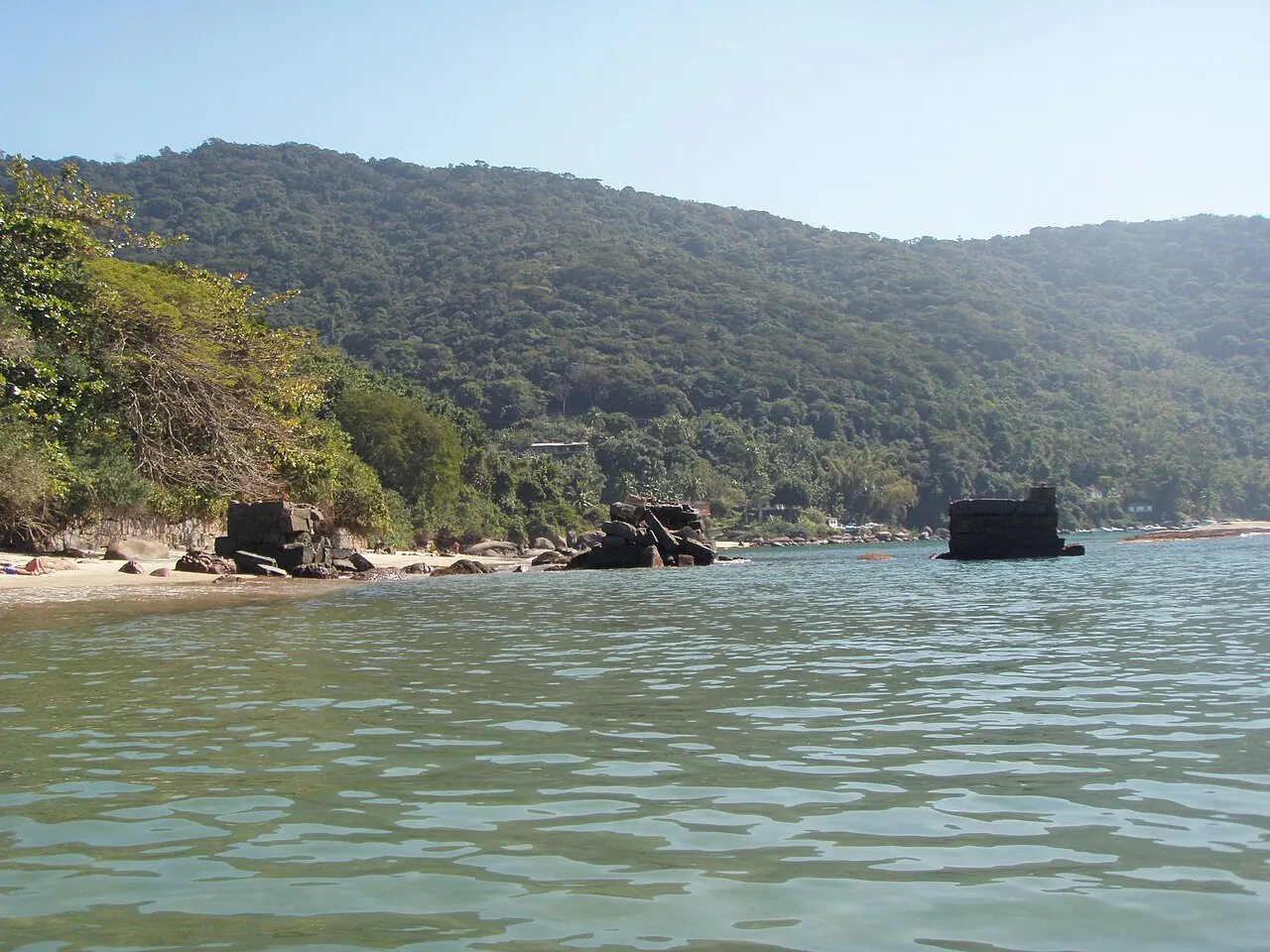
Lazareto Ruins
The remains of the imperial lazaretto of 1886, which became a prison in 1942 and was blown up in 1962, lie next to Praia Preta, a dark-sand beach, on trail T1, the Abraão Circuit. There is no museum: just walls and foundations between the forest and the beach, which help explain why the island stayed closed off for so long.
With a new cholera epidemic in the Mediterranean, the Empire buys the Fazenda do Holandês, in Abraão cove, and builds a lazaretto to quarantine ship passengers.
Check access

Aqueduct
Granite and brick arches built in 1893 to carry water from the forest to the Lazareto, on the same Abraão Circuit. From the village to the aqueduct and the poção (natural pool), the walk takes about an hour.
Check access

Cachoeira da Feiticeira
A waterfall in the forest, reached by trail T2, which continues from the aqueduct, or by a trail from Praia da Feiticeira. From Abraão, estimates range from 40 minutes to 1.5 hours, because there are climbs: plan for the longer one. From the beach to the waterfall it is about 30 minutes each way, more than fits in the 50-minute stop of the half-island boat tour; to see it, walk from the village.
Board the half-island speedboat tour at 10:30 a.m. at the Abraão pier, with about 50 minutes at each stop. Swim in Lagoa Verde and Lagoa Azul, shallow and clear; bring a mask if you have one. Use the stops at Praia do Amor and Praia da Feiticeira for a swim in the sea. Have lunch at the restaurant at the stop in Saco do Céu or Maguariquessaba, paid separately.
Check access

Vila Dois Rios
The village on the ocean side where the Cândido Mendes Penal Institute operated, blown up in 1994. UERJ maintains the Ilha Grande Ecomuseum there, with the Museu do Cárcere in the prison ruins, and the long beach lies between the mouths of two rivers. You get there on trail T14, a dirt road of about three hours on foot from Abraão, of medium difficulty and with steep climbs. The museum has been closed for months at a time; confirm that it is open before you go.
At 193 km², Ilha Grande has hills covered in Atlantic Forest that rise to 982 m at Pico do Papagaio and 1,031 m at Pedra d'Água. The settlements lie beside the coves: Vila do Abraão, Araçatiba, Provetá, Aventureiro and Dois Rios.
Check access
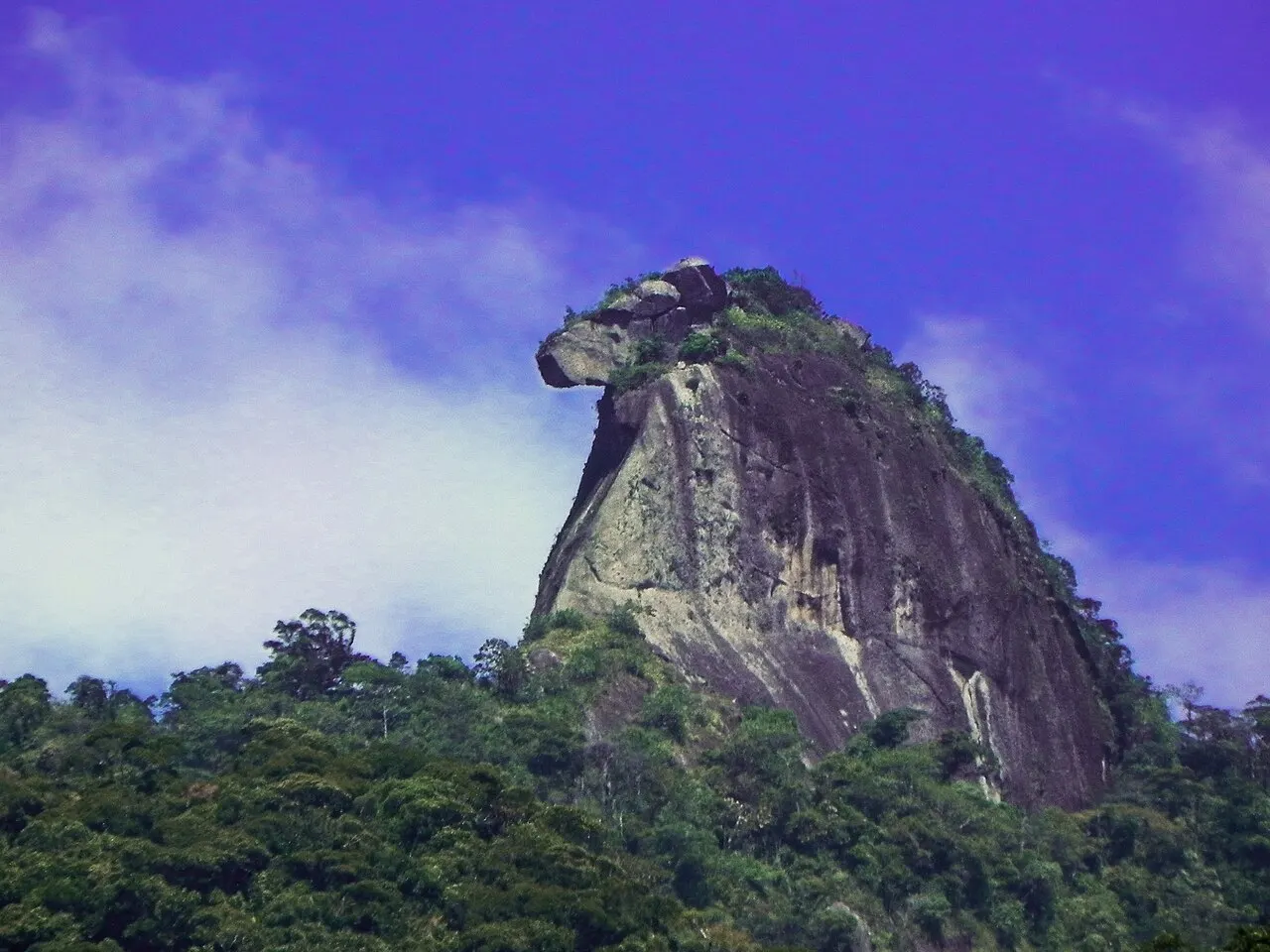
Pico do Papagaio
The peak is 982 m high. Trail T13 is 5.5 km and takes about six hours; Inea describes it as one of the most challenging on the island. Leave early in the morning, turn back if the peak is clouded over or rainy, and carry water and food. Under Inea Resolution 273/2023, access is limited to 90 people a day, and at night, from 5 p.m. to 7 a.m., you can climb only with a guide or conductor accredited by the park. An accredited guide is also recommended by day for anyone with little trail experience.
The trails run through dense forest, with forks and missing signs.
Check access
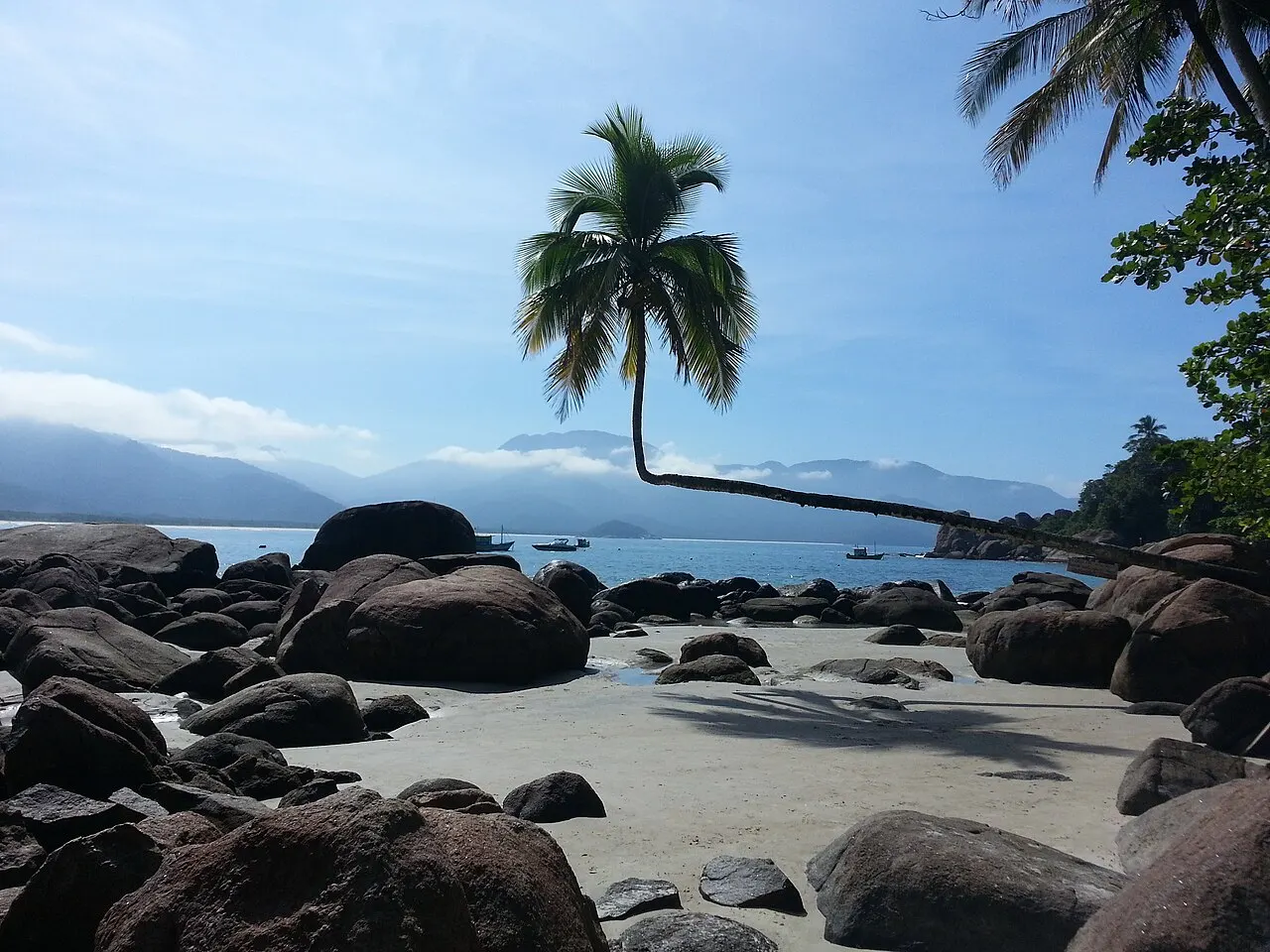
Praia do Aventureiro
The ocean beach of the caiçara village of Aventureiro, inside a sustainable development reserve where about 50 families live. Most people arrive on the round-the-island tour, which depends on the sea; staying overnight requires registration at a campsite or lodging accredited by Inea, and on year-end holidays the places sell out weeks ahead.
The eastern extension of the village, along the cove. It has pousadas and restaurants with tables on the sand, less traffic than the center and, at the end of Praia do Canto, the start of trail T10 to Palmas and Pouso.
Check access
Nilo’s itinerary
Start with the basic programme and choose extensions for the time you have.
Plan my days in the app ↗Day 1 · Arrival and the Abraão Circuit
Issue the Sustainable Tourism Fee voucher on the Viva Angra website before leaving home, and withdraw cash on the mainland.
Take a morning speedboat from Conceição de Jacareí (15 to 30 minutes) or from Angra dos Reis (30 to 50 minutes) and leave your luggage at the pousada in Abraão.
Confirm the return boat time at the pier or the pousada and book the next days' tours at the agency.
After lunch, hike trail T1, the Abraão Circuit: Praia Preta and the Lazareto Ruins, and from there the Aqueduct and the poção (natural pool), about an hour's walk from the village.
Buy water and a snack for the next day, return to Abraão in late afternoon and have dinner on Rua da Praia or at Praia do Canto.
Day 2 · Lopes Mendes
Set out with all the day's water and food: there is no bar or kiosk at Lopes Mendes, and at Pouso there are only simple restaurants and vendors.
Board the 9:30 a.m. schooner at the Abraão pier to Praia do Pouso.
From the middle of Praia do Pouso, follow trail T11 for about half an hour to Lopes Mendes.
Spend the day on the beach; on a day with surf, go into the water only where it is shallow and calm.
Return along the same trail to Pouso in time for the return boat, which reaches Abraão around 5 p.m.
If you prefer to walk, go out on T10, from the end of Praia do Canto to Pouso, in 2.5 to 3 hours, and continue on T11: 3 to 3.5 hours to Lopes Mendes, with no source of drinking water on the way. The boat back has to be arranged with the agency.
Day 3 · The north-coast lagoons
Board the half-island speedboat tour at 10:30 a.m. at the Abraão pier, with about 50 minutes at each stop.
Swim in Lagoa Verde and Lagoa Azul, shallow and clear; bring a mask if you have one.
Use the stops at Praia do Amor and Praia da Feiticeira for a swim in the sea.
Have lunch at the restaurant at the stop in Saco do Céu or Maguariquessaba, paid separately.
Return to Abraão around 4:30 p.m. and watch the end of the afternoon at Praia do Canto.


If you stay longer
Day 4 · Dois Rios or Pico do Papagaio
For Dois Rios, leave Abraão early in the morning on trail T14, a dirt road of about three hours on foot, with steep climbs, carrying water for the round trip.
At Dois Rios, see the prison ruins and the Museu do Cárcere, if it is open, and swim at the beach between the two rivers.
Walk back along T14 with time to reach Abraão before dark.
If you prefer Papagaio, climb T13 leaving early in the morning, on a day with no cloud at the top: it is 5.5 km and about six hours, according to Inea, with water and food in your pack.
With time to spare, Cachoeira da Feiticeira is reached by trail T2, from the aqueduct.
Day 5 · Round-the-island tour and Praia do Aventureiro
Day trip
The speedboat tour that circles the island leaves the Abraão pier at 9:30 a.m. and returns at 6 p.m., for about R$ 220 per person at an agency in the village in October 2026. Through open sea, it passes Caxadaço, Dois Rios (photo only), Parnaioca, Aventureiro and Praia dos Meros, with lunch at Japariz or Maguariquessaba. It is the tour that depends most on the sea and the wind: save it for the first day of good weather and confirm the day before.


Food
Fish with banana
A fish steak cooked with banana, a dish of the caiçara cuisine of the coast between Rio de Janeiro and São Paulo. It appears on the menus of restaurants in Vila do Abraão and Praia do Canto, usually to share.
Moqueca
Fish or shrimp stewed in a pot with tomato, onion and cilantro. Shrimp moqueca appears on the menus of the village's seafood restaurants, usually as a portion for two.
Casquinha de siri
Crab meat sautéed and gratinéed in its own shell, served as a starter in the restaurants of Rua da Praia.
Buffet by weight and prato feito
At lunch, restaurants in the village serve a buffet weighed by the kilo or a prato feito (the PF), with rice, beans, farofa and a meat, fish or chicken. It is the most economical meal before or after a hike.
Where to eat
- Lua e Mar · Praia do Canto
Caiçara cooking with tables on the sand: moqueca with rice and pirão, fish with banana, grilled seafood and risottos, in portions to share between two. It is one of the pricier options in the village, for a late lunch or a seafood dinner a few minutes from the center. Guides report that it usually closes on Wednesdays.
Source · 2026-10-16
- Vila do Abraão (Rua da Praia and surroundings)
For a budget lunch before or after a hike, restaurants in the village serve food by weight or a prato feito, and at night many switch to small plates and pizza. In low season, some restaurants close for weeks: ask at the pousada which ones are open.
- Praia do Pouso
Simple restaurants, vendors with coconut water and drinks and, especially in summer, a floating restaurant. It is where you eat on the Lopes Mendes day, while waiting for the boat back.
- Lopes Mendes
There are no permanent bars or kiosks on the beach, and on a cloudy day or in low season there may be no vendor at all. Bring water and a snack for the whole day from the village.
- North coast (Saco do Céu and Maguariquessaba)
Beach restaurants where the half-island tours stop for lunch, with fish and moqueca. You get there by boat, and lunch is not included in the tour price.
$: food by weight or a prato feito at a simple restaurant in the village · $$: moqueca or fish to share at a restaurant in the village · $$$: seafood dinner at a beachfront restaurant · 2026-10-16
Day trips
Round-the-island tour and Praia do Aventureiro
The speedboat tour that circles the island leaves the Abraão pier at 9:30 a.m. and returns at 6 p.m., for about R$ 220 per person at an agency in the village in October 2026. Through open sea, it passes Caxadaço, Dois Rios (photo only), Parnaioca, Aventureiro and Praia dos Meros, with lunch at Japariz or Maguariquessaba. It is the tour that depends most on the sea and the wind: save it for the first day of good weather and confirm the day before.
Where to begin
Arrival and the Abraão Circuit
Issue the Sustainable Tourism Fee voucher on the Viva Angra website before leaving home, and withdraw cash on the mainland.
Lopes Mendes
Set out with all the day's water and food: there is no bar or kiosk at Lopes Mendes, and at Pouso there are only simple restaurants and vendors.
The north-coast lagoons
Board the half-island speedboat tour at 10:30 a.m. at the Abraão pier, with about 50 minutes at each stop.
Dois Rios or Pico do Papagaio
For Dois Rios, leave Abraão early in the morning on trail T14, a dirt road of about three hours on foot, with steep climbs, carrying water for the round trip.
Money
The currency is the real (R$). Since June 2026, every visitor to Angra dos Reis needs the Sustainable Tourism Fee voucher, issued on the Viva Angra website or at kiosks, and most people pay R$ 50 per person, valid for 30 days for moving between the mainland and Ilha Grande. Visitors going to the islands from another city pay R$ 50 if they can show two nights in registered lodging in Angra and R$ 100 without that proof. The same table lists R$ 50 for the day use of visitors from another city in the first year of the charge and does not make clear which amount applies to a day trip to the island: the website's simulator answers case by case. Exempt, but still issuing the free voucher, are Angra residents and relatives up to the second degree, service providers, children up to 12, people 60 or older and people with disabilities (the issuing page says "under 12"; confirm the age in the simulator). Viva Angra amounts consulted on October 16, 2026. The boat tours are the biggest expense after lodging: at an agency in Abraão, in October 2026, the schooner to Lopes Mendes cost R$ 70 per person, the half-island speedboat tour to the lagoons R$ 150 in low and mid season and R$ 170 in high season, with lunch paid separately, and the round-the-island speedboat tour R$ 220. The public ferry costs R$ 20.50 per leg; the speedboats from Conceição de Jacareí, R$ 60 one way, plus the boarding fee reported by resellers. There is no bank branch on the island; the Melhores Destinos guide mentions a single Caixa ATM, and power outages and weak signal can take the card machine offline. Withdraw cash on the mainland before boarding.
From Rio and São Paulo to Abraão
Guide estimate
Scroll to compare all columns
| Route | Time | Price |
|---|---|---|
| Rio → Angra dos Reis · Costa Verde bus | about 3 hours | price not given |
| Rio → Conceição de Jacareí · same bus, km 455 of the BR-101 | about 2 hours | price not given |
| Rio → Abraão · van and speedboat transfer | about 3.5 hours | price not given |
| São Paulo → Angra dos Reis · Reunidas Paulista bus | about 8 hours 20 minutes | price not given |
| Conceição de Jacareí → Abraão · speedboat | 15 to 30 minutes | R$60 one way, R$100 round trip, plus a R$10.30 boarding fee (undated) |
| Angra dos Reis → Abraão · speedboat | about 30 to 50 minutes | price not given |
| Angra dos Reis → Abraão · public ferry | one departure a day, at 3:30 p.m. (1:30 p.m. on weekends and holidays) | R$20.50 per leg |
| Mangaratiba → Abraão · public ferry | one departure a day, at 8 a.m. | R$20.50 per leg |
Getting there and around
From Rio de Janeiro
There is no airport on the island; the nearest are Galeão (GIG) and Santos Dumont (SDU), in Rio. From the Novo Rio bus station, Viação Costa Verde goes to Angra dos Reis in about 3 hours; for the boats from Conceição de Jacareí, you get off the same bus at km 455 of the BR-101, in about 2 hours, and walk about 5 minutes to the pier. There are also combined van and speedboat transfers, sold by agencies, that pick up at hotels in the Zona Sul and Barra and at both airports and cross via Conceição de Jacareí; the trip takes about 3.5 hours, depending on traffic.
From São Paulo
Reunidas Paulista runs direct buses from Terminal Tietê to the Angra dos Reis bus station, in about 8 hours 20 minutes, with several departures a day. From the bus station, continue to the boarding pier in central Angra. If you prefer to split the trip, you can sleep in Paraty and continue to Angra the next morning.
The crossings
From Conceição de Jacareí, speedboats reach Abraão in 15 to 30 minutes, hourly between 8 a.m. and 6 p.m., with returns from the island until about 5:30 p.m. Melhores Destinos lists R$ 60 one way and R$ 100 round trip from two vendors at the pier, and resellers report a boarding fee of R$ 10.30 per person charged separately; neither source is dated. From Angra dos Reis, speedboats make the crossing in about 30 to 50 minutes throughout the day. The public ferry, operated by Barcas Rio since February 2025, costs R$ 20.50 per leg and has one departure a day from each port: from Angra at 3:30 p.m. (1:30 p.m. on weekends and holidays), with the return from Abraão at 10 a.m.; from Mangaratiba at 8 a.m., with a return in the afternoon. A July 2026 guide gives 3 p.m. and 5 p.m. for the same legs: confirm with the operator or the pousada the day before.
Car on the mainland
Cars do not cross to the island. In Conceição de Jacareí and in Angra there are private parking lots near the boarding point, for about R$ 30 a day.
Arriving in Abraão
The pier has no terminal and no taxi line. Luggage goes on foot or on the porters' handcarts along the dirt streets, and some pousadas send someone to meet guests if they know the arrival time. The village can be crossed on foot in about ten minutes. A hard-shell wheeled suitcase suffers; a backpack or soft bag works better.
On foot around the island
There are no passenger cars. The state park numbers the trails T1 to T16, and together they circle the island, except for the stretch between Aventureiro and Parnaioca, done by boat because the beaches of the Praia do Sul Biological Reserve are closed. Signage has gaps, and cell signal is rare: download the map beforehand.
By boat around the island
Schooners and speedboats leave the Abraão pier for Lopes Mendes, the lagoons and the round-the-island tour, sold by the village's agencies. Tours that go out to open sea depend on wind and waves, and the captain may cancel or change the route for safety.
Safety
The most common risks on Ilha Grande are on the trails and at sea. The trails cross dense forest, with patchy signage, confusing shortcuts, no guaranteed source of drinking water and rare cell signal: tell someone where you are going, carry water, a flashlight and a downloaded map, and if you get lost, go back to the last known point. Trails T12, T13, T15 and T16 are the wildest, often with fallen trees, and Pico do Papagaio, one of the most challenging according to Inea, calls for physical fitness and a clear sky; an accredited guide is recommended for anyone with little experience. At Lopes Mendes and the other ocean-side beaches, waves and currents can be strong, and there is no infrastructure on the sand. For the crossing, use the boats of the ticket offices and companies established at the piers. In the village, the care needed is that of any crowded tourist place: watch your belongings on the beach and at the pier on holidays.
Etiquette tips
The TTS voucher is individual
The tourism fee voucher is personal, non-transferable and tied to the boarding point chosen at issuance. Issue one for each person, including those who are exempt, before reaching the pier.
Camp only in campsites
Camping outside an authorized campsite is prohibited across the whole island, which is covered by conservation units. At Aventureiro, in operations such as the one in the summer of 2025 to 2026, Inea checked on arrival who was registered with accredited lodging and told those who were not to turn back.
Praia do Sul is closed
The beaches of the Praia do Sul Biological Reserve do not receive recreational visits: only research and authorized school visits. Inea fines anyone who lands there.
Papagaio at night has rules
Climbing Pico do Papagaio to watch the sunrise is allowed, but between 5 p.m. and 7 a.m. only with a guide or conductor accredited by the park, and everyone signs a liability waiver.
Mistakes to avoid
Combining Lopes Mendes and the lagoons in one day
They lie on opposite sides of the island, and each tour takes the whole day: at an agency in Abraão, in October 2026, the schooner to Lopes Mendes left at 9:30 a.m. and returned at 5 p.m., and the half-island tour to the lagoons left at 10:30 a.m. and returned at 4:30 p.m.
Setting out on the trail without water
On trails T10 and T11, from Abraão to Pouso and to Lopes Mendes, there is no source of drinking water, and at Lopes Mendes there is no bar or kiosk. Leave the village with all the day's water.
Coming back from the trail after sunset
The trails run through dense forest, with forks and missing signs. Anyone walking back from Lopes Mendes, Dois Rios or Papagaio in late afternoon needs a flashlight, and the safest plan is to leave early in the morning.
Booking a flight on the day you leave the island
Speedboats and tours are canceled when the sea rises, and the Angra ferry leaves Abraão only at 10 a.m. Half a spare day on the mainland before the flight avoids missing it.
Counting on the card alone
There is no bank branch on the island and guides mention only one ATM; power outages and weak signal take down the card machine. Arriving without cash can leave you unable to pay for the boat or lunch on the beach.
Useful phrases
A que horas sai o último barco para o continente?
A question to ask as soon as you arrive: the return time changes outside summer
Esse passeio inclui o almoço?
On boat tours, lunch is usually paid separately, at the restaurant at the stop
Onde começa a trilha T10?
At the end of Praia do Canto, the trail that leads to Palmas, Pouso and Lopes Mendes
Aceita cartão ou só dinheiro?
Useful to ask before ordering, since not every card machine works on the island
O mar está bom para a volta à ilha hoje?
Agencies decide in the morning whether the open-sea tour goes out
Moqueca para dois, por favor
Most moquecas and fish dishes are served in portions for two
Where to stay
- Vila do Abraão · First-time visitors who will take the boat tours and want restaurants and agencies within walking distance: All the boats from the mainland and almost all the tours leave from the village pier, and the trails to the Lazareto, Lopes Mendes, Dois Rios and Papagaio start there. It is where most pousadas, campsites and hostels are. The downside is the crowds: in summer and on holidays the streets and the pier fill up, and the beach in front, with boat traffic, is not good for swimming.
- Praia do Canto, Praia da Júlia and Crena · Couples and anyone who wants to sleep closer to the water without giving up the village: They are a few minutes' walk from central Abraão, with pousadas and restaurants with tables on the sand, and trail T10 to Lopes Mendes starts at the end of Praia do Canto. They are quieter than the center. The downside is carrying luggage a little farther from the pier and walking back along the waterfront at night.
- Aventureiro · Anyone who wants an isolated caiçara village, with camping and an ocean beach, and accepts arriving by boat: The village lies in a reserve on the ocean side, far from the bustle of Abraão. Visitation is controlled by Inea: only people registered at one of the accredited campsites or lodgings can stay overnight, and they sell out early on holidays. The downside is access, which depends on the sea or a long trail from Provetá, and the simple facilities.
$: a campsite spot or a hostel bed · $$: a room at a simple pousada · $$$: a room at a pousada with more amenities · 2026-10-16
Districts
Vila do Abraão
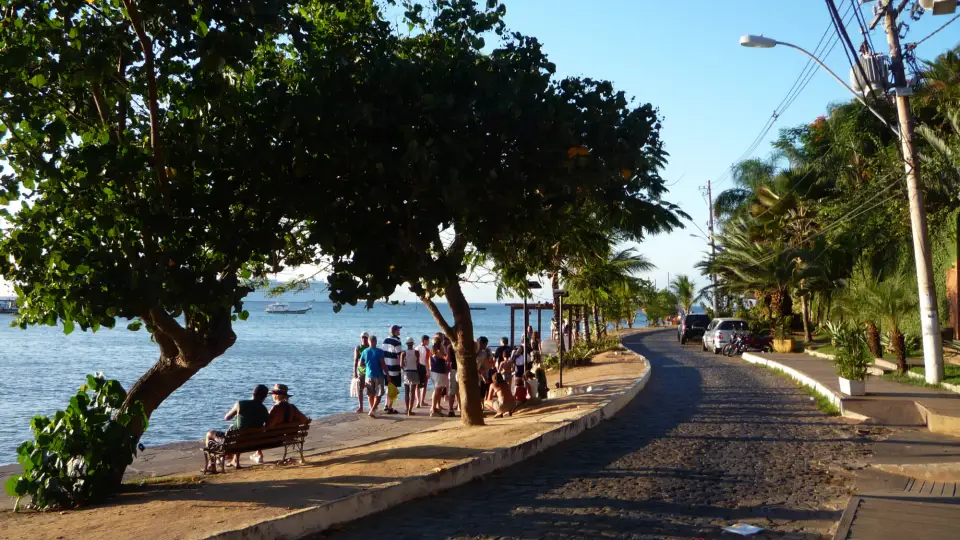
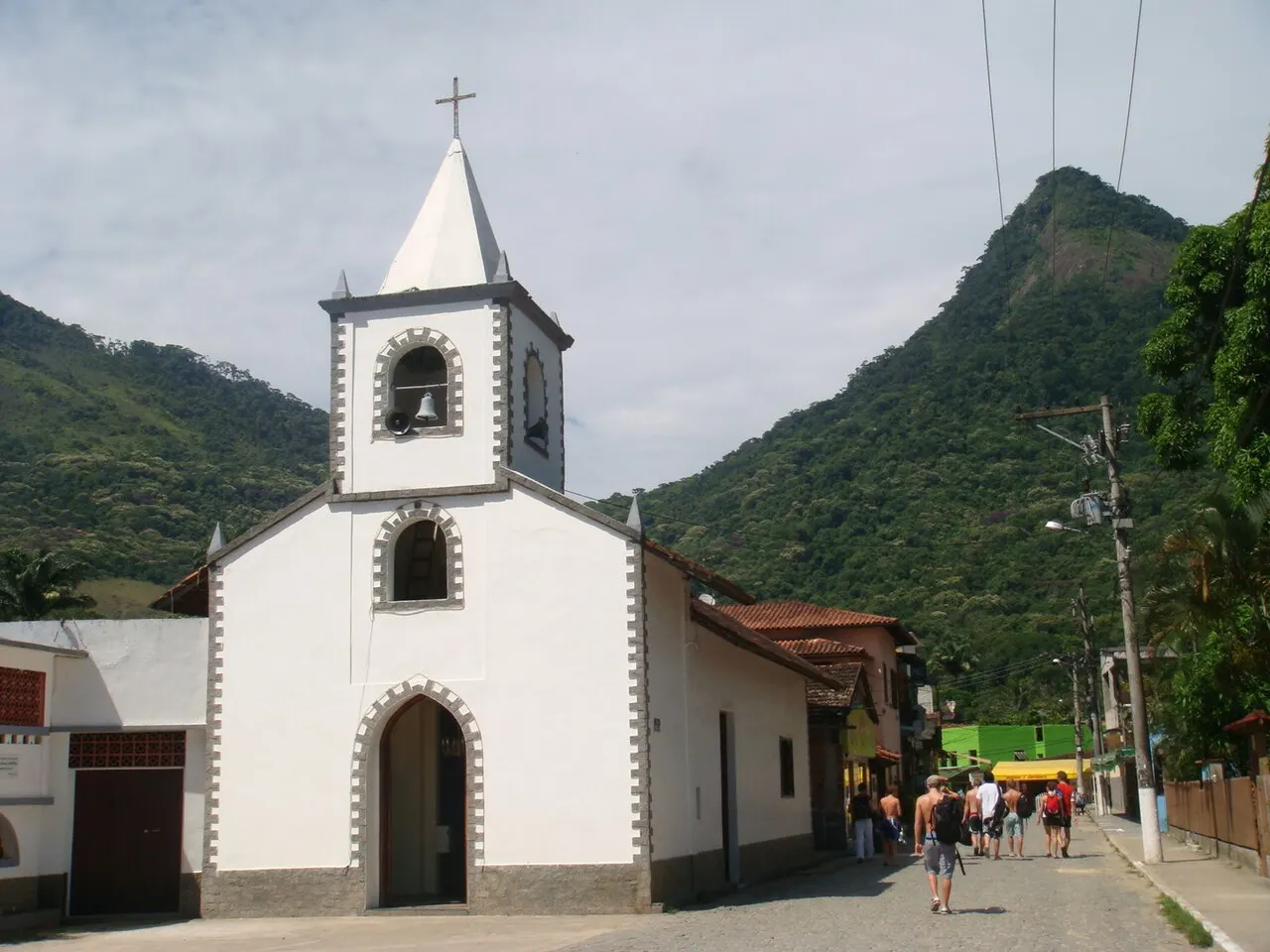
The pier village, where boats from the mainland arrive and from where tour schooners and speedboats leave. It concentrates pousadas, campsites, restaurants, agencies and the church of São Sebastião, on dirt and sand streets that can be crossed on foot in about ten minutes. The beach in front has constant boat traffic and is not the best for swimming.
Praia do Canto, Praia da Júlia and Crena
The eastern extension of the village, along the cove. It has pousadas and restaurants with tables on the sand, less traffic than the center and, at the end of Praia do Canto, the start of trail T10 to Palmas and Pouso.
Palmas and Pouso
Coves on the far side of the first hill, linked to Abraão by trail T10, which passes through Palmas and reaches Pouso in 2.5 to 3 hours. Praia do Pouso is where the schooners to Lopes Mendes land, about half an hour away on foot along T11. At Pouso there are simple restaurants, beach vendors and, especially in summer, a floating restaurant.
Lopes Mendes
A beach of about 3 km of fine white sand on the ocean side, with no residents and no buildings, surrounded by restinga scrub. It has good surf and, on a calm-sea day, shallow water for swimming.
North coast
The shoreline facing the bay, between Freguesia de Santana, Japariz and Saco do Céu: calm coves, Lagoa Azul and Lagoa Verde, and beach restaurants where the boat tours stop for lunch. You get there by boat.
Dois Rios
A village on the ocean side where the prison operated until 1994, now run by UERJ, with the ruins, the Museu do Cárcere and a long beach between two rivers. You get there on trail T14, about three hours on foot from Abraão.
Aventureiro and the south coast
A caiçara village in the Aventureiro Sustainable Development Reserve, with a beach on the ocean coast. Visitation is controlled by Inea: only people registered at accredited campsites or lodging can stay overnight. The beaches of the neighboring Praia do Sul Biological Reserve are closed to recreational visits.
Araçatiba and Provetá
Settlements on the west of the island, linked by trail T8. From Provetá, trail T9 leads to Aventureiro in about two and a half hours, with steep climbs.
History
before 1500 · Tamoio territory
The island was inhabited by Tupi peoples, the Tamoio of the Portuguese chroniclers, who called it Ipaum Guaçu, the Big Island.
1502 · Gonçalo Coelho's expedition in the bay
The Portuguese fleet reaches the bay on January 6, Epiphany, the date that gave Angra dos Reis its name.
1554–1567 · The Tamoio Confederation
The Tamoio and other Tupi peoples of the coast resist Portuguese colonization between 1554 and 1567.
1591 · Thomas Cavendish's attack
The English privateer attacks the island on December 15.
1803 · The parish of Santana
The island becomes the parish of Santana da Ilha Grande de Fora. Sugarcane and coffee plantations occupy the island until the last decade of the 19th century, and it becomes a route of the trade in enslaved people.
1884–1886 · The Ilha Grande Lazareto
With a new cholera epidemic in the Mediterranean, the Empire buys the Fazenda do Holandês, in Abraão cove, and builds a lazaretto to quarantine ship passengers. The pavilions are ready in February 1886.
1893 · The dam and the aqueduct
Works at the Lazareto bring water from the forest to the complex through an aqueduct of granite and brick, whose arches still stand on the Abraão trail.
1894–1903 · The Dois Rios correctional colony
In late 1894 the Dois Rios Correctional Colony is created on the ocean side. Closed in 1897, it reopens in 1903 and begins to receive prisoners convicted of misdemeanors.
1936 · Graciliano Ramos at Dois Rios
Jailed without trial after the communist uprising of November 1935, the writer passes through the Dois Rios colony. The experience is in "Memórias do Cárcere" (Prison Memoirs), published in 1953.
1942 · The Lazareto becomes a prison
After major renovations, the old Lazareto becomes the Cândido Mendes Penal Colony, which together with the Dois Rios agricultural colony forms one of the most important penitentiary complexes in the Republic.
1950s · The sardine factories
Fish salting replaces farming from the early 1930s and, at its peak, about twenty sardine factories operate in the island's coves.
1962 · The implosion in Abraão
By order of Governor Carlos Lacerda, the buildings of the Abraão penal colony are blown up, and with them the Lazareto's landmarks. The ruins next to Praia Preta and the aqueduct remain.
1971 · The state park
Ilha Grande State Park is created, expanded in 2007 to 12,052 hectares. Other conservation units cover the rest of the island, among them the Praia do Sul Biological Reserve.
1994 · The end of the Dois Rios prison
The Cândido Mendes Penal Institute is closed and blown up under Governor Leonel Brizola. In the 1970s, inmates there had founded the Falange Vermelha, the origin of the Comando Vermelho. UERJ takes over the area and in 1998 opens an environmental studies center.
2014 · The Aventureiro reserve
The caiçara village of Aventureiro and the former marine park become a Sustainable Development Reserve, where traditional residents and controlled visitation coexist.
2019 · World Heritage
On July 5, UNESCO inscribes Paraty and Ilha Grande as Brazil's first mixed cultural and natural site.
2026 · The tourism fee
On June 1, Angra dos Reis begins charging the Sustainable Tourism Fee at the Abraão pier as well, amid protests from residents and pousada owners.
Complete history
A quarantine island
The forest that now covers almost all of Ilha Grande grew over land that was once sugarcane and coffee plantations. What interrupted the settlement was the role the state gave the island. In 1884, faced with a new cholera epidemic, the Empire bought the Fazenda do Holandês, in Abraão cove, and built a lazaretto there to isolate passengers from suspect ships. The pavilions were separated by ticket class, and surveillance was as much a part of the design as the hospital. In 1893 came the dam and the aqueduct, still standing on the trail that leaves the village.
A century of prisons
The architecture built to isolate soon served to imprison. From 1894 the Lazareto's buildings housed military prisoners, and in the same year the Dois Rios correctional colony appeared, on the ocean side. After the 1935 uprising, political prisoners were sent there, Graciliano Ramos among them. In 1942 the Lazareto became the Cândido Mendes Penal Colony; in 1962 Governor Carlos Lacerda ordered it blown up. The Dois Rios prison operated until 1994, when it too was blown up. For more than a hundred years, a good part of the island belonged to the penitentiary system.
From fishing to tourism
Outside the prisons, the island lived off fishing. In the 1950s, about twenty sardine factories salted fish in the coves. Today the economy depends mainly on tourism and fishing, and the whole island is covered by conservation units created since 1971. In 2019 the island joined Paraty on the World Heritage list, and in 2026 Angra dos Reis began charging a tourism fee to fund preservation, over the protests of some residents.
The ruins next to Praia Preta were first a quarantine for ship passengers and then a prison. I'd visit them on the first day, because they explain the rest of the island.
Geography and shape of the city
Hills and coves
At 193 km², Ilha Grande has hills covered in Atlantic Forest that rise to 982 m at Pico do Papagaio and 1,031 m at Pedra d'Água. The settlements lie beside the coves: Vila do Abraão, Araçatiba, Provetá, Aventureiro and Dois Rios.
Two coasts
The north side, facing the bay and the mainland, has sheltered coves, calm water and Lagoa Azul and Lagoa Verde, shallow pools between the island and nearby islets. The south side faces the ocean: here are the long beaches with surf, such as Lopes Mendes and Dois Rios, and the Praia do Sul Biological Reserve, closed to recreational visits.
Summer rain
At the INMET station in Angra dos Reis (1981 to 2010 normal), about 1,796 mm of rain falls per year. December is the wettest month, with 258 mm, and August the driest, with 54 mm. Average highs range from 30.1 °C in February to 24 °C in July.
The round-the-island tour skirts the ocean side, past Caxadaço, Parnaioca and Aventureiro, and is the tour most often canceled for wind and waves. I'd save it for the first calm-sea day and confirm the day before.
Culture
The caiçaras of the island
The island's longtime residents are called caiçaras, ilhéus or badjecos. They are families who lived off small farming and fishing in the coves, and at Aventureiro about 50 caiçara families remain, inside a reserve created to reconcile their way of life with conservation.
The memory of prison
The island keeps the history of the prisons in ruins, in the Museu do Cárcere at Dois Rios and in literature: Graciliano Ramos described the colony in "Memórias do Cárcere" (Prison Memoirs), adapted for film by Nelson Pereira dos Santos in 1984. Ordinary and political prisoners passed through the island over a century.
Science on the island
Since the end of the prison, UERJ has run an environmental studies center at Dois Rios, opened in 1998, and the Ilha Grande Ecomuseum, of which the Museu do Cárcere is part.
Iemanjá and the July festival
On February 2, 2025, Vila do Abraão held a morning celebration of Iemanjá organized with spiritist centers and the city government, with music, dance and a sea procession with offerings made of material that does not pollute the sea. In July, the city government hosts the Ilha Grande Music and Ecology Festival in Abraão, which reached its 23rd edition in 2026, with free concerts, a song contest, a crafts fair and preservation activities.
Festivals and events
Iemanjá
February 2. In 2025, the celebration in Vila do Abraão began at 9 a.m., with a cultural and religious program and a sea procession; anyone who wanted to board the procession registered in advance with the Angra dos Reis Culture Secretariat. Check the year's program on the city government's website.
Ilha Grande Music and Ecology Festival
Early July, in Vila do Abraão. The 23rd edition ran from July 3 to 5, 2026, with a free program: national acts, the final of a song contest with free-theme and ecology-theme categories, a crafts fair, workshops and environmental activities.
New Year's Eve and Carnival
Late December and February or March, depending on the calendar. These are the island's busiest periods: for New Year's Eve 2025 into 2026, the campsites and accredited lodging at Aventureiro sold out as early as November, and only day visits were allowed.
Books and films
Memórias do Cárcere (Graciliano Ramos, 1953)
The account by the writer jailed in 1936, published after his death, includes his time at the Dois Rios colony and explains what the prisons meant for the island.
Memórias do Cárcere (Nelson Pereira dos Santos, 1984)
The film adaptation of the book, directed by Nelson Pereira dos Santos.
Frequently asked questions
Ilha Grande: How do you get there from Rio?
There is no airport on the island. From the Novo Rio bus station, the Viação Costa Verde bus drops you at km 455 of the BR-101 in about 2 hours, 5 minutes from the Conceição de Jacareí pier, where speedboats take 15 to 30 minutes to Abraão.
Ilha Grande: What if you fly into Rio?
There are van and speedboat transfers, sold by agencies, that pick up at Galeão, Santos Dumont and hotels in the Zona Sul and Barra and cross via Conceição de Jacareí; the trip takes about 3.5 hours, depending on traffic.
Ilha Grande: Do you have to pay a fee to visit?
Yes, the TTS voucher, issued on the Viva Angra website: most people pay R$ 50, valid for 30 days, and visitors from another city who cannot show two nights in registered lodging in Angra pay R$ 100 (October 2026). For a day trip, check the amount in the simulator.
Ilha Grande: Who is exempt from the tourism fee?
Children up to 12, people 60 or older, people with disabilities, Angra residents and relatives up to the second degree, and service providers. Even when exempt, they issue the voucher, free, on Viva Angra; confirm the child's age in the simulator.
Ilha Grande: How many days should you stay?
Three days, sleeping in Vila do Abraão: the Abraão Circuit, Lopes Mendes and Lagoa Azul and Lagoa Verde. On a fourth, Dois Rios on foot or Pico do Papagaio with a clear summit; on a fifth, the round-the-island speedboat tour, with a calm sea. A day trip from Rio, without staying overnight, fits only part of this.
Ilha Grande: Can you pay for everything by card?
Don't count on it: there is no bank branch on the island, guides mention only one ATM, and power outages and weak signal take down the card machine. Withdraw cash on the mainland before boarding.
Ilha Grande: How do you get to Lopes Mendes?
Most people take the schooner from Abraão to Praia do Pouso and walk about half an hour along trail T11. On foot from the village, on T10 and T11, it is 3 to 3.5 hours one way, with no drinking water on the way and no kiosk on the beach.
Ilha Grande: When is the best time to go?
From April to November it rains less; June to August are the driest and coolest months, good for long trails, but cold fronts can cancel speedboats. December to March is summer, hotter, rainier and crowded.
Ilha Grande: What should you take on the trails?
Water, a flashlight and a downloaded map: the trails cross dense forest with patchy signage, no guaranteed source of water and rare cell signal. Tell someone where you are going and, if you get lost, go back to the last known point.
Ilha Grande: What is the round-the-island tour like?
The speedboat leaves the Abraão pier at 9:30 a.m. and returns at 6 p.m., for about R$ 220 per person at an agency in Abraão (October 2026), through open sea to Aventureiro. It is the tour that depends most on the sea and wind: save it for the first good-weather day and confirm the day before.
Other cities in the country
Brazil ↗- Days
- 4
- When
- Apr–Jun
- Per person/day
- Average 615 BRLMid-range · per person/day
Cost scope
Per person per day: accommodation, meals, urban transport, visits and a small allowance for extras. Flights excluded; larger purchases vary. Editorial estimate, not a quote.
- Days
- 2–3
- When
- Apr–May · Sep
- Per person/day
- Average 400–700 BRLMid-range · per person/day
Cost scope
Per person per day: accommodation, meals, urban transport, visits and a small allowance for extras. Flights excluded; larger purchases vary. Editorial estimate, not a quote.
- Days
- 2–3
- When
- Jan–Mar · Sep–Dec
- Per person/day
- Average 350–550 BRLMid-range · per person/day
Cost scope
Per person per day: accommodation, meals, urban transport, visits and a small allowance for extras. Flights excluded; larger purchases vary. Editorial estimate, not a quote.
- Days
- 1–2
- When
- May–Sep
- Per person/day
- Average 260–520 BRLMid-range · per person/day
Cost scope
Per person per day: accommodation, meals, urban transport, visits and a small allowance for extras. Flights excluded; larger purchases vary. Editorial estimate, not a quote.
- Days
- 3–4
- When
- Jun–Sep
- Per person/day
- Average 400–700 BRLMid-range · per person/day
Cost scope
Per person per day: accommodation, meals, urban transport, visits and a small allowance for extras. Flights excluded; larger purchases vary. Editorial estimate, not a quote.
- Days
- 2–3
- When
- Apr–Jun
- Per person/day
- Average 350–550 BRLMid-range · per person/day
Cost scope
Per person per day: accommodation, meals, urban transport, visits and a small allowance for extras. Flights excluded; larger purchases vary. Editorial estimate, not a quote.
- Days
- 3–5
- When
- Mar–Apr · Nov
- Per person/day
- Average 397 BRLMid-range · per person/day
Cost scope
Per person per day: accommodation, meals, urban transport, visits and a small allowance for extras. Flights excluded; larger purchases vary. Editorial estimate, not a quote.
- Days
- 2–4
- When
- Mar–May · Sep
- Per person/day
- Explore costsGuide estimate
Cost scope
Per person per day: accommodation, meals, urban transport, visits and a small allowance for extras. Flights excluded; larger purchases vary. Editorial estimate, not a quote.
- Days
- 4–5
- When
- Aug–Nov
- Per person/day
- Explore costsGuide estimate
Cost scope
Per person per day: accommodation, meals, urban transport, visits and a small allowance for extras. Flights excluded; larger purchases vary. Editorial estimate, not a quote.
- Days
- 3–4
- When
- Jul–Sep
- Per person/day
- Explore costsGuide estimate
Cost scope
Per person per day: accommodation, meals, urban transport, visits and a small allowance for extras. Flights excluded; larger purchases vary. Editorial estimate, not a quote.
- Days
- 3–4
- When
- Sep–Nov
- Per person/day
- Explore costsGuide estimate
Cost scope
Per person per day: accommodation, meals, urban transport, visits and a small allowance for extras. Flights excluded; larger purchases vary. Editorial estimate, not a quote.
- Days
- 2–4
- When
- May–Sep
- Per person/day
- Explore costsGuide estimate
Cost scope
Per person per day: accommodation, meals, urban transport, visits and a small allowance for extras. Flights excluded; larger purchases vary. Editorial estimate, not a quote.
- Days
- 3–5
- When
- Jun–Sep
- Per person/day
- Explore costsGuide estimate
Cost scope
Per person per day: accommodation, meals, urban transport, visits and a small allowance for extras. Flights excluded; larger purchases vary. Editorial estimate, not a quote.
- Days
- 3–4
- When
- Jun–Aug
- Per person/day
- Explore costsGuide estimate
Cost scope
Per person per day: accommodation, meals, urban transport, visits and a small allowance for extras. Flights excluded; larger purchases vary. Editorial estimate, not a quote.
- Days
- 4–5
- When
- Jan–Mar · Sep–Dec
- Per person/day
- Explore costsGuide estimate
Cost scope
Per person per day: accommodation, meals, urban transport, visits and a small allowance for extras. Flights excluded; larger purchases vary. Editorial estimate, not a quote.
- Days
- 3–4
- When
- Oct–Dec
- Per person/day
- Average 1,110 BRLMid-range · per person/day
Cost scope
Per person per day: accommodation, meals, urban transport, visits and a small allowance for extras. Flights excluded; larger purchases vary. Editorial estimate, not a quote.
- Days
- 3–4
- When
- Aug–Sep
- Per person/day
- Explore costsGuide estimate
Cost scope
Per person per day: accommodation, meals, urban transport, visits and a small allowance for extras. Flights excluded; larger purchases vary. Editorial estimate, not a quote.
- Days
- 4–7
- When
- Apr–Sep
- Per person/day
- Explore costsGuide estimate
Cost scope
Per person per day: accommodation, meals, urban transport, visits and a small allowance for extras. Flights excluded; larger purchases vary. Editorial estimate, not a quote.
- Days
- 3–4
- When
- Jan · Sep–Dec
- Per person/day
- Explore costsGuide estimate
Cost scope
Per person per day: accommodation, meals, urban transport, visits and a small allowance for extras. Flights excluded; larger purchases vary. Editorial estimate, not a quote.
- Days
- 2
- When
- Aug–Dec
- Per person/day
- Average 442 BRLMid-range · per person/day
Cost scope
Per person per day: accommodation, meals, urban transport, visits and a small allowance for extras. Flights excluded; larger purchases vary. Editorial estimate, not a quote.
- Days
- 3–5
- When
- Jan–Feb · Sep–Dec
- Per person/day
- Explore costsGuide estimate
Cost scope
Per person per day: accommodation, meals, urban transport, visits and a small allowance for extras. Flights excluded; larger purchases vary. Editorial estimate, not a quote.
- Days
- 3–5
- When
- May–Sep
- Per person/day
- Explore costsGuide estimate
Cost scope
Per person per day: accommodation, meals, urban transport, visits and a small allowance for extras. Flights excluded; larger purchases vary. Editorial estimate, not a quote.
- Days
- 2–3
- When
- Apr–Sep
- Per person/day
- Average 484 BRLMid-range · per person/day
Cost scope
Per person per day: accommodation, meals, urban transport, visits and a small allowance for extras. Flights excluded; larger purchases vary. Editorial estimate, not a quote.
- Days
- 3
- When
- Apr–May · Aug
- Per person/day
- Average 478 BRLMid-range · per person/day
Cost scope
Per person per day: accommodation, meals, urban transport, visits and a small allowance for extras. Flights excluded; larger purchases vary. Editorial estimate, not a quote.
- Days
- 3–4
- When
- Aug–Dec
- Per person/day
- Explore costsGuide estimate
Cost scope
Per person per day: accommodation, meals, urban transport, visits and a small allowance for extras. Flights excluded; larger purchases vary. Editorial estimate, not a quote.
- Days
- 2
- When
- Apr–May · Sep
- Per person/day
- Explore costsGuide estimate
Cost scope
Per person per day: accommodation, meals, urban transport, visits and a small allowance for extras. Flights excluded; larger purchases vary. Editorial estimate, not a quote.
- Days
- 3
- When
- Sep–Dec
- Per person/day
- Explore costsGuide estimate
Cost scope
Per person per day: accommodation, meals, urban transport, visits and a small allowance for extras. Flights excluded; larger purchases vary. Editorial estimate, not a quote.
- Days
- 4
- When
- Jul–Sep
- Per person/day
- Explore costsGuide estimate
Cost scope
Per person per day: accommodation, meals, urban transport, visits and a small allowance for extras. Flights excluded; larger purchases vary. Editorial estimate, not a quote.
- Days
- 4–5
- When
- May–Sep
- Per person/day
- Explore costsGuide estimate
Cost scope
Per person per day: accommodation, meals, urban transport, visits and a small allowance for extras. Flights excluded; larger purchases vary. Editorial estimate, not a quote.
- Days
- 3
- When
- May–Sep
- Per person/day
- Explore costsGuide estimate
Cost scope
Per person per day: accommodation, meals, urban transport, visits and a small allowance for extras. Flights excluded; larger purchases vary. Editorial estimate, not a quote.