Brazil
Manaus
Amazonas Theatre, the Meeting of the Waters and tacacá
Days Start with the basic programme and choose extensions for the time you have.
How the guide reaches this number
A fourth day goes to the waterfalls of Presidente Figueiredo, 107 km to the north. Come to see a city of 2.3 million people running without a reliable road to the rest of the country. If you want forest outside your bedroom window, choose a jungle lodge: inside the city only the Ducke Reserve holds dense forest. With just one day, go to the market before 10am, take the theater tour mid-morning, and have fish for lunch downtown. In the late afternoon, drink tacacá on Largo de São Sebastião. Save the Meeting of the Waters for when you have half a day free, because in a rush it's just a line on the water seen from far off. What disappoints is the city's layout: the radial avenues carried the city away from the river that gave birth to it. September, with clear skies and a low river, is the month I'd choose.
3–4
When June to September; high water in June–July, low water in September–November; 23–34°C year-round
How the guide reaches this number
Manaus sits just over 3° from the equator and has no temperature seasons. The annual average is about 27 °C, with highs of 31 to 34 °C, lows rarely below 23 °C and humidity almost always above 80%. What changes over the year is the rain and the river level. The rainy season runs from December to May, peaking in March and April, when it rains almost every day, usually in mid-afternoon, hard and for about an hour. From June to November it rains much less, and August and September are the driest months. The river works as a second season. It rises between May and July, when you can boat inside the flooded forest and the igapós become reachable by canoe. It falls between September and November, when sandy beaches appear and some igarapés become impassable. June and July combine a high river with tapering rain; August and September bring the clearest skies and the lowest water. Avoid March, the rainiest month. In years of severe drought, also keep an eye on September and October: in 2023 and 2024, smoke from regional wildfires worsened the city's air for weeks.
Per person/day R$ 180–280 budget; R$ 400–700 comfortable; jungle lodge is separate, R$ 700–1,800 per person per day
How the guide reaches this number
Per person per day: accommodation, meals, urban transport, visits and a small allowance for extras. Flights excluded; larger purchases vary. Editorial estimate, not a quote.
 What Nilo thinks
Stay three days: one downtown, in the center that rubber paid for, with the market and the theater, one at the Meeting of the Waters and the igarapés of Janauari, and one in the urban forest of INPA and MUSA. A fourth day goes to the waterfalls of Presidente Figueiredo, 107 km to the north. Come to see a city of 2.3 million people running without a reliable road to the rest of the country. If you want forest outside your bedroom window, choose a jungle lodge: inside the city only the Ducke Reserve holds dense forest. With just one day, go to the market before 10am, take the theater tour mid-morning, and have fish for lunch downtown. In the late afternoon, drink tacacá on Largo de São Sebastião. Save the Meeting of the Waters for when you have half a day free, because in a rush it's just a line on the water seen from far off. What disappoints is the city's layout: the radial avenues carried the city away from the river that gave birth to it. September, with clear skies and a low river, is the month I'd choose.Manaus is a metropolis of 2.3 million people surrounded by forest and river, with no reliable road to the rest of the country, and almost everyone arrives by plane or by boat. Rubber money paid for the Amazonas Theatre, from 1896, with its dome of 36,000 glazed tiles in the colors of the flag, and the floating port that rises and falls with the river. Near the Centro, the black waters of the Negro and the muddy waters of the Solimões run side by side without mixing, at the Meeting of the Waters. Inside the city, MUSA's 42 m tower puts you above the treetops of the Ducke Reserve; to have forest around your room, choose a jungle lodge. In the late afternoon, try tacacá, the tucupi broth with jambu that sidewalk carts serve in a gourd. Come between June and September and stay three days, with a fourth for the waterfalls of Presidente Figueiredo.
Quick facts
- Population
- about 2.3 million in the municipality (2025 IBGE estimate: 2,303,732), about 2.8 million in the metro area; 7th largest in Brazil
- Founded
- 1669, Fort of São José do Rio Negro; became a city on October 24, 1848; name Manáos from 1856, spelling Manaus from 1939
- Country and region
- Brazil, state of Amazonas, left bank of the Rio Negro, 11 km above the meeting point with the Solimões
- Language
- Portuguese; Nheengatu and dozens of indigenous languages in the region; limited English and Spanish outside hotels and agencies
- Currency
- Real (BRL, R$); about 5.4–5.8 per dollar and about 6.2–6.6 per euro in 2026
- Time zone
- Amazonas Time, UTC−4; no daylight saving
- Best time to visit
- June to September; high water in June–July, low water in September–November; 23–34°C year-round
- Average daily cost
- R$ 180–280 budget; R$ 400–700 comfortable; jungle lodge is separate, R$ 700–1,800 per person per day
When to go
June to September; high water in June–July, low water in September–November; 23–34°C year-round
January
24° to 31°C
306 mm of rain
February
24° to 31°C
297 mm of rain
March
24° to 31°C
321 mm of rain
April
24° to 31°C
331 mm of rain
May
24° to 32°C
233 mm of rain
October
25° to 34°C
114 mm of rain
November
24° to 33°C
188 mm of rain
December
24° to 32°C
254 mm of rain
How the year changes
Manaus sits just over 3° from the equator and has no temperature seasons. The annual average is about 27 °C, with highs of 31 to 34 °C, lows rarely below 23 °C and humidity almost always above 80%. What changes over the year is the rain and the river level. The rainy season runs from December to May, peaking in March and April, when it rains almost every day, usually in mid-afternoon, hard and for about an hour. From June to November it rains much less, and August and September are the driest months. The river works as a second season. It rises between May and July, when you can boat inside the flooded forest and the igapós become reachable by canoe. It falls between September and November, when sandy beaches appear and some igarapés become impassable. June and July combine a high river with tapering rain; August and September bring the clearest skies and the lowest water. Avoid March, the rainiest month. In years of severe drought, also keep an eye on September and October: in 2023 and 2024, smoke from regional wildfires worsened the city's air for weeks.
The same numbers as a table
| Month | Temperature °C | Rain mm |
|---|---|---|
| January | 24 to 31 | 306 |
| February | 24 to 31 | 297 |
| March | 24 to 31 | 321 |
| April | 24 to 31 | 331 |
| May | 24 to 32 | 233 |
| June · | 24 to 32 | 117 |
| July · | 24 to 33 | 67 |
| August · | 24 to 34 | 56 |
| September · | 25 to 34 | 79 |
| October | 25 to 34 | 114 |
| November | 24 to 33 | 188 |
| December | 24 to 32 | 254 |
Nilo's tips
From the airport, Uber or 99 beats the fixed-rate taxi
From the airport to downtown, Uber and 99 cost R$45–75, versus R$75–100 for the fixed-rate taxi, for the same 14 km. If you're staying more than a day, buy the Passa Fácil card right at the terminal.
Amazonas Theatre visit: R$20; Sundays only until 1pm
On Sundays and holidays, the guided tour only runs from 9am to 1pm, so don't leave the theater for Sunday afternoon. From Tuesday to Saturday, it leaves every 45 minutes, from 9am to 5pm, and costs R$20 full price and R$10 half price, free for Amazonas residents. Take the first tour of the day, with a smaller group, and cross Largo de São Sebastião before the sun heats up.
Go to the Mercado Municipal and MUSA tower before 10am
Before 10am, the fish is arriving at the Mercado Municipal Adolpho Lisboa, and the stalls of herbs, resins, oils, and garrafadas are still opening. MUSA's 42 m metal tower, in the Adolpho Ducke Reserve, calls for the same schedule, because after 10am the climb gets hot and the toucans have already left the canopy.
Leave at 7am to see the Meeting of the Waters
The divide between the dark water and the muddy water shows up best with low sun and a falling river. Board the first boat, at 7am, because after ten, with the sun overhead, it loses contrast in photos.
The tacacá cart opens at four, never before
Before 4pm, the sun is too strong to stay out on the street, and the sidewalk carts only start serving once it drops. The best-known ones are at Largo de São Sebastião, and the gourd costs R$15–25. Hold it by the sides, because the bottom is the hot part.
Downtown empties at 6pm; eat dinner in Vieiralves or Ponta Negra
When the shops close, the streets of the Centro go quiet. Go for dinner in Vieiralves, in Nossa Senhora das Graças, or stroll the Ponta Negra boardwalk when the sun goes down.
Explore the map
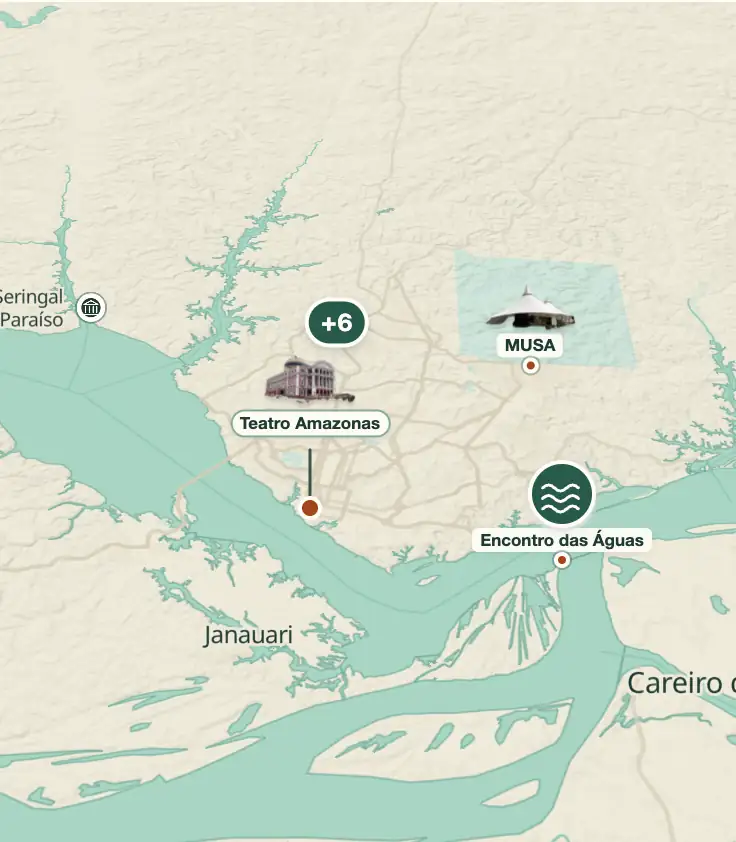
© OpenStreetMap · OpenFreeMap · © OpenMapTiles
Explore the map, read about the other places and plan your travel days in the app.
Open the appWhat to see
Surrounded by forest and river, Manaus is a metropolis of 2.3 million people where the jungle is visited by boat and the street fills up in the late afternoon.
In front of the city, the Rio Negro is about 3 km wide and varies more than 10 m between high water and low water, which explains the 1903 floating dock and the beaches that appear and disappear.

Amazonas Theatre
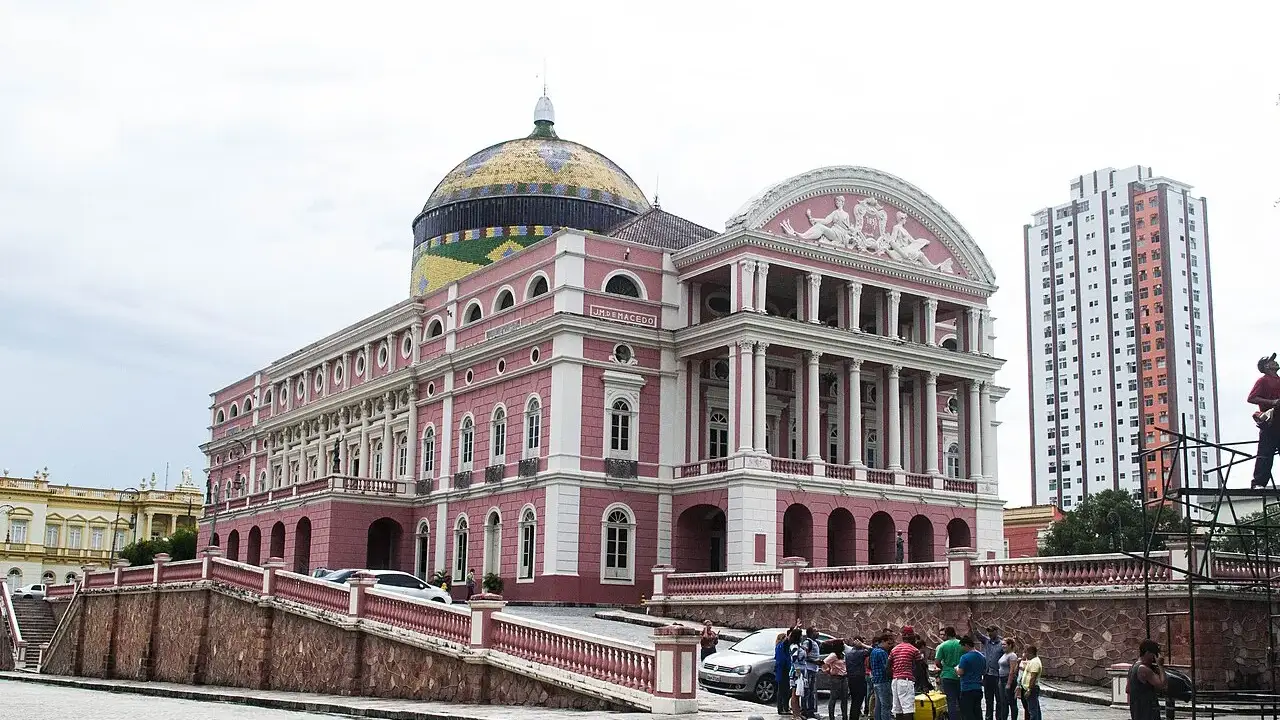
An opera house opened on December 31, 1896, at the height of the rubber boom, with imported materials: Carrara marble, British iron, French furniture, and 36,000 glazed tiles from Alsace on the dome, in the colors of the national flag. The drop curtain, painted in Paris by Crispim do Amaral, depicts the Meeting of the Waters. Guided tours run Tuesday to Saturday, 9am to 5pm, and Sundays and holidays, 9am to 1pm; R$20 full price and R$10 half price, free for Amazonas residents, with tours leaving every 45 minutes in Portuguese, English, and Spanish.
The drop curtain depicts the Meeting of the Waters.
Check access
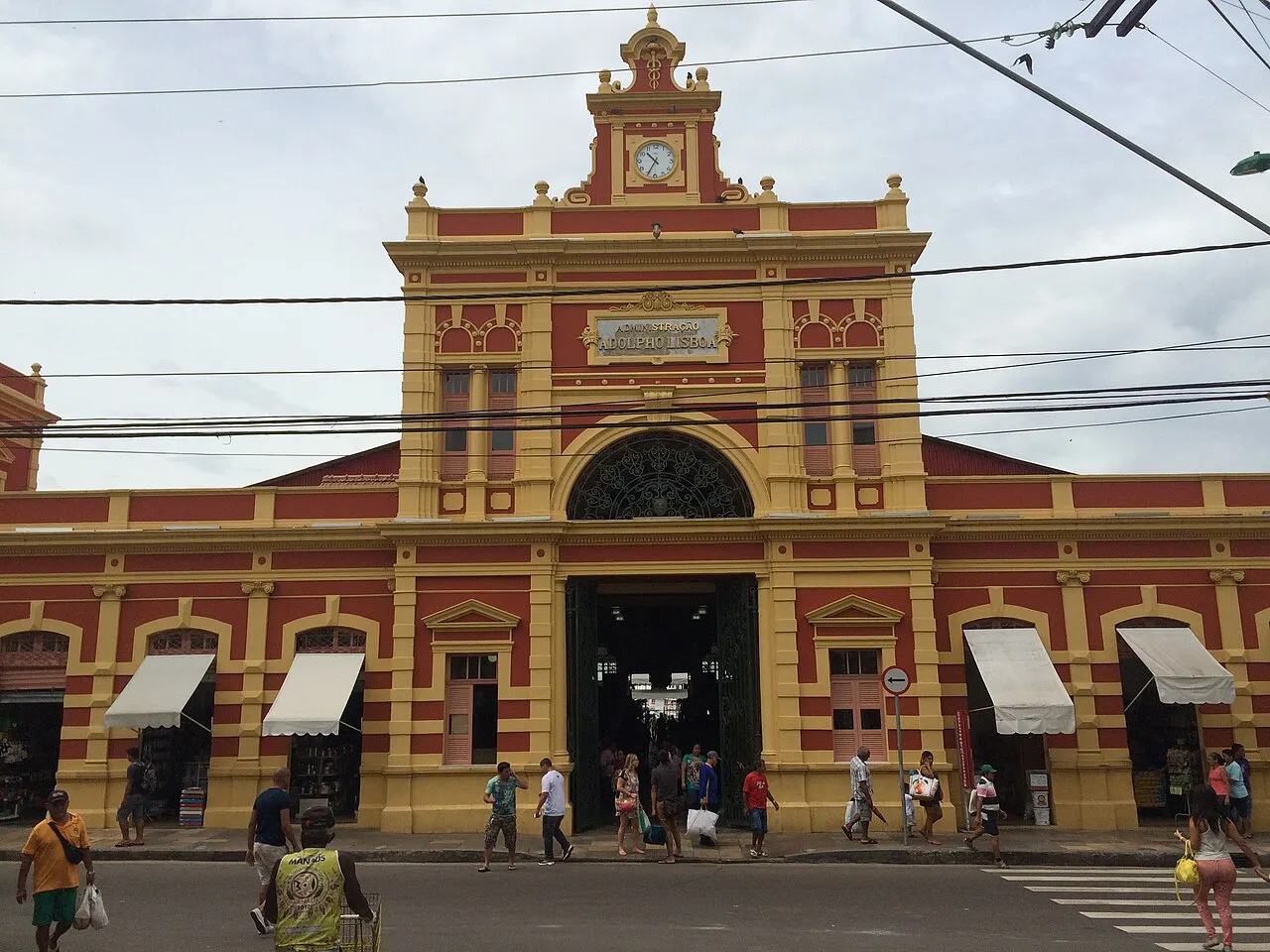
Adolpho Lisboa Municipal Market
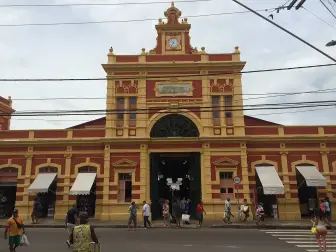
Opened in 1883 with iron structure imported from Europe and a layout inspired by Les Halles in Paris; the attribution to Gustave Eiffel is repeated without documented proof. Reopened in 2013 after a long restoration.
The attribution to Eiffel is repeated without any document to prove it.
Check access
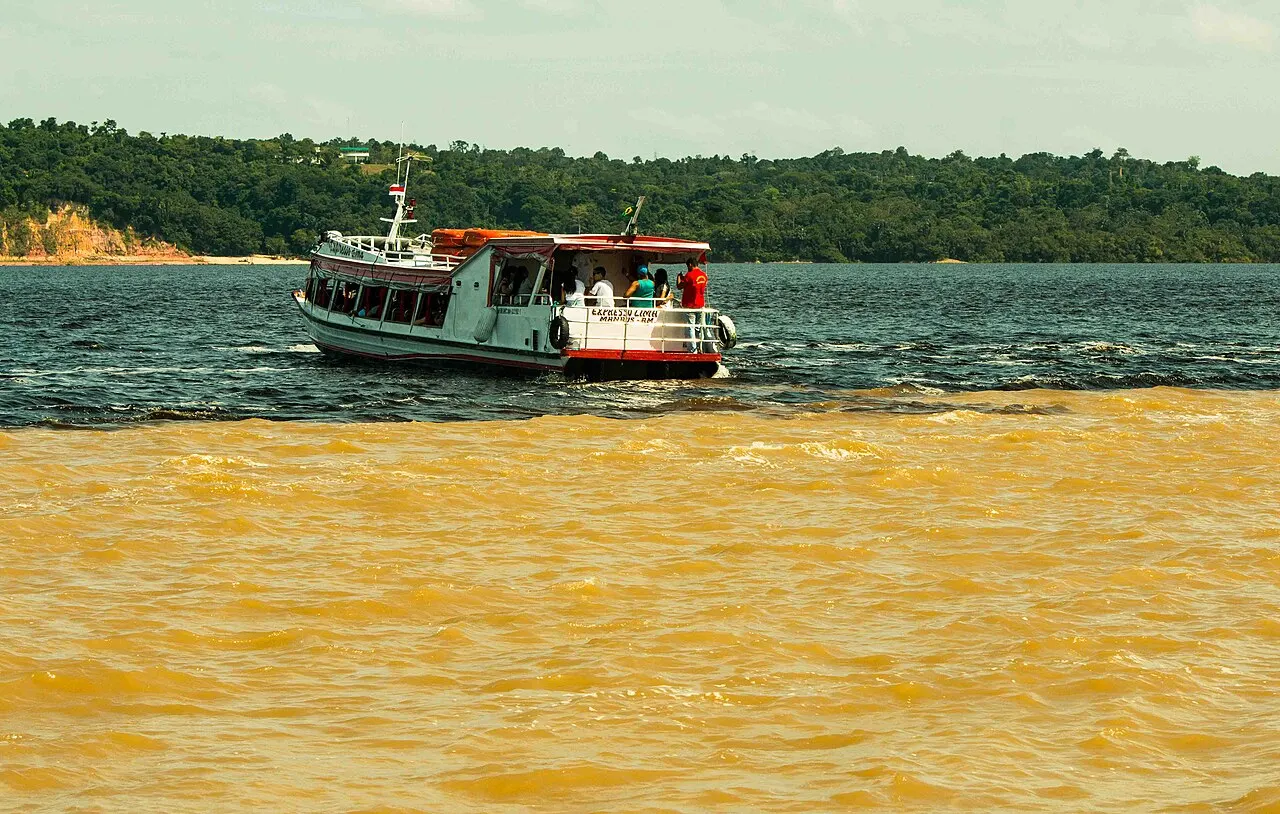
Meeting of the Waters
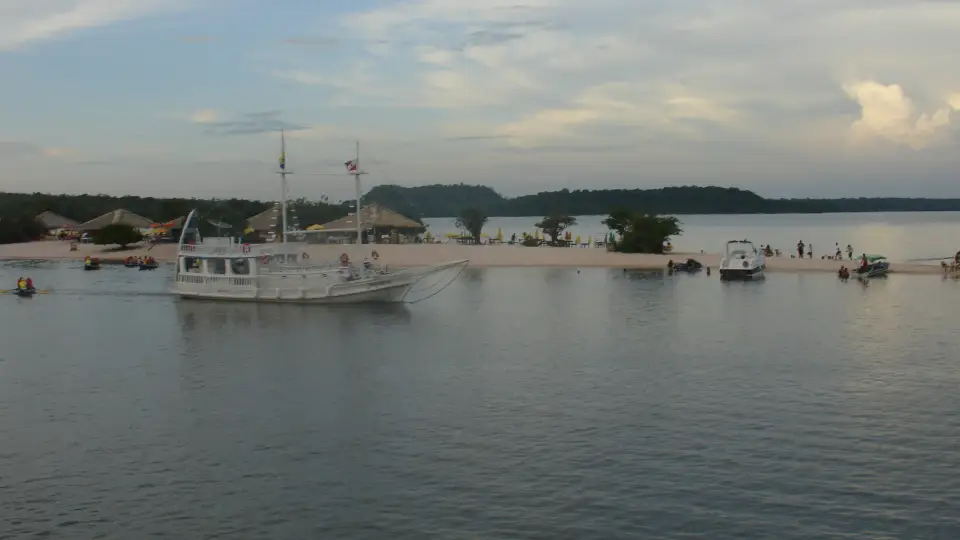
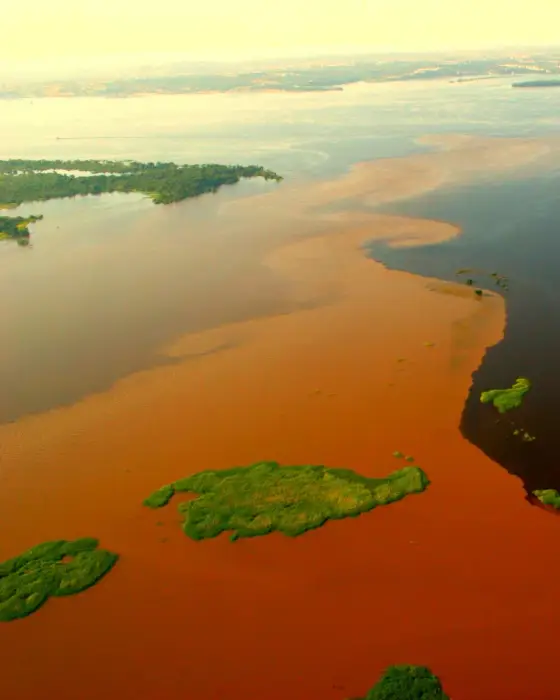
11 km from Centro, the black, acidic waters of the Rio Negro run alongside the ochre, silty waters of the Solimões for about 6 km without mixing, due to differences in temperature (about 28°C versus about 22°C), density, and current speed. Boats leave from the Ceasa port, Manaus Moderna, and Marina do Davi; the line is sharpest with morning sun and low water.
The band between the Negro and the Solimões runs for about 6 km, 11 km from Centro: black, acidic water on one side, ochre, muddy water on the other, near 28°C against near 22°C. Choose Ceasa, Manaus Moderna, or Marina do Davi. In the morning, with low water, the band shows up best.
Check access

MUSA: Amazon Museum
An open-air museum inside the Adolpho Ducke Forest Reserve, 10,000 hectares of primary forest within the city limits. The centerpiece is the 42-meter metal tower, climbed on foot, which puts the visitor above the canopy: early, with luck, you can spot flocks of toucans. The visit also takes in the orchid house, the giant water-lily tank, and the insect collection.
The 42 m tower puts visitors above the canopy.
Check access
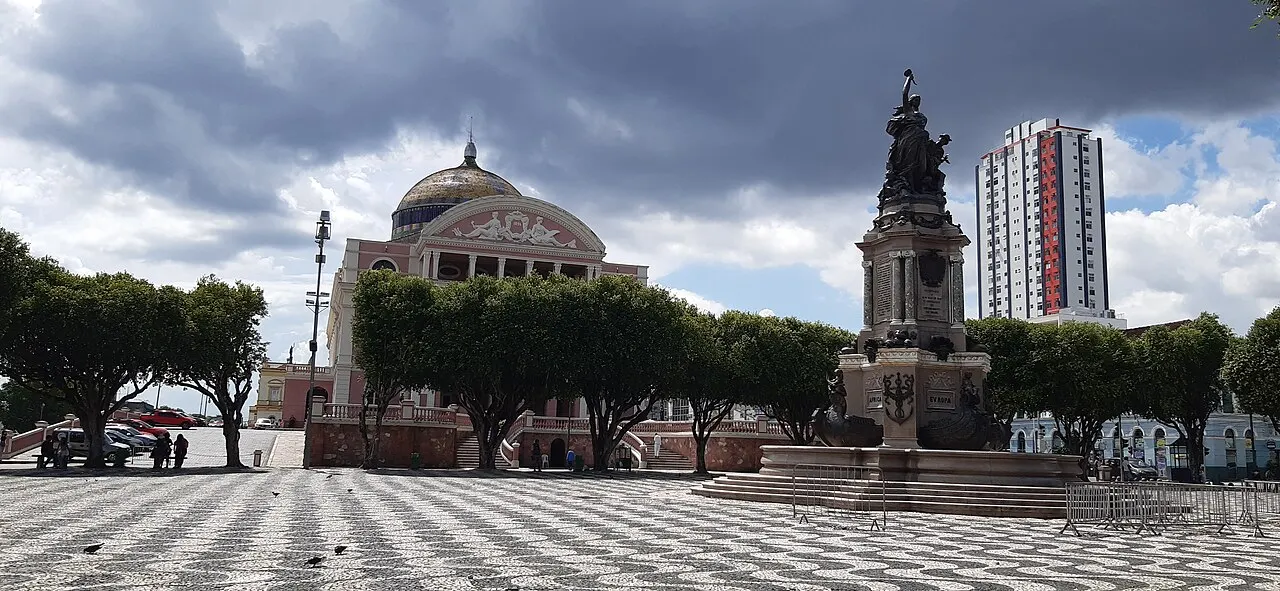
Largo de São Sebastião
The square in front of the theater, with the Church of São Sebastião (1888) and the Monument to the Opening of the Ports (1900), four bronze ships representing four continents, commissioned in Italy to celebrate the opening of the river to foreign shipping. The black-and-white wave paving reproduces the meeting of the Negro and the Solimões and is the city's most-copied design.
The paving reproduces the meeting of the Negro and the Solimões.
Check access
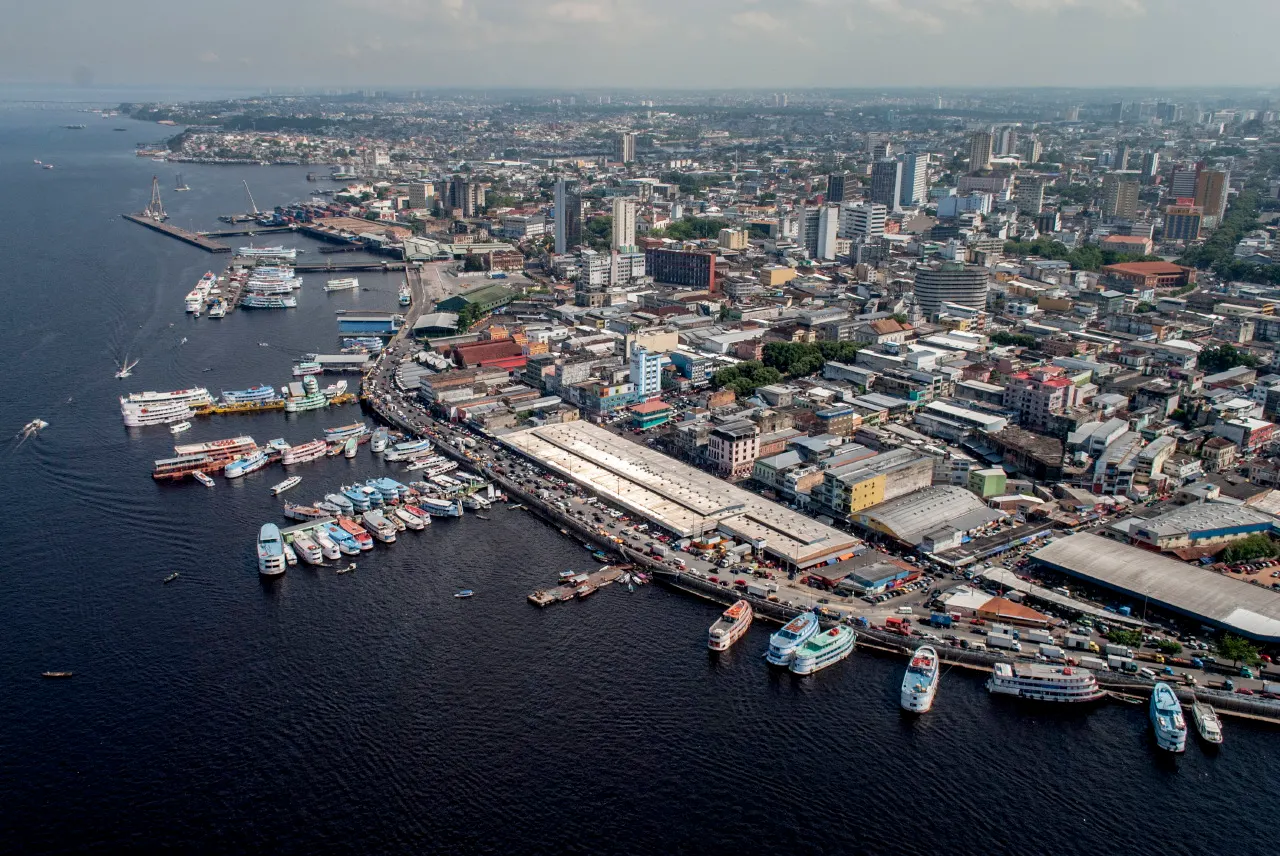
Floating Port and Customs House
The floating dock, built between 1902 and 1903 by the British company Manáos Harbour, rises and falls with the river: it's the engineering answer to a yearly swing of more than 10 meters. Next to it, the Customs House (1906) arrived prefabricated from England. The dock's gauge marks the record high of 30.02 m in June 2021 and the record low of 12.11 m in October 2024.
The floating dock rises and falls with the river.
Check access

Rio Negro Palace
A mansion built around 1903 for the German rubber merchant Waldemar Scholz, later the seat of the Amazonas state government until 1995 and now a cultural center with free admission. It shows how the latex elite lived, with hardwoods, stained glass and European furniture.
It was the seat of the Amazonas state government until 1995.
Check access

Science Forest (INPA)
Thirteen hectares run by the National Institute for Amazon Research, founded in 1952 and open to the public since 1995. It has tanks for Amazonian manatees and giant otters in rehabilitation, squirrel monkeys roaming free among the trees, and the Science House. Closes early afternoon; check the hours on the day of your visit.
It has tanks of Amazonian manatees and giant otters in rehabilitation.
Check access
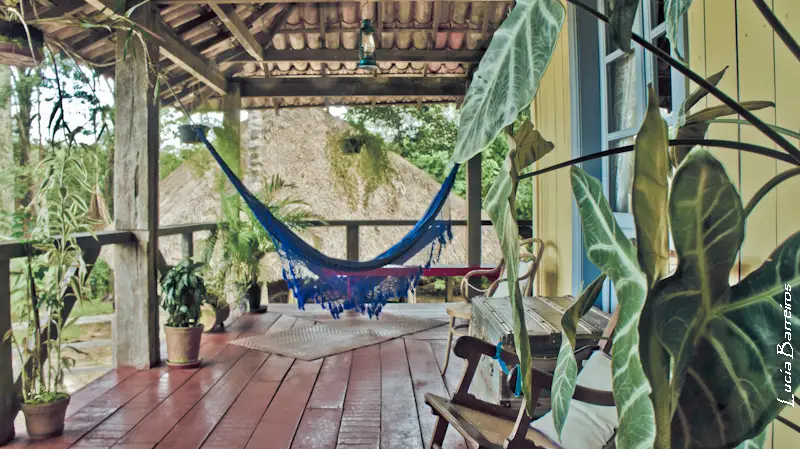
Vila Paraíso Rubber Plantation Museum
A replica of a late-19th-century rubber estate on the São João stream, built in 2001 as a set for the film A Selva and kept afterward as a museum. The main house, the supply shed and the smokehouse explain the debt system that bound the rubber tapper to the boss. You can only get there by boat, 30 to 40 minutes from Marina do Davi.
It's a 2001 replica, built as the set for the film A Selva, and it's only reached by boat: 30 to 40 minutes from Marina do Davi. The same half-morning boat ride leads to the Meeting of the Waters and to Janauari, which aren't a set for anything.
Check access
Nilo’s itinerary
Start with the basic programme and choose extensions for the time you have.
Plan my days in the app ↗Day 1 · The downtown built with rubber money
Start at 8am at the Adolpho Lisboa Municipal Market; look for jaraqui, tambaqui, and salted pirarucu at the back stalls and the herbs and oils along the sides.
Cross to the Floating Port and the Customs House and read the river gauge on the wall: the 2021 record flood marked 30.02 m and the 2024 drought, 12.11 m.
Walk up Av. Eduardo Ribeiro to Largo de São Sebastião and take the guided tour of the Amazonas Theatre: R$20 full price, R$10 half price, Tuesday to Saturday, 9am to 5pm, with tours every 45 minutes.
Have fish for lunch downtown and spend the hottest hours, between 1pm and 3pm, inside the Rio Negro Palace or the Palacete Provincial, both with free admission.
Head back to Largo at 5pm for cart tacacá and stay for the street program, which usually happens on weekends in front of the theater.
Day 2 · The Meeting of the Waters and the Janauari creeks
Leave at 7am from the Ceasa port or Marina do Davi toward the Meeting of the Waters; the double band stretches about 6 km and is sharpest with morning sun.
Head on to Janauari Ecological Park, on Lake Janauari, and take a small canoe into the narrow igarapés to see giant water lilies up close.
Have grilled tambaqui for lunch at a floating restaurant in Careiro da Várzea and ask for Uarini flour on the side, to compare with the regular kind.
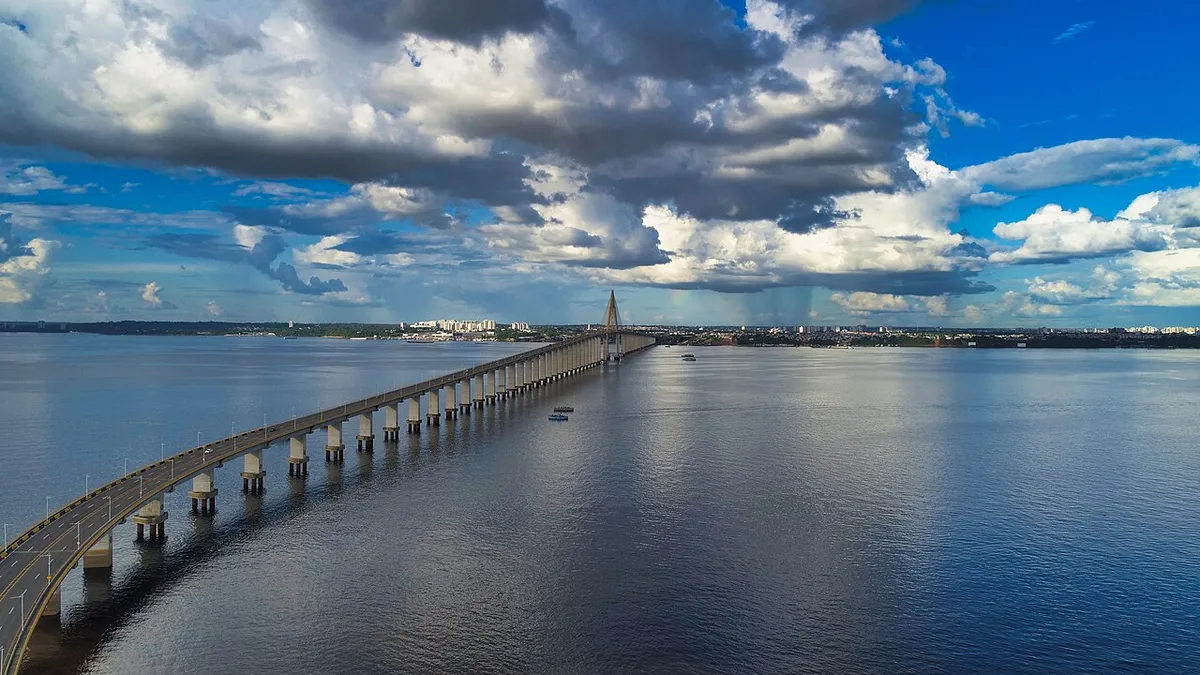
On the way back, cross the 3,595-meter Rio Negro Bridge to Iranduba, just to see the city and the river from outside: a half-hour round trip by car.
End on the Ponta Negra boardwalk at sunset; between September and January the sandy beach is there, and the rest of the year it disappears under the water.
Day 3 · Forest inside the city
Arrive at MUSA, in the Adolpho Ducke Reserve, right when it opens, and climb the 42 m metal tower above the canopy on foot before 10am, while the heat hasn't picked up yet and the toucans are still in the treetops.
Cross the city by taxi or ride-hailing app to the Bosque da Ciência do INPA, open in the morning, and arrive before 12pm to see manatees and giant otters in research tanks and squirrel monkeys roaming free.
Have x-caboquinho or savory açaí with cassava flour and fried fish for lunch at a neighborhood snack bar, off the Centro circuit.
Take the boat from Marina do Davi to the Vila Paraíso Rubber Plantation Museum, 30 to 40 minutes, and walk through the main house and the supply shed.
Close out the night in Vieiralves or on the Ponta Negra waterfront, where most of the bars and restaurants stay open late.




If you stay longer
Day 4 · Presidente Figueiredo
Day trip
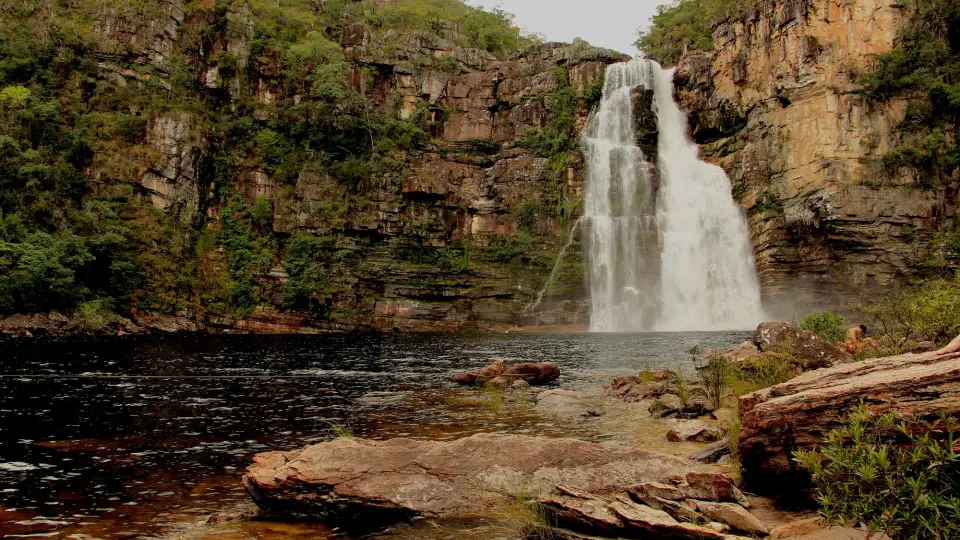
107 km north on the BR-174, 1 hour 30 minutes to 2 hours by car. A sandstone municipality with more than a hundred catalogued waterfalls and caves. The most visited are Cachoeira de Iracema, Cachoeira das Orquídeas, and Gruta da Judeia. Go in the dry season, from July to November, when the water is clear and the trails are passable.
Food
 AI illustration
Tacacá
A hot broth of tucupi, the fermented yellow liquid of bitter cassava, with tapioca starch, dried shrimp, and jambu, the herb that numbs the mouth. It's served in a gourd at sidewalk carts and costs R$15–25.
 AI illustration
X-caboquinho
A French-bread roll with tucumã, coalho cheese and sometimes fried plantain. It's the city's standard breakfast, R$12–20 at any neighborhood snack bar; tucumã is a palm fruit, fibrous and oily, with a flavor that divides opinion.
 AI illustration
Tambaqui
This scaled fish feeds on fruit in the floodplain, and that is why its flesh is fatty. It's grilled over coals, served as ribs, or in a stew; grilled tambaqui ribs are the manauara Sunday lunch. Ask for cassava flour and murupi pepper on the side.
 AI illustration
Pirarucu
One of the world's largest freshwater fish, now caught under community management with an annual quota set by agreement between communities and environmental agencies. It appears salted and shredded in pirarucu de casaca (layers of fish, fried banana, and toasted cassava flour) or fried in steaks.
 AI illustration
Fried jaraqui
A small, bony fish, fried whole and eaten by hand, with cassava flour and pepper. It's the city's cheapest and most-eaten fish; the good season runs roughly from November to March, when the shoals come downriver.
 AI illustration
Amazonas-style açaí
Here it's savory and thick, no syrup or granola: it's eaten in a bowl with cassava flour on top and fried fish on the side, at lunch or dinner. The sweet, chilled version is considered a Southeast Brazil invention.
 AI illustration
Regional fruits and juices
Cupuaçu, taperebá, soursop, buriti, bacaba, araçá-boi, camu-camu, and boiled pupunha at breakfast. A juice bar serves ten to twenty flavors and a glass costs R$8–15; ask for it without sugar if you want to taste the fruit.
 AI illustration
Maués guaraná and Baré soda
The guaraná comes from Maués, 270 km downriver, sold as a hard stick grated on a dried pirarucu tongue and dissolved in water: a traditional stimulant of the Sateré-Mawé. Baré, a soda created in Manaus in the early 20th century, is the bottled version and the city's standard soft drink.
Day trips

Presidente Figueiredo
107 km north on the BR-174, 1 hour 30 minutes to 2 hours by car. A sandstone municipality with more than a hundred catalogued waterfalls and caves. The most visited are Cachoeira de Iracema, Cachoeira das Orquídeas, and Gruta da Judeia. Go in the dry season, from July to November, when the water is clear and the trails are passable.

Novo Airão and Anavilhanas
180 km over the bridge and along highways AM-070 and AM-352, 2 hours 30 minutes to 3 hours by car. Gateway to Anavilhanas National Park, a river archipelago with about 400 islands on the Rio Negro. Pink river dolphins appear at the floating dock on the waterfront; don't pay to touch or feed the animals.
Careiro da Várzea and Lake Janauari
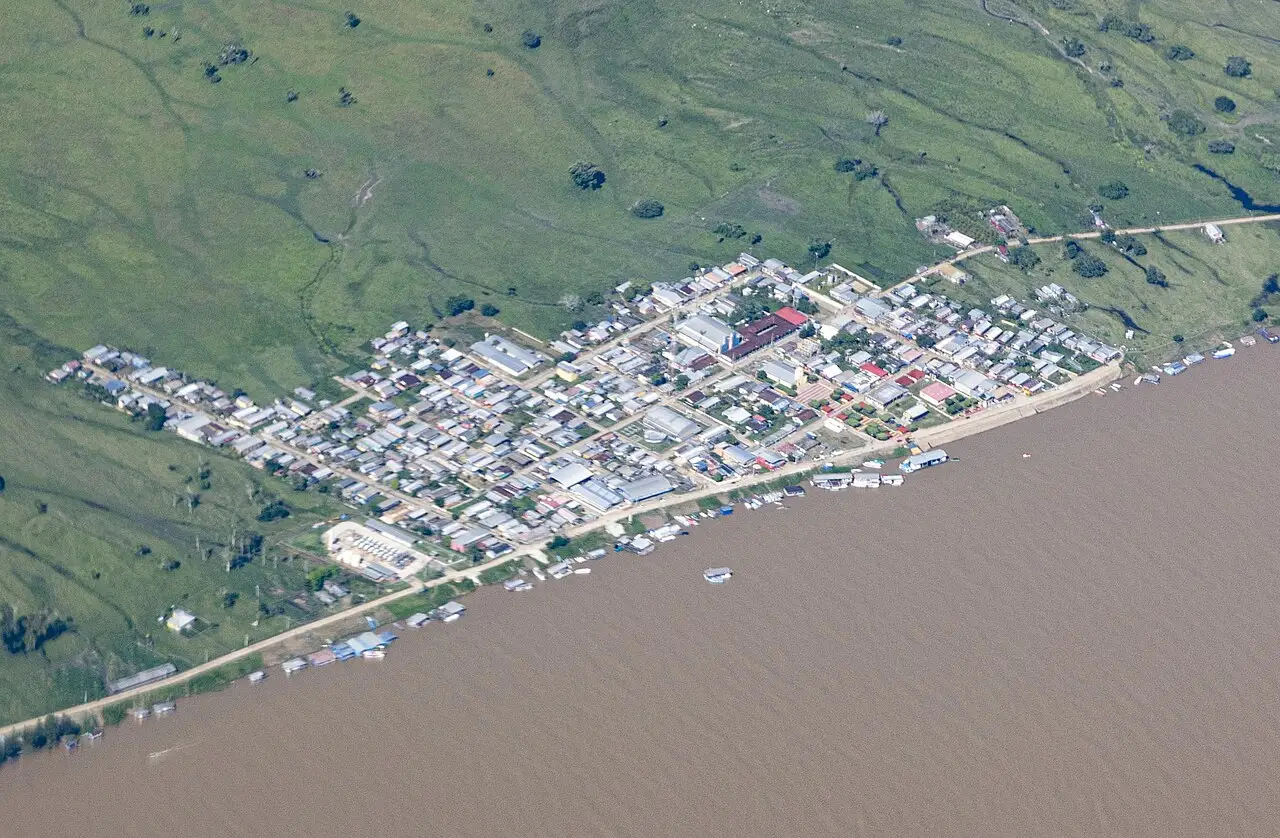
20 to 60 minutes by boat from the Ceasa port or Manaus Moderna. Combines the Meeting of the Waters, the giant-water-lily streams of Janauari Ecological Park, and lunch at a floating restaurant. Half a day is enough; bring repellent, a hat, and cash.
Where to begin
The downtown built with rubber money
Start at 8am at the Adolpho Lisboa Municipal Market; look for jaraqui, tambaqui, and salted pirarucu at the back stalls and the herbs and oils along the sides.
The Meeting of the Waters and the Janauari creeks
Leave at 7am from the Ceasa port or Marina do Davi toward the Meeting of the Waters; the double band stretches about 6 km and is sharpest with morning sun.
Forest inside the city
Arrive at MUSA, in the Adolpho Ducke Reserve, right when it opens, and climb the 42 m metal tower above the canopy on foot before 10am, while the heat hasn't picked up yet and the toucans are still in the treetops.
Money
The currency is the Brazilian real (R$); in 2026 the exchange rate hovers around R$5.4–5.8 to the dollar and R$6.2–6.6 to the euro, approximate figures. Everything costs more here than in the rest of northern Brazil for a simple reason: almost everything arrives by barge or by plane. A cafezinho costs R$3–6, an x-caboquinho R$12–20, tacacá R$15–25, a set lunch R$25–40, a pay-by-weight restaurant R$60–90 per kilo, a fish dinner for two with drinks R$140–260 and a 600 ml beer in a bar R$12–18. A simple hotel downtown runs R$150–250 a night, a three-star in the Zona Centro-Sul R$250–450, and a jungle lodge with full board and excursions R$700–1,800 per person per day. A full-day tour to the Meeting of the Waters with Janauari costs R$200–350 per person in a group, and a private boat runs R$250–600 depending on size and length: all approximate 2026 prices. Pix is accepted almost everywhere, even at market stalls; cards work in restaurants and shops, but bring cash for boatmen, buses and markets. The tip is the 10% service charge already printed on the bill, and it isn't mandatory. One cost that shows up before the trip is the visa: Brazilians and most Europeans and South Americans don't need one, but since April 2025 citizens of the United States, Canada and Australia need an e-visa, paid for and obtained before boarding.
Getting there and around
Airport, taxis, buses and passenger riverboats
Eduardo Gomes International Airport (MAO) is about 14 km from downtown along Av. Torquato Tapajós, and it's also the main air cargo terminal in northern Brazil, handling much of what the Free Trade Zone makes and imports. A fixed-rate taxi to downtown costs around R$75–100 and takes 25 to 40 minutes outside rush hour, while Uber and 99 usually run R$45–75. By bus, line 306 (Aeroporto–Centro) charges the regular fare and takes 50 to 70 minutes. The other way in is by water: from the Estação Hidroviária, next to the Floating Port, passenger riverboats leave for Parintins (about 18 hours), Santarém (about 36 hours), Tefé, Tabatinga (about 7 days upstream) and Belém (about 4 days downstream). For these trips, bring a hammock, rope, a padlock and water.
No subway, no train: six bus terminals
Manaus has no subway and no train. The system runs on buses, operated by the Sinetram consortium, with six transfer terminals (T1 to T6) and the Passa Fácil card sold at the terminals; in 2026 the fare is R$5.00 full and R$2.50 reduced, with free transfers between lines inside the terminal. Ride-hailing apps are cheap and the practical way to get around: a ride within the Zona Centro-Sul costs R$12–25. The historic center is walkable, but the rest of the city isn't, because distances are long, sidewalks are uneven and the heat bears down on every block. Apart from the Ponta Negra waterfront and stretches of Av. Constantino Nery, there's no bike lane worth using. Only two roads lead out overland: the BR-174, paved to Boa Vista (785 km), which crosses the Waimiri-Atroari Indigenous Territory with a gate closed from 6pm to 6am, and the BR-319 to Porto Velho, with a long unpaved stretch that's often impassable in the rain.
Safety
Manaus has a homicide rate above the Brazilian average, but lethal violence concentrates in outlying neighborhoods and disputes between groups, far from the visited circuit. The real risk for visitors is different and mundane: phone theft and pickpocketing, by day, on Av. Eduardo Ribeiro, around the Municipal Market, and at Centro bus stops. Keep your phone put away and don't use headphones and a map in your hand at the same time: locals commonly warn people who do to put the phone away. Centro empties out after 6pm, when the shops close. From then on, get around by ride-hailing car instead of on foot, and leave the port area, Manaus Moderna, and Panair for daytime. Educandos, Compensa, São José, and Jorge Teixeira aren't areas to walk without someone who knows them. The Ponta Negra waterfront and the streets of Vieiralves have foot traffic and policing late into the night. The most common scams involve fake guides who approach at the port and the airport selling tours without a registered company, and a price agreed per boat that turns into per person when it's time to pay. On health, get the yellow fever vaccine at least 10 days before the trip. Dengue circulates year-round, malaria is rare in the urban area and more present in riverine communities, and dehydration and heatstroke are the problems that hit visitors most.
Etiquette tips
Rio Negro in front of the city; the Amazon starts 11 km downstream
The Amazon River only starts past its meeting with the Solimões, 11 km below Centro. Calling everything the Amazon River is the quickest way to mark yourself as a newcomer.
Tacacá is drunk standing up, from the gourd, without a spoon
Tacacá is drunk from the gourd itself: blow on it, drink the broth from the rim while holding the gourd by the sides, because the bottom is hot, and eat the shrimp and jambu at the end, with a toothpick or your hand. The jambu numbs your mouth for a few minutes, and that's the expected effect. The gourd isn't yours to keep: it goes back to the vendor, who washes and refills it.
Cassava flour on top of the plate: fish, açaí and beans
Cassava flour goes on top of fish, açaí, beans and even broth. You can order a dish without farinha, but it sounds odd; the kind from Uarini, crunchy and granular, is the most prized and the most expensive.
Say the people's name, not indio or native
Vocabulary matters: refer to people by the name of their people, such as Sateré-Mawé or Tikuna, and not as “índio.” In the Parque das Tribos, an Indigenous neighborhood in Tarumã-Açu, and in any community, ask permission before photographing people, homes or rituals.
Don't buy crafts made of wild-animal teeth, feathers, or hide
It's a crime under Law 9,605/1998, and the material can be seized at the airport. Buy arumã basketry, pottery, tucum-fiber hammocks, oils, and guaraná sticks, which are legal and locally made.
Bring a sweater for the artificial cold
Executive city buses, malls, movie theaters and restaurants in the Centro keep the thermostat near 18°C. The city manufactures these units in the Industrial District and uses them as a permanent showroom.
Mistakes to avoid
The forest doesn't start at the end of the avenue
Thinking the forest starts at the end of the avenue. From Manaus you can't see dense forest, except in the Ducke Reserve, and the jungle lodges are 2–4 hours away by boat or road. Half-day tours show floodplain, igarapés and giant water lilies, but not dense forest, so set aside at least one night out of town if the forest is what you came to see.
Counting on a road to get in or out
Counting on a road to get in or out, because on the map the two highways seem to do the job. In practice, the BR-319 turns to mud in the rain and the BR-174 has a gate that closes at night in Waimiri-Atroari territory, so plan to arrive and leave by plane or by boat.
Ten meters between high and low water
Planning without checking the river level. Between the June–July high water and the September–November low water, the difference is more than 10 meters: at high water you boat inside the igapó, and in the dry season beaches appear, the boat docks far away, and some tours simply don't run. Ask the agency about the river level in the week of your trip before you lock in your itinerary.
Booking a tour with whoever approaches you at the port
Booking a tour with whoever approaches you at the port or the airport without checking their registration. Hire a company registered with Amazonastur, confirm life jackets for everyone aboard, and agree in writing whether the price is per boat or per person. Switching between the two is the most common scam.
Underestimating the sun, the humidity and thirst
Going out without protection against sun, humidity and dehydration. At 3° south of the equator and with humidity above 80%, a hat, sunscreen, repellent with icaridin and two liters of water per person are the day's basics. Light-colored long sleeves are cooler than they look and also protect you from sun and mosquitoes.
Useful phrases
Maninho / maninha
Little brother, little sister. It's the standard form of address on the street, used with waiters, drivers, vendors, and strangers of any age.
Égua!
An interjection of surprise, approval, or exhaustion, depending on tone. It has no fixed translation, isn't a curse word, and shows up in nearly every conversation.
Curumim / cunhantã
Boy and girl, from Tupi, used in everyday speech, not as folklore. Much of Manaus's everyday vocabulary comes from Nheengatu.
Xibé
Cassava flour with cold water, eaten with a spoon. It's home food, farm food, and boat-trip food, not a restaurant dish.
Baré
An indigenous people of the Rio Negro and, by extension, a nickname for anyone born in Manaus. Also the brand of the local guaraná soda.
Tu vai?
The everyday pronoun is tu, almost always with the verb in the third person. Using você all the time sounds formal or marks you as an outsider.
Districts
Centro
The core built by rubber, between the Floating Port and Largo de São Sebastião: the theater, the iron market, Customs House, Rio Negro Palace, and a dense popular trade in electronics and imports inherited from the Free Trade Zone. It runs from 8am to 6pm and empties out once the shops close.
Praça 14 de Janeiro and Aparecida
Low-lying neighborhoods next to Centro, historically tied to the city's Black population and old terreiros; Praça 14 is one of the oldest addresses in Manaus's Afro-Amazonian culture. Residential, with sidewalk bars and neighborhood party houses.
Cachoeirinha
A working-class and wholesale-trade district just north of Centro, with whole streets of auto-parts and hardware shops and Terminal 2, the transit hub. It's where you catch a bus to nearly anywhere in the city.
Adrianópolis and Nossa Senhora das Graças
A vertical, upper-income south-central zone, with offices, consulates, and malls. The streets of Vieiralves, in Nossa Senhora das Graças, hold most of the city's restaurants and bars. It's where you go for dinner.
Ponta Negra and Tarumã
The western tip on the Rio Negro, with the redone waterfront, the amphitheater, and the bigger hotels. Outside low-water season, the waterfront turns into an evening walk.
Educandos and São Raimundo
The southern slope, across the Educandos stream, with stilt houses, boatyards, and the Panair market. It shows the riverine Manaus inside the city; visit by day and preferably with someone who knows the area.
Cidade Nova and North Zone
Housing complexes opened from the 1980s on for workers at the industrial hub, and today the municipality's biggest population cluster. Off the tourist circuit, but this is where Manaus actually lives and eats.
Industrial District
A planned area to the south, created with the Free Trade Zone in 1967: about 500 factories making electronics, motorcycles, air conditioners, and drink concentrates. Not a sightseeing destination, but it explains the city's economy and the traffic jams at 6am and 5pm.
History
before 1600 · Manaó, Baré, and Tarumã
The lower Rio Negro was home to Arawak- and Tupi-speaking peoples who traded tucum-fiber hammocks, grated guaraná and pottery along hundreds of kilometers of river. The city's name comes from the Manaó, who resisted enslavement and were scattered in the 18th century.
1669 · Fort of São José do Rio Negro
Francisco da Mota Falcão builds a small mud-and-timber fort at the mouth of a stream to block the Dutch and Spanish from moving up the Rio Negro. The settlement that grows around it becomes known as Lugar da Barra.
1755–1791 · Captaincy of São José do Rio Negro
The Portuguese crown creates the captaincy in 1755, seated at Mariuá, today's Barcelos, and moves the seat to Barra do Rio Negro in 1791. Carmelite missions and the Indian Directorate forcibly reorganize the villages into Portuguese-speaking towns.
1832–1856 · From town to capital with a new name
Raised to town status in 1832 and to city on October 24, 1848, the date of the municipal anniversary. The Province of Amazonas is created by law in 1850 and installed in 1852; in 1856 the city is renamed Manáos.
1866 · River opened to foreign shipping
The decree of December 7, 1866, in effect from September 1867, opens the Amazon to ships of any flag. Manaus stops being a military post and becomes the commercial gateway to an entire river basin.
1879–1912 · Rubber boom
World demand for Hevea brasiliensis latex transforms the city: electric light in 1896, electric trams in 1899, piped water, the Amazonas Theatre in 1896, a floating port in 1903, and the Customs House in 1906. The wealth is concentrated in a handful of export houses and rests on the forced debt of the rubber tappers.

1912–1920 · The collapse
Plantations in Southeast Asia, grown from the 70,000 seeds Henry Wickham took out in 1876, drive down the price of latex starting in 1910. Within a few years the province's revenue evaporates, trading houses close, and the city's population shrinks.
1942–1945 · Battle for Rubber
With Asia occupied by Japan, the Washington Accords make Brazil send tens of thousands of northeasterners to the rubber plantations, the so-called rubber soldiers (estimates of 30 to 60 thousand). The boom is short and ends with the end of the war.
1957–1967 · Manaus Free Trade Zone
Law 3,173 of 1957 creates a free port, and Decree-Law 288, of February 28, 1967, turns it into the Free Trade Zone, with tax exemptions and Suframa to administer it. The Industrial District begins operating in the early 1970s.
1970–2000 · Population boom
The city jumps from about 312,000 residents in 1970 to 1.4 million in 2000, driven by factory jobs and migration from the interior. Stilt-house settlements along the streams become the main urban problem, tackled from 2005 on by the Prosamim program.
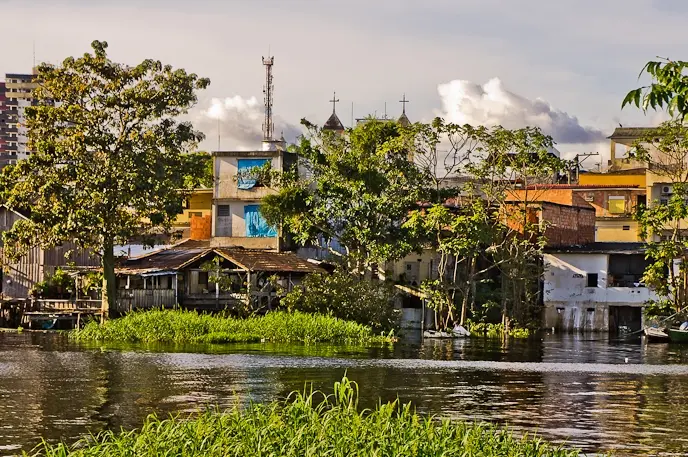
2011–2026 · The 2011 bridge, the 2014 arena and the river's record droughts
The 3,595-meter Rio Negro Bridge opens on October 24, 2011, and the Amazonia Arena in 2014, for the World Cup. The Free Trade Zone incentives were extended to 2073, and the river hit its record flood in 2021 (30.02 m) and its record drought in October 2024 (12.11 m).
Complete history
The 1669 fort and the Lugar da Barra
Manaus exists because of a border dispute. In 1669 the Portuguese built a small mud fort at the mouth of a Rio Negro stream to stop the Dutch and Spanish from moving up the basin, and the settlement that grew around it, Lugar da Barra, spent the 18th century as an outpost for Carmelite missions, wild cacao and cinnamon gathering, and the capture of indigenous labor. Creating the Captaincy of São José do Rio Negro in 1755 and moving its seat to Barra in 1791 gave the city the administrative role it never lost. In 1848 it became a city, and in 1852 the capital of the new Province of Amazonas, still with fewer than 10,000 people and a subsistence economy.
The rubber boom, from 1879 to 1912
Vulcanization, patented in 1844, and later the tire and the auto industry, created a world demand for latex that only the Amazon could meet. Between 1879 and 1912, Manaus was the financial hub of that trade: foreign export houses, English, German, and Portuguese banks, and a city equipped ahead of much of Brazil: electric power in 1896, electric streetcars in 1899, telephone, piped water, and an English floating dock from 1903 that rose and fell with the river. The Amazonas Theatre, opened on December 31, 1896, with material brought from Carrara, Alsace, and Scotland, is the monument to that logic: import everything, including the repertoire. The social base was the opposite: on the rubber estate, the tapper received goods on credit at the boss's price and worked to pay off a debt that never ended.
The rubber collapse, 1910 to 1945
The collapse came soon after the boom. Henry Wickham took about 70,000 rubber-tree seeds to Kew Gardens in 1876; the seedlings went to Ceylon and Malaya, and by around 1910 orderly, productive Asian plantations were delivering latex cheaper than what could be gathered scattered through the forest. Within less than a decade the province's revenue collapsed, trading houses closed, construction stopped, and the theater went decades with almost no season. An attempt at revival came during the Second World War, with the 1942 Washington Accords and the sending of tens of thousands of northeasterners to the rubber camps, but the price fell again in 1945 and Manaus began shrinking once more.
The Manaus Free Trade Zone, created in 1967
Law 3,173 of 1957 created a free port, and Decree-Law 288 of February 28, 1967, set up the Manaus Free Trade Zone, exempt from import duty and from IPI (the federal tax on manufactured goods) and run by Suframa. The Industrial District opened in the 1970s and began assembling TVs, motorcycles, air conditioners and cell phones; today it brings together about 500 companies and close to 100,000 direct jobs. The demographic effect was violent: 312,000 people in 1970, 1 million in 1991 and 2.06 million in the 2022 Census. Newcomers settled the banks of the igarapés in stilt houses, and removing them became public policy with the Prosamim program, from 2005 on.
An industrial metropolis in the middle of the forest
Today Manaus lives with a practical contradiction: it's an industrial metropolis in the middle of a forest that it sells as scenery but doesn't directly live from. The Free Trade Zone incentives have been extended to 2073, which brings predictability and at the same time keeps the economy dependent on a rule made in Brasília. The city gained a 3,595 m bridge over the Rio Negro in 2011 and a 44,000-seat stadium in 2014, both bigger than daily use justifies. The river, meanwhile, started breaking records in both directions, with a flood crest of 30.02 m in June 2021 and a low of 12.11 m in October 2024, which cut off communities, halted river transport and came with wildfire smoke over the city in September and October.
The Free Trade Zone, created in 1967, brought Manaus an industrial park that still employs around 100,000 people.
Geography and shape of the city
Ridges, streams, and floodable valleys
Manaus sits just over 3° south of the Equator, between 30 and 100 meters above sea level, on a plateau of ancient sediments on the left bank of the Rio Negro. Dozens of streams cut through it on their way down to the river, so the terrain is a sequence of ridges and floodable valleys, and many of the city's bridges cross water, not dry ground.
The radial avenues, the river, and the floating dock
The historic center clings to the bank next to the port, and from there the street grid opens into radial avenues (Eduardo Ribeiro, Constantino Nery, Djalma Batista, Torquato Tapajós, Grande Circular) that pushed the city north and east through the 20th century and left the river behind; today most of the population lives away from the water and rarely sees it. In front of the city the Rio Negro is about 3 km wide and varies more than 10 m between high and low water, which explains the 1903 floating dock and the beaches that come and go.
Ducke Reserve, the industrial district, and the bridge
To the northeast, the Adolpho Ducke Forest Reserve holds 10,000 hectares of primary forest inside the city limits, one of the largest urban patches of forest in the world; to the south and east are the Industrial District and the residential neighborhoods that grew up around it. Since 2011 the Rio Negro Bridge has linked the city to Iranduba and opened the right bank of the river to settlement, but by land Manaus is still practically cut off from the rest of the country.
Many of Manaus's bridges pass over igarapés, the streams that flow down to the Rio Negro.
Culture
Boi-bumbá as toada
The music of Manaus is boi-bumbá in the form of toada: heavy percussion, a collective refrain and the storyline of a folk pageant, born from the boi festivities and turned into an arena spectacle by the Parintins Festival from the 1980s on. In the capital it dominates the city's anniversary on October 24, when Boi Manaus takes over the avenues for several days, and it returns at Carnaboi, a carnival played with toada instead of marchinha. Alongside it you'll hear melody, the Amazonas take on electronic brega that blasts from sound trucks and North Zone block parties, and the memory of Carrapicho lives on: their Tic Tic Tac sold millions of copies in Europe in 1996 without leaving much money in the city.
Literature and opera: Hatoum, Márcio Souza and the Amazonas Festival
Milton Hatoum, born in Manaus in 1952, is the writer who best described the city: Tale of a Certain Orient (1989) and The Brothers (2000) tell the story of the Manaus of Lebanese immigrants, the port and the river, and The Brothers became a TV miniseries in 2017. Márcio Souza, also from Manaus, wrote the satire of the rubber cycle in Galvez, Emperor of Acre (1976), and the poet Thiago de Mello, from Barreirinha, is read all over Brazil for the Statutes of Man (1964). At the Amazonas Theatre, the Amazonas Philharmonic Orchestra keeps a regular season, and the Amazonas Opera Festival has been held since 1997, which explains why you can see Verdi and Wagner productions more than 1,400 km from the ocean.
Indigenous peoples, encantados and soccer
Manaus has one of the largest urban indigenous populations in Brazil (Sateré-Mawé, Tikuna, Baré, Mura, Kokama, and others) and Parque das Tribos, in Tarumã-Açu, was recognized in 2018 as an indigenous neighborhood, with its own school, associations, and craft production. Religious life combines popular Catholicism, fast-growing evangelical churches in the North Zone neighborhoods, and umbanda terreiros with Amazonian spirits, the encantados, tied to the folklore of the pink river dolphin and the great snake. In soccer, Nacional (1913) and Fast Clube (1930) split the old fan base with Manaus FC, and the Amazonia Arena, opened in 2014 for the World Cup with about 44,000 seats, is too big for local demand.
Festivals and events
 AI illustration
Boi Manaus: October 24
The city's anniversary, celebrated with boi-bumbá toada shows at several spots, traditionally on Av. Constantino Nery and in Centro, over three to five days. It's Manaus's biggest street festival, free to attend, and the whole city wears a boi shirt.

Parintins Festival: last three days of June
It doesn't happen in Manaus, but it stops the city cold: Garantido and Caprichoso face off at the Bumbódromo in Parintins, 420 km downriver, in front of about 35,000 people a night. Boat and flight tickets and lodging sell out months in advance.
 AI illustration
Amazonas Folklore Festival: June
A month of performances by boi-bumbá groups, cirandas, pastorinhas, quadrilha dance troupes, and folk groups in the capital, with its traditional home at the Amazon Peoples Cultural Center, near the Suframa roundabout. Cheap or free admission, local crowd.
 AI illustration
Amazonas Opera Festival: April and May
An opera season at the Amazonas Theatre since 1997, with the Amazonas Philharmonic Orchestra, its own chorus, and guest soloists. The program usually comes out in the first quarter, and the low-priced tickets sell out fast.
 AI illustration
Carnival and Carnaboi: February or March
Samba-school parades at the Manaus Sambadrome, and alongside them, Carnaboi, street parties and shows where the soundtrack is boi toada instead of marchinha. The Sambadrome also hosts big concerts outside of carnival season.
Books and films
The Brothers, Milton Hatoum (2000)
A novel about a Lebanese family in Manaus between the 1910s and 1960s, written by an author born in the city. It explains what rubber built, what was left afterward, and how the port, the river, and immigration merged to shape the city.
Galvez, Emperor of Acre, Márcio Souza (1976)
A satire of the rubber economy and the region's political adventures at the end of the 19th century, by another manauara writer. It gives the measure of the easy-money, improvised logic that put up the Amazonas Theatre in the middle of the forest.
Fitzcarraldo, Werner Herzog (1982)
A film about a European obsessed with building an opera house in the Amazon, shot in Peru but born from Manaus's history. It's the fastest way to understand why there's an Italian-style theater more than 1,400 km from the ocean.
Frequently asked questions
Manaus: Where can you see the forest from the city?
From Manaus you can't see dense forest, except in the Ducke Reserve, and the jungle lodges are 2 to 4 hours away by boat or road.
Manaus: Where is the airport?
Eduardo Gomes International Airport (MAO) is about 14 km from downtown along Av. Torquato Tapajós, and it's also the main air cargo terminal in northern Brazil, handling much of what the Free Trade Zone makes and imports.
Manaus: What's the currency, and what's the real worth?
The currency is the Brazilian real (R$); in 2026 the exchange rate hovers around R$5.4 to 5.8 to the dollar and R$6.2 to 6.6 to the euro, approximate figures.
Manaus: Where does the Amazon River begin?
The Amazon River, under that name, only starts past where the Rio Negro meets the Solimões at the Meeting of the Waters, 11 km below Centro.
Manaus: What's the real risk for visitors?
Manaus has a homicide rate above the Brazilian average, but lethal violence concentrates in outlying neighborhoods and disputes between groups, far from the visited circuit.
Other cities in the country
Brazil ↗- Days
- 4
- When
- Apr–Jun
- Per person/day
- Average 615 BRLMid-range · per person/day
Cost scope
Per person per day: accommodation, meals, urban transport, visits and a small allowance for extras. Flights excluded; larger purchases vary. Editorial estimate, not a quote.
- Days
- 2–3
- When
- Apr–May · Sep
- Per person/day
- Average 400–700 BRLMid-range · per person/day
Cost scope
Per person per day: accommodation, meals, urban transport, visits and a small allowance for extras. Flights excluded; larger purchases vary. Editorial estimate, not a quote.
- Days
- 2–3
- When
- Jan–Mar · Sep–Dec
- Per person/day
- Average 350–550 BRLMid-range · per person/day
Cost scope
Per person per day: accommodation, meals, urban transport, visits and a small allowance for extras. Flights excluded; larger purchases vary. Editorial estimate, not a quote.
- Days
- 1–2
- When
- May–Sep
- Per person/day
- Average 260–520 BRLMid-range · per person/day
Cost scope
Per person per day: accommodation, meals, urban transport, visits and a small allowance for extras. Flights excluded; larger purchases vary. Editorial estimate, not a quote.
- Days
- 2–3
- When
- Apr–Jun
- Per person/day
- Average 350–550 BRLMid-range · per person/day
Cost scope
Per person per day: accommodation, meals, urban transport, visits and a small allowance for extras. Flights excluded; larger purchases vary. Editorial estimate, not a quote.
- Days
- 3–5
- When
- Mar–Apr · Nov
- Per person/day
- Average 397 BRLMid-range · per person/day
Cost scope
Per person per day: accommodation, meals, urban transport, visits and a small allowance for extras. Flights excluded; larger purchases vary. Editorial estimate, not a quote.
- Days
- 2–4
- When
- Mar–May · Sep
- Per person/day
- Explore costsGuide estimate
Cost scope
Per person per day: accommodation, meals, urban transport, visits and a small allowance for extras. Flights excluded; larger purchases vary. Editorial estimate, not a quote.
- Days
- 4–5
- When
- Aug–Nov
- Per person/day
- Explore costsGuide estimate
Cost scope
Per person per day: accommodation, meals, urban transport, visits and a small allowance for extras. Flights excluded; larger purchases vary. Editorial estimate, not a quote.
- Days
- 3–4
- When
- Jul–Sep
- Per person/day
- Explore costsGuide estimate
Cost scope
Per person per day: accommodation, meals, urban transport, visits and a small allowance for extras. Flights excluded; larger purchases vary. Editorial estimate, not a quote.
- Days
- 3–4
- When
- Sep–Nov
- Per person/day
- Explore costsGuide estimate
Cost scope
Per person per day: accommodation, meals, urban transport, visits and a small allowance for extras. Flights excluded; larger purchases vary. Editorial estimate, not a quote.
- Days
- 2–4
- When
- May–Sep
- Per person/day
- Explore costsGuide estimate
Cost scope
Per person per day: accommodation, meals, urban transport, visits and a small allowance for extras. Flights excluded; larger purchases vary. Editorial estimate, not a quote.
- Days
- 3–5
- When
- Jun–Sep
- Per person/day
- Explore costsGuide estimate
Cost scope
Per person per day: accommodation, meals, urban transport, visits and a small allowance for extras. Flights excluded; larger purchases vary. Editorial estimate, not a quote.
- Days
- 3–4
- When
- Jun–Aug
- Per person/day
- Explore costsGuide estimate
Cost scope
Per person per day: accommodation, meals, urban transport, visits and a small allowance for extras. Flights excluded; larger purchases vary. Editorial estimate, not a quote.
- Days
- 4–5
- When
- Jan–Mar · Sep–Dec
- Per person/day
- Explore costsGuide estimate
Cost scope
Per person per day: accommodation, meals, urban transport, visits and a small allowance for extras. Flights excluded; larger purchases vary. Editorial estimate, not a quote.
- Days
- 3–4
- When
- Oct–Dec
- Per person/day
- Average 1,110 BRLMid-range · per person/day
Cost scope
Per person per day: accommodation, meals, urban transport, visits and a small allowance for extras. Flights excluded; larger purchases vary. Editorial estimate, not a quote.
- Days
- 3–4
- When
- Aug–Sep
- Per person/day
- Explore costsGuide estimate
Cost scope
Per person per day: accommodation, meals, urban transport, visits and a small allowance for extras. Flights excluded; larger purchases vary. Editorial estimate, not a quote.
- Days
- 4–7
- When
- Apr–Sep
- Per person/day
- Explore costsGuide estimate
Cost scope
Per person per day: accommodation, meals, urban transport, visits and a small allowance for extras. Flights excluded; larger purchases vary. Editorial estimate, not a quote.
- Days
- 3–4
- When
- Jan · Sep–Dec
- Per person/day
- Explore costsGuide estimate
Cost scope
Per person per day: accommodation, meals, urban transport, visits and a small allowance for extras. Flights excluded; larger purchases vary. Editorial estimate, not a quote.
- Days
- 2
- When
- Aug–Dec
- Per person/day
- Average 442 BRLMid-range · per person/day
Cost scope
Per person per day: accommodation, meals, urban transport, visits and a small allowance for extras. Flights excluded; larger purchases vary. Editorial estimate, not a quote.
- Days
- 3–5
- When
- Jan–Feb · Sep–Dec
- Per person/day
- Explore costsGuide estimate
Cost scope
Per person per day: accommodation, meals, urban transport, visits and a small allowance for extras. Flights excluded; larger purchases vary. Editorial estimate, not a quote.
- Days
- 3–5
- When
- May–Sep
- Per person/day
- Explore costsGuide estimate
Cost scope
Per person per day: accommodation, meals, urban transport, visits and a small allowance for extras. Flights excluded; larger purchases vary. Editorial estimate, not a quote.
- Days
- 2–3
- When
- Apr–Sep
- Per person/day
- Average 484 BRLMid-range · per person/day
Cost scope
Per person per day: accommodation, meals, urban transport, visits and a small allowance for extras. Flights excluded; larger purchases vary. Editorial estimate, not a quote.
- Days
- 3
- When
- Apr–May · Aug
- Per person/day
- Average 478 BRLMid-range · per person/day
Cost scope
Per person per day: accommodation, meals, urban transport, visits and a small allowance for extras. Flights excluded; larger purchases vary. Editorial estimate, not a quote.
- Days
- 3–4
- When
- Aug–Dec
- Per person/day
- Explore costsGuide estimate
Cost scope
Per person per day: accommodation, meals, urban transport, visits and a small allowance for extras. Flights excluded; larger purchases vary. Editorial estimate, not a quote.
- Days
- 2
- When
- Apr–May · Sep
- Per person/day
- Explore costsGuide estimate
Cost scope
Per person per day: accommodation, meals, urban transport, visits and a small allowance for extras. Flights excluded; larger purchases vary. Editorial estimate, not a quote.
- Days
- 3
- When
- Sep–Dec
- Per person/day
- Explore costsGuide estimate
Cost scope
Per person per day: accommodation, meals, urban transport, visits and a small allowance for extras. Flights excluded; larger purchases vary. Editorial estimate, not a quote.
- Days
- 3–5
- When
- Apr–Nov
- Per person/day
- Average 427 BRLMid-range · per person/day
Cost scope
Per person per day: accommodation, meals, urban transport, visits and a small allowance for extras. Flights excluded; larger purchases vary. Editorial estimate, not a quote.
- Days
- 4
- When
- Jul–Sep
- Per person/day
- Explore costsGuide estimate
Cost scope
Per person per day: accommodation, meals, urban transport, visits and a small allowance for extras. Flights excluded; larger purchases vary. Editorial estimate, not a quote.
- Days
- 4–5
- When
- May–Sep
- Per person/day
- Explore costsGuide estimate
Cost scope
Per person per day: accommodation, meals, urban transport, visits and a small allowance for extras. Flights excluded; larger purchases vary. Editorial estimate, not a quote.
- Days
- 3
- When
- May–Sep
- Per person/day
- Explore costsGuide estimate
Cost scope
Per person per day: accommodation, meals, urban transport, visits and a small allowance for extras. Flights excluded; larger purchases vary. Editorial estimate, not a quote.