Brazil
Bonito
Clear rivers to float down, the Gruta do Lago Azul, and tours with limited spots and a voucher
Days Start with the basic programme and choose extensions for the time you have.
How the guide reaches this number
The first is for arrival, with the Aquário Natural in the afternoon, 7 km from the center. The second is the Gruta do Lago Azul in the morning and the Abismo Anhumas, if there is a spot, or the Grutas de São Miguel in the afternoon. The third is entirely in Jardim: the Rio da Prata in the morning and the Buraco das Araras in the afternoon. The fourth brings together the Rio Sucuri and the Estância Mimosa waterfalls. With three days I'd cut the fourth, because the Gruta, the Rio da Prata and the Buraco das Araras are the three tours I wouldn't swap; with fewer than three, the road eats the time for the rivers. With more time, I'd continue to the Pantanal de Miranda, about 130 km away, and sleep there at least one night.
3–4
When September to November: outside the rainiest months, December to March, and the July school holidays, which in the city hall's season calendar run until early August, and it is already the period, September to February, when sunlight turns the lake at the Gruta do Lago Azul blue; the rivers can be visited year-round
How the guide reaches this number
Bonito has a tropical climate, averaging 24 °C, and gets 1,500 to 1,700 mm of rain a year, with the rainiest months from December to March; in those months heavy rain can cancel or interrupt a float. The spring water does not change with the season: on the Rio Olho d'Água, which you float down into the Rio da Prata, it stays at 24 °C all year. At the Gruta do Lago Azul, the sun reaches the lake and turns it blue between September and February. Visitor traffic weighs as much as the weather: in the first half of 2026, January was the busiest month (34,159 tourists) and June the quietest (11,971), and the city hall's season calendar marks the school holidays from mid-July to early August and the end of December.
Per person/day Add lodging per night, meals per person and each day's tours, all with a voucher; the daily environmental fee and transport to the attractions change the total a lot.
How the guide reaches this number
Per person per day: accommodation, meals, urban transport, visits and a small allowance for extras. Flights excluded; larger purchases vary. Editorial estimate, not a quote.
 What Nilo thinks
I'd stay four days in Bonito. The first is for arrival, with the Aquário Natural in the afternoon, 7 km from the center. The second is the Gruta do Lago Azul in the morning and the Abismo Anhumas, if there is a spot, or the Grutas de São Miguel in the afternoon. The third is entirely in Jardim: the Rio da Prata in the morning and the Buraco das Araras in the afternoon. The fourth brings together the Rio Sucuri and the Estância Mimosa waterfalls. With three days I'd cut the fourth, because the Gruta, the Rio da Prata and the Buraco das Araras are the three tours I wouldn't swap; with fewer than three, the road eats the time for the rivers. With more time, I'd continue to the Pantanal de Miranda, about 130 km away, and sleep there at least one night.Bonito sits at the foot of the Serra da Bodoquena, a limestone massif full of caves, abysses and springs, scattered across the farms around town: springs you float down from, in mask and snorkel, over 24 °C water; a cave whose lake turns blue when the sun comes in, from September to February; a 72 m abyss with a lake at the bottom; and, in neighboring Jardim, a sinkhole about 100 m deep where red macaws live. Since 1995 the municipality has controlled visits: each attraction has spots counted by the day, every group walks with a guide and nobody enters without a voucher issued by an agency. That is why the trip is put together before leaving home, with the tours locked in and the time of each one set.
Quick facts
- Population
- 25,294 inhabitants in the municipality of Bonito (IBGE, 2026 estimate); 23,659 in the 2022 Census
- Founding
- Captain Luiz da Costa Leite Falcão settled at the Fazenda Rincão Bonito in 1869; the district was created in 1915 and the municipality on October 2, 1948
- Country and region
- Brazil, Center-West; southwestern Mato Grosso do Sul, in the Serra da Bodoquena, about 300 km from Campo Grande
- Language
- Portuguese
- Currency
- Real (BRL, R$)
- Time zone
- UTC−4 year-round (Mato Grosso do Sul time, no daylight saving time)
- Best time to visit
- September to November: outside the rainiest months, December to March, and the July school holidays, which in the city hall's season calendar run until early August, and it is already the period, September to February, when sunlight turns the lake at the Gruta do Lago Azul blue; the rivers can be visited year-round
- Average daily cost
- Add lodging per night, meals per person and each day's tours, all with a voucher; the daily environmental fee and transport to the attractions change the total a lot.
When to go
September to November: outside the rainiest months, December to March, and the July school holidays, which in the city hall's season calendar run until early August, and it is already the period, September to February, when sunlight turns the lake at the Gruta do Lago Azul blue; the rivers can be visited year-round
How the year changes
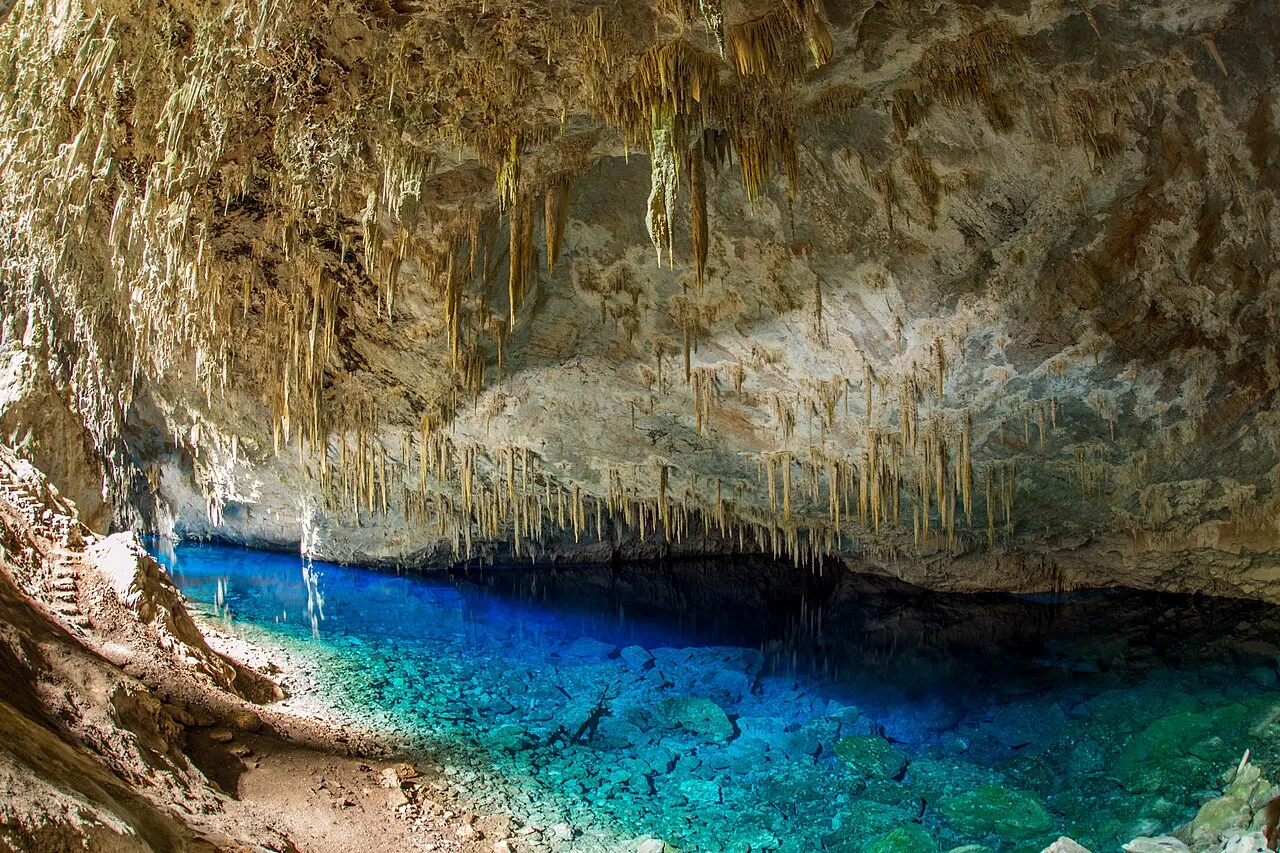
Bonito has a tropical climate, averaging 24 °C, and gets 1,500 to 1,700 mm of rain a year, with the rainiest months from December to March; in those months heavy rain can cancel or interrupt a float. The spring water does not change with the season: on the Rio Olho d'Água, which you float down into the Rio da Prata, it stays at 24 °C all year. At the Gruta do Lago Azul, the sun reaches the lake and turns it blue between September and February. Visitor traffic weighs as much as the weather: in the first half of 2026, January was the busiest month (34,159 tourists) and June the quietest (11,971), and the city hall's season calendar marks the school holidays from mid-July to early August and the end of December.
Nilo's tips
Book the tours before the flight
The Gruta do Lago Azul, the Abismo Anhumas and the Rio da Prata have a daily limit. I'd pick the agency, lock in those three and only then set flight and hotel, especially for January, July and late December.
Put Jardim in a single day
The Rio da Prata, at 45 km, and the Buraco das Araras, at 55 km, are in the same municipality. I'd do the Rio da Prata in the morning, with lunch included, and the Buraco das Araras in the afternoon, to avoid repeating the road.
The cave from September to February
If the Gruta do Lago Azul is the reason for the trip, I'd go between September and February, when the sun reaches the lake and turns it blue, and I'd avoid December to March if the priority were not losing a float to rain.
Ask for the full price
I'd ask the agency for the price per person with transport, lunch and equipment, and add the R$ 15 a day for the environmental fee. Tours run from R$ 90 to R$ 1,900 (the Gruta do Lago Azul alone costs R$ 120 to R$ 180), and transport changes the math for anyone without a car.
Explore the map
Explore the map, read about the other places and plan your travel days in the app.
Open the appWhat to see
Bonito: A limestone range
In the rivers, the limestone forms tufa, natural barriers that create small waterfalls. Downtown has the Tourist Service Center, on Rua Coronel Pilad Rebuá (Monday to Friday, 7 a.m. to 5 p.m.), and the Praça da Liberdade, the stage for New Year's Eve and the Christmas program, plus most of the hotels, agencies and restaurants.
Gruta do Lago Azul
Twenty-one km from town, the cave is Bonito's postcard: a limestone cavern with a lake more than 50 m long, lit by the circular entrance. Between September and February sunlight hits the water and turns the lake blue. The descent is about 300 steps, with sneakers required, and the lake is for looking only: diving is allowed only for research, which is how bones of giant sloths and saber-toothed tigers were found. The area has been protected since 1978, and the visit has a daily limit, so book in advance. The cave's website charges R$ 120 per person in low season and R$ 180 in high season, without transport (checked in October 2026). Takes half a day.
Bonito's postcard view: the lake, more than 50 m long at the foot of about 300 steps, turns blue when sunlight enters, from September to February, and visits have a daily limit.
Check access
Recanto Ecológico Rio da Prata
In Jardim, 45 km from Bonito on a paved road, the Recanto opened in 1995, has been a private reserve (RPPN) since 1999 and only accepts visits booked through a tourism agency. After a walk through the riparian forest, the descent starts at the spring of the Rio Olho d'Água, at 24 °C all year, and continues for about 1.7 km to the mouth, then about 600 m more along the Rio da Prata. The tour takes 4 hours and includes wetsuit, mask, snorkel and vest, plus lunch, served from 11:30 a.m. to 3:30 p.m. It accepts children from 5 years old, and those under 12 go with their parents. Leave Bonito at least 45 minutes before your scheduled time.
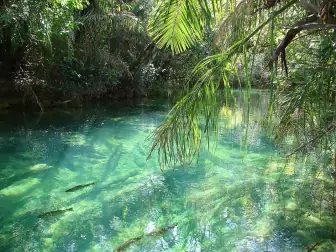
Floating from the Olho d'Água spring, at 24°C all year, on a four-hour tour with lunch included is the experience that defines the trip; a morning slot leaves the afternoon free for Buraco das Araras.
Check access

Buraco das Araras
In Jardim, 55 km from Bonito, it is a sinkhole about 100 m deep and 500 m around, where red macaws live. A 970 m trail circles the rim, with two lookouts, and it is easy for any age; the place records 160 bird species. Takes half a day and combines with the Rio da Prata on the same day.
An easy 970 m trail lets you see the roughly 100 m-deep sinkhole with red macaws; combine it with Rio da Prata on the same day.
Check access
Aquário Natural
Seven km from the center, on the road to Guia Lopes da Laguna, the reserve has the spring of the Rio Baía Bonita. After a trail to the spring, the float covers about 900 m in around 40 minutes, with a boat accompanying the group; the whole tour lasts two and a half hours on average. It is close enough to fit into a morning or afternoon on the day you arrive.
Seven km from the center, the roughly 900 m float on the Baía Bonita fits into the afternoon you arrive.
Check access
Abismo Anhumas
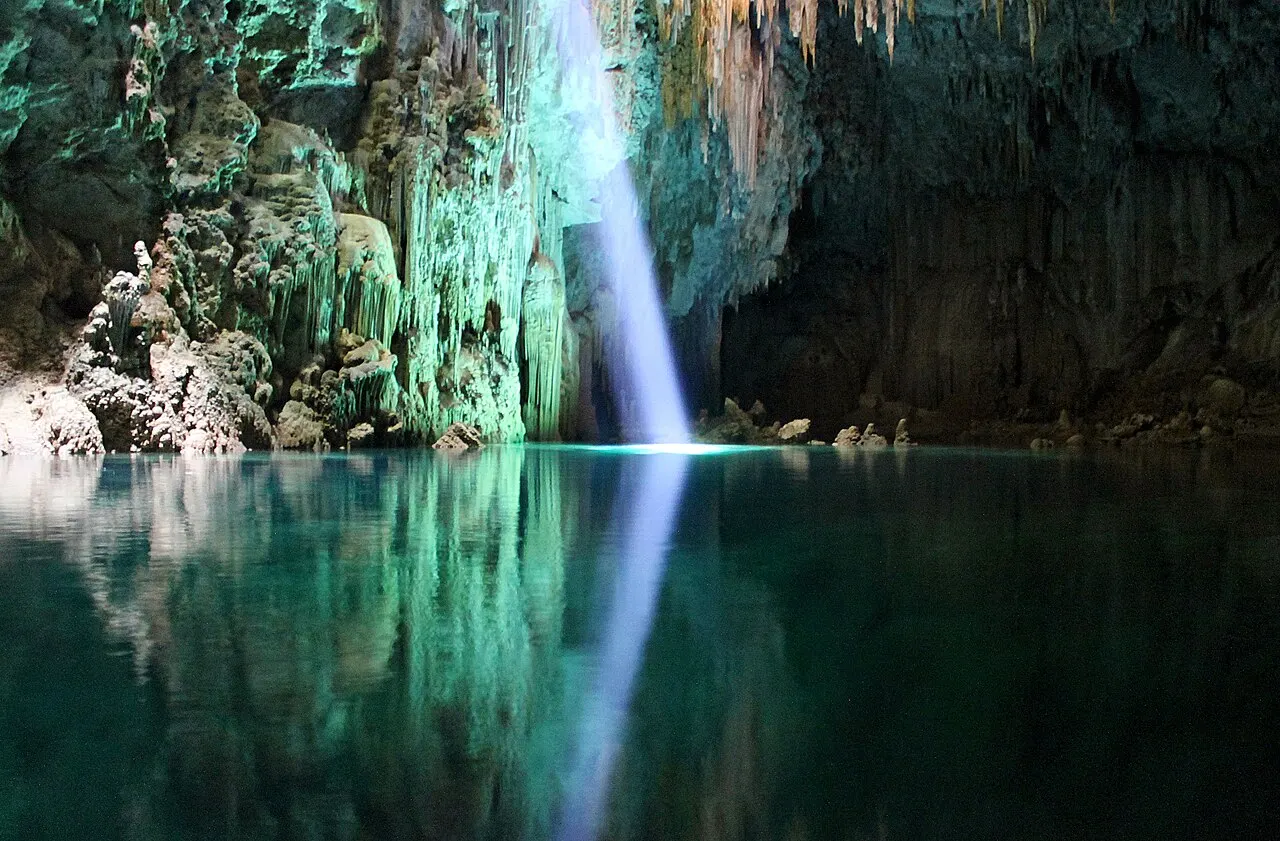
Twenty-three km from town, it is an opening in the ground through which you descend 72 m, by electric rappel, to an underground lake of crystal-clear water with submerged cones. At the bottom there is a boat ride, floating with a snorkel and tank diving: the introductory dive, from 12 years old and with no certification, goes to about 8 m. Groups are small and each group's time is set by the team the day before.
The 72 m descent by electric rappel to an underground lake with submerged cones is an experience unlike any other in the region. Groups are small, places fill early and the time is set the day before.
Check access

Rio Sucuri
Nineteen km from town, the Sucuri float is about 1,800 m long and starts after an easy trail to the springs, with a support boat the whole way. Anyone who doesn't want to get in the water can do the route by boat only. Takes half a day.
The roughly 1,800 m float, with a boat-only option, is a good second river outing if you have a fourth day.
Check access

Estância Mimosa
Twenty-five km from town, the farm has forest trails that end at waterfalls. The regional lunch is served at the headquarters, near the lagoon, cooked on a wood stove. It is the waterfall tour for people who have already floated and want a different kind of day.
Trails ending at waterfalls and a regional lunch cooked on a wood stove offer a different day if you have only been floating.
Check access
Grutas de São Miguel
Eighteen km from town, it is a dry cave with artificial lighting and lanterns, with stalactites and stalagmites. Access crosses a suspension bridge in the middle of the cerrado, at canopy height, with a bird-watching lookout. Takes half a day.
The lit dry cave and suspension bridge over the cerrado are an alternative when Abismo Anhumas is fully booked, without the lake that defines Gruta do Lago Azul.
Check access
Balneário Municipal
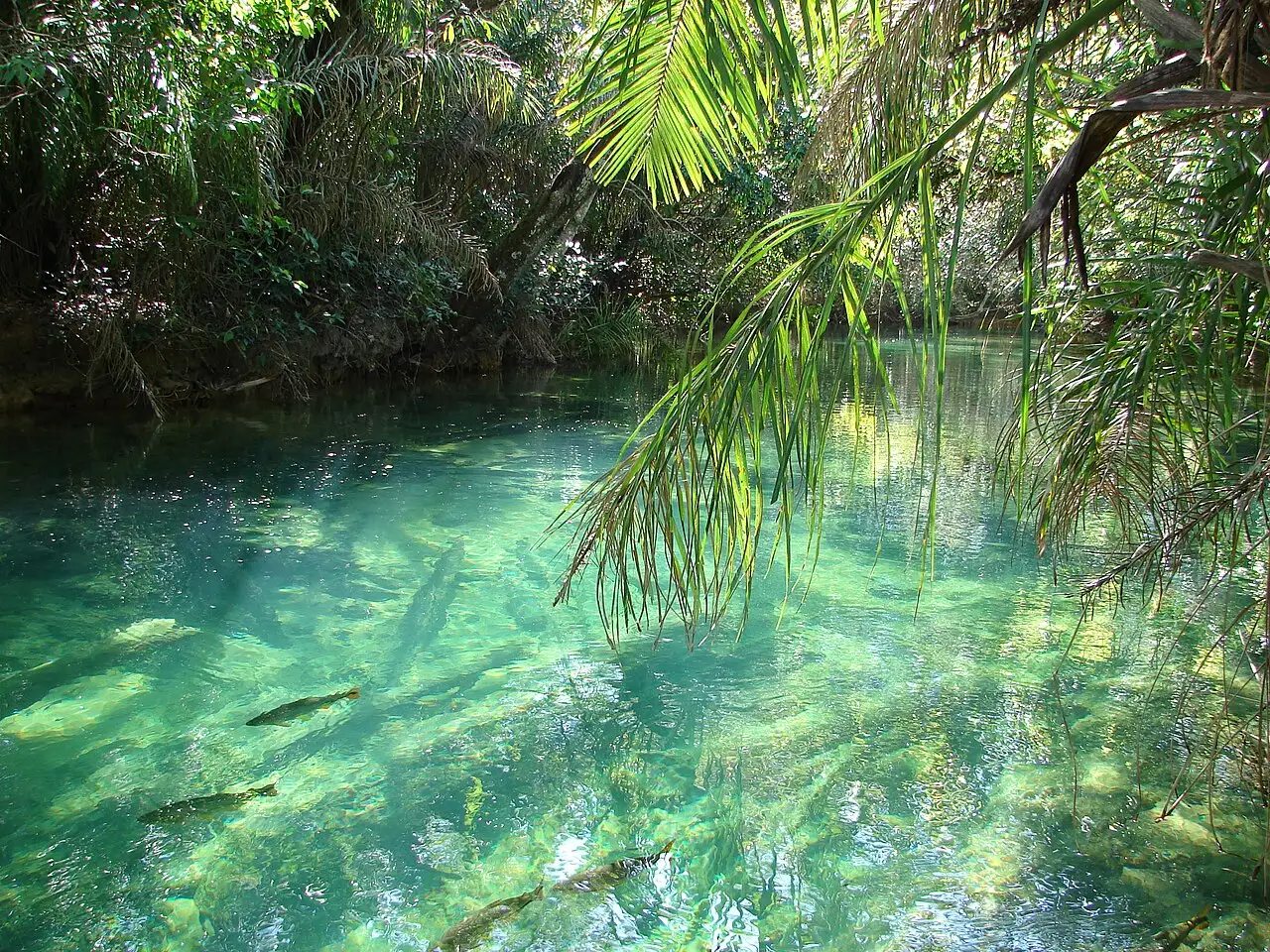
Seven km from the center, along a stretch of about 200 m of the Rio Formoso, it has shallow areas for children and deeper ones full of piraputangas, and sometimes capuchin monkeys and macaws in the trees. It has parking, snack bars, a restaurant and kiosks with grills. Check the hours, and whether entry requires a voucher, with the Tourism Secretariat at (67) 99254-8990, or at the Tourist Service Center, open Monday to Friday.
Swimming in the Rio Formoso, with piraputanga fish and shallow areas for children, rounds off a free day, but is not a reason to make the trip.
Check access
Nilo’s itinerary
Start with the basic programme and choose extensions for the time you have.
Plan my days in the app ↗Day 1 · Arrival, environmental fee and the Aquário Natural
Reach Bonito through the town's airport or by car from Campo Grande, about 4 hours by road.
Check that the Environmental Conservation Fee is paid and that the agency has issued the vouchers for the coming days.
In the afternoon, go to the Aquário Natural, 7 km from the center, and do the trail to the spring and the float of about 900 m on the Rio Baía Bonita; allow two and a half hours.
At the end of the day, head back to the center for dinner.
Day 2 · Gruta do Lago Azul and Abismo Anhumas
In the morning, head to the Gruta do Lago Azul, 21 km away, in sneakers; it is about 300 steps down and the same back up.
If you got a spot at the Abismo Anhumas, 23 km away, it takes up the other half of the day, with the 72 m descent and the underground lake; the team sets the time the day before, and if it falls in the morning, leave the cave for the afternoon.
Without Anhumas, spend the afternoon at the Grutas de São Miguel, 18 km away, with the suspension bridge over the cerrado.
Sleep in Bonito: the next day starts early on the road to Jardim.
Day 3 · Rio da Prata and Buraco das Araras, in Jardim
Leave Bonito at least 45 minutes before the time booked at the Recanto Ecológico Rio da Prata, 45 km away on a paved road; prefer a morning time.
Do the trail and the float from the spring of the Rio Olho d'Água; the tour takes 4 hours and lunch is included.
In the afternoon, continue to the Buraco das Araras, also in Jardim, and walk the 970 m trail along the rim of the sinkhole, with two lookouts. Ask the agency for the times of the two tours back to back.
Return to Bonito to sleep.

If you stay longer
Day 4 · Rio Sucuri and the Estância Mimosa waterfalls
In the morning, do the float of about 1,800 m on the Rio Sucuri, 19 km away, or the same route by boat.
In the afternoon, go to the Estância Mimosa, 25 km away, for the waterfall trails; if you want the farm's regional lunch, book the Mimosa for the morning and the Sucuri for the afternoon.
Finish with a river dip at the Balneário Municipal, 7 km away, if its hours allow.


Food
Pintado and pacu
The two river fish most cited in Mato Grosso do Sul cooking, which appear in many of the state's fish dishes.
Chipa
Horseshoe-shaped cheese bread, one of Mato Grosso do Sul's traditional savory snacks.
Sopa paraguaia
Despite the name, it is not a soup: it is a savory cornbread pie with onion and cheese, baked and served in slices as a side.
Arroz carreteiro
Rice cooked with dried beef, one of the state's traditional savory dishes.
Caldo de piranha
Broth made with piranha, a fish from the region's rivers, listed among the state's traditional preparations.
Tereré
Yerba mate prepared with ice-cold water, drunk in a circle and with rules of its own. It is the drink for gatherings of friends and family in Mato Grosso do Sul.
Guavira
A small Cerrado fruit that gives its name to a food festival in Bonito in November, where it appears in traditional and contemporary dishes.
Where to eat
- Downtown · $
Chipa and coffee at a bakery before heading out on a tour.
- Downtown · $$
River fish, like pintado and pacu, with arroz carreteiro and sopa paraguaia at the regional restaurants.
- Attractions · $$
Regional lunch cooked on a wood stove: included in the Rio da Prata tour and served at the Estância Mimosa headquarters.
$: chipa, a savory snack and coffee at a bakery · $$: a fish dish or regional lunch at a downtown restaurant · $$$: dinner at a hotel restaurant or a chef-driven kitchen · 2026-10-15
Day trips
Pantanal de Miranda
Miranda, known as the Gateway to the Pantanal, is about 130 km from Bonito by road, around 2 hours by car, on the banks of the Rio Miranda and the BR-262, which links Campo Grande to Corumbá. It is on the way to the Pantanal, which is why it is the most common extension for people leaving Bonito. A round trip in one day uses four hours of road: to see the Pantanal properly, count on at least one night in the region, at lodging that organizes wildlife-watching tours, and arrange the transfer with the Bonito agency.
Where to begin
Gruta do Lago Azul and Abismo Anhumas
In the morning, head to the Gruta do Lago Azul, 21 km away, in sneakers; it is about 300 steps down and the same back up.
Rio da Prata and Buraco das Araras, in Jardim
Leave Bonito at least 45 minutes before the time booked at the Recanto Ecológico Rio da Prata, 45 km away on a paved road; prefer a morning time.
Rio Sucuri and the Estância Mimosa waterfalls
In the morning, do the float of about 1,800 m on the Rio Sucuri, 19 km away, or the same route by boat.
Money
The currency is the real (R$). Tours are paid separately and vary a lot: in July 2026 they ran from R$ 90 to R$ 1,900 per person, according to Correio do Estado. As a reference, the Gruta do Lago Azul website charged in October 2026 R$ 120 per person in low season and R$ 180 in high season, without transport. Under the municipal rule, the tour is paid to the accredited agency that issues the voucher, and lunch, when included, as at the Rio da Prata, comes in the package. Add the Environmental Conservation Fee, R$ 15 per person per day since December 20, 2025, paid at turistapornatureza.com.br, and transport to the attractions, which is arranged separately if you don't have a car. Ask the agency for the total price per person, with transport and lunch, before you commit.
Getting there and around
Getting there: direct flight or via Campo Grande
Bonito Regional Airport (BYO) is about 15 km from the center, around 16 minutes by car. According to the city hall (page checked in October 2026), Gol (from Congonhas, in São Paulo), Azul (from Campinas) and Latam operate direct flights there, of about 2h05 on average; check the operating dates, because service is smaller than at Campo Grande. Campo Grande (CGR) has more flights and usually lower fares, and from there it is about 300 km and 4 hours by car, along the BR-060 to Sidrolândia, the BR-419 to Guia Lopes da Laguna and the MS-382 to Bonito. Viação Cruzeiro do Sul runs the route by bus, and there are shared vans and chartered cars.
Getting between the attractions
There is no public transport to the attractions, which are 7 to 55 km from town, and transport is not included in the ticket. Either you rent a car, or you arrange transport, by van or car, with the agency that sells the tour. For the Rio da Prata, at 45 km, leave at least 45 minutes before the scheduled time.
In town
You can cover the center on foot: hotels, agencies, restaurants and the Praça da Liberdade are close to one another.
Safety
What needs attention in Bonito is the water and the way to it. Every attraction has a guide, who gives the safety rules at the start of the tour; follow the floating position, because the rivers have logs and rocks you can't see with your head out of the water. Heavy rain can cancel or interrupt the activity; at the Rio da Prata there is no refund after the tour has started, and each attraction's rain rule should be confirmed with the agency. At the Gruta do Lago Azul there are about 300 steps down and up, with sneakers required. At the Rio da Prata the minimum age is 5, and pregnant women only up to 24 weeks, without a high-risk pregnancy. The Rio da Prata does not recommend floating to anyone who has had invasive surgery in the last 30 days, has epilepsy, a history of stroke, heart attack or anaphylactic shock, or uses a pacemaker (in those cases a liability waiver is signed), warns that respiratory problems, heart problems and labyrinthitis may get worse, and has no prescription masks: use contact lenses. At the Abismo Anhumas the descent is 72 m. Anyone driving to the attractions should count on up to 55 km of road.
Etiquette tips
Floating position
On floats you stay belly down, legs still and arms along your body, following the guide. Anyone who can't adapt to the equipment or the position doesn't float, for safety; at the Rio da Prata, that person chooses between the alternative tour and a refund.
Sunscreen and repellent, minimal
At the Rio da Prata the guidance is to use as little sunscreen as possible, only where the wetsuit doesn't cover (face, neck, back of the legs), preferably eco-friendly, and natural repellent. Leggings under the wetsuit protect from the sun.
No fins, no swim goggles, no alcohol
On the Rio da Prata float, fins and swim goggles are not used, and you don't drink alcohol before or during the tour. You don't enter the park with food or drink; lunch is included.
Voucher and fee at hand
Keep the tour voucher and the receipt for the Environmental Conservation Fee: the agency checks the fee payment before releasing the voucher.
Mistakes to avoid
Buying the ticket before the tours
The Gruta do Lago Azul, the Abismo Anhumas and the Rio da Prata have a daily visitor limit. Lock in the tours with the agency and only then set flight and hotel dates, especially in January, July and late December.
Going to the attraction without a voucher
In Bonito you don't buy tickets at the door of the attractions under the municipal rule: booking goes through an accredited agency, which issues the voucher and sets the time.
Forgetting the environmental fee
The Environmental Conservation Fee, R$ 15 per person per day, is paid separately, on the turistapornatureza.com.br portal. Take care of it before you arrive.
Underestimating the distances
The Rio da Prata is 45 km away and the Buraco das Araras 55 km, by road. Without a car, arrange transport together with the tour, and don't book two tours in opposite directions on the same day.
Putting on sunscreen as at the beach
Sunscreen and repellent go on minimally, only where the wetsuit doesn't cover.
Useful phrases
Voucher
The booking confirmation issued by the agency, without which you can't enter the attraction
Flutuação
Going down the river floating face down, with mask, snorkel, vest and wetsuit
Balneário
A stretch of river with facilities for bathing, like the Balneário Municipal
Dolina
A hole in limestone terrain formed by the collapse of a cavity's roof, like the Buraco das Araras
TCA
Environmental Conservation Fee, charged per person per day
Tereré
Yerba mate with ice-cold water, drunk in a circle
Where to stay
- Downtown · First time, people not renting a car and people who want to walk to dinner · $$: Agencies, restaurants, the Tourist Service Center and the Praça da Liberdade are close to one another.
- Outskirts, on the roads to the attractions · People with a car who want nature all around · $$$: The farm hotels and resorts outside the center are closer to the springs, but every dinner becomes a drive.
- Downtown, in a simple pousada · Tight budget · $: A simple pousada downtown leaves more budget for the tours, which are paid separately, and keeps agencies and restaurants within walking distance.
$: simple pousada downtown · $$: hotel downtown · $$$: farm hotel or resort outside town · 2026-10-15
Districts
Downtown
Downtown has the Tourist Service Center, on Rua Coronel Pilad Rebuá (Monday to Friday, 7 a.m. to 5 p.m.), and the Praça da Liberdade, the stage for New Year's Eve and the Christmas program, plus most of the hotels, agencies and restaurants. It is where you sleep without a car and where you buy tours.
Rural Bonito
The attractions are on farms and reserves spread along the roads out of town: the Aquário Natural and the Balneário Municipal at 7 km, the Grutas de São Miguel at 18 km, the Rio Sucuri at 19 km, the Gruta do Lago Azul at 21 km, the Abismo Anhumas at 23 km and the Estância Mimosa at 25 km.
Jardim
The neighboring municipality, to the south, has two of the region's most sought-after tours: the Recanto Ecológico Rio da Prata, 45 km from Bonito on a paved road, and the Buraco das Araras, at 55 km. Both fit in the same day.
Serra da Bodoquena
The Serra da Bodoquena National Park, created in 2000, covers parts of Bonito, Jardim, Bodoquena and Porto Murtinho. The town of Bodoquena, to the north, has its own waterfall and floating attractions.
History
1632 · Xerez is destroyed
The Spanish settlement of Xerez, in the region, is destroyed by the bandeira of Antônio Raposo Tavares. The first inhabitants of the area were the Guaicuru.
1869 · The Fazenda Rincão Bonito
Captain Luiz da Costa Leite Falcão settles on the land of the Fazenda Rincão Bonito, where the core of the town begins. The municipality's name comes from the farm.
1915 · District of Miranda
A state law creates the peace district of Bonito, subordinate to Miranda.
1948 · Municipality
On October 2, State Law No. 145 raises Bonito to municipality, separate from Miranda. It is installed on January 1, 1949.
1977 · Mato Grosso do Sul
With the division of Mato Grosso, Bonito becomes part of the new state of Mato Grosso do Sul.
1978 · The Gruta do Lago Azul protected
The Gruta do Lago Azul and the Grutas de Nossa Senhora Aparecida are protected as natural monuments.
1985 · The first gate in the cave
The Gruta do Lago Azul gets its first gate to limit the passage of tourists, at a time when visits were still informal.
1995 · Single voucher and required guide
The Municipal Tourism Council establishes the single voucher, being accompanied by a guide becomes mandatory at the attractions, and the Recanto Ecológico Rio da Prata opens, one of the first trail-and-float tours.
2000 · Serra da Bodoquena National Park
The national park is created, with about 76,000 hectares in Bonito, Jardim, Bodoquena and Porto Murtinho.
2025 · Environmental Conservation Fee
On December 20, a charge of R$ 15 per visitor per day begins, paid on a city hall portal.
Complete history
A farm that became a town
Before the settlers, the region was Guaicuru territory, and in the 17th century it had a Spanish settlement, Xerez, destroyed in 1632 by a bandeira from São Paulo. The core of Bonito began much later, in 1869, when Captain Luiz da Costa Leite Falcão settled at the Fazenda Rincão Bonito, which gave the town its name. From the Paraguayan War, when Paraguayan troops invaded the region, what remains are aroeira beams from a bridge over the Rio Formoso. Until 1948 Bonito belonged to Miranda: it became a district in 1915 and a municipality on October 2, 1948.
From river swimming to the voucher
Tourism began informally in the 1970s and 1980s, with visits to the Gruta do Lago Azul and the Ilha do Padre, and in the 1990s with swimming and floating at the Aquário Natural and in the Peixe, Sucuri and Formoso rivers, with no access rules. The cave got its first gate in 1985. The turning point came in 1995: the Municipal Tourism Council created the single voucher, which records each visitor and each attraction, and a guide became mandatory. That same year the Recanto Ecológico Rio da Prata opened, and in 1996 the town's first resort. This system, with a daily limit per attraction, is why in Bonito you don't buy a ticket at the door.
Today's debate
In 2025 the town received 293,712 tourists, according to the Bonito Tourism and Events Observatory, and at the end of that year it began charging a daily environmental fee. In 2026 the model is under discussion: some of the attractions want to sell the tour directly to the visitor while keeping the cap on spots, and the local agencies defend intermediation. In August 2026 the city hall opened a bid for a digital voucher platform. Attractions in Jardim, Bodoquena and Miranda do not follow Bonito's municipal rule, and some already sell directly.
Since 1995 a guide has been required at Bonito's attractions, and every visit goes through a single voucher.
Geography and shape of the city
A limestone range
Bonito covers 5,373 km² in southwestern Mato Grosso do Sul, and the town sits at 315 m above sea level, at the foot of the Serra da Bodoquena. The range is limestone, and the water running through it has opened caves, abysses, underground conduits and sinkholes, holes formed by the collapse of a cavity's roof, like the Buraco das Araras. In the rivers, the limestone forms tufa, natural barriers that create small waterfalls.
Rivers that rise clear
The Rio Formoso, which the city hall describes as Bonito's main river, runs past the Balneário Municipal; the Sucuri and the Baía Bonita, where the Aquário Natural is, are other spring-fed rivers where you float. In neighboring Jardim, the spring of the Rio Olho d'Água has water at 24 °C all year. Because the tours start at springs, inside farms, almost everything you visit is 7 to 55 km from town.
Climate
The climate is tropical, averaging 24 °C with 1,500 to 1,700 mm of rain a year. The rainiest months run from December to March; heavy rain can cancel or interrupt a float.
The Serra da Bodoquena is limestone: water has opened caves, abysses and sinkholes in it, and it is from there that the rivers you float down rise.
Culture
A town organized around tourism
Tourism has shaped Bonito: in 2022 the town had about 85 hotels and more than 7,000 beds for 23,659 inhabitants in that year's Census, and since 2006 the municipal school system has had a course in basic notions of tourism. Since 1995 no attraction under the municipal rule receives visitors without a guide.
Winter Festival, film and books
The cultural calendar goes beyond nature. The Festival de Inverno de Bonito, organized by the state government with the city hall, reached its 25th edition in 2026, with free music, theater, dance, circus and film at several spots around town. In July come the Feira Literária de Bonito and the Bonito CineSur, a South American film festival with open-air screenings.
Lasso, rodeo and São Pedro
Ranch culture shows up in the festivals: the Carnalaço, a statewide long-lasso gathering, in February; the Festa do Peão, in May; and the Festa de São Pedro Apóstolo, in late June, which reached its 96th edition in 2026, with masses, a church fair and a horseback parade.
Festivals and events
Festival de Inverno de Bonito: late August
Music, theater, dance, circus, visual arts, film and literature, with a free program at several venues in town. In 2026 it ran August 26 to 30, in its 25th edition.
Festa de São Pedro Apóstolo: late June
A religious and cultural festival, with masses, church fairs and a horseback parade. In 2026 it ran June 26 to 29.
Bonito CineSur: late July
A South American film festival with showcases, open-air screenings and free workshops. In 2026 it ran July 24 to August 1.
Festival da Guavira: November
A food festival built around the Cerrado fruit, with cooking shows, a producers' market, crafts and music, free to enter. In 2026, the 20th edition is on November 20 and 21.
Natal Mais Bonito and New Year's Eve: December
Decorations and performances at the Praça da Liberdade from the end of November, and at the turn of the year shows in the same square and silent fireworks at midnight. Confirm the decoration dates with the Tourism Secretariat.
Frequently asked questions
Bonito: Direct flight or via Campo Grande?
Bonito Regional Airport (BYO), about 15 km from the center, gets direct flights from Gol, Azul and Latam, with less service; Campo Grande (CGR) has more flights and usually lower fares, and from there it is about 300 km and 4 hours by car.
Bonito: Can you buy the ticket at the attraction's door?
For attractions subject to Bonito’s municipal rule, no: booking goes through an accredited agency, which issues the voucher and sets the time, and the Environmental Conservation Fee, R$ 15 per person per day, is paid separately on the turistapornatureza.com.br portal, before you arrive.
Bonito: How many days should you stay?
I'd stay four days. With three, I'd cut the fourth, because the Gruta do Lago Azul, the Rio da Prata and the Buraco das Araras are the three tours I wouldn't swap; with fewer than three, the road eats the time for the rivers.
Bonito: When is the best time to go?
September to November: outside the rainiest months, December to March, and the July school holidays, and it is already the period when sunlight turns the lake at the Gruta do Lago Azul blue; the rivers can be visited year-round.
Bonito: Can you visit the Pantanal in a day?
Miranda, the gateway to the Pantanal, is about 130 km away, around 2 hours by car, and a round trip in one day uses four hours of road: to see the Pantanal properly, count on at least one night in the region and arrange the transfer with the Bonito agency.
Other cities in the country
Brazil ↗- Days
- 4
- When
- Apr–Jun
- Per person/day
- Average 615 BRLMid-range · per person/day
Cost scope
Per person per day: accommodation, meals, urban transport, visits and a small allowance for extras. Flights excluded; larger purchases vary. Editorial estimate, not a quote.
- Days
- 2–3
- When
- Apr–May · Sep
- Per person/day
- Average 400–700 BRLMid-range · per person/day
Cost scope
Per person per day: accommodation, meals, urban transport, visits and a small allowance for extras. Flights excluded; larger purchases vary. Editorial estimate, not a quote.
- Days
- 2–3
- When
- Jan–Mar · Sep–Dec
- Per person/day
- Average 350–550 BRLMid-range · per person/day
Cost scope
Per person per day: accommodation, meals, urban transport, visits and a small allowance for extras. Flights excluded; larger purchases vary. Editorial estimate, not a quote.
- Days
- 1–2
- When
- May–Sep
- Per person/day
- Average 260–520 BRLMid-range · per person/day
Cost scope
Per person per day: accommodation, meals, urban transport, visits and a small allowance for extras. Flights excluded; larger purchases vary. Editorial estimate, not a quote.
- Days
- 3–4
- When
- Jun–Sep
- Per person/day
- Average 400–700 BRLMid-range · per person/day
Cost scope
Per person per day: accommodation, meals, urban transport, visits and a small allowance for extras. Flights excluded; larger purchases vary. Editorial estimate, not a quote.
- Days
- 2–3
- When
- Apr–Jun
- Per person/day
- Average 350–550 BRLMid-range · per person/day
Cost scope
Per person per day: accommodation, meals, urban transport, visits and a small allowance for extras. Flights excluded; larger purchases vary. Editorial estimate, not a quote.
- Days
- 3–5
- When
- Mar–Apr · Nov
- Per person/day
- Average 397 BRLMid-range · per person/day
Cost scope
Per person per day: accommodation, meals, urban transport, visits and a small allowance for extras. Flights excluded; larger purchases vary. Editorial estimate, not a quote.
- Days
- 2–4
- When
- Mar–May · Sep
- Per person/day
- Explore costsGuide estimate
Cost scope
Per person per day: accommodation, meals, urban transport, visits and a small allowance for extras. Flights excluded; larger purchases vary. Editorial estimate, not a quote.
- Days
- 4–5
- When
- Aug–Nov
- Per person/day
- Explore costsGuide estimate
Cost scope
Per person per day: accommodation, meals, urban transport, visits and a small allowance for extras. Flights excluded; larger purchases vary. Editorial estimate, not a quote.
- Days
- 3–4
- When
- Jul–Sep
- Per person/day
- Explore costsGuide estimate
Cost scope
Per person per day: accommodation, meals, urban transport, visits and a small allowance for extras. Flights excluded; larger purchases vary. Editorial estimate, not a quote.
- Days
- 2–4
- When
- May–Sep
- Per person/day
- Explore costsGuide estimate
Cost scope
Per person per day: accommodation, meals, urban transport, visits and a small allowance for extras. Flights excluded; larger purchases vary. Editorial estimate, not a quote.
- Days
- 3–5
- When
- Jun–Sep
- Per person/day
- Explore costsGuide estimate
Cost scope
Per person per day: accommodation, meals, urban transport, visits and a small allowance for extras. Flights excluded; larger purchases vary. Editorial estimate, not a quote.
- Days
- 3–4
- When
- Jun–Aug
- Per person/day
- Explore costsGuide estimate
Cost scope
Per person per day: accommodation, meals, urban transport, visits and a small allowance for extras. Flights excluded; larger purchases vary. Editorial estimate, not a quote.
- Days
- 4–5
- When
- Jan–Mar · Sep–Dec
- Per person/day
- Explore costsGuide estimate
Cost scope
Per person per day: accommodation, meals, urban transport, visits and a small allowance for extras. Flights excluded; larger purchases vary. Editorial estimate, not a quote.
- Days
- 3–4
- When
- Oct–Dec
- Per person/day
- Average 1,110 BRLMid-range · per person/day
Cost scope
Per person per day: accommodation, meals, urban transport, visits and a small allowance for extras. Flights excluded; larger purchases vary. Editorial estimate, not a quote.
- Days
- 3–4
- When
- Aug–Sep
- Per person/day
- Explore costsGuide estimate
Cost scope
Per person per day: accommodation, meals, urban transport, visits and a small allowance for extras. Flights excluded; larger purchases vary. Editorial estimate, not a quote.
- Days
- 4–7
- When
- Apr–Sep
- Per person/day
- Explore costsGuide estimate
Cost scope
Per person per day: accommodation, meals, urban transport, visits and a small allowance for extras. Flights excluded; larger purchases vary. Editorial estimate, not a quote.
- Days
- 3–4
- When
- Jan · Sep–Dec
- Per person/day
- Explore costsGuide estimate
Cost scope
Per person per day: accommodation, meals, urban transport, visits and a small allowance for extras. Flights excluded; larger purchases vary. Editorial estimate, not a quote.
- Days
- 2
- When
- Aug–Dec
- Per person/day
- Average 442 BRLMid-range · per person/day
Cost scope
Per person per day: accommodation, meals, urban transport, visits and a small allowance for extras. Flights excluded; larger purchases vary. Editorial estimate, not a quote.
- Days
- 3–5
- When
- Jan–Feb · Sep–Dec
- Per person/day
- Explore costsGuide estimate
Cost scope
Per person per day: accommodation, meals, urban transport, visits and a small allowance for extras. Flights excluded; larger purchases vary. Editorial estimate, not a quote.
- Days
- 3–5
- When
- May–Sep
- Per person/day
- Explore costsGuide estimate
Cost scope
Per person per day: accommodation, meals, urban transport, visits and a small allowance for extras. Flights excluded; larger purchases vary. Editorial estimate, not a quote.
- Days
- 2–3
- When
- Apr–Sep
- Per person/day
- Average 484 BRLMid-range · per person/day
Cost scope
Per person per day: accommodation, meals, urban transport, visits and a small allowance for extras. Flights excluded; larger purchases vary. Editorial estimate, not a quote.
- Days
- 3
- When
- Apr–May · Aug
- Per person/day
- Average 478 BRLMid-range · per person/day
Cost scope
Per person per day: accommodation, meals, urban transport, visits and a small allowance for extras. Flights excluded; larger purchases vary. Editorial estimate, not a quote.
- Days
- 3–4
- When
- Aug–Dec
- Per person/day
- Explore costsGuide estimate
Cost scope
Per person per day: accommodation, meals, urban transport, visits and a small allowance for extras. Flights excluded; larger purchases vary. Editorial estimate, not a quote.
- Days
- 2
- When
- Apr–May · Sep
- Per person/day
- Explore costsGuide estimate
Cost scope
Per person per day: accommodation, meals, urban transport, visits and a small allowance for extras. Flights excluded; larger purchases vary. Editorial estimate, not a quote.
- Days
- 3
- When
- Sep–Dec
- Per person/day
- Explore costsGuide estimate
Cost scope
Per person per day: accommodation, meals, urban transport, visits and a small allowance for extras. Flights excluded; larger purchases vary. Editorial estimate, not a quote.
- Days
- 3–5
- When
- Apr–Nov
- Per person/day
- Average 427 BRLMid-range · per person/day
Cost scope
Per person per day: accommodation, meals, urban transport, visits and a small allowance for extras. Flights excluded; larger purchases vary. Editorial estimate, not a quote.
- Days
- 4
- When
- Jul–Sep
- Per person/day
- Explore costsGuide estimate
Cost scope
Per person per day: accommodation, meals, urban transport, visits and a small allowance for extras. Flights excluded; larger purchases vary. Editorial estimate, not a quote.
- Days
- 4–5
- When
- May–Sep
- Per person/day
- Explore costsGuide estimate
Cost scope
Per person per day: accommodation, meals, urban transport, visits and a small allowance for extras. Flights excluded; larger purchases vary. Editorial estimate, not a quote.
- Days
- 3
- When
- May–Sep
- Per person/day
- Explore costsGuide estimate
Cost scope
Per person per day: accommodation, meals, urban transport, visits and a small allowance for extras. Flights excluded; larger purchases vary. Editorial estimate, not a quote.