Brazil
Búzios
Búzios: 23 beaches on one peninsula, calm water on one side and surf on the other, and Arraial do Cabo an hour down the road
Days Start with the basic programme and choose extensions for the time you have.
How the guide reaches this number
The first is the north side: Azeda and Azedinha early, João Fernandes by water taxi for lunch, the view from the Sant'Anna hill and the sunset on Orla Bardot, with Rua das Pedras at night. The second is the east and south side, by car or taxi: Forno and Foca in the morning, Ferradura late in the morning, Geribá and Ferradurinha in the afternoon and dinner at Porto da Barra. The third is Arraial do Cabo, which has the most transparent water in the region and fits in a day of boat and trail if you leave early. Two days is the minimum I'd stand behind: it covers both sides of Búzios, and Arraial waits for another trip. With small children, I'd swap Geribá for Ferradura and Tartaruga. Cabo Frio fits in an afternoon on the way, without needing a day of its own.
2–3
When April to September, outside the long holiday weekends and the July school vacation; May to August have the steadiest weather and August is the driest month, while December to February bring heat, vacations and a crowded town
How the guide reaches this number
Búzios can be visited year-round, because the Região dos Lagos gets little rain for the Rio de Janeiro coast. From April to September the weather is steadier: May to August have little rain, and August is usually the driest month and the emptiest outside holidays, with cooler nights. July is the exception: the school holidays fill the town and put the month in high season. December to February are the hottest days, but December and January are the rainiest months, and the vacations, New Year's Eve and Carnival pack beaches, water taxis and restaurants. September and October bring spring with little rain and a full town on long holiday weekends. From October to April, the cruise season puts more people in the Centro on port days; the municipality publishes the ship forecast. In any month, the weekend is busier and more expensive than weekdays.
Per person/day Budget about 200 BRL; mid-range about 484 BRL; comfortable about 1,090 BRL per person, based on spending reported by travelers to Budget Your Trip (checked in October 2026).
How the guide reaches this number
Per person per day: accommodation, meals, urban transport, visits and a small allowance for extras. Flights excluded; larger purchases vary. Editorial estimate, not a quote.
 What Nilo thinks
I'd book three days, sleeping in Búzios all three nights. The first is the north side: Azeda and Azedinha early, João Fernandes by water taxi for lunch, the view from the Sant'Anna hill and the sunset on Orla Bardot, with Rua das Pedras at night. The second is the east and south side, by car or taxi: Forno and Foca in the morning, Ferradura late in the morning, Geribá and Ferradurinha in the afternoon and dinner at Porto da Barra. The third is Arraial do Cabo, which has the most transparent water in the region and fits in a day of boat and trail if you leave early. Two days is the minimum I'd stand behind: it covers both sides of Búzios, and Arraial waits for another trip. With small children, I'd swap Geribá for Ferradura and Tartaruga. Cabo Frio fits in an afternoon on the way, without needing a day of its own.In Búzios, you choose the day by the sea. The cold water that rises from the depths off Arraial do Cabo reaches the beaches to the east and south, which is why Forno, Foca and Tucuns are clear and cold even in summer, with pink garnet sand at Brava and Forno. On the other side of the peninsula, Azeda and João Fernandes are warm, still coves, linked by water taxis that leave from Píer do Centro and Praia dos Ossos. The fishing village is still in view: boats anchor off Orla Bardot and Ossos, the São Pedro procession leaves from Píer dos Pescadores, and the Sant'Anna chapel on the hill predates any pousada. Late in the afternoon, anyone not on the waterfront goes to Porto da Barra, in Manguinhos, facing the sun as it sets over the bay. And an hour down the road, Arraial do Cabo offers the clearest sea in the region, Ilha do Farol and the Prainhas do Pontal do Atalaia.
Quick facts
- Population
- 44,365 inhabitants in the municipality (IBGE estimate for 2026); 40,006 in the 2022 Census
- Founding
- Fishing village with a whaling station in the 18th century; a district of Cabo Frio until its emancipation on November 12, 1995
- Country and region
- Brazil, state of Rio de Janeiro, Região dos Lagos; about 170 km by road from downtown Rio de Janeiro and 25 km from Cabo Frio
- Language
- Portuguese; Spanish is common in shops and hotels, because of the Argentine community
- Currency
- Real (R$, BRL)
- Time zone
- UTC−3 year-round, with no daylight saving time
- Best time to visit
- April to September, outside the long holiday weekends and the July school vacation; May to August have the steadiest weather and August is the driest month, while December to February bring heat, vacations and a crowded town
- Average daily cost
- Budget about 200 BRL; mid-range about 484 BRL; comfortable about 1,090 BRL per person, based on spending reported by travelers to Budget Your Trip (checked in October 2026).
When to go
April to September, outside the long holiday weekends and the July school vacation; May to August have the steadiest weather and August is the driest month, while December to February bring heat, vacations and a crowded town
How the year changes
Búzios can be visited year-round, because the Região dos Lagos gets little rain for the Rio de Janeiro coast. From April to September the weather is steadier: May to August have little rain, and August is usually the driest month and the emptiest outside holidays, with cooler nights. July is the exception: the school holidays fill the town and put the month in high season. December to February are the hottest days, but December and January are the rainiest months, and the vacations, New Year's Eve and Carnival pack beaches, water taxis and restaurants. September and October bring spring with little rain and a full town on long holiday weekends. From October to April, the cruise season puts more people in the Centro on port days; the municipality publishes the ship forecast. In any month, the weekend is busier and more expensive than weekdays.
Nilo's tips
The water taxi solves the north side
From Píer do Centro and Praia dos Ossos, boats go to Azeda, Azedinha, João Fernandes, João Fernandinho, Canto, Tartaruga and Manguinhos. I'd use the water taxi instead of the car on that side of the peninsula, and I'd ask the time of the last boat before getting off at the beach.
Three midweek nights
Outside vacations and holidays, pousadas usually charge less from Sunday to Thursday, and on weekdays the crowds are low-season, with quieter beaches. I'd arrive on Sunday or Monday and do Arraial on a weekday too, because the weekend is the busiest in both places.
Check the ship schedule
From October to April, cruise ships land passengers at Píer do Centro. The municipality publishes the forecast of calls; on a ship day, I'd do Orla Bardot and Rua das Pedras at night, after the passengers go back on board.
Arraial changed in 2026
Schooners no longer land at the Prainhas do Pontal do Atalaia. If setting foot on the Prainhas is the goal, I'd choose the water taxi from Praia dos Anjos or the trail, and I'd confirm the situation with the operator the day before.
Explore the map
Explore the map, read about the other places and plan your travel days in the app.
Open the appWhat to see
Búzios: A peninsula with three fronts
At Brava and Forno, the sand is pink, because of the garnet that comes from the surrounding rocks. The northeast tip of the peninsula, with João Fernandes and João Fernandinho, calm and transparent water, and restaurants and beach shacks on the sand. Pousadas climb the hill on both sides of the road. To get to the Centro, take a water taxi, a taxi, a ride-hailing app or a car; parking spaces are few.

Orla Bardot
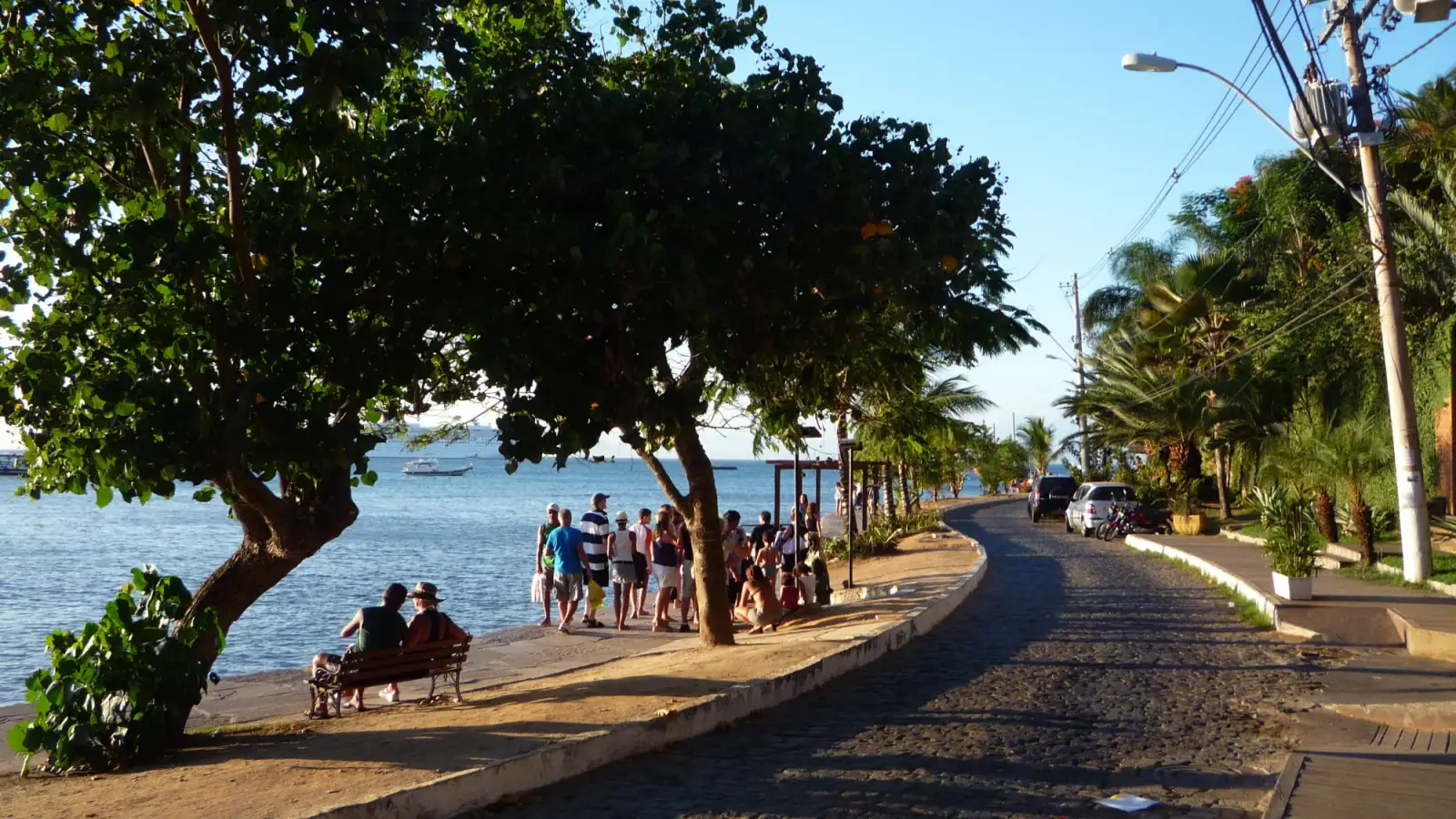
The promenade along Praia da Armação, linking the Centro to Praia dos Ossos, is Búzios's postcard. Fishing boats lie at anchor off the waterfront, Caboclo Island looks very close, and three bronze sculptures honor Brigitte Bardot, the fishermen and former president Juscelino Kubitschek. For most of its length there is no sand, and the benches, decks and bars are the place to watch the sunset. At the start of the waterfront is Píer do Centro, where the water taxis and some of the boat tours leave; farther along, Píer dos Pescadores is still used for fishing.
The old core between Praia do Canto and Praia da Armação, with Rua das Pedras, Rua Manoel Turíbio de Farias, Praça Santos Dumont and Orla Bardot.
Check access

Praia Azeda
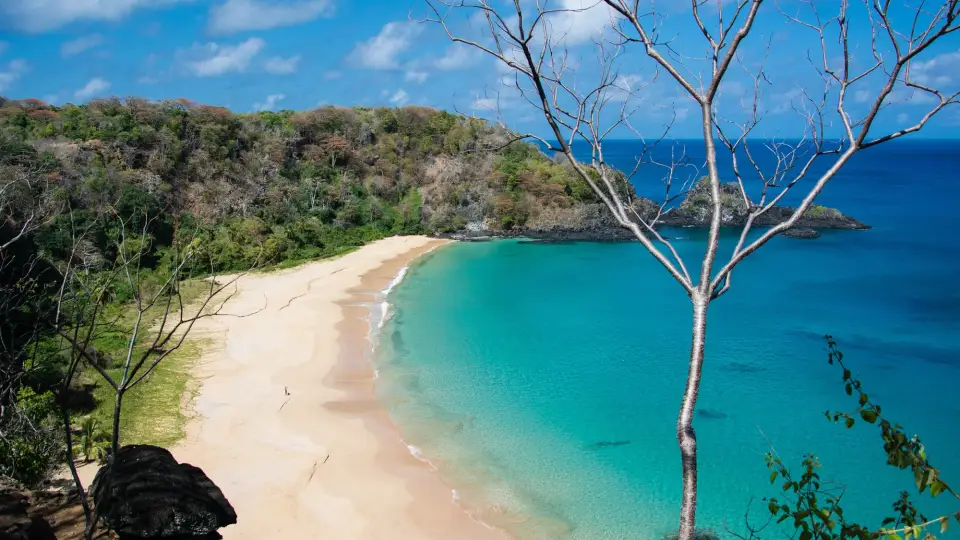
Azeda, 200 m long, and Azedinha, 50 m, form a pool of calm, transparent water between vegetation-covered rocky headlands, inside a municipal environmental protection area. You get there on foot up the slope at the right-hand corner of Praia dos Ossos and along a wooden staircase, or by water taxi. At Azeda there is an old mansion of the Honold family; Azedinha, reached by a path over the rocks, has no building in sight. Both are crowded on holidays and in high season.
The beaches to the east and south, such as Brava, Geribá and Tucuns, are open-sea beaches and get waves.
Check access
Praia de João Fernandes
At the northeast tip of the peninsula, facing Ilha Branca, João Fernandes and João Fernandinho add up to about 800 m of calm, blue, transparent water, good for swimming, snorkeling, kayaking and stand-up paddleboarding. João Fernandes has restaurants and shacks with tables on the sand; João Fernandinho, smaller, is reached by a descent from the top of the hill. Both are served by water taxi.
It suits anyone who wants to do almost everything on foot; at night the main streets are busy and noisy.
Check access

Rua das Pedras
The street of uneven stones in the Centro, closed to vehicles, gathers shops, bars and restaurants, and the parallel Rua Manoel Turíbio de Farias continues the shopping. By day it is a stroll for shopping; at night it is the heart of the nightlife, busier on holidays and during the cruise season. The uneven stones call for flat shoes.
The water taxis and schooners leave from here, and so do most of the shops, banks and a good share of the restaurants.
Check access

Praia dos Ossos
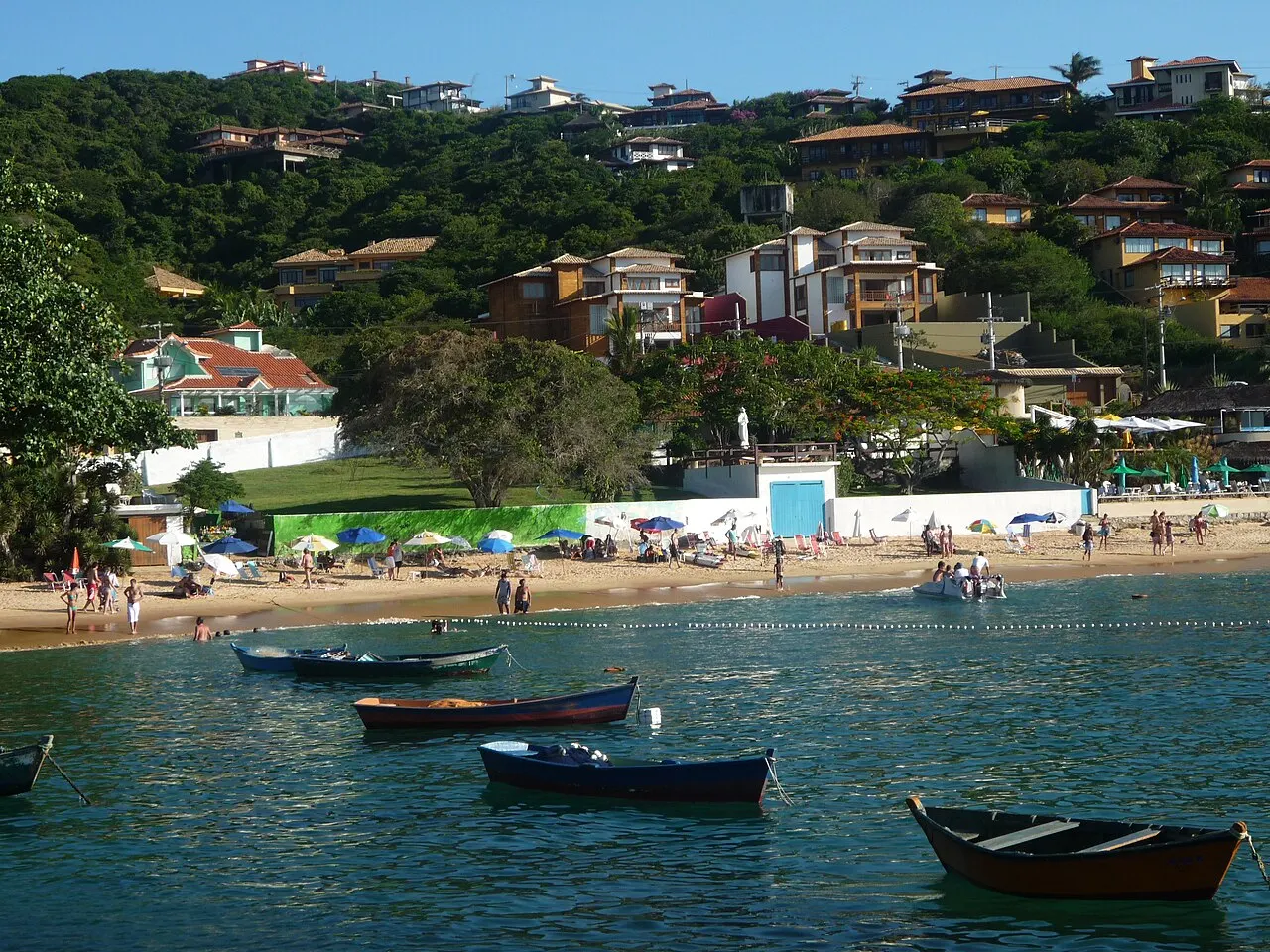
A small 400 m cove with colorful boats, trees and renovated fishermen's houses, which the municipality calls postcard-perfect. On the hill to the left stands Igreja de Sant'Anna, the town's patron saint, with Mass on Saturdays at 8 p.m. On the right starts the path to Azeda and Azedinha. It is more a place for looking and walking than for a swim.
Búzios occupies a peninsula about 8 km long that juts into the Atlantic east of Cabo Frio. Avenida José Bento Ribeiro Dantas enters at Praia Rasa and crosses the town to the Centro; the streets to each beach branch off from it. The northern coves, between Armação and João Fernandes, are sheltered and have calm water.
Check access
Praia da Ferradura
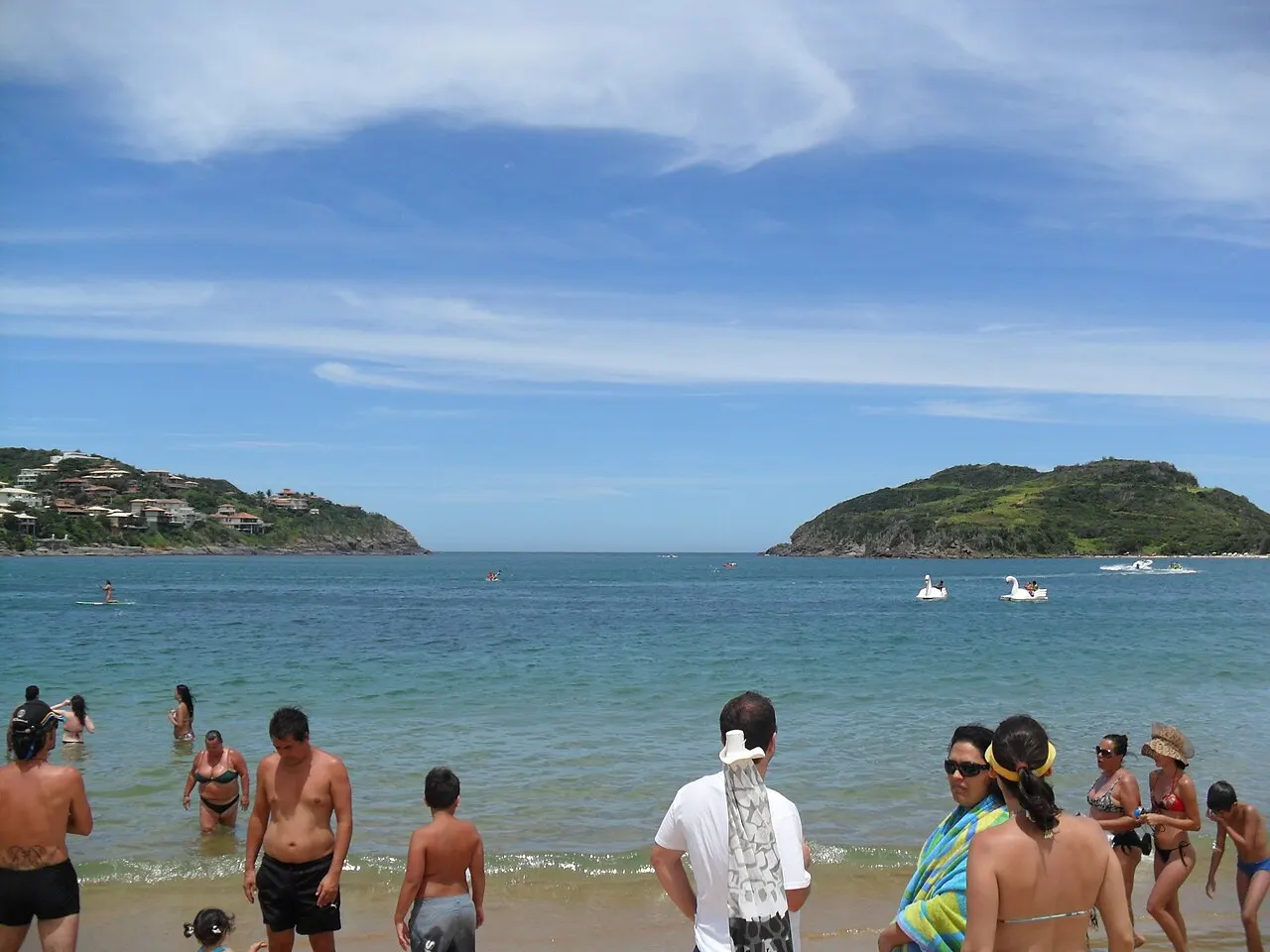
A 1.5 km cove of pale sand, closed at both ends and sheltered from wind and currents. The water is calm and cold, and there are pedal boats, kayaks and diving. Cars can get close to the sand, which makes life easier for anyone with small children.
A hillside between the Centro and Praia dos Ossos, with pousadas that look over Praia da Armação and stairs that drop down to Orla Bardot.
Check access
Praia da Ferradurinha
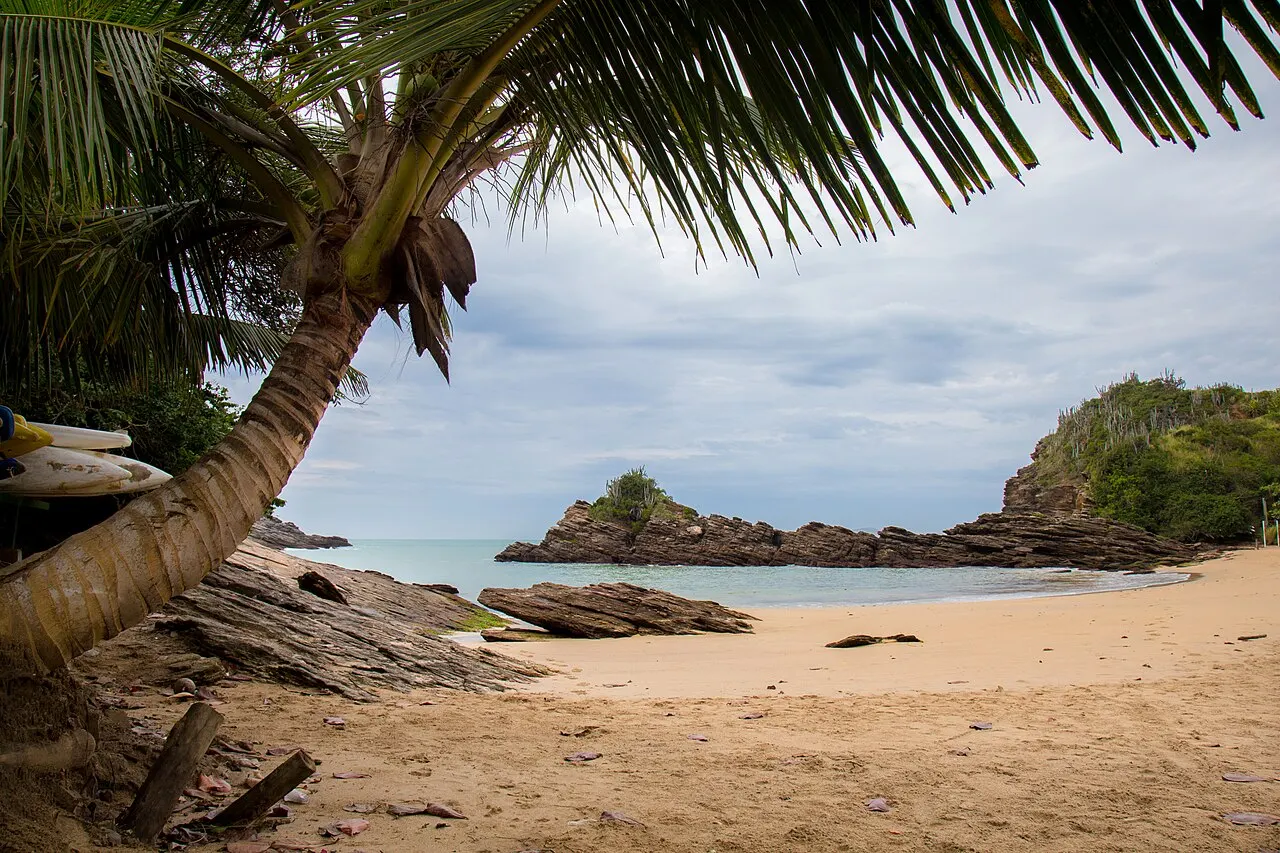
A 100 m beach of cold, calm water, wedged between two rocky points, with stand-up paddleboarding, kayaking and a restaurant. Access is on foot, along a street on the left side of Geribá. From there the trail leads to Praia dos Amores and the natural pools of Ferradurinha, which fill when waves hit the rocks.
It is a few minutes' walk from Rua das Pedras, with less noise than the Centro; parking is difficult on the hill's streets.
Check access
Praia do Forno
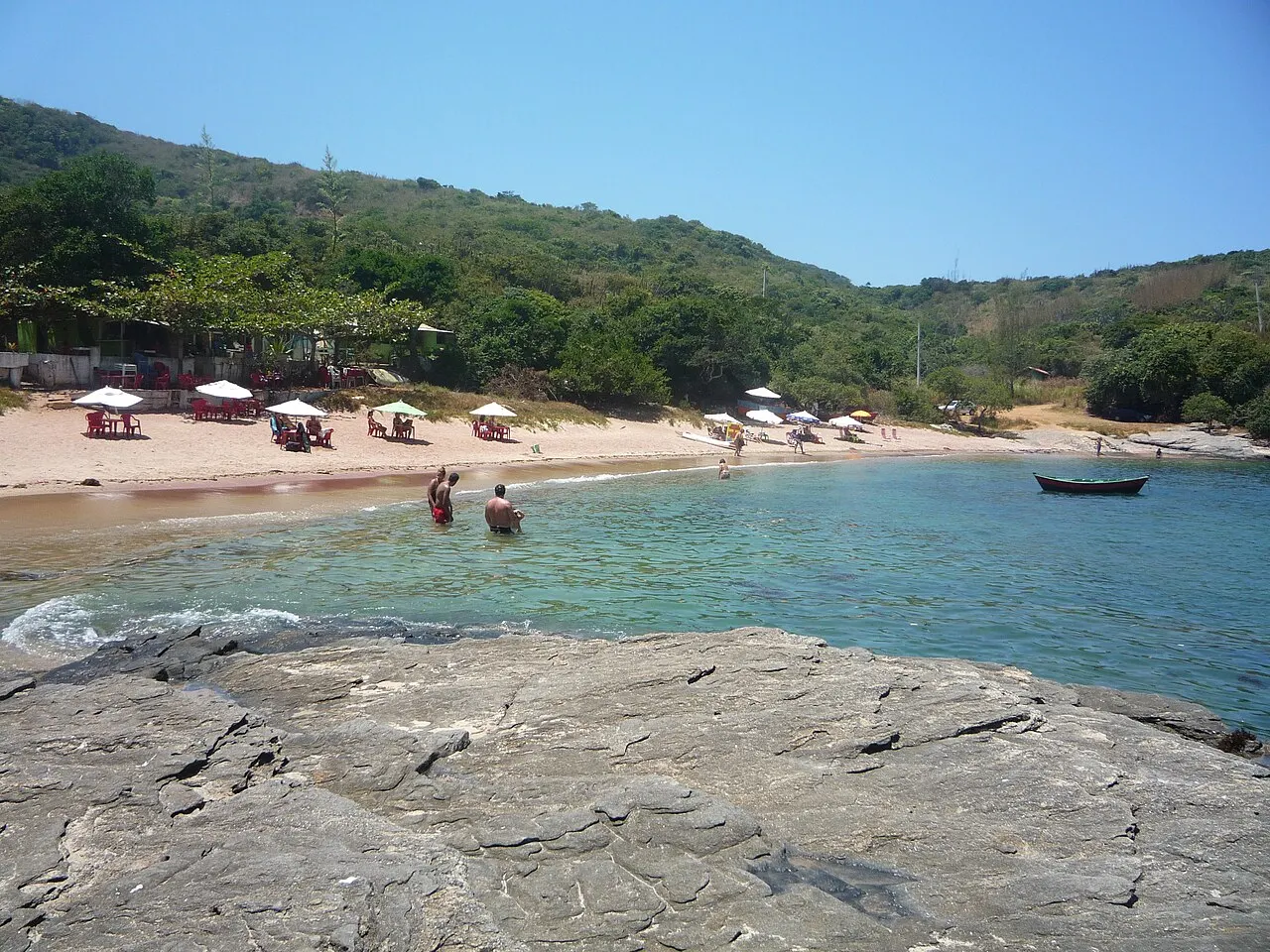
A small 100 m beach ringed by rock, inside the Parque Estadual da Costa do Sol, with clear, cold water and natural pools beside the rocky headlands. It is good for snorkeling, kayaking and stand-up paddleboarding, and has beach shacks. Next to it is Praia da Foca, a 50 m cove between rocks, with a short walk to the sand.
The beaches on the east and south sides feel the influence of the upwelling that surfaces at Arraial do Cabo: the east wind pushes warm surface water out to sea, and cold, plankton-rich water rises from the depths.
Check access
Praia Brava
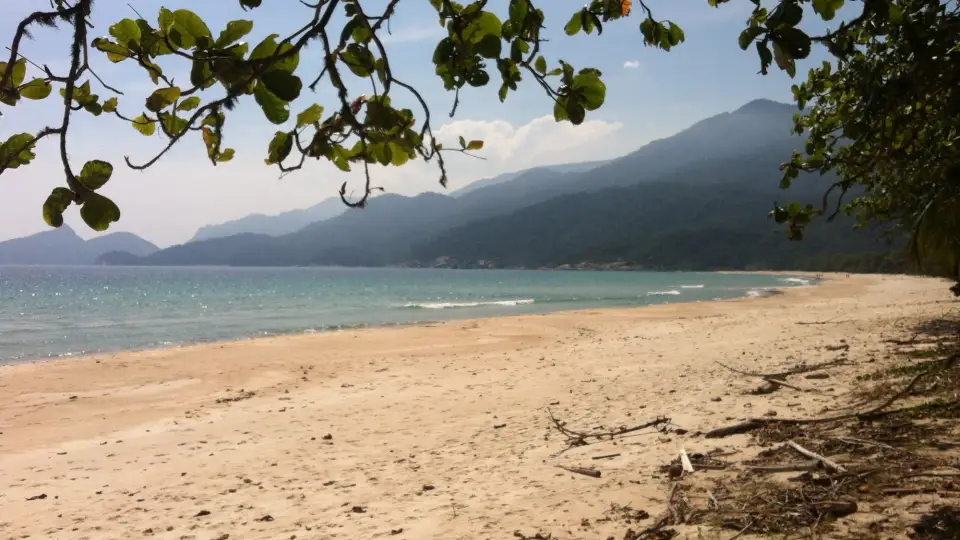
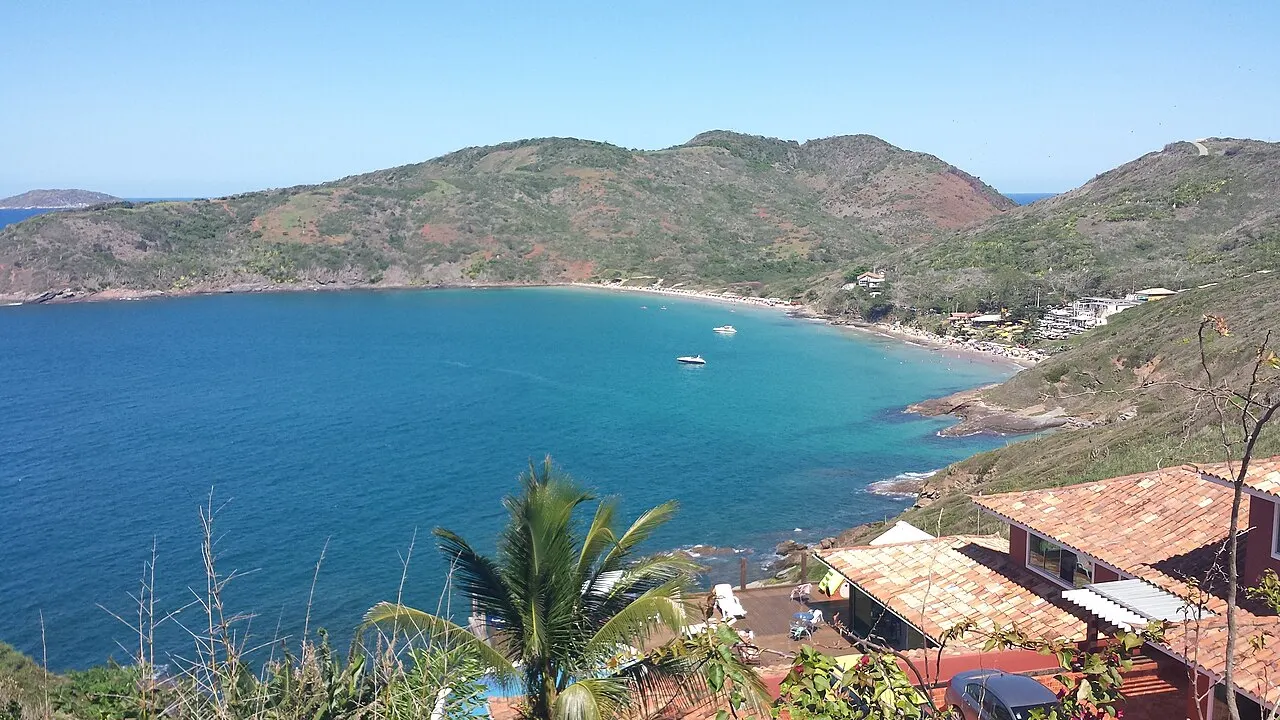
A 660 m open-sea beach ringed by rocky headlands, with strong waves that draw surfers and restaurants on the sand. A rock formation divides the beach: the left side is for surfing, the right is more secluded. The sand is pink, because of the garnet in the surrounding rocks.
That is why Forno, Foca and Tucuns have clear, cold water even in summer.
Check access
Nilo’s itinerary
Start with the basic programme and choose extensions for the time you have.
Plan my days in the app ↗Day 1 · The north side, on foot and by water taxi
Early, leave the Centro along Orla Bardot to Praia dos Ossos (under 15 minutes on foot) and climb the slope at the right-hand corner to the Azeda staircase; spend the morning between Azeda and Azedinha, before they fill up.
Late in the morning, take the water taxi from Azeda to João Fernandes and have lunch at one of the shacks or restaurants on the sand; in the afternoon, swim at João Fernandes or go down to João Fernandinho. Before you go down, confirm the time of the last boat back.
Mid-afternoon, take the water taxi back to Praia dos Ossos and climb the hill to Igreja de Sant'Anna for the view of the cove and the fishing boats; on Saturdays, the 8 p.m. Mass is the chance to see inside the church.
Late in the afternoon, walk along Orla Bardot toward the Centro, past the statue of Brigitte Bardot, and settle on one of the benches or decks facing the sea for the sunset.
In the evening, have dinner in the Centro and stroll Rua das Pedras and Rua Manoel Turíbio de Farias.
Day 2 · Forno, Ferradura and Geribá, with sunset at Porto da Barra
In the morning, take a taxi, a ride-hailing app or a car to Praia do Forno, to swim in the cold, clear water and see the natural pools beside the rocky headlands; Praia da Foca, next door, is a short walk away.
Late in the morning, continue to Praia da Ferradura, with calm water, pedal boats, kayaks and restaurants, and have lunch there. With small children, stay at Ferradura for the rest of the day and swap Geribá for Tartaruga late in the afternoon.
After lunch, go to Geribá and walk to the left-hand corner for Ferradurinha, reached on foot by a street on that side of the beach; anyone who likes trails continues from there to the natural pools.
Late in the afternoon, continue to Porto da Barra, in Manguinhos, for dinner facing the bay at sunset, and return to the Centro by taxi or ride-hailing app.


If you stay longer
Day 3 · Arraial do Cabo, by boat and on foot
Leave Búzios very early, preferably on a weekday: by car it is about 38 km, almost an hour; by bus, Salineira has a direct line with few departures, or change buses in Cabo Frio. Agencies in Búzios also sell the tour with transport.
At Praia dos Anjos, board a boat tour from the fishermen's marina; Ilha do Farol only receives boats authorized by the Navy, time on land is limited and there are no facilities on the beach, so bring water.
For the Prainhas do Pontal do Atalaia, use a small water taxi from Praia dos Anjos or climb the trail; from the top, the wooden staircase has more than 250 steps. Schooners and catamarans have not landed there since January 2026.
Have lunch near Praia dos Anjos and return to Búzios late in the afternoon, to sleep at the same pousada.
Food
Seafood and moqueca
Fish, shrimp and squid appear on almost every menu on the peninsula. Moqueca, cooked in a clay pot with tomato, onion and cilantro, shares space with paellas and grilled fish in the restaurants of the Centro, Porto da Barra and the beaches.
Beach-shack platters
At beach shacks such as those at João Fernandes, Azeda and Geribá, platters serve as lunch: garlic-and-oil shrimp, fish strips, fried cassava and potatoes, and filé aperitivo (beef strips), all served to share.
Sardines
A fish from the local catch, fried or roasted. The town dedicates the Sardine and Seafood Festival to it, which in 2026 reached its 10th edition, in September.
Crepes
Filled crepes, with combinations such as chicken with catupiry cheese or cheese with banana, are a traditional snack on Rua das Pedras at night.
Prato feito (PF)
A single-plate meal with rice, beans, salad and a meat or fish, the cheapest option for lunch in the Centro and on Orla Bardot. Many restaurants serve portions to share between two people.
Argentine parrilla
The Argentine community brought steakhouses in the style of their country, with cuts grilled over embers and menus in Spanish, in the Centro and at Porto da Barra.
Where to eat
- Chez Michou · Rua das Pedras
Crepes with generous fillings, in flavors such as chicken with catupiry and cheese with banana, to eat on the move at night. It is one of the best-known spots on the street, and the crowd at the door is part of the street's evening bustle.
Source · 2026-10-16
- Restaurante do David · Centro, Rua Manoel Turíbio de Farias
A traditional seafood restaurant, with moquecas and paellas in portions that serve two or three people. It opens for lunch, which helps anyone spending the day in the Centro.
Source · 2026-10-16
- Mata Hari · Orla Bardot, near Praia dos Ossos
Pratos feitos to share, with tables on the sidewalk and a view of Praia da Armação, one of the most affordable meals on the waterfront.
Source · 2026-10-16
- Octopous · Porto da Barra, Manguinhos
A kitchen centered on octopus, which appears in starters and main courses, with a four-course tasting menu, from the sea or from the land. The tables are almost on the sand, facing the sunset over the bay.
Source · 2026-10-16
- Rocka · Praia Brava
A beach restaurant with a contemporary menu of fresh fish and paella, for lunch in your swimsuit with a view of the rocky headlands.
Source · 2026-10-16
- João Fernandes
Beach shacks and restaurants with tables on the sand serve portions of garlic-and-oil shrimp, fish strips and fried cassava. It is the northern beach with the most facilities for lunch without leaving the water.
$: a prato feito on the waterfront, a crepe on Rua das Pedras or a shared portion at a beach shack · $$: seafood and moqueca in a Centro restaurant · $$$: a chef-driven restaurant on Orla Bardot, at Porto da Barra or on Praia Brava · 2026-10-16
Day trips
Arraial do Cabo
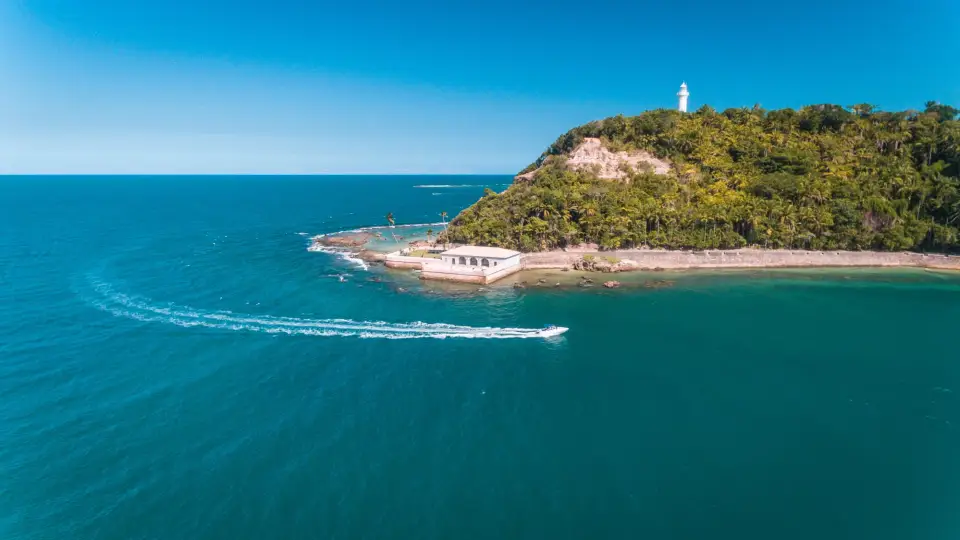
About 38 km from Búzios by road, almost an hour by car, or by Salineira bus, on the direct line with few departures or with a change in Cabo Frio. It is the city of the upwelling, where cold water from the depths rises to the surface and leaves the sea very transparent, inside the Reserva Extrativista Marinha do Arraial do Cabo, managed by ICMBio. The boat tours leave from Praia dos Anjos and usually include Ilha do Farol, where only boats authorized by the Navy may land. The Prainhas do Pontal do Atalaia, two coves between cliffs, are reached by small water taxi, which carries up to 24 people, or by trail and staircase: since January 2026, ICMBio has suspended the landing of schooners and catamarans, after inspections that found too many boats, too many visitors and too much time spent there, and as of July 2026 there was no date for resuming. Check sea conditions and the landing situation with the operator the day before, and prefer a weekday.
Cabo Frio
About 25 km away, 40 minutes by car, or by the direct Salineira line. The largest city in the Região dos Lagos has Praia do Forte, with 7.5 km of sand, and the 17th-century Forte de São Mateus, at the end of the beach. It fits in an afternoon, and it is where the airport and the bus change for Arraial are.
Where to begin
The north side, on foot and by water taxi
Early, leave the Centro along Orla Bardot to Praia dos Ossos (under 15 minutes on foot) and climb the slope at the right-hand corner to the Azeda staircase; spend the morning between Azeda and Azedinha, before they fill up.
Forno, Ferradura and Geribá, with sunset at Porto da Barra
In the morning, take a taxi, a ride-hailing app or a car to Praia do Forno, to swim in the cold, clear water and see the natural pools beside the rocky headlands; Praia da Foca, next door, is a short walk away.
Money
The currency is the real (R$). Transport has the prices that are easiest to check. On October 16, 2026, the Salineira intercity fare between Búzios, Cabo Frio and Arraial do Cabo was R$8.35, and the Viação 1001 bus to Búzios ran from R$93.33 to R$178.99 from the Rodoviária Novo Rio and from R$117.50 to R$127.30 from Galeão, plus fees. On the peninsula, the Viaje na Viagem guide, on a page updated in April 2026, records a water taxi at R$20 to R$30 per passenger depending on distance, a set-fare taxi at R$20 for rides within the Centro and R$20 to R$30 from the Centro to the main beaches, Uber up to R$15 at the normal fare, a van at R$5 and metered parking at R$4.80 an hour; the same page gave a bus fare lower than the current one, so treat these figures as a reference and confirm on the spot. Lodging is the most variable part of the bill: outside vacations and holidays, pousadas usually charge less from Sunday to Thursday than on the weekend, and the pousadas with a view on Morro do Humaitá are among the most expensive. Restaurants, beach shacks and schooners do not publish a common price list; ask the price of the boat trip and the boarding fee, when there is one, before you pay.
Getting there and around
Getting there from Rio de Janeiro
Viação 1001 links Rio to Búzios from two departure points. From the Rodoviária Novo Rio, buses leave throughout the day: in a check on October 16, 2026, there were nine departures for the following day, from 6:04 a.m. to 8:34 p.m., with a trip of 3 hours 10 minutes to 3 hours 50 minutes and fares from R$93.33 (conventional) to R$178.99 (leito, fully reclining seat), plus fees. From Galeão Airport there is a direct bus, with few departures: in the same check, three, at 9:20 a.m., 11:20 a.m. and 3:20 p.m., taking 3h54 to 4h14, with fares from R$117.50 to R$127.30, plus fees. Outside those times, anyone landing at Galeão goes to the Rodoviária Novo Rio, about 12 km away, or books a transfer, shared or private, to the pousada. The bus drops passengers in the Centro of Búzios, not at the pousada's door; there is a taxi stand at the bus station. By car, it is about 170 km from downtown Rio, over the Rio-Niterói Bridge and the Região dos Lagos highway, about three hours without traffic; on holiday Fridays, the trip takes much longer.
Via Cabo Frio Airport
Cabo Frio International Airport (CFB) is about 32 km from Búzios by road. For summer 2026/2027 there are two announcements: LATAM starts regular flights to Guarulhos, in São Paulo, in December 2026, with four flights a week (Monday, Thursday, Friday and Sunday), and Azul announced extra flights to Confins, in Belo Horizonte, from December 12 to February 13, on Tuesdays, Wednesdays, Fridays and Saturdays. From the airport to Búzios, you go by taxi, ride-hailing app or rental car.
Getting around the peninsula
The water taxi is the most practical way to reach the northern beaches: boats leave from Píer do Centro, at the start of Orla Bardot, and from Praia dos Ossos, and go to Azeda, Azedinha, João Fernandes, João Fernandinho, Canto, Tartaruga and Manguinhos. They are small boats, which leave with at least two passengers. For Geribá, Ferradura and the east side, take a taxi, a ride-hailing app or a car. Taxi fares are set by a posted table, displayed at the stands on Praça Santos Dumont, on the main avenue and at the entrance to Geribá, in front of Igreja de Santa Rita; there are no taxis waiting at the beaches, so it is worth keeping the driver's phone number for the return. Cooperative vans run along Estrada da Usina and leave passengers a 10 to 25 minute walk from the beaches. In the blue-painted curb spaces near the beaches and the Centro, parking is metered and paid, through the Summer Parking system, with attendants in blue uniforms or credits bought beforehand.
To Cabo Frio and Arraial do Cabo
Viação Salineira runs the intercity buses between Búzios, Cabo Frio and Arraial do Cabo, in urban-type vehicles that carry standing passengers and fill up during vacations and holidays. The intercity fare was R$8.35 on October 16, 2026. There is a direct line from Búzios to Cabo Frio, and to Arraial there is a no-transfer line with few departures a day; the alternative is to change buses in Cabo Frio. Line numbers and schedules are on Salineira's website and app, and are worth checking before you set out. By car, Arraial is about 38 km away, almost an hour, and Cabo Frio about 25 km, 40 minutes.
Safety
Búzios is a small tourist town, and the main precautions concern the sea, traffic and mosquitoes. The open-sea beaches, such as Geribá, Brava, Tucuns and José Gonçalves, have strong waves: enter near a lifeguard post when there is one, ask about currents before swimming, and heed the flags and signs. The trails, such as the one to Olho de Boi and the one to the Ferradurinha pools, do not always have signs, and a registered guide keeps you from getting lost. On Avenida José Bento Ribeiro Dantas there are speed cameras that limit speed to 40 km/h in some stretches, and many pedestrian crossings; at night, anyone walking along the avenue should use the crosswalks. On holidays and on ship days, Rua das Pedras is crowded: keep your phone and wallet safe, as in any crowd. The municipality warns that the rainy summer is usually the period of rising dengue cases, transmitted, like Zika and chikungunya, by the Aedes aegypti mosquito; bringing repellent is a simple precaution. There is a police post at Praça Santos Dumont; the municipal hospital Dr. Rodolpho Perisse is between Cem Braças and São José, and the fire department answers at 193. In rainy periods, the municipal Civil Defense publishes alerts.
Etiquette tips
No sound on the beach
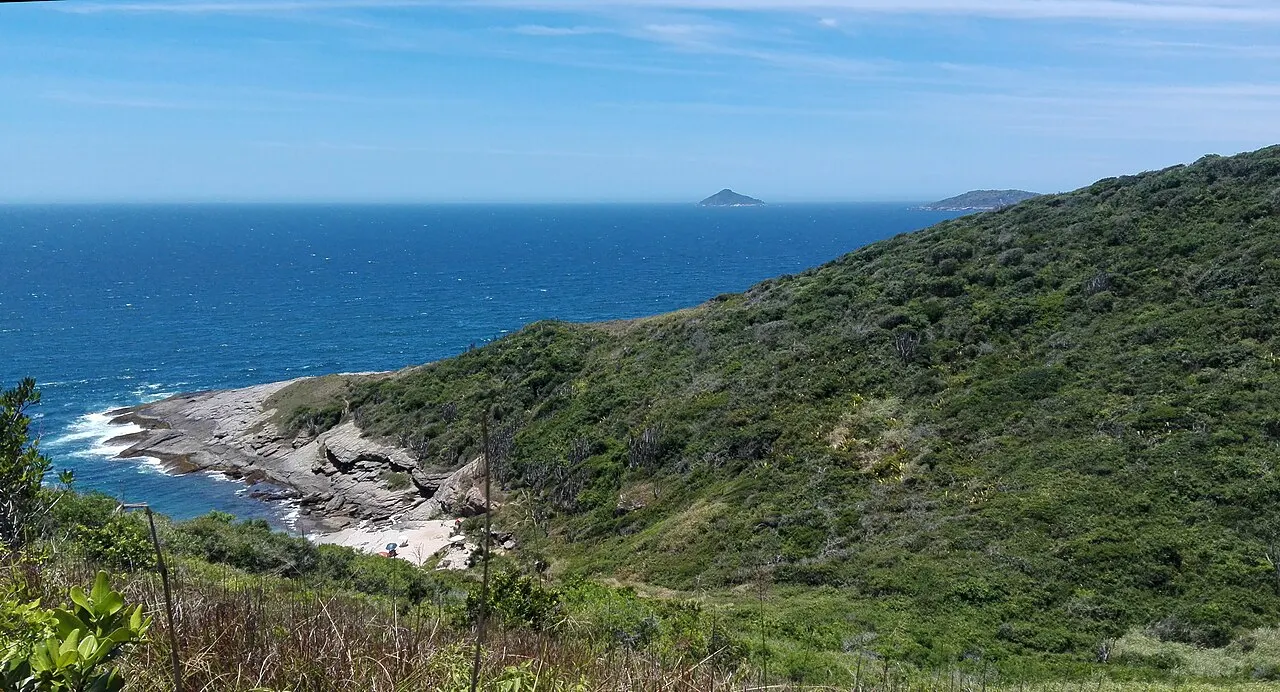
Búzios's code of conduct prohibits any kind of sound on the beaches, large, medium or small, which includes the portable speaker.
Sand sports only in the marked area
Altinha, frescobol and footvolley are allowed only in the delimited areas of Manguinhos, Geribá, Armação, Brava, Tucuns and Caravelas; on the other beaches, they are not.
Animals off the sand
Dogs and other animals may not enter the beaches of Búzios, even with their owner.
Olho de Boi is naturist
At Praia Olho de Boi, nudity is the custom. Anyone who doesn't want to take part should choose another beach, and photographing people is intrusive.
Stones and shells stay where they are
At Praia de José Gonçalves, inside the Pau-Brasil APA, removing pebbles from the sand is prohibited, as is collecting plants and animals in the protected area.
Mistakes to avoid
Choosing the beach without looking at the sea
Open-sea beaches such as Geribá, Brava and Tucuns can have strong waves while Azeda and João Fernandes are calm. With children, or to swim, prefer the northern coves, Ferradura or Tartaruga.
Driving to the Centro at night
Parking spaces near Rua das Pedras are few and paid, and the streets of Morro do Humaitá are narrow. At night, a taxi, a ride-hailing app or a walk along the waterfront works better.
Arriving at Azeda at noon on a holiday
Azeda and Azedinha are small and fill up in high season and on holidays; early in the morning there is still room on the sand.
Expecting the schooner to stop at the sand
The schooner tour makes swimming stops off the beaches and islands, but the boat does not touch the sand. To spend the day at a northern beach, the water taxi is the right way.
Counting on schooners to land at Prainhas
Since January 2026, ICMBio has suspended the landing of schooners and catamarans at the Prainhas do Pontal do Atalaia, in Arraial do Cabo. Anyone who wants to set foot on the Prainhas goes by small water taxi or by trail.
Sleeping in Rasa or Tucuns without a car
Both are far from the Centro and the water taxi. Without a car, the daily commute becomes taxis and waiting.
Useful phrases
Bom dia, quanto custa o aquatáxi até a Azeda?
A useful question at Píer do Centro or Praia dos Ossos; confirm the price per person before boarding.
A que horas sai o último barco de volta?
So you don't get stuck on a northern beach with no transport late in the afternoon.
Tem cadeira e guarda-sol para alugar?
Some beach shacks provide them free to customers who buy something; others charge by the hour or by the day.
Uma porção de camarão ao alho e óleo, por favor.
The most common order at the beach shacks; the portion usually serves two people.
O mar está calmo hoje?
Ask the shack owner or the lifeguard before going in at Geribá or Brava.
Onde fica o ponto de táxi mais perto?
There are no taxis waiting at the beaches; ask for the phone number of the driver who took you.
Where to stay
- Centro · Anyone traveling without a car who wants to walk to Rua das Pedras, Orla Bardot and the water taxi: Everything is a few minutes' walk away: shops, banks, restaurants, Píer do Centro, the bus station and the taxi stands. It is the most practical location for changing beaches without driving. The downside is the noise from Rua das Pedras and the neighboring streets at night, especially on weekends and holidays.
- Morro do Humaitá · Couples and anyone who wants a view of Praia da Armação, near the Centro and with less noise: The pousadas on the slope between the Centro and Praia dos Ossos have sea views, some with stairs straight down to Orla Bardot, and Rua das Pedras is a short walk away. Rates are among the highest in town, and parking on the hill's streets is difficult; choose a pousada with a garage if you are driving.
- Praia dos Ossos · Anyone who wants to be near the Centro in a more secluded setting, with Azeda on foot and the water taxi for the rest of the north side: It has its own shops, restaurants and a water-taxi stop for João Fernandes and the other northern beaches, it is under 15 minutes' walk from Rua das Pedras along the waterfront and about 8 minutes from Azeda. Praia dos Ossos itself is not good for swimming, and the slopes are hard going for anyone with limited mobility.
- João Fernandes · Anyone who wants to wake up and go straight down to calm, transparent water: The pousadas are on the hills on both sides of the road, near João Fernandes and João Fernandinho, with restaurants on the sand and a water taxi to the other northern beaches. There is no hotel literally on the sand, and to get to the Centro at night you need a taxi, a ride-hailing app or a car; parking spaces are few.
- Ferradura · Families with small children: The cove is shallow and calm, with flat access and pedal boats, and there are pousadas and a family-oriented resort. It is close to the Centro by car, but a night on Rua das Pedras calls for a taxi or ride-hailing app, and holiday homes occupy the beachfront.
- Geribá · Surfers and anyone who wants a beachfront pousada on a lively beach: It has the largest selection of beachfront pousadas on the peninsula, shops and Porto da Barra nearby. The sea has waves, less calm for children, and Rua das Pedras is far: count on a taxi, ride-hailing app or car every night.
$: a simple pousada in the Centro, Sunday to Thursday outside holidays · $$: a pousada in Ossos, João Fernandes or Ferradura · $$$: a pousada with a view on Morro do Humaitá or on the sand at Geribá · 2026-10-16
Districts
Centro
The old core between Praia do Canto and Praia da Armação, with Rua das Pedras, Rua Manoel Turíbio de Farias, Praça Santos Dumont and Orla Bardot. The water taxis and schooners leave from here, and so do most of the shops, banks and a good share of the restaurants. It suits anyone who wants to do almost everything on foot; at night the main streets are busy and noisy.
Morro do Humaitá
A hillside between the Centro and Praia dos Ossos, with pousadas that look over Praia da Armação and stairs that drop down to Orla Bardot. It is a few minutes' walk from Rua das Pedras, with less noise than the Centro; parking is difficult on the hill's streets.
Praia dos Ossos
A cove of fishing boats with Igreja de Sant'Anna on top of the hill, a small shopping strip and its own water-taxi stop. It is under 15 minutes on foot from Rua das Pedras along Orla Bardot and about 8 minutes from Azeda. The beach itself is more for looking at than for swimming.
João Fernandes
The northeast tip of the peninsula, with João Fernandes and João Fernandinho, calm and transparent water, and restaurants and beach shacks on the sand. Pousadas climb the hill on both sides of the road. To get to the Centro, take a water taxi, a taxi, a ride-hailing app or a car; parking spaces are few.
Ferradura
A neighborhood around the horseshoe-shaped cove, sheltered from wind and currents, with shallow water, pedal boats and kayaks. It is the most sought-after area for families with small children. It is close to the Centro by car, but far on foot at night.

Geribá
The busiest beach on the peninsula, with almost 2 km of white sand, surf-friendly waves and a marked area for sand sports. It has the most beachfront pousadas and is near Porto da Barra; Rua das Pedras requires a car, taxi or ride-hailing app.
Manguinhos and Porto da Barra
The strip on the west side facing the bay, with Praia de Manguinhos, the pier where people watch the sunset and the Porto da Barra restaurant complex. The constant wind makes the beach a spot for sailing and kitesurfing.
East side: Brava, Forno and Olho de Boi
The open-sea coast between Ferradura and the tip of the peninsula, with rocky headlands, small beaches and pink sand. Forno and Foca have cold water and natural pools; Brava has waves and restaurants; Olho de Boi can only be reached by trail.
Rasa
The first part of town for anyone arriving by road, with Praia Rasa, about 9 km long, shallow water and wind for windsurfing and kitesurfing, condominiums and a marina. It is far from the Centro and suits mostly those who come to sail.
History
16th c. · Land of the Tupinambá
The Tupinambá, also called Tamoio, lived along the coast, fished and grew manioc, and traded brazilwood with French corsairs.
1575 · The end of Antarctic France in the region
The Portuguese, allied with Indigenous groups, defeat the French and the Tamoio confederation on the coast between Rio and Cabo Frio.
18th c. · The whaling station
An armação, a place where boats were outfitted and whales processed, operates on the beach that now bears the name. The oil lit the lamps of Rio de Janeiro.
18th c. · Igreja de Sant'Anna
The chapel on the hill between Armação and Ossos gives the settlement its first name, Santa Anna da Armação dos Búzios. Sant'Anna is the town's patron saint.
19th c. · Clandestine landings
After the ban on the slave trade in 1850, the peninsula continues to receive illegal landings; Praia de José Gonçalves is named after a slave trader.
1888 · Abolition and Rasa
After abolition, freed people settle in Rasa, near a quilombo that was already there.
1950s · The first summer visitors
Visitors rent fishermen's houses, and the first holiday homes appear in Manguinhos and the Centro.
1964 · Brigitte Bardot
The French actress spends a season in the village with her boyfriend, Bob Zagury, and the international press follows her.
1974 · The Rio-Niterói Bridge
The bridge and Estrada José Bento Ribeiro Dantas widen access from Rio; until 1973, the link to Cabo Frio was a narrow dirt road.
1976 · The Praia dos Ossos murder
Ângela Diniz is murdered by her partner, Doca Street, in a house on Praia dos Ossos. The case became a reference point in the debate on femicide in Brazil.
1995 · Emancipation
On November 12, Búzios stops being a district of Cabo Frio and becomes a municipality.
2011 · Parque Estadual da Costa do Sol
The park protects restinga, dunes and rocky headlands in six municipalities of the Região dos Lagos, including stretches of the beaches of Forno, Tartaruga and Tucuns.
2025 · Death of Bardot
Brigitte Bardot dies in Saint-Tropez on December 28. Her bronze statue remains on Orla Bardot, the promenade that bears her name and that the municipality describes as one of the town's postcards.
Complete history
Indigenous peoples, corsairs and whales
Before the Portuguese arrived, the peninsula was Tupinambá territory; they fished, hunted, grew manioc and traded brazilwood with French corsairs. The defeat of the French and the Tamoio confederation in 1575 opened the region to the Portuguese, but the tip of the peninsula remained isolated for a long time. In the 18th century, a whaling station began operating on the beach that keeps its name: boats were outfitted and whales processed there, and the oil went to light Rio de Janeiro. The most repeated explanation for the name Praia dos Ossos (Bones Beach) is that bones were buried there; the municipality also records another, that of the human bones of Indigenous people killed in the war of 1575.
Slavery and Rasa
The indented coast served for clandestine landings of enslaved Africans even after the slave trade was banned in 1850. Praia de José Gonçalves, to the west, is named after a trader who used the cove for this. After abolition in 1888, freed people settled in Rasa, on the road in for anyone arriving by highway, near an older quilombo. It is a side of the history that the beach itinerary tends to leave out.
From fishing village to resort
Until the mid-20th century, Búzios was a fishing hamlet linked to Cabo Frio by a dirt road that rain cut off. The first summer visitors came in the 1950s and rented fishermen's houses. In 1964, the visit of Brigitte Bardot, then at the height of her fame, brought photographers and the interest of the foreign press; the waterfront now bears her name and a bronze statue. In the 1970s, with the Rio-Niterói Bridge and Estrada José Bento Ribeiro Dantas, more visitors and investors arrived, especially Argentines and French, and Argentines still own a large share of the shops and hotels.
The municipality
Búzios split from Cabo Frio on November 12, 1995, a date the town celebrates with free concerts. Growth pushed many longtime residents into neighborhoods such as Rasa, Cem Braças and José Gonçalves, while the waterfront filled with pousadas. Part of the rocky headlands and restinga is now protected by the Parque Estadual da Costa do Sol, created in 2011, and by the Pau-Brasil Environmental Protection Area, from 2002. Today the town also receives cruise ships, which anchor offshore and land passengers at Píer do Centro and Porto Veleiro.
Geography and shape of the city
A peninsula with three fronts
Búzios occupies a peninsula about 8 km long that juts into the Atlantic east of Cabo Frio. Avenida José Bento Ribeiro Dantas enters at Praia Rasa and crosses the town to the Centro; the streets to each beach branch off from it. The northern coves, between Armação and João Fernandes, are sheltered and have calm water. The beaches to the east and south, such as Brava, Geribá and Tucuns, are open-sea beaches and get waves.
Cold, clear water
The beaches on the east and south sides feel the influence of the upwelling that surfaces at Arraial do Cabo: the east wind pushes warm surface water out to sea, and cold, plankton-rich water rises from the depths. That is why Forno, Foca and Tucuns have clear, cold water even in summer. At Brava and Forno, the sand is pink, because of the garnet that comes from the surrounding rocks.
Dry and windy climate
The Região dos Lagos gets less rain than the rest of the Rio de Janeiro coast, and the wind is constant, which draws sailors and kitesurfers to Manguinhos and Rasa. The vegetation on the hills is low, restinga and steppe savanna, quite different from the Atlantic forest of the Costa Verde. Summer brings most of the rain, and winter usually has clear skies.
Near the beaches and the Centro, the blue-curb spaces are metered and paid through Summer Parking, with attendants in blue uniforms or credits bought beforehand.
The municipality maintains restrooms at Praça Santos Dumont, at the left-hand corner of Geribá and at the right-hand corner of Ferradura.
Culture
Fishermen and patron saints
Fishing is still visible at Píer dos Pescadores and in the boats anchored at Armação and Ossos. The town's oldest festivals grow out of it and the church: the Festa dos Pescadores, with a sea procession in honor of São Pedro, and the Festa de Sant'Anna, on the church hill, organized by the parish and the festeiros of the patron saint.
Argentine and French accents
Since the 1970s, Argentines and French have opened pousadas, restaurants and shops, and the influence shows in the menus, the names of the places and the Spanish heard on Rua das Pedras and at João Fernandes. Bardot's statue and the Gran Cine Bardot cinema, on the waterfront, recall the 1964 season that took the village's name to the foreign press.
Festival calendar
The municipality publishes a calendar of events in Praça Santos Dumont, Praça dos Ossos and on Orla Bardot. The concerts of the Búzios Jazz Festival, the Festa de Sant'Anna and the town's anniversary are free, as are the workshops and classes of Degusta Búzios, where the dishes are sold by the participating restaurants. At Wine in Búzios, the wine fair is held in the square, but tasting uses the official glass, sold separately, and the boat trip with wines is paid. Sailing has its own calendar, with regattas such as Búzios Sailing Week, taking advantage of the wind at Manguinhos.
Festivals and events
Wine in Búzios
Early June (in 2026, June 3 to 7), at Praça Santos Dumont: a wine fair with Brazilian and foreign exhibitors, a boat trip with tastings, and an official glass sold in advance.
Festa dos Pescadores
On the weekend closest to São Pedro's day, June 29 (in 2026, Sunday the 28th), at Praça dos Pescadores, with a sea procession leaving from Píer dos Pescadores, local food and concerts.
Festa de Sant'Anna
Around July 26, the patron saint's day (in 2026, July 24 to 26), at Morro da Igreja and Praia dos Ossos, with religious celebrations, cultural events and free concerts.
Degusta Búzios
From the end of July into August (in 2026, July 31 to August 9), with more than 120 establishments, and free workshops and classes at Praça Santos Dumont, Praça dos Ossos, Rua das Pedras and Orla Bardot.
Sardine and Seafood Festival
In September (in 2026, 18 to 20), at the Sociedade Esportiva de Búzios, with about 50 dishes and concerts.
Town anniversary
Around November 12, the date of emancipation, with three days of free concerts.
Books and films
Praia dos Ossos (Rádio Novelo, 2020)
An eight-episode documentary podcast, hosted by Branca Vianna, about the murder of Ângela Diniz in a house on Praia dos Ossos in 1976, and about how the trial handled the case. It shows the Búzios of the 1970s summer crowd and the weight the crime had in the debate on femicide in Brazil.
And God Created Woman (Roger Vadim, 1956)
The film that made Brigitte Bardot famous around the world, shot in Saint-Tropez. It helps explain why her season in Búzios, eight years later, drew the foreign press and became the origin of the resort's fame.
Frequently asked questions
Búzios: how do I get there from Rio de Janeiro?
Viação 1001 leaves the Rodoviária Novo Rio throughout the day, taking 3 hours 10 minutes to 3 hours 50 minutes; from Galeão a direct bus runs at few times, and otherwise you go to Novo Rio, 12 km away, or take a transfer. By car it is about 170 km, some three hours without traffic and much longer on holiday Fridays.
Búzios: how many days should I stay?
Three days, sleeping in Búzios: one for the north side, by water taxi, one for the east and south side, by car or taxi, and one for Arraial do Cabo, leaving early. Two days is the minimum and covers both sides of Búzios, leaving Arraial for another trip.
Búzios: which beaches are best for swimming with children?
To swim, and with children, prefer the northern coves, such as Azeda and João Fernandes, Ferradura, shallow and with flat access, or Tartaruga. Open-sea beaches such as Geribá, Brava and Tucuns can have strong waves while the northern ones are calm.
Búzios: where should I stay without a car?
In the Centro, where Rua das Pedras, Orla Bardot, the water taxi and the taxi stands are a few minutes' walk away; the downside is the noise at night, especially on weekends and holidays. Rasa and Tucuns are far from the Centro and the water taxi.
Búzios: can I visit Arraial do Cabo in a day?
Yes, leaving early: it is about 38 km, almost an hour by car, or by Salineira bus. Since January 2026, schooners and catamarans have not landed at the Prainhas, and as of July 2026 there was still no date for resuming; go by small water taxi or by trail, and check with the operator the day before.
Búzios: when is the best time to go?
From April to September the weather is steadier, but July is high season because of the school holidays; August is usually the driest month and the emptiest outside holidays. December and January are the rainiest months, with vacations, New Year's Eve and Carnival packing the town.
Other cities in the country
Brazil ↗- Days
- 4
- When
- Apr–Jun
- Per person/day
- Average 615 BRLMid-range · per person/day
Cost scope
Per person per day: accommodation, meals, urban transport, visits and a small allowance for extras. Flights excluded; larger purchases vary. Editorial estimate, not a quote.
- Days
- 2–3
- When
- Apr–May · Sep
- Per person/day
- Average 400–700 BRLMid-range · per person/day
Cost scope
Per person per day: accommodation, meals, urban transport, visits and a small allowance for extras. Flights excluded; larger purchases vary. Editorial estimate, not a quote.
- Days
- 2–3
- When
- Jan–Mar · Sep–Dec
- Per person/day
- Average 350–550 BRLMid-range · per person/day
Cost scope
Per person per day: accommodation, meals, urban transport, visits and a small allowance for extras. Flights excluded; larger purchases vary. Editorial estimate, not a quote.
- Days
- 1–2
- When
- May–Sep
- Per person/day
- Average 260–520 BRLMid-range · per person/day
Cost scope
Per person per day: accommodation, meals, urban transport, visits and a small allowance for extras. Flights excluded; larger purchases vary. Editorial estimate, not a quote.
- Days
- 3–4
- When
- Jun–Sep
- Per person/day
- Average 400–700 BRLMid-range · per person/day
Cost scope
Per person per day: accommodation, meals, urban transport, visits and a small allowance for extras. Flights excluded; larger purchases vary. Editorial estimate, not a quote.
- Days
- 2–3
- When
- Apr–Jun
- Per person/day
- Average 350–550 BRLMid-range · per person/day
Cost scope
Per person per day: accommodation, meals, urban transport, visits and a small allowance for extras. Flights excluded; larger purchases vary. Editorial estimate, not a quote.
- Days
- 3–5
- When
- Mar–Apr · Nov
- Per person/day
- Average 397 BRLMid-range · per person/day
Cost scope
Per person per day: accommodation, meals, urban transport, visits and a small allowance for extras. Flights excluded; larger purchases vary. Editorial estimate, not a quote.
- Days
- 2–4
- When
- Mar–May · Sep
- Per person/day
- Explore costsGuide estimate
Cost scope
Per person per day: accommodation, meals, urban transport, visits and a small allowance for extras. Flights excluded; larger purchases vary. Editorial estimate, not a quote.
- Days
- 4–5
- When
- Aug–Nov
- Per person/day
- Explore costsGuide estimate
Cost scope
Per person per day: accommodation, meals, urban transport, visits and a small allowance for extras. Flights excluded; larger purchases vary. Editorial estimate, not a quote.
- Days
- 3–4
- When
- Jul–Sep
- Per person/day
- Explore costsGuide estimate
Cost scope
Per person per day: accommodation, meals, urban transport, visits and a small allowance for extras. Flights excluded; larger purchases vary. Editorial estimate, not a quote.
- Days
- 3–4
- When
- Sep–Nov
- Per person/day
- Explore costsGuide estimate
Cost scope
Per person per day: accommodation, meals, urban transport, visits and a small allowance for extras. Flights excluded; larger purchases vary. Editorial estimate, not a quote.
- Days
- 2–4
- When
- May–Sep
- Per person/day
- Explore costsGuide estimate
Cost scope
Per person per day: accommodation, meals, urban transport, visits and a small allowance for extras. Flights excluded; larger purchases vary. Editorial estimate, not a quote.
- Days
- 3–5
- When
- Jun–Sep
- Per person/day
- Explore costsGuide estimate
Cost scope
Per person per day: accommodation, meals, urban transport, visits and a small allowance for extras. Flights excluded; larger purchases vary. Editorial estimate, not a quote.
- Days
- 3–4
- When
- Jun–Aug
- Per person/day
- Explore costsGuide estimate
Cost scope
Per person per day: accommodation, meals, urban transport, visits and a small allowance for extras. Flights excluded; larger purchases vary. Editorial estimate, not a quote.
- Days
- 4–5
- When
- Jan–Mar · Sep–Dec
- Per person/day
- Explore costsGuide estimate
Cost scope
Per person per day: accommodation, meals, urban transport, visits and a small allowance for extras. Flights excluded; larger purchases vary. Editorial estimate, not a quote.
- Days
- 3–4
- When
- Oct–Dec
- Per person/day
- Average 1,110 BRLMid-range · per person/day
Cost scope
Per person per day: accommodation, meals, urban transport, visits and a small allowance for extras. Flights excluded; larger purchases vary. Editorial estimate, not a quote.
- Days
- 3–4
- When
- Aug–Sep
- Per person/day
- Explore costsGuide estimate
Cost scope
Per person per day: accommodation, meals, urban transport, visits and a small allowance for extras. Flights excluded; larger purchases vary. Editorial estimate, not a quote.
- Days
- 4–7
- When
- Apr–Sep
- Per person/day
- Explore costsGuide estimate
Cost scope
Per person per day: accommodation, meals, urban transport, visits and a small allowance for extras. Flights excluded; larger purchases vary. Editorial estimate, not a quote.
- Days
- 3–4
- When
- Jan · Sep–Dec
- Per person/day
- Explore costsGuide estimate
Cost scope
Per person per day: accommodation, meals, urban transport, visits and a small allowance for extras. Flights excluded; larger purchases vary. Editorial estimate, not a quote.
- Days
- 2
- When
- Aug–Dec
- Per person/day
- Average 442 BRLMid-range · per person/day
Cost scope
Per person per day: accommodation, meals, urban transport, visits and a small allowance for extras. Flights excluded; larger purchases vary. Editorial estimate, not a quote.
- Days
- 3–5
- When
- Jan–Feb · Sep–Dec
- Per person/day
- Explore costsGuide estimate
Cost scope
Per person per day: accommodation, meals, urban transport, visits and a small allowance for extras. Flights excluded; larger purchases vary. Editorial estimate, not a quote.
- Days
- 3–5
- When
- May–Sep
- Per person/day
- Explore costsGuide estimate
Cost scope
Per person per day: accommodation, meals, urban transport, visits and a small allowance for extras. Flights excluded; larger purchases vary. Editorial estimate, not a quote.
- Days
- 3
- When
- Apr–May · Aug
- Per person/day
- Average 478 BRLMid-range · per person/day
Cost scope
Per person per day: accommodation, meals, urban transport, visits and a small allowance for extras. Flights excluded; larger purchases vary. Editorial estimate, not a quote.
- Days
- 3–4
- When
- Aug–Dec
- Per person/day
- Explore costsGuide estimate
Cost scope
Per person per day: accommodation, meals, urban transport, visits and a small allowance for extras. Flights excluded; larger purchases vary. Editorial estimate, not a quote.
- Days
- 2
- When
- Apr–May · Sep
- Per person/day
- Explore costsGuide estimate
Cost scope
Per person per day: accommodation, meals, urban transport, visits and a small allowance for extras. Flights excluded; larger purchases vary. Editorial estimate, not a quote.
- Days
- 3
- When
- Sep–Dec
- Per person/day
- Explore costsGuide estimate
Cost scope
Per person per day: accommodation, meals, urban transport, visits and a small allowance for extras. Flights excluded; larger purchases vary. Editorial estimate, not a quote.
- Days
- 3–5
- When
- Apr–Nov
- Per person/day
- Average 427 BRLMid-range · per person/day
Cost scope
Per person per day: accommodation, meals, urban transport, visits and a small allowance for extras. Flights excluded; larger purchases vary. Editorial estimate, not a quote.
- Days
- 4
- When
- Jul–Sep
- Per person/day
- Explore costsGuide estimate
Cost scope
Per person per day: accommodation, meals, urban transport, visits and a small allowance for extras. Flights excluded; larger purchases vary. Editorial estimate, not a quote.
- Days
- 4–5
- When
- May–Sep
- Per person/day
- Explore costsGuide estimate
Cost scope
Per person per day: accommodation, meals, urban transport, visits and a small allowance for extras. Flights excluded; larger purchases vary. Editorial estimate, not a quote.
- Days
- 3
- When
- May–Sep
- Per person/day
- Explore costsGuide estimate
Cost scope
Per person per day: accommodation, meals, urban transport, visits and a small allowance for extras. Flights excluded; larger purchases vary. Editorial estimate, not a quote.